Protect your time. Build your wealth.
Bitcoin, sound money, and financial sovereignty.
Founder of Bitcoin Wealth. "Money should store time, not steal it"
Bitcoin just fell below $60,000.
Yesterday $582 million left Bitcoin ETFs.
The price can drop. Money can leave the funds.
Neither has to decide when you sell if you never put yourself in a position where someone else holds the exit.
Own the choice. Own your time.
— James
@MitchellAskew Code is free to copy. Energy costs money.
AI can write a billion versions of Bitcoin’s history. For my node to accept one over the current chain, it has to follow the rules and carry more proof of work.
Someone still has to pay the power bill.
@Breedlove22 That bridge runs both ways.
A miner spends energy to secure Bitcoin. You spend an hour earning it. The sats you save today can free an evening with your family years from now.
Physical work becomes digital time you actually get to keep.
Everyone wants to profit from the next technological revolution.
Few think about how to preserve those profits.
AI changes how we create wealth.
Bitcoin changes how we store it.
One is about productivity.
The other is about preserving the value of your time.
— James
@halfin Fran, “machines for us, not over us” says it beautifully. Somewhere today, someone is sitting at a computer with an idea the rest of us haven’t imagined yet. Hal helped give that person the freedom to try. Thank you for keeping his voice in this conversation.
@joinFinney Hal Finney ran Bitcoin on his own computer and received the first transfer from Satoshi. Neither needed anyone’s permission.
The next person with an idea that good deserves the same freedom to build it, share it, and let anyone try it. That’s a case worth making in Washington.
If 3% inflation becomes normal, 3% of your work disappears every year.
Fed Governor Waller said they may need to shock people because businesses are treating 3% price increases as normal.
The Fed manages money with rates and press conferences.
Bitcoin set a limit no one can change: 21 million.
Price moves. Supply doesn’t.
We spend years working for money.
But what we're really spending is time.
Once those hours are gone, we don't get them back.
Bitcoin offers a different way to save because its supply is limited to 21 million.
Its price can rise and fall sharply, but nobody can simply decide to print more.
The goal isn't to spend your life watching a price chart.
It's to protect more of the value of the work you've already done.
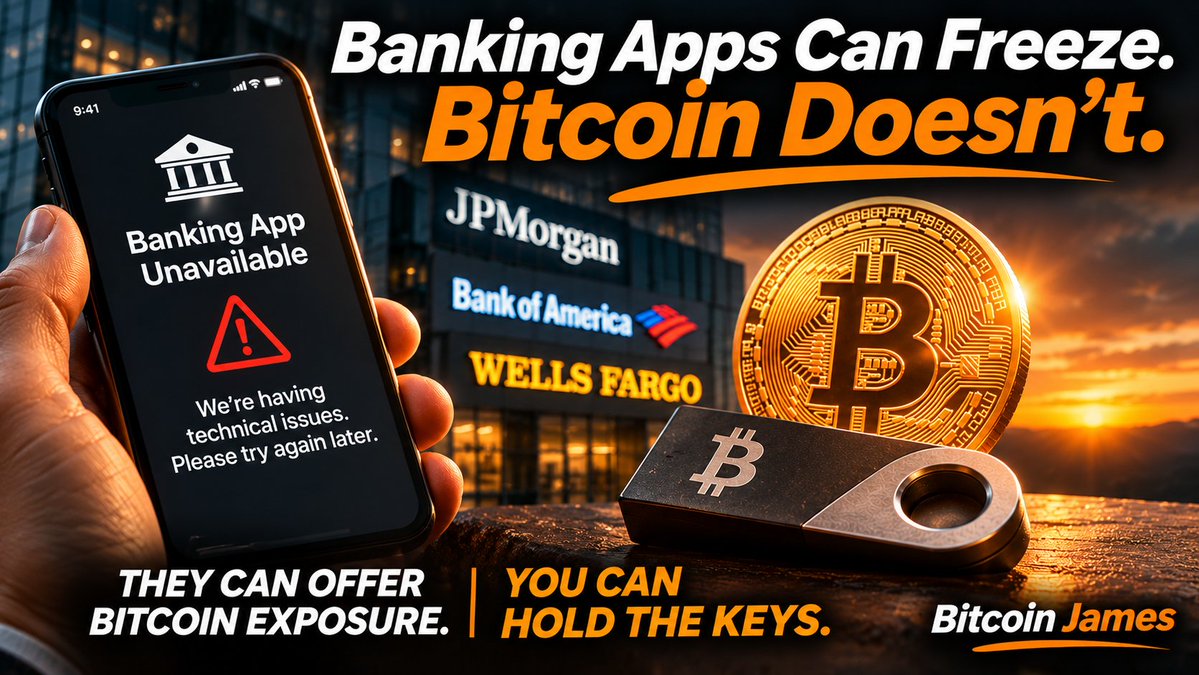
Your banking app can freeze. Bitcoin doesn’t keep banker hours.
Yesterday Chase and other major banks saw customers struggle to access accounts or move money after a software bug.
A bank account is convenient. It isn’t the same as Bitcoin you hold yourself.
They can hold the paper. You can hold the keys.
The worst time to sell Bitcoin is when someone else picks the date.
Debt decides when you sell. No debt means you decide.
A price drop doesn’t force the sale. The loan does.
Same Bitcoin. Same market. Different outcomes.
You choose the timeline. Or someone else does.
— James
A rainy-day fund shouldn't melt in the rain.
A Texas bill would let cities and counties invest up to $10 million each in Bitcoin or other crypto. It isn't law.
A savings balance can stay the same while inflation eats its buying power.
Families face that too.
Your life's work shouldn't depend on one man's job.
Nvidia's CEO just resigned. Markets panicked. Bitcoin slipped under $72,000.
That's how a lot of people still treat Bitcoin. Like it's just another tech stock.
It isn't.
A CEO can walk out.
A board can scramble.
A headline can hit the price in an afternoon.
Bitcoin's supply doesn't move with the news.
21 million yesterday.
21 million today.
21 million tomorrow.
Stocks depend on management.
Dollars depend on central bankers.
Bitcoin depends on rules.
The price will still move. It clearly does.
But if you're trying to protect the value of your work over time, one man's resignation should matter a lot less than a money system no one can print more of.
The market can panic.
The supply stays the same.
That's why patient people keep stacking.
@BitcoinMagazine High time preference people get shaken out on the red years. Low time preference people just keep stacking and protect the value of their labor. Bitcoin stores time. The numbers prove it.
@RoundtableSpace Most people see the dips and sell. The ones who treat Bitcoin as stored time just keep stacking. Fiat steals the value of your labor every year. Bitcoin keeps it. That's why the long-term numbers look like this.
@ForecastQuant Models like this don’t predict the path. They describe what scarcity plus time has done so far. Charge it every week. Check it every decade.
On Veterans Day, I think about sacrifice, service, and what a lifetime of work is worth.
Bitcoin on Veterans Day 2013 was around $340.
In 2017 it was around $6,400.
In 2021 it was around $64,800.
Today it’s about $73,800.
Yes, that’s a significant drop from the all-time high.
It’s not easy watching the value of your savings fall.
But zoom out.
A few hundred dollars saved in Bitcoin in 2013 became the kind of money most people wouldn’t have imagined back then.
A few hundred dollars left in a drawer did what dollars do.
It lost ground.
Quietly.
Year after year.
Bitcoin isn’t just a trade to catch.
It’s a way to save the value of your work in something no one can print more of.
That’s why I think of it as a battery for your time.
You charge it slowly.
You don’t stare at it every day.
And if you do it right, it holds more of your life’s work over time.
Charge it every week.
Check it every decade.
Today's most important price chart might be sitting in your grocery bag.
Bitcoin fell below $74,000. Everyone's watching the price.
Inflation came in hotter: +0.4% overall, +0.5% food, +1.0% gasoline.
You work just as hard and afford less.
Bitcoin's price can fall. Its 21 million limit doesn't change.
The real goal isn't watching a number go up.
It's keeping more of the value of the hours you've already worked.
Some people say Bitcoin needs to stop going up before it can become money.
They have the order backwards.
People need a reason to keep it before they spend it by choice.
A merchant who takes Bitcoin and instantly converts it to dollars is still saving in dollars.
Real adoption happens when that merchant says, “I’d rather keep the Bitcoin.”
That’s more than a new payment option.
That is a change in what people trust with their work.
As more people choose to hold Bitcoin, more have a reason to earn it, accept it, and eventually spend it.
A rising price gets the attention.
What people choose to keep shows what is changing.
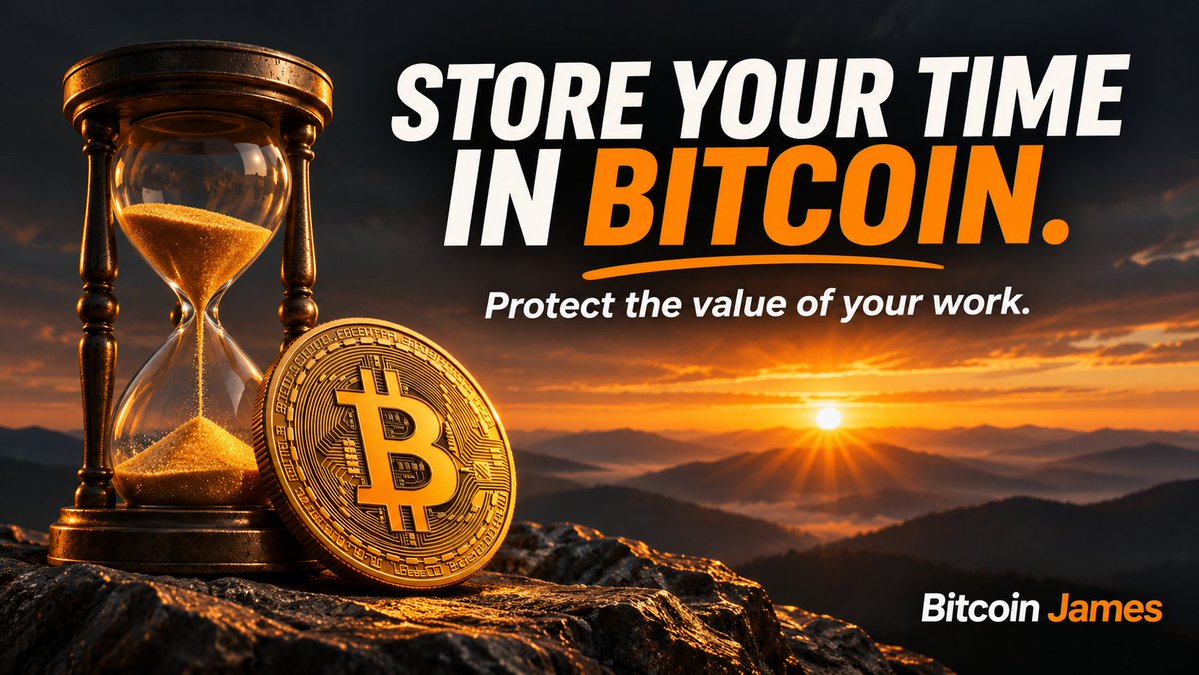
Your time is the real asset.
Store it in something nobody can print at will.