The hardest thing in business is not seeing the future. It is surviving long enough to build it.
My fireside chat with @Julian_Liniger at @BTCPrague on focus, endurance, corporate transformation, and how entrepreneurs can use Bitcoin, AI, and digital finance to create the next generation of products.
Full interview below.
00:00 - Bitcoin as the dominant global Digital Capital network: 17 years, hundreds of billions invested, and a potential $100T opportunity
00:51 - Bitcoin near the 200-week moving average: why $BTC is more compelling after a 50% drawdown
01:52 - Strategy’s scale and the media narrative: from ~$600M enterprise value to as high as ~$120B
10:29 - Bitcoin fundamentals: economic empowerment, sovereign property rights, and the dominant digital monetary network
12:16 - Why there is no second best: Bitcoin as Digital Capital, Digital Money, and a potential $100T network
16:09 - Entrepreneur advice: build a simple product using new technology to solve a real problem
20:30 - Focus, endurance, and the danger of dilutive distractions
32:25 - What I would build today: AI plus Digital Assets, especially Digital Money and Digital Yield
33:27 - Digital Credit: taking a 40 vol asset, stripping it to ~4 vol, and creating new yield products
34:57 - Digital Money: 6–8% yield in major currencies with no volatility
38:05 - $STRC, $SATA, and the next layer of bitcoin-backed financial products
48:52 - Q&A: why Strategy sold 32 BTC and why bitcoin-backed capital must support credit and equity
59:29 - Q&A: Strategy as a shock absorber: selling 32 BTC while buying net ~250,000 BTC during the bear market
01:02:39 - Why public companies protect Bitcoin through accounting, tax, legal, political, and economic advocacy
01:07:58 - Strategy as the extension of the Bitcoin network into the free market system
Bitcoin has already won as Digital Capital.
The next wave is Digital Credit, Digital Money, Digital Yield, and Bitcoin-backed capital markets — products that can bring trillions of dollars of traditional credit and money market capital onto Bitcoin.
My interview with @Cointelegraph at @BTCPrague.
00:57 — Bitcoin in a drawdown: five major pullbacks in six years, stronger fundamentals, and rising dominance
02:23 — Digital Credit: from zero to an $11B+ asset class in 12 months
03:35 — Digital Money: bitcoin-backed yieldcoins and the path from 40 vol to 0 vol
04:31 — The opportunity for 8% yield in dollars, euros, yen, pounds, and francs
06:02 — $300T of credit, $30–50T of money markets, and the $10T opportunity for Bitcoin
07:19 — Why Bitcoin is winning economically, technically, and ethically
08:26 — Quantum computing, FUD, and why bear markets amplify Bitcoin debates
10:37 — AI capital rotation, Bitcoin’s current drawdown, and the path to recovery
11:36 — Six years of Strategy: why I would have moved faster into Digital Credit
12:22 — The ideal Bitcoin Treasury Company: common equity plus STRC-style Digital Credit
14:35 — The 32 BTC sale, the $100M bitcoin buyback, and why capital must back credit
17:02 — Defending the equity, credit, and bitcoin-backed capital structure
19:03 — The tradeoff: buy 200,000 BTC and sell 10,000 BTC — or buy and sell zero
20:15 — “Never sell,” Twitter trolls, and Strategy’s fiduciary obligations
22:06 — Bitcoin per share, long-term accretion, and accumulating through bull and bear markets
22:34 — $21B of equity raised in 16 weeks and ~$10B of bitcoin acquired this year
24:18 — The Strategic Bitcoin Reserve, US leadership, and supportive regulation
27:18 — Digital Credit, bank credit, and Digital Money bringing trillions onto Bitcoin
28:01 — Why Bitcoin can grow organically without central bank support
Bitcoin Capitalism — my keynote from @BTCPrague 2026.
Digital Capital is the foundation for Digital Credit, Digital Money, Digital Yield, Digital Equity, and a universe of Bitcoin-backed products and services.
Timestamps:
01:37 - The Four Bitcoin Ideologies and the case for Bitcoin Capitalism
03:29 - Bitcoin as Digital Capital: thousand-year capital with a half-life of infinity
06:12 - Bitcoin network snapshot and ~68% dominance
07:41 - What is money? The Austrian view, the conventional investor view, and “Bitcoin is money, everything else is credit”
09:21 - Digital Money and Digital Credit: bitcoin-backed products for fiat-facing investors
11:28 - Digital Credit: an ~$11–12B asset class that was zero 12 months ago
14:54 - Bitcoin’s opportunity: $1T of bitcoin vs. $1,000T of global capital
15:43 - The 10-dimensional model for reaching stranded capital
16:44 - 1) Asset types: commodities, equities, credit, derivatives, real estate, money, and tokens
18:07 - 2) Capital functions: store of value, appreciation, income, collateral, and payments
19:29 - 3) Custody: self-custody, banks, custodians, broker-dealers, prime brokers, and exchanges
20:34 - 4) Jurisdictions: 664,000 legal and regulatory environments for capital
22:03 - 5) Distribution networks: banks, exchanges, payment networks, and $156T controlled by wealth advisors
23:13 - 6) Account forms: retirement accounts, brokerage accounts, insurance policies, treasuries, and trusts
24:51 - 7) Risk: market, currency, duration, regulatory, credit, technical, security, theft, and counterparty risk
26:03 - 8) Liquidity: transforming $350T of illiquid capital with liquid digital assets
28:02 - 9) Investors: banks control ~$200T and need compliant bitcoin-backed products
30:09 - 10) Product characteristics: fixed rate, floating rate, leverage, callability, fees, and structure
30:45 - The 10x10 matrix for channeling global capital into Bitcoin
31:19 - How $10–20T of capital could expand Bitcoin into a $100T network, moving from $70K to $700K to $7M per bitcoin
32:10 - Bitcoin Capitalism as a Darwinian market: winners, challengers, failures, and 1,400 companies tracked by Strategy
34:53 - Existing bitcoin-backed products: @Trezor, @Unchained, @Fidelity, @Fold_app, @Tando_me, @Relai_app, @CashApp, @HodlHodl, @AnchorWatch, @Meanwhile, $IBIT, $STRC, and $MSTR
40:03 - Digital Capital, Digital Credit, Digital Money, and Digital Yield competing with traditional capital markets
41:03 - Digital Money and Digital Yield: better stablecoins and higher-yield bitcoin-backed products
47:27 - 3 ways to participate: savers, investors, and innovators
49:19 - The aluminum airplane analogy: people buy the product, not the commodity underneath
52:29 - Build a ₿ridge to connect $BTC to the global capital markets
53:42 - 10,000 products, 10,000 needs, and 100,000 corporate efforts to change the world
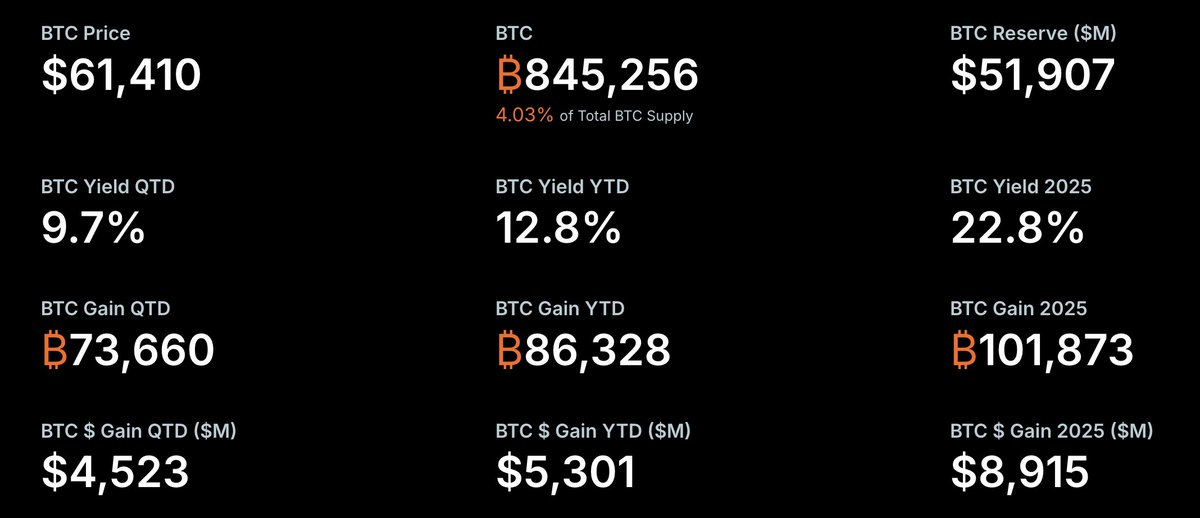
Strategy has acquired 1,587 BTC for $100 million to increase our $BTC Reserve to ₿846,842. We have also increased our USD Reserve by $100 million to $1.1 billion. $MSTR $STRC https://t.co/27PYXJN7GD
The difference between BPS and CEBE BPS is Amplification. With no debt or preferreds, BPS = CEBE BPS and a Bitcoin Treasury Company should track BTC like an ETF. As liabilities increase, BPS and CEBE diverge, creating the potential to outperform BTC.
The shorter the liability duration, the more CEBE matters. The longer the duration, the more BPS matters. If claims came due today, CEBE BPS would be the more relevant metric. If BTC outpaces dividend obligations, BPS better captures common equity upside.
Not all liabilities are equal. Short-duration, high-cost liabilities can turn amplification into risk and underperformance. Long-duration, low-cost liabilities can turn amplification into common equity upside. If BTC ARR exceeds the cost of capital, a well-capitalized Bitcoin Treasury Company should outperform BTC.
BPS measures Bitcoin per common share before senior claims. CEBE BPS measures Bitcoin per common share after senior claims. CEBE is the conservative risk metric. BPS is the common equity growth metric. BTC Yield measures BPS execution.
Digital Credit. Digital Money. Digital Equity. Digital Treasury.
My conversation with @ColeMacro at @BTCPrague on the future of capital markets, followed by Q&A on the nuances of Bitcoin-backed securities and corporate finance.
It’s encouraging to see Bitcoiners engage in a fact- and model-based discussion on the merits of a public company built on the reflexivity of Digital Capital, Equity, and Credit. @Strategy has spent six years refining this model on a revolutionary asset class entering adulthood.
Accretion depends on the metric. Net Assets per Share measures balance sheet strength and residual asset value. BTC per Share measures Bitcoin intensity and long-term equity upside. NAV accretion improves asset coverage. BTC Yield accretion increases Bitcoin per share. $MSTR $BTC
JUST IN: Michael Saylor just said "if Strategy $MSTR is selling equity above net asset value and swapping it for tangible assets like Bitcoin or cash, it will be accretive."
$XXI CEO @JackMallers asked Saylor how to think about mNAV and dilution. This was the answer. 🔥🔥
"We're the largest holder of Bitcoin in the world. We're the largest purchaser of Bitcoin in the world. And we'll continue to be". Watch my conversation with @CNBC@PowerLunch below.
00:00 — "We're net purchasers of Bitcoin." The 32 BTC sale helped inoculate the market, test our processes, and capture tax losses over time
1:47 — We balance the needs of our constituents: $MSTR and $STRC shareholders, $BTC hodlers, and debt holders
3:07 — Four-year cycles, macro volatility, geopolitical conflict, inflation uncertainty, Fed policy, Clarity
4:15 — Bitcoin is a hedge against inflation and big government
5:32 — Capital that rotates from $BTC to AI will come back to $BTC
6:42 — With clearer rules, every major bank is going to flood into $BTC and crypto
7:27 — Expanding financial-system access is good for Bitcoin
$STRC and $MSTR shareholders have approved the amendment to move $STRC dividends from monthly to semi-monthly. Under the new cadence, the first record date is June 30 and the first payment date is July 15. Thank you to every shareholder who voted. https://t.co/3sIqqF3FCR
Bitcoin Capitalist: Bitcoin reaches its full potential by integrating with the global economy: currencies, credit, securities, companies, banks, institutions, governments, families, and individuals. Bitcoin is an open monetary network for everyone.
JUST IN: Investment bank The Benchmark Company analyst Mark Palmer has initiated a buy rating on #Bitcoin treasury company Strive $ASST with a price target of $32.
"Strive has a capital structure that is purpose-built to withstand BTC volatility." 🔥
Capital markets are funding the AI buildout at historic scale: ~$400B over 6 months. Bitcoin ETFs have seen ~$4B of outflows since May 14, pressuring $BTC. This is a capital rotation, not a Bitcoin impairment. Volatility creates opportunity.
Final week to vote for twice-monthly dividends. If you haven’t voted, please do so now. We believe this upgrade helps make Digital Credit better for $BTC, $MSTR, and $STRC. Please share with other holders. We need your support. https://t.co/0QObDgFH5w