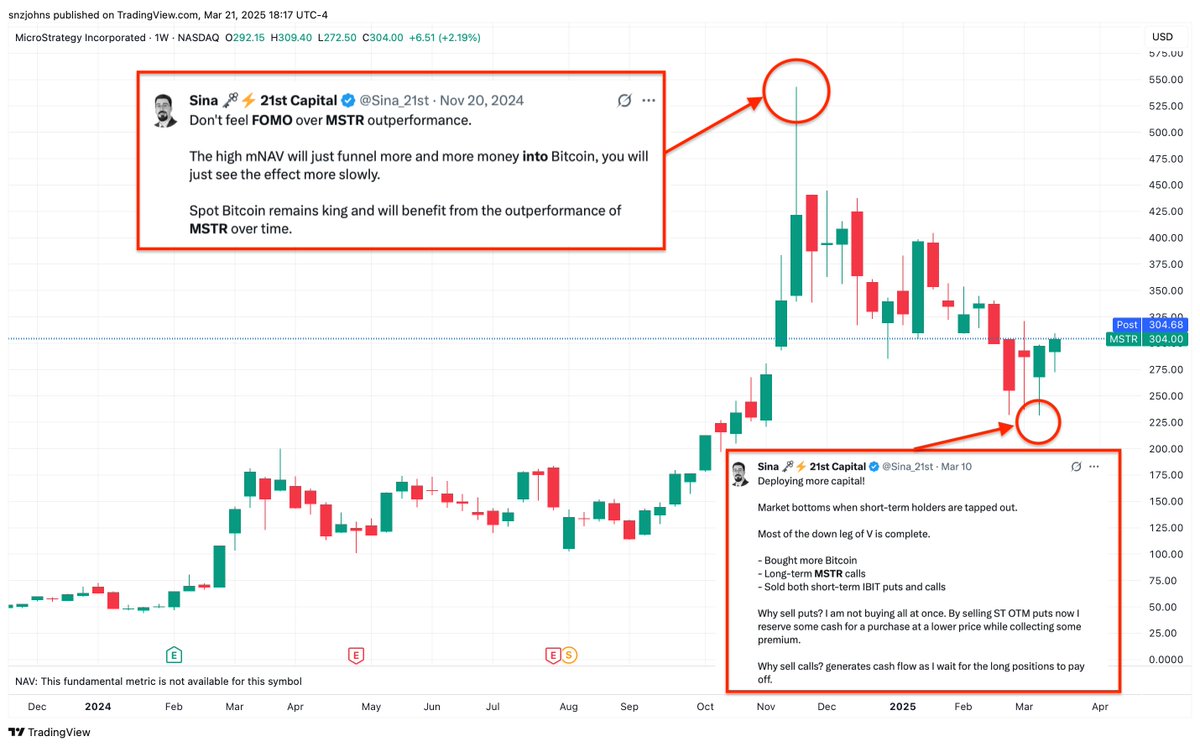
A summary of my views on $MSTR
Out in the public
Some would say it is experience; others would say it is hard work
Either way you won't get hype from me
The Bitcoin Intelligence is About to Launch!
We have something exciting to share.
Next week, we are launching the ultimate Bitcoin analytics platform – Bitcoin Intelligence – which you have been asking for all along.
It includes:
1- Bitcoin data & live charts with our models (Quantile Model, VPLI, Power Law, etc.)
2- Video analyses
3- Newsletter: The Bitcoin Intelligence Report
All three will be accessible in one dashboard.
And it covers updates on macroeconomics, on-chain data, price dynamics, and derivatives.
After two decades of data modeling, a decade of studying Bitcoin, years of publishing Bitcoin analysis on social media, and many requests throughout last year, I am ready to take things to the next level.
And I am not alone; we will be working with a team of top Bitcoin analysts to bring you the content you deserve.
We’re soon opening early access, and we’d love for you to be among the first to experience it.
Watch a short video introducing Bitcoin Intelligence.
And find a link to the waitlist in the first comment below.
Robustness Check of the Quantile Model: Is the Model Sensitive to Outliers?
Why It Matters
An important aspect of a model’s validity is its resilience to outliers.
Outliers introduce meaningless noise. A good model should not be overly sensitive to noise or to any particular data point.
This is why we avoid doing overly simplistic technical analysis (“TA”) or “dot-connecting” when modeling data.
In technical terms, the model should be robust to outliers.
Methodology
To test the Quantile Model’s robustness, we will alter the data so that the last cycle peaks at $100K instead of $67K.
To make this scenario more extreme, we will keep the price at $100K for two weeks—fully pushing the model to see if it is thrown off by the outlier.
Results
The predictions do not change. The model does not care!
It is not dependent on how any particular cycle played out because it captures the general long-term behavior, making it very resilient to any specific unexpected event.
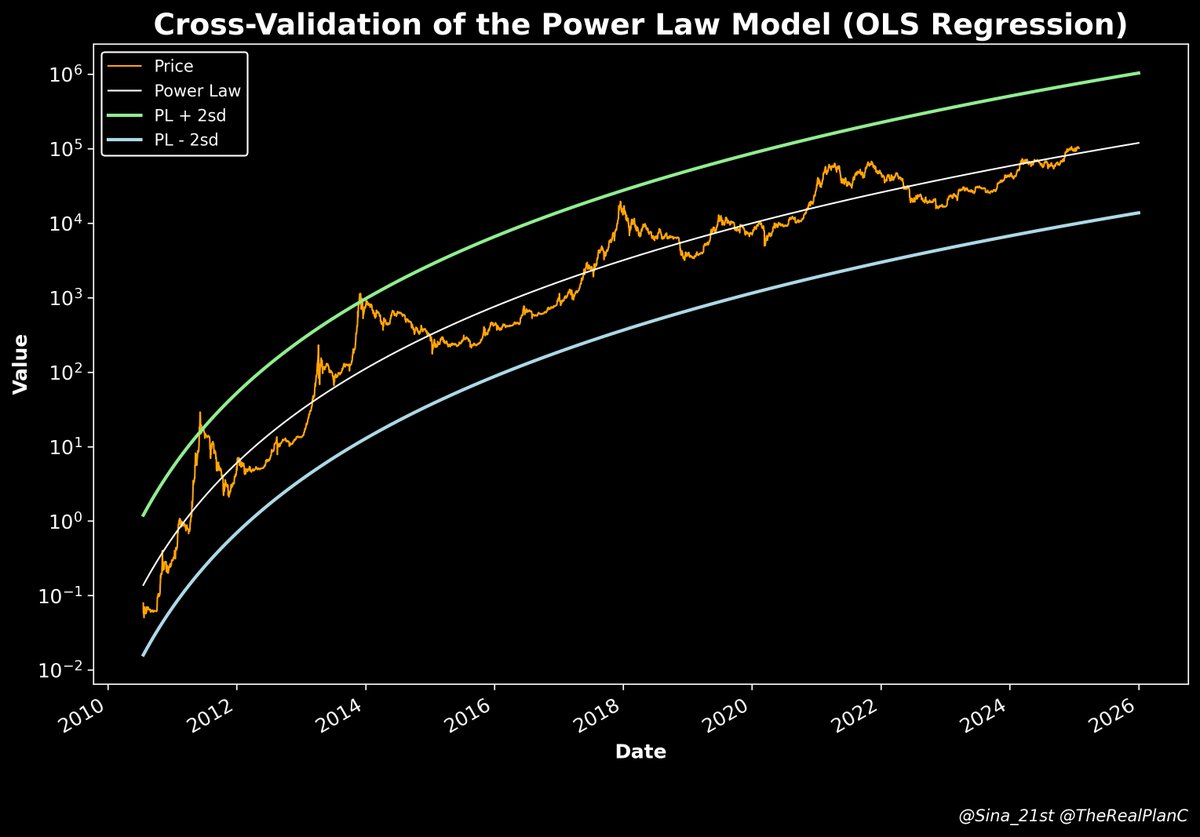
How does the Bitcoin Quantile Model compare to the standard deviation bands of the Power Law Model?
Click on the post to see the full article with properly placed charts.
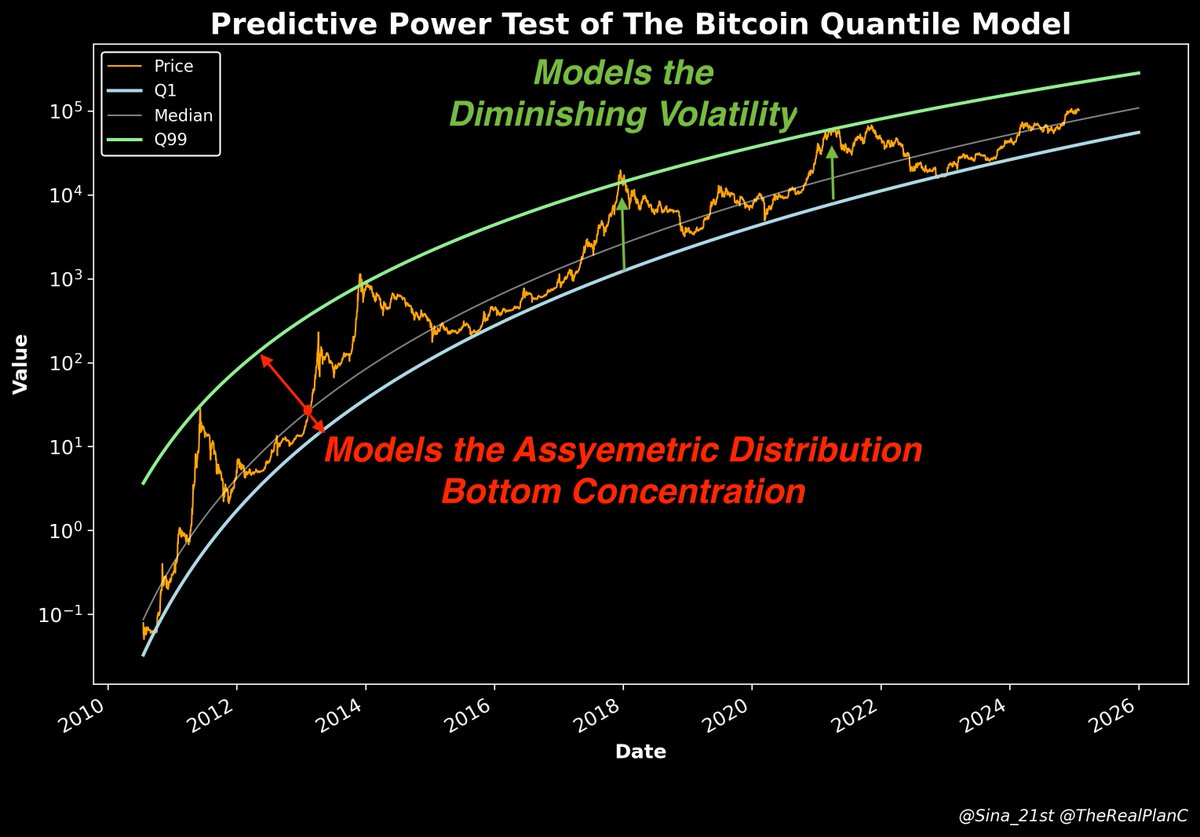
The Quantile model optimizes around finding the best-fitting lines for each portion of the distribution.
The Q1 and Q99 lines fit the top & bottom 1% of the data to provide a channel without any data manipulation by the analyst (key feature).
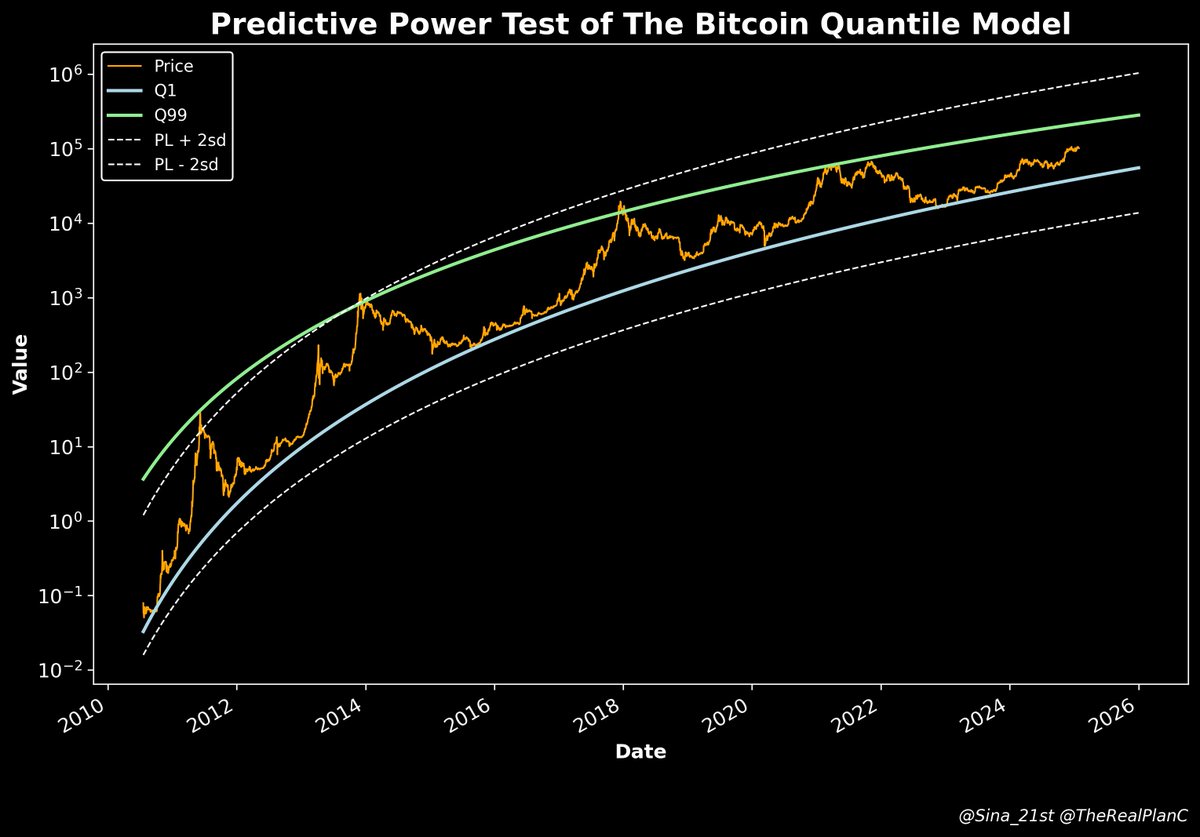
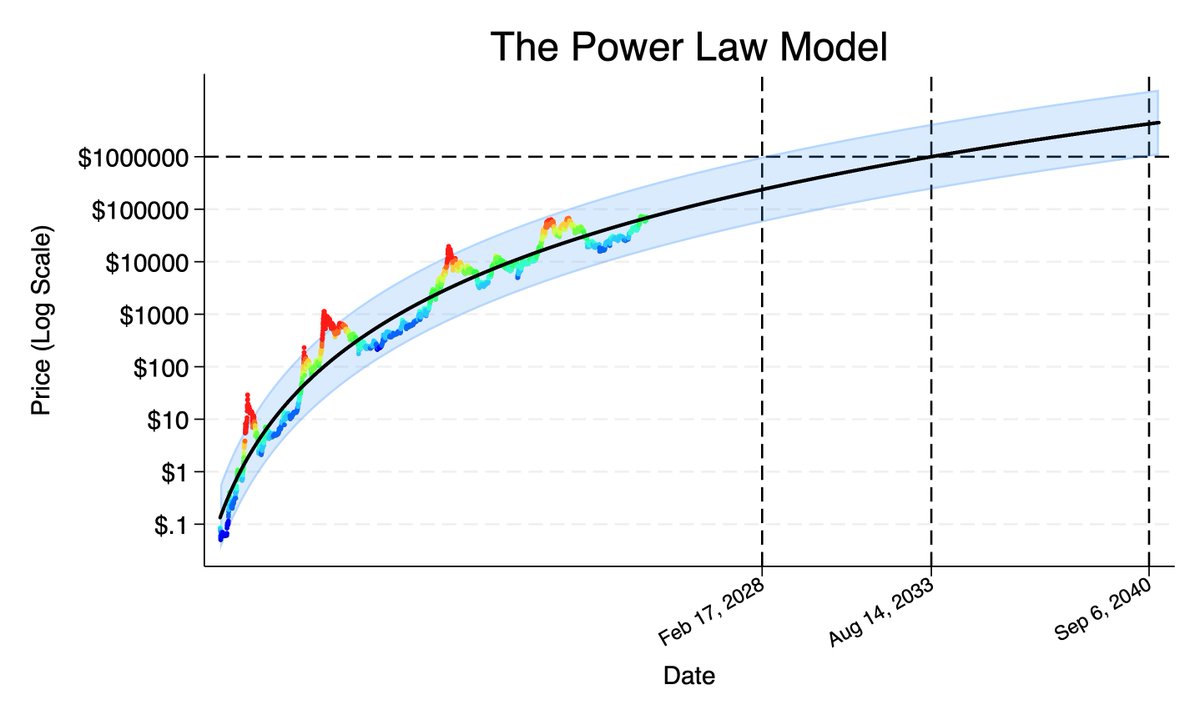
The PL model gives an average, and when adding the standard deviation bands (2 SDs up & down), it deviates from the price. Why? Because Bitcoin is both assymetric and has diminishing volatility.
The quantile model has two advantages:
- It captures the tops because it takes into account diminishing volatility.
- It captures the bottoms because it takes into account the asymmetric nature of bitcoin (i.e., the skewed distribution with most data points concentrated at the lower range).
And it does all these with a unified model, using all the at once, without the analyst manually chopping up the dataset, which introduces bias.
Below are the two models overlaid.
Predictive Power of The Bitcoin Quantile Model 👀
If you ran this model at the end of 2018 (when Bitcoin was at $3700), it would very closely predict the top and bottom of the last cycle. Unbelievable!
Let's see the results:
April 2021 (first top of cycle 3):
Actual Price: $64K
99th Quantile Prediction: $84K
Within $20K!
November 2022 (cycle bottom):
Actual Price: $16K
99th Quantile Prediction: $19K
Within $3K!
Remember, people were giving price targets of $280K to $800K in 2020, and the Quantile Model would have predicted the top within $20,000 dollars.
Similarly, people were saying Bitcoin would never break below last cycle's peak (20K), but the quantile model would have predicted the bottom within $3K.
What is more? it also nailed the COVID bottom.
We have no other model with this level of predictive power.
🚨 The biggest financial problem? It’s not what you think.
💰 Inflation erodes your wealth.
⚖️ Governments manipulate money.
🔐 Bitcoin is the solution.
Watch 21st Capital’s CEO, @rkbtc, break it down with @pahueg. 🎙️👇
Will nation-state adoption break the power law?
Many people ask me whether the PL is too bearish and the SBR or a geopolitical game theoretic Bitcoin rush will break it to the upside.
In this 🧵, I will address what it takes to break the model.
0/n
Self-custody: only you can spend coins
Inheritance: your heir can spend if you are not here
Can we have inheritance in self-custody?
Previously, no!
Today, with Miniscript, Liana, and Smart Vault, YES!
@KLoaec explains how we address this conundrum with self-custody
The shitcoins of this cycle won’t be altcoins. That grift is not working anymore.
Instead they will be fiat affinity scams on Bitcoin.
“Buy my stock, because the company likes Bitcoin”
Luna was building a Bitcoin treasury, Stacks claims to be building “on” Bitcoin, most alt coins are effectively Bitcoin derivatives. And these people called them scams. Only to shill their own fiat plays on Bitcoin.
🚨 The Countdown is On! 🚨
⏳ LIVE in Less Than an Hour:
@Ziya_Sadr & @mktahmasbi are diving into the hottest debate of the year:
“Is Quantum Computing the End of Bitcoin?”
📅 Tonight at 10 PM (Dubai Time)
🌐 Where: https://t.co/Kco2YZ7WnK
Get ready for bold insights from our CPO on the future of Bitcoin and the quantum challenges ahead.
👉 Don’t Miss Out: Watch Live Now!
Join the conversation and bring your questions!
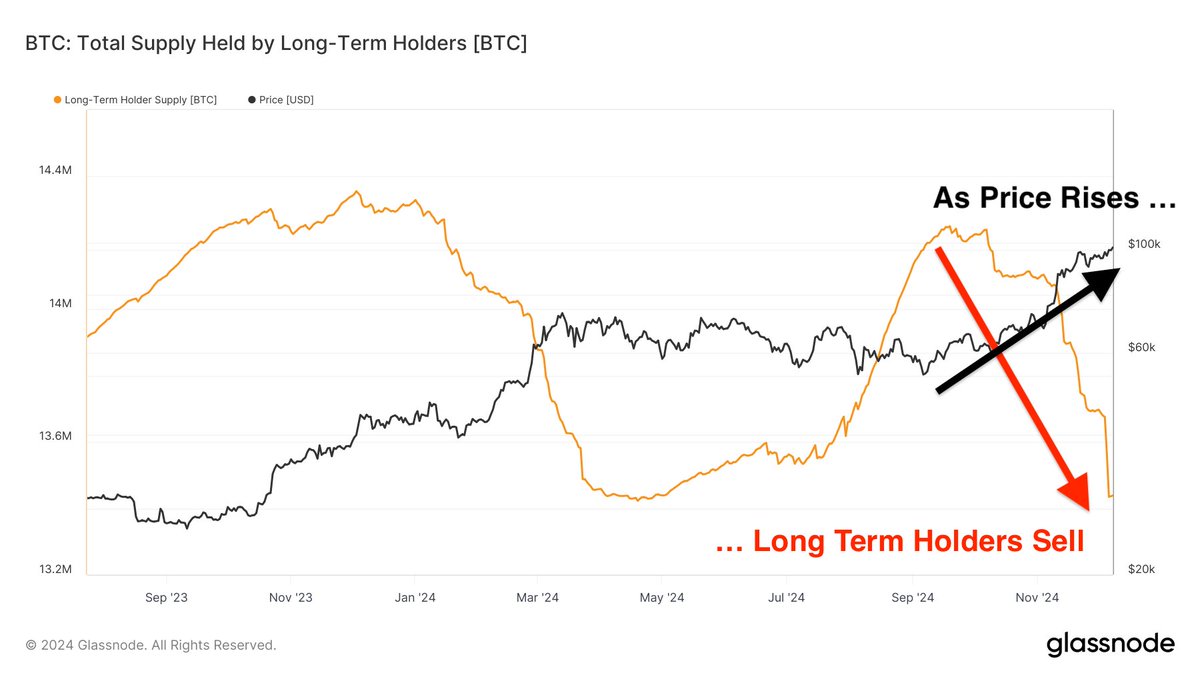
Bitcoin Supply Shock theory says that most coins are taken out of circulation forever and at some point we will run out of coins, which will lead to astronomical price appreciation. If this is true, we might get $1M next year.
Well, that is not gonna happen because as soon as coins are short, price will surely rise, but it will also certainly bring new supply online, which prevents the supply shock from happening.
Evidence? Long-term holders have sold 1.2M coins during the run from $64K to $100K, i.e., $100B worth of new sell pressure.
This is why we spend months consolidating after every big jump.
Bitcoin is the scarcest asset on earth. But it will not remain out of equilibrium for a long time. It is actually also very very liquid. Everyone everywhere and at every hour can take profit. And they will.
The conclusion is that price will grow reasonably fast due to adoption, but an explosion due to supply shock is a fantasy.
The Next Decade is Going to be Terrible for China
Projections that China will overtake the US have been widely exaggerated.
China's working-age population is projected to decline 1.73% annually.
While there are currently 100 working-age people available to support every 20 elderly people, by 2035,
the same working population will have to support 33 elderly people.
By 2100, 100 working-age Chinese will have to support as many as 120 elderly Chinese.
The result is much lower economic growth.
Higher labor costs, driven by the rapidly shrinking labor force, will push manufacturing out of China to labor-abundant countries such as Vietnam, Bangladesh, and India. Manufacturing labour costs in China are already twice as high as in Vietnam.
Also, note that population trends are almost irreversible in the mid-term. A change in policy today will show its effects decades later.
China's era of rapid economic growth is about to end.
Securing Bitcoin within an organization is super difficult. Why and How?
A thread 🧵
1/Traditional single-sig & multi-sig wallets come with risks like theft, key loss, and internal conflicts.
Enter: Bitcoin vaults—a smarter, multi-layered security solution. #Bitcoin#security
Fantastic discussion with Kevin from Wizardsardine about the latest advances in self-custody.
Everybody who wants to invest a meaningful amount in Bitcoin should listen to this.