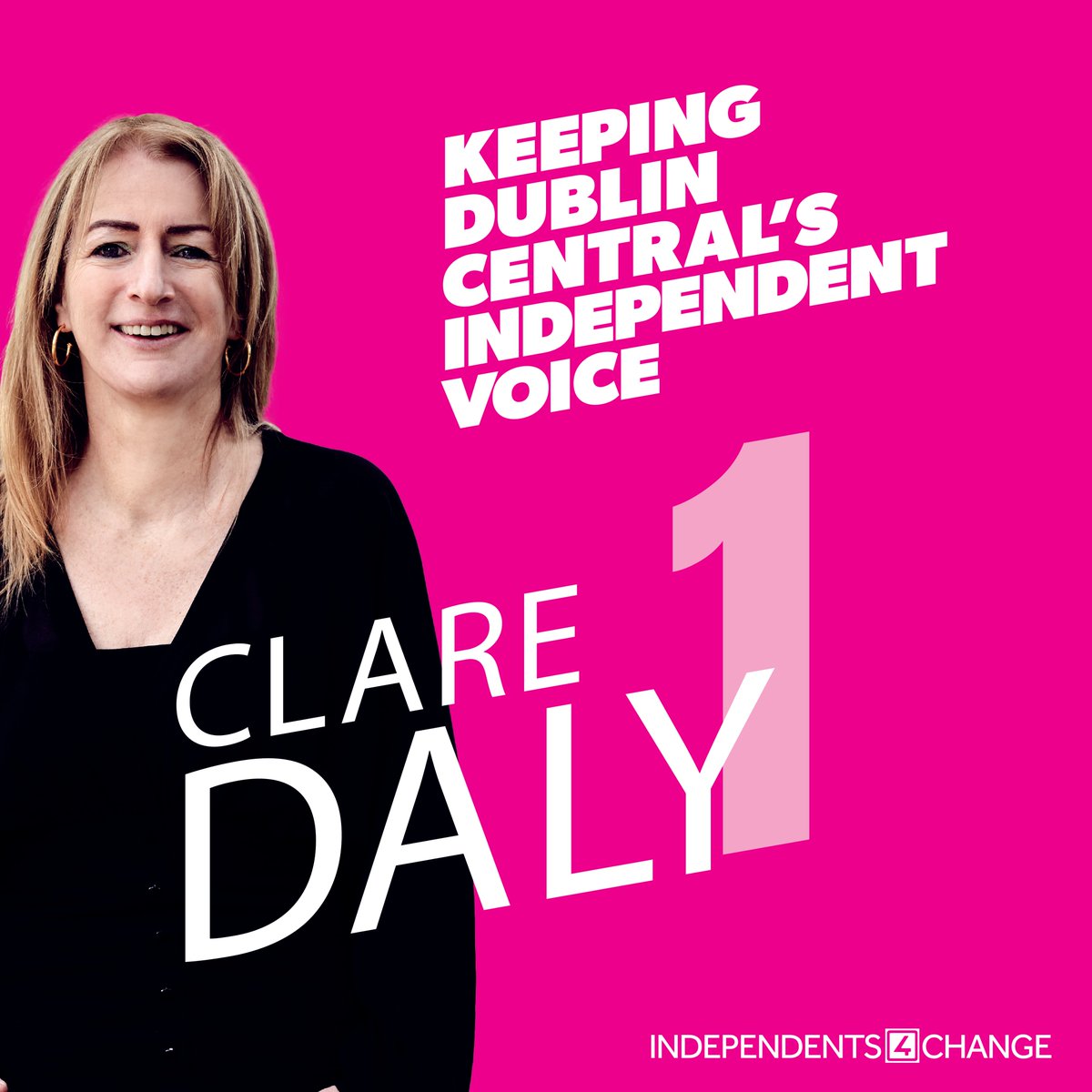
Why I am standing in Dublin Central
After 25 years as a public representative in North Dublin, at local, national, and European level, I thought long and hard about whether to contest the next General Election. Many people, from all over the country, expressed the hope that myself and Mick Wallace would return to the Dáil. Like many, I am deeply concerned at the direction the country is going, and at the lack of any serious challenge, debate, or holding to account of the Government in the Dáil or the media.
We have record inequality against the backdrop of record wealth; a housing and rents crisis that has forced many to emigrate while plunging others into poverty or homelessness, with affordable secure accommodation denied to even those with relatively decent employment. We have abject failure to take adequate steps to deal with the imminent dangers from climate change; the undermining of our neutrality and further integration into EU militarisation; and complete failure to take action against Israeli genocide in Gaza.
While recognising these problems, I had handed over work in my area to the excellent poll-topping Councillor Dean Mulligan and felt that he deserved the chance to stand as a TD with my support.
I was therefore surprised and honoured when contacted by independent activists and public representatives from across Dublin Central who asked me to go forward as an Independent candidate in their area. Dublin Central has a long history of fearless Independent TDs who were not afraid to speak up and speak out for their community, in the tradition of Tony Gregory & Maureen O'Sullivan. That approach is needed now more than ever, as the city is neglected and communities feel abandoned. I have a long track record as a serious organiser from my student days, on to my work as a shop-steward and leader of the Anti-Water Charges & Anti-Bin Charges campaigns. I have a reputation for taking up issues before they were popular, be it abortion rights or Garda reform. I have an international profile as an anti-war and pro- Palestine advocate.
I haven't got that record on the ground in Dublin Central, but those that do, like Maureen O'Sullivan, Councillor Cieran Perry, former MEP Patricia McKenna, East Wall's Joe Mooney, and others have put their faith in me as the best person to take their struggles into the Dáil, and I am humbled to accept and go forward on that basis. I represented Dublin Central as an MEP and had the pleasure of regularly bringing schools and community groups from the area over to Brussels on educational visits. I lived in the area for many years, in Glasnevin and Phibsborough in my student days, in Stoneybatter as a young worker, and now in Drumcondra. I am honoured to have been asked to be part of the fight to make Dublin Central a better place for everyone that lives there, and to take that fight to the Dáil.
🧵1/3 🪖 "Brotherly heart, everything is fine, we will take you out" - powerful evacuation footage from near Lyubimovka
Volunteers of the Tiger detachment from the 155th Guards Marine Brigade of the Pacific Fleet discover wounded soldiers during the battle for Lyubimovka.
Subliminal Messaging in Generative AI: An Ethical Quandary
Dear Lance,
TL;DR: Generative AI systems potentially leveraging subliminal messaging for covert persuasion represent significant ethical risks. This practice can undermine individual autonomy, violate privacy, and perpetuate manipulation, thus warranting immediate scrutiny and regulation based on ethical frameworks like the IEEE Standards.
The implications of subliminal messaging through Generative AI, as explored in your article, raise profound ethical concerns. The use of hidden persuasive techniques, even when subtle, can lead to:
1. Violation of Autonomy: Manipulating users without their conscious awareness undermines their ability to make informed decisions. It compromises individuals' fundamental right to control their thoughts and actions, a key principle in AI ethics.
2. Privacy Infringements: When subliminal messaging is covertly applied, often leveraging data patterns, it becomes an invasion of privacy. Users may unknowingly reveal their preferences, biases, or emotional responses, which can be exploited.
3. Trust Erosion in AI Systems: The ethical deployment of AI is critical in maintaining public trust. Any discovery of subliminal manipulation risks eroding this trust, not just in individual AI systems but in the broader AI landscape, potentially stalling progress in this domain.
Need for Regulatory Oversight: The lack of clear policies to govern subliminal messaging opens the door for misuse. The IEEE's standards on the ethical design of intelligent systems emphasize fairness, transparency, and respect for human dignity. These principles should inform the development of regulations to prevent the misuse of such AI capabilities.
In conclusion, while Generative AI holds immense potential, its alignment with ethical standards is non-negotiable. Even when designed for benign purposes, subliminal messaging poses an existential threat to privacy, autonomy, and public trust in AI systems.
Is Mise Le Meas,
Graham dePenros
Ethical Implications of Thought Preference Optimization in AI
Dear Lance,
TL;DR: While Thought Preference Optimization (TPO) holds promise for refining generative AI outputs, its application presents ethical challenges, especially concerning autonomy, transparency, and privacy.
The idea of optimizing AI through Thought Preference Optimization (TPO), as explored in your article, raises several ethical issues that need to be critically examined. On one hand, TPO could enhance AI's adaptability and personalization, but the method of tapping into human cognitive patterns to improve AI raises key concerns that align with the IEEE Standards on Ethical Design of Intelligent and Autonomous Systems.
Ethical Concerns: Autonomy, Privacy, and Accountability
1. Autonomy: If AI systems rely on human thought patterns, it begs the question of how much control humans retain. Are we allowing AI to direct our thinking processes or subconsciously shaping them?
2. Transparency: AI systems should maintain transparency, especially when integrating complex human thought preferences. Users need to be informed and fully understand the extent of AI's influence over their decision-making.
3. Privacy: Any method that involves accessing or optimizing human cognitive patterns must prioritize privacy. How will AI models using TPO ensure that individual thought data is kept private, and how will consent be managed?
4. Dual-Use Concerns: As AI ethics experts, we also need to reflect on how this technology could be misused in military applications or surveillance. Could TPO unintentionally become a tool for thought manipulation or behavioral control?
Inclusive Design & Human-Centric AI
Moreover, it’s vital that TPO adheres to principles of fairness, inclusivity, and human rights. Will TPO be designed to cater to diverse thought processes, avoiding the reinforcement of societal biases? The potential for TPO to influence human-AI interaction is immense, but ethical AI development should always keep the common good at its core.
In conclusion, while TPO could revolutionize generative AI, its implications for human autonomy, transparency, and privacy demand rigorous scrutiny and robust ethical frameworks. I urge the community to reflect deeply on these issues and ensure that innovation doesn’t come at the cost of human dignity.
Is Mise Le Meas,
Graham dePenros