🚀 BITMAPCORE — INTERACTIVE BLOCK NAVIGATION
We are now testing a new functionality in BitmapCore: navigating inside an individual Bitcoin block as a virtual environment.
You can currently select a specific block, enter it, and move around its structure directly within BitmapCore.
This is the first stage of our interactive World development.
For now, the experience is limited to one block at a time. Navigation across multiple blocks and the larger Bitcoin World has not yet been implemented. That is the next stage we will work toward.
There is also still significant room for improvement. The navigation system, avatar, interaction mechanics, visual details, and overall usability are all at an early stage and will continue to evolve.
The important part for us is that the underlying functionality is now working.
With individual block navigation taking shape, we can begin expanding this foundation toward a larger interactive environment where multiple Bitcoin blocks can eventually become part of the same navigable World.
This is only an early look at what we are building.
The interactive World is still under development.
More blocks. More interaction. More to come.
https://t.co/5b4ON5V3OT
#Bitmap #Bitcoin #Ordinals
💥 New Visual Experience across BitmapCore.
Previously, the images displayed on the main screen were 2D, static, and completely unaffected by the cursor.
With this update, they are now being displayed in 3D and react subtly when the cursor moves over them.
When you place the cursor over an image, that specific image responds with a light movement, creating a more dynamic sense of depth. The other images remain still until the cursor moves over them.
This is the first screen where we are implementing the new 3D image system, and we will continue extending it to the remaining screens throughout the day.
The objective is not simply to change the images, but to make the interface feel more dynamic, refined, and visually engaging while maintaining a clean experience.
There is still more to implement, but this is an important first step in the visual evolution of BitmapCore.
We wanted to share this progress with our users as we continue improving the application.
3D images.
Subtle interaction.
A more refined BitmapCore experience.
More screens are coming throughout the day.
#Bitmap #Bitcoin #Ordinals
🟧 Navigate within a 3D Bitmap Block
You can now enter and explore individual Bitcoin blocks in 3D directly through BitmapCore.
Here is how:
1. Go to:
https://t.co/WRzoHTA1wW
2. Search for a Bitcoin block using the search bar and enter the block you want to explore.
3. Open the block.
You will see the block information screen with its 3D image.
4. Below the image, select “ENTER BLOCK 3D”.
You will then enter the 3D environment of that specific Bitcoin block.
Once inside, you can also use the search bar in the upper-left corner to look for another block without leaving the 3D environment.
This means you can move from one block to another directly from the 3D experience.
At the moment, navigation is available one block at a time. The larger interactive World, where multiple Bitcoin blocks can be connected into a broader environment, is still being developed.
As we showed in our previous update, this is the first stage of building that experience.
One block at a time.
One step closer to the Bitcoin World.
#Bitcoin #Bitmap #Ordinals
@BitmapPlotz Can you give me a link to compare their messages with mine to see if I have them all or if anything is missing? A comparison would be good, even though my data is pulled directly from the mempool, an extra check is always helpful.
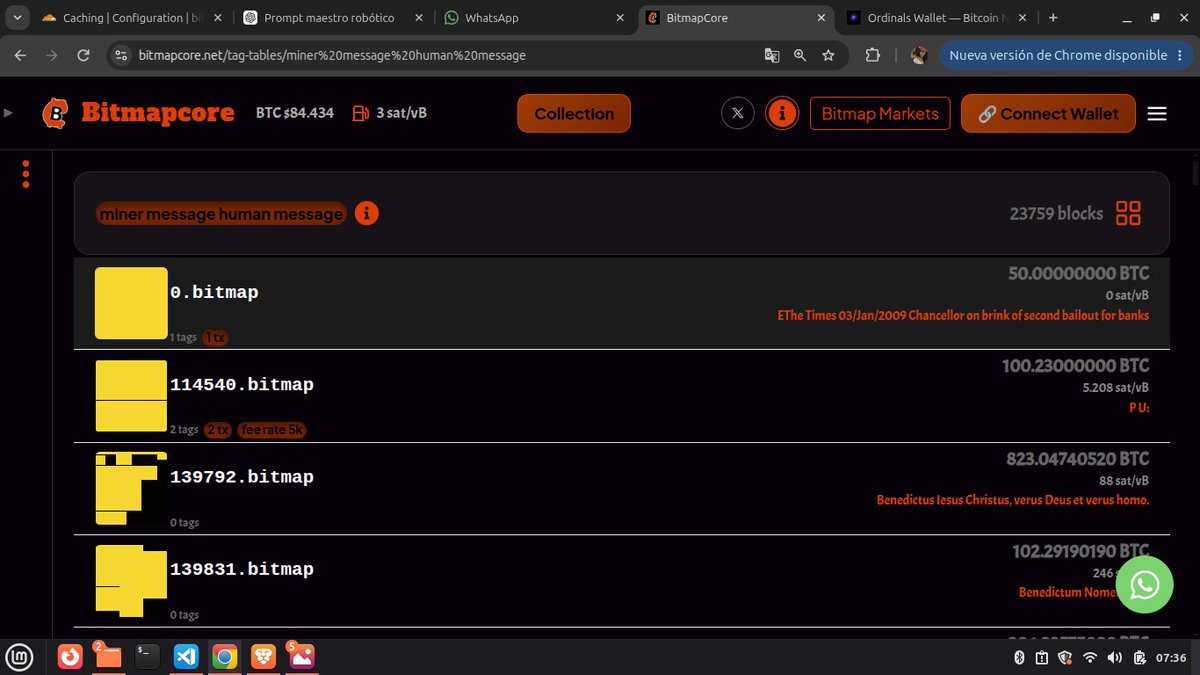
📝 A NOTE ON BITCOIN’S MINER MESSAGES
Within the first 960,001 Bitcoin blocks we analyzed, 779,091 blocks contain some form of miner message.
Of those, 23,759 blocks contain messages that are readable by humans.
In BitmapCore, these blocks are currently classified under the Miner Message Human Message tag.
This category includes human-written messages, historical references, greetings, and other readable content placed in the coinbase data by miners.
It also includes the first and most famous example:
Block #0 — January 3, 2009
“The Times 03/Jan/2009 Chancellor on brink of second bailout for banks”
The message is embedded in the Genesis Block’s coinbase data and remains one of the most recognizable pieces of text in Bitcoin’s history.
#bitmap #btc #ordinals
BITMAPCORE — IMAGE UPGRADE 90% COMPLETE
Our image infrastructure upgrade is now approximately 90% complete.
The new high-resolution images are already working inside BitmapCore, and we can now represent Bitcoin blocks in 3D with significantly more detail than before.
This is important because the previous 240–250 px images became heavily pixelated when zooming in, making it difficult to preserve the structure and proportions of the individual blocks.
The new images are being prepared specifically to support the continued development of our interactive World.
We are already advancing the 3D navigation experience. When you search for a specific Bitcoin block in BitmapCore, its information screen can now display that block in 3D. although the deeper interactive experience is still under development.
The block itself is not yet a fully navigable 3D World. You cannot enter and move through the individual blocks yet. That is part of the functionality we are continuing to build.
We still have some work remaining, including restoring and adapting our special image tags, which were affected during the resolution upgrade.
But at approximately 90% completion, the new infrastructure is already giving us something we could not properly achieve with the previous image resolution.
The foundation is now in place.
The 3D experience is working.
The interactive World continues to evolve.
Thank you to everyone who has been following BitmapCore and supporting the project from the beginning, wherever you discovered it and wherever you are joining us from.
We will continue working to deliver a better experience and improved usability throughout the application.
#Ordinals #Bitmap #BTC
⚠️ IMAGE INFRASTRUCTURE UPGRADE - in Bitmapcore
We are currently upgrading the image infrastructure behind BitmapCore as part of the development of our interactive World.
The images currently stored on our VPS are around 240–250 px. This resolution was sufficient for the current application, but it is not suitable for the level of zoom and detail required by the World.
When zooming deeply into the current images, they become heavily pixelated and the individual block shapes lose definition. This has become a real limitation for the development of the interactive environment.
We are therefore rebuilding this image layer at 2048 px, improving the source quality and converting the files from PNG to WebP. This allows us to work with significantly larger images while keeping storage and delivery more efficient.
This upgrade is important because we cannot properly continue evolving the World while the underlying image resolution remains a limitation.
It will also allow us to stop spending development time working around this issue and focus on the other technical problems and features that still need to be solved.
The image upgrade itself is expected to take approximately 12–24 hours.
During this period, BitmapCore may:
• respond more slowly than usual
• temporarily become unavailable
• experience intermittent loading issues
After this process, the new higher-resolution images will be available in the application. The interactive World itself is still under development and will require considerably more work.
This is one of the necessary steps to build it properly.
🔖🔖 NEW TAGS IN BITMAPCORE
We have now added a new set of classifications for Miner Messages the blochain in the bitcoin.
Our initial research grouped miner messages into broader categories. However, one of those categories still contained hundreds of thousands of blocks, making it too large to be useful as a single classification.
We refined that dataset by separating the largest and most relevant mining pools into their own categories, while keeping smaller pools grouped together.
The new classifications are:
• Pool Other — 216,361 blocks
• Extranonce — 115,624
• AntPool — 107,487
• Foundry — 71,184
• Mining Signal — 58,185
• ViaBTC — 51,623
• BTC Guild — 31,323
• Slush — 30,054
• Unknown Miner — 28,894
• F2Pool — 24,358
• Human Message — 23,759
• Binance — 20,239
These classifications cover 779,091 of the 955,001 Bitcoin blocks analyzed — 81.6% of the dataset.
This gives us a more detailed way to distinguish mining pools, extranonce data, technical signals, historical miners, and human-readable messages.
With these additions, BitmapCore now has 84 classification tags.
We believe the current structure works well, particularly because the largest categories are now separated instead of leaving hundreds of thousands of blocks under one broad label.
That said, we would like to hear from the Bitmap community:
Do you think some of the smaller categories should be combined, or should we keep the 12 classifications as they are?
https://t.co/5b4ON5VBEr
#bitmap #ordinals #bitcoin #btc #blockchain
⛏️ BITCOIN MINER MESSAGES — A NEW CLASSIFICATION LAYER
We have completed an analysis of 960,001 Bitcoin blocks, examining the miner messages contained in their coinbase data.
The results are significant:
784,091 blocks contain a miner message
175,910 blocks contain no miner message
With more than 784,000 miner messages, we don't think it makes sense to place all of them into a single classification. The messages contain very different types of information.
Our current research identifies 7 possible categories:
⛏️ 1. Mining Pool / Pool Identification — 478,590 blocks (61%)
Messages identifying known mining pools, including AntPool, Foundry, F2Pool, ViaBTC, Slush, BTC Guild, BitFury, Binance, BTCC, Poolin, MARA, Huobi, Luxor, BitClub, Eligius, BW, Secpool, SBICrypto, 50BTC, BitMinter, HaoBTC, OKEx, Bixin, Trustpool, gbminers, and others.
🏢 2. Miner / Organization Identification — 58,826 blocks (7.5%)
Messages that appear to identify individual miners, organizations, users, or smaller mining operations.
💻 3. Mining Software / Infrastructure — 9,729 blocks (1.2%)
References to mining software, versions, protocols, and infrastructure, including bfgminer, ckpool, stratum, getwork, and related technical identifiers.
🔢 4. ExtraNonce / Mining-Job Data — 6,219 blocks (0.8%)
Technical mining data including long hexadecimal patterns, job identifiers, extranonce, nonce, difficulty-related information, and similar structures.
🏷️ 5. Pool Tags + Technical Data — 201,115 blocks (25.6%)
Messages combining pool identification with technical or protocol signals such as /P2SH/, /SEGWIT/, /BIP100/, /NYA/, /EB1/, and others.
📝 6. Custom / Human-Readable Messages — 14,389 blocks (1.8%)
Deliberate readable messages including historical references, URLs, greetings, religious texts, quotations, and other custom messages.
❓ 7. Unknown / Unclassified — 152,375 blocks (19.4%)
Messages that we currently cannot reliably attribute to another category, including binary fragments, truncated data, non-printable content, and other unclear patterns.
These numbers show why a single “Miner Message” classification would lose a significant amount of information.
At the moment, these categories have NOT been added to BitmapCore's database or application.
We are publishing the research first because we want to examine the structure of these messages carefully before turning the categories into actual BitmapCore classifications.
ONE QUESTION FOR THE BITMAP COMMUNITY
If we add a “Miner Message” classification to a Bitmap, should BitmapCore also display the exact message found in that block?
Our current preference is to keep the classification simple:
Miner Message → Yes
Meaning that the block contains a miner message, without displaying the full message itself.
However, if users consider the exact miner message useful information, we could also store and display the original message in BitmapCore.
Which approach would be more useful to you?
If you think the exact message should be included, let us know. We have not added this data to the database yet, so the structure can still be changed before implementation.
960,001 Bitcoin blocks analyzed.
784,091 miner messages identified.
7 potential classification categories.
Now we are deciding how this historical Bitcoin data should be structured inside BitmapCore.
#bitcoin #bitmap
💥 BITTICK AGENTS — OUR FIRST ORDINALS COLLECTION
Our first Ordinals collection, BitTick Agents, is available for trading on UniSat and Ordinals Wallet.
Only 5 BitTick Agents remain at the current minimum price of 0.0004 BTC.
Regular price: 0.0014 BTC
Access our collection directly:
https://t.co/eKVYIpmmo6
https://t.co/ntOSx0U9GA
#ordinals #NFT #bitcoin #btc
@blockamoto It’s crazy now; back then they were worth next to nothing, but now they’re worth a fortune. And in a few years, they’ll be worth even more—blessed Bitcoin.
🔖 WE FOUND A BITCOIN FEE-RATE OUTLIER 📛
We analyzed approximately 955,000 Bitcoin blocks to classify their average fee rates and identify extreme values.
In our historical scan, Block #157235 recorded the highest average fee rate we found in the dataset:
1,143,052 sat/vB
Block #157235:
• Date: December 12, 2011
• Transactions: 31
• Total fees: 171.84649523 BTC
• Weight: 61.1 kWU
• Miner: https://t.co/k3Gguyljce
The 171.84649523 BTC figure represents the total fees paid by the transactions in the block, not the average fee rate.
Using the explorer’s displayed rounded weight gives an approximate fee rate of 1.125M sat/vB, while our dataset calculates 1,143,052 sat/vB from the underlying block data. The difference is consistent with the rounded weight displayed by the explorer.
This analysis also led to an expansion of BitmapCore’s classification system.
16 NEW FEE-RATE CLASSIFICATION TAGS
We added 16 new fee-rate tag categories:
fee_rate1k · fee_rate2k · fee_rate3k · fee_rate4k · fee_rate5k · fee_rate6k · fee_rate7k · fee_rate8k · fee_rate10k · fee_rate12k · fee_rate14k · fee_rate17k · fee_rate20k · fee_rate30k · fee_rate50k · fee_rate100k
These categories classify Bitcoin blocks according to their average fee rate (sat/vB) within their defined ranges.
With these additions, BitmapCore now has 72 classification tags covering different on-chain properties of Bitcoin blocks.
The distribution is highly uneven at the extreme end.
In our scan, only 144 blocks exceeded 8,000 sat/vB.
Block #157235 stands far above that range, with an average fee rate of 1,143,052 sat/vB.
https://t.co/WRzoHTztHo
Every classification is derived from Bitcoin block data and cross-checked against public blockchain explorers.
https://t.co/rq4PGZ7bSJ
https://t.co/0RLggE0D2t
https://t.co/xcMAvclMgs
#btc #bitcoin #bitmap
I don't want to create different bitmaps. It is certainly possible—it’s just code, after all, and could be programmed—but rewriting an image algorithm would be a lot of work and isn't worth it for us. The simplest approach was to take the standard algorithm everyone uses and adapt it to our limitations. To be clear, I am not going to create different bitmaps; we do acknowledge that there are improvements we can and should make to our images, and we are continuing to work on enhancing them.
🟧 BITMAPS: THERE IS NO OFFICIAL IMAGE ALGORITHM
There is an important distinction in the Bitmap ecosystem:
Neither Ordinal Theory nor the Bitmap standard defines a single official algorithm for converting a Bitcoin block into an image.
Bitcoin provides the underlying data. The visual representation is an interpretation.
Bitfeed was one of the earliest implementations of the well-known Mondrian-style Bitcoin block visualization. Transactions are represented as squares, with their size derived from transaction value, and arranged using a Mondrian bin-packing algorithm.
https://t.co/o2G6pmuM8s
Ordinals Wallet’s open-source bitmap-renderer uses the same visual approach and explicitly describes it as a Mondrian bin-packing algorithm ported from Bitfeed.
https://t.co/LQjvqI1h0i
Bitlords takes a different approach with Bitmon Patterns, using its own visual interpretation to classify patterns such as Punks, Grid and others.
https://t.co/vuA84oMeQ2
The important point is: none of these approaches is automatically “wrong.”
They are different interpretations of the same underlying Bitcoin block data.
### Why doesn’t BitmapCore use the Bitmon visual theory?
There are two main reasons.
1️⃣ THE BITMAP STANDARD DOES NOT REQUIRE IT
The official Bitmap Theory defines the Bitmap framework, including Districts and Parcels, but it does not require every platform to use one specific image-rendering algorithm.
https://t.co/AMI2nFHXMK
The Bitmap documentation also recognizes that the underlying Bitcoin data can be interpreted in different ways.
https://t.co/YN40dTekCM
As an independent platform, BitmapCore has the right to use its own visual interpretation while continuing to use the same Bitmap standard.
Using a different image algorithm does not make our interpretation automatically correct or incorrect — just as using Bitmon does not make Bitlords the only valid visual interpretation.
2️⃣ VISUAL PATTERNS ARE ALGORITHM-DEPENDENT
This is the more important technical distinction for BitmapCore.
A Bitcoin block can be transformed by an algorithm into grids, letters, houses, characters, animals, geometric shapes or many other forms.
But those visual patterns are not themselves Bitcoin on-chain facts.
If the rendering algorithm changes, the resulting image — and therefore a classification based on that image — can also change.
BitmapCore also has its own image algorithm. We do not claim that our images are the official representation of a Bitcoin block.
Our approach is to keep visualization and classification separate.
Our images are an interpretation.
Our Bitmap classifications are designed around characteristics derived from verifiable Bitcoin on-chain data: block height, transaction count, transaction values, block data and other deterministic properties.
That distinction matters.
A visual algorithm can interpret the blockchain.
It cannot make its visual interpretation an on-chain fact.
BitmapCore therefore does not use Bitmon as the foundation of its classification system.
We continue to use the Bitmap standard for what it actually defines, while building our own independent tools and interpretations on top of Bitcoin data.
This is not a competition over who has the “correct” picture.
It is about recognizing the difference between the immutable data and the algorithms used to interpret it.
ONE BITCOIN DATASET.
DIFFERENT VISUAL INTERPRETATIONS.
AN OPEN BITMAP ECOSYSTEM.
#bitmap #bitmappers #ordinals
🚀 A Smarter BitmapCore Homepage
We’ve just improved the BitmapCore homepage to make Bitmap market analysis faster and more useful.
Previously, marketplace listings occupied the left side of the homepage.
Now, the latest listings are displayed on the right, where you can continue monitoring the newest opportunities across the marketplaces we track:
• Unisat
• Ordinals Wallet
• BitmapCore Marketplace
But the biggest improvement is on the left.
We’ve moved our Bitmap tag floor-price analysis directly into the homepage.
BitmapCore currently tracks 56 Bitmap classifications, and our system automatically organizes active listings into separate sections by tag.
At the moment, 42 of those tags have active listings, each with its own floor price.
This gives you two levels of information in one place:
📊 Overall Bitmap floor price
🏷️ Floor price for each individual tag
So instead of only seeing the cheapest Bitmap available, you can select a specific classification, compare its floor price with the other listings in that category, and make a more informed decision — without leaving the homepage.
And the latest listings are still right there.
Less navigation.
More information.
Better Bitmap analysis.
This is more than a UI change.
It’s a better way to explore the Bitmap market. 🟧
BitmapCore is still under development, and we’ll continue refining the platform as we build more tools specifically for the Bitmap ecosystem.
This update started with community feedback.
If you think there’s another piece of Bitmap-related information that would genuinely be useful to have directly on the homepage, feel free to share your idea.
We’re listening. 🟧
#Bitcoin #Bitmap #Ordinals #BitmapCore #Bitmappers