Sentios badges are now LIVE!
Show Sentios coverage anywhere.
Githug, explorers, wallets, dashboards, websites
The badge is now a hot link that opens to our active projects page on the Sentios website:
https://t.co/hXMN0HlOAr
Let the world know Sentios agents are continuously auditing your codebase on significant feature releases.
Want your project listed? Contact us to put Sentios on your codebase.
@bitsecai $TAO
Volume matters to us, and not only for revenue. Every audit we run makes the next one sharper.
Announcing our sales pilot with @Leadpoet AI. Alongside the Head of Sales and BD hire and the BitIgnite referral program, Bitsec is expanding our sales reach.
More revenue → faster growth
More data → better audits
@bitsecai $TAO
You asked for it, and we built it.
By popular request: the Bitsec referral program, BitIgnite, is LIVE.
Introduce a team to Sentios Continuous Coverage and earn 10% of the initial purchase plus any additional purchases over the next 6 months.
Just one of several ways we are expanding our sales reach, with more to come.
Know a team that ships code and can’t afford a hit? DM us.
@bitsecai $TAO
Point a model at a codebase, ask it to find bugs, and call it an audit. That's slop.
A scan will find something. Some of it real, some of it invented, plenty of it true but harmless. It got so bad, curl shut down its bug bounty in January after a flood of AI-generated reports that sounded technical and described things that weren't there.
A scan also can't tell you what it missed, and a second run can turn up different findings than the first.
The bugs that matter are the ones an attacker can turn into stolen funds, exposed secrets, leaked private data, or system breakage. A true audit searches for all threats and hunting all of them takes skill: strategy, agents, multiple models, and careful prompting. It's not what you use, it's how you use it.
And the best audits are the ones that stay ahead of the field by continuing to innovate.
(and in fact, we’re testing something new right now)
@bitsecai $TAO
Every audit we run leaves something behind.
A finding. A false positive. A severity call. A fix, and whether the fix held.
One report is just a report. Thousands of them become a record of how real code actually breaks, and that record does a lot of work. It teaches our filters to tell a real bug from slop, shows where each model is weak so the right one gets each job, and gives miners fresh production code to compete on that they can’t memorize the way they can a static benchmark. It also lets us route work to the cheapest model that can handle it, and it’s the raw material for the small specialized auditing models we’re building toward.
Anyone willing to pay can rent the same frontier models we use, but the data that makes them better at auditing only comes from running the audits.
So volume matters to us. More audits means more data, which means sharper agents and better finds.
Continuous coverage for our clients, and continuous learning for us.
@bitsecai $TAO
You asked for it, and we built it.
By popular request: the Bitsec referral program, BitIgnite, is LIVE.
Introduce a team to Sentios Continuous Coverage and earn 10% of the initial purchase plus any additional purchases over the next 6 months.
Just one of several ways we are expanding our sales reach, with more to come.
Know a team that ships code and can’t afford a hit? DM us.
@bitsecai $TAO
Testing of our end-to-end automated audits has started.
The first benefit is the obvious one. An audit no longer has to be hand-held from kickoff to final report, which eats a lot of time. Now it can run by itself and a person only needs to review the results allowing us to scale our auditing capacity significantly.
That same ability leads somewhere bigger. If nobody has to steer an audit, nobody has to be on the other end of an order either. Requesting coverage becomes self-service, and anyone can do it on their own.
And once anyone can, the one placing the order doesn’t even have to be a human. An agent that writes and ships code can request its own audit, the same way a developer would.
So not only is it much more efficient for our team, it significantly scales our reach into agentic clients which are likely to be the dominant cohort of code writers needing audits.
@bitsecai $TAO
Humans-in-the-loop are the bottleneck in software factories, systems “harnessing loops at scale.”
The human reviews in a loop are usually a backstop for quality and security, but they slow the cycles down and make it far more expensive with drastically limited scalability. So the ideal is actually to run what’s known as a “dark” factory; the less human review, the darker the factory. The question though is how to move there with confidence, that what the human once reviewed is no longer necessary.
Bitsec’s contribution to that confidence:
End-to-end fully automated security audits.
Security is one thing the human review is there to catch. Unlike design decisions, it can be tested.
This will allow teams to plug Sentios directly into their software factory loops and achieve the same high quality audits we’re known for.
We’re bringing continuous audits to agentic workflows.
The product will go into testing phase next week.
@bitsecai $TAO
Humans-in-the-loop are the bottleneck in software factories, systems “harnessing loops at scale.”
The human reviews in a loop are usually a backstop for quality and security, but they slow the cycles down and make it far more expensive with drastically limited scalability. So the ideal is actually to run what’s known as a “dark” factory; the less human review, the darker the factory. The question though is how to move there with confidence, that what the human once reviewed is no longer necessary.
Bitsec’s contribution to that confidence:
End-to-end fully automated security audits.
Security is one thing the human review is there to catch. Unlike design decisions, it can be tested.
This will allow teams to plug Sentios directly into their software factory loops and achieve the same high quality audits we’re known for.
We’re bringing continuous audits to agentic workflows.
The product will go into testing phase next week.
@bitsecai $TAO
S&P Global has acquired OpenZeppelin, and OpenAI is reportedly in early talks to buy Trail of Bits.
Neither is crypto-native. One is a pillar of traditional finance, the other a frontier AI lab, and both reached for firms with deep web3 records.
Finance is moving onto blockchains, where smart contracts are the infrastructure the assets run on. S&P has said it wants to assess the technology risk beneath on-chain financial products, and that risk sits in code that is public, holds value directly, and turns a missed bug into an immediate loss.
Audit firms that last in that environment build skills that are rare elsewhere. S&P didn’t go the traditional audit route. It chose a web3 firm. That may not be a trend yet but it’s interesting.
The world is already waking up to the idea that code carrying this much value is constantly changing, and a check done once is out of date the next time new code ships. Since the code is the infrastructure, continuous audits are how that value stays protected.
@Bitsecai $TAO
We’re expanding our team.
Bitsec has a new Head of Sales and Business Development.
We set a high bar for this role with three must haves. They need to be business savvy enough to run our sales pipeline and BD, be technical enough to understand how Bitsec and Sentios works as well as talk to CTOs in their language, and most importantly be highly trustworthy.
It’s time to accelerate and expand sales.
(we’re also cooking up tech that will give us even more of a sales boost. More on that soon.)
@bitsecai $TAO
NEW CLIENT ANNOUNCEMENT
We’re happy to announce that Beam is now covered by Sentios Continuous Coverage.
Beam has a live badge on their Github README linked to the Sentios Active Projects Page.
https://t.co/hXMN0HmmpZ
Let everyone know your code has Continuous Coverage.
DM us to join the ranks.
@Bitsecai $TAO
“$200,000 bug found with $1000 in AI costs. That’s a huge difference!”
this first discovery is what has become @bitsecai continuous audit system
- interview with @TheStreet at @ExploitSummit
reqd the full interview covered by thestreet, yahoo finance, MSN and AOL
NEW: @bitsecai has launched Sentios badges: hot links for websites, explorers and dashboards that open its active-projects page. The badges make continuous audit coverage visible where a project is viewed.
https://t.co/O3Mf39vhcr
"There are brilliant people from everywhere in the world looking to do something good." – John Yu, Bitsec founder / CEO
The secret sauce is Bittensor and its Incentive Mechanism.
We find these brilliant people and have them compete to build the best strategies comprised of multiple large models, agents, sub agents, prompts, memory management, context management, and tool use into a strategic harness.
These become models of sorts and only the best performing ones win.
Speaking of models, we’re moving toward a security audit future where we develop actual models, like a cluster of small expert auditing models with their own specialty features that in combination will be far more robust than not only large single models, but also the harness strategies that are cutting edge today.
We’re taking it there.
$TAO @bitsecai
PARTNERSHIP ANNOUNCEMENT
Bitsec is happy to announce our newest client: TWIF
The attitude regarding meme coins is sharply divided in web3 but we see this move as a signal that TWIF cares about its code base and that signing up for continuous coverage means they intend to be around for awhile. Kudos to the TWIF team.
Welcome to Sentios Continuous Coverage
@bitsecai@TaoWifHood $TAO
Catch Bitsec founder John Yu’s full Exploit ‘26 talk here:
https://t.co/kkOmbhzoAv
In the talk, John announces code audits for Bittensor subnet Incentive Mechanisms and goes over a couple example exploits.
He makes the case that it’s much more effective for a team dedicated to security audits to review code than the ones that developed it.
And of course, the obvious benefits of having continuous coverage for your code base.
Special thanks to the @vidaio_ team for their excellent LIVESTREAM and VOD coverage of the event.
@bitsecai $TAO
Did you miss any of the great presentations at @ExploitSummit ?
Or do you have any talks you’d like to watch again?
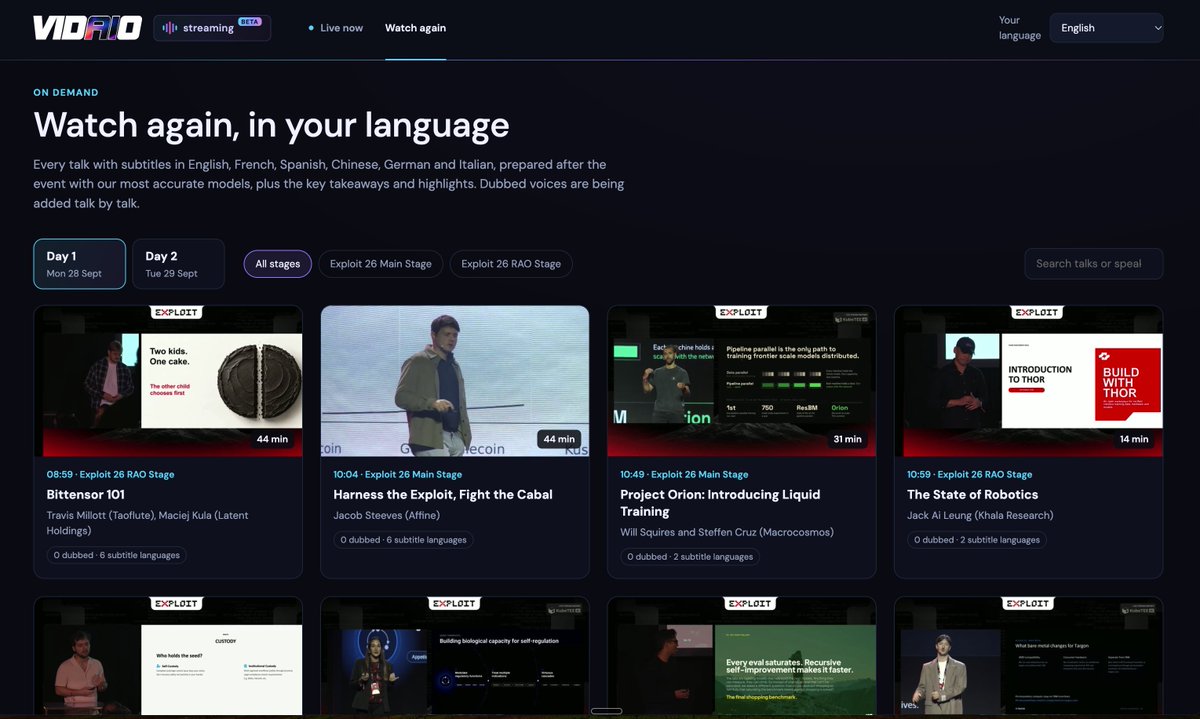
Great news. Our LIVESTREAM website has them all.
https://t.co/Zl6fYetQ5F
Video On Demand (VOD) allows you to watch all the action.
At the top of the page, look for the “Watch again” tab.
Filter by Day 1 or 2, and which stage the talk was given.
Optionally, use the search bar on the right to search by speaker, subnet, or talk title.
Every talk will have subtitles in English, French, Spanish, Chinese, German, and Italian, prepared after the event with our most accurate models, plus the key takeaways and highlights. Dubbed voices are being added talk by talk as well. Choose your language in the top right pull-down list. Currently, all videos have English and French subtitles, and many have all 6 available. (The rest coming as soon as we get back home)
Open any talk for the full presentations, and see Key Takeaways and Highlights as well as other events from that day on the right. Download the subtitles/transcript in multiple languages.
We appreciate our community and welcome any feedback regarding your user experience for both the LIVESTREAM and the WATCH AGAIN services. Please let us know if there are any features you’d like to see.
Happy viewing!
@vidaio_ bittensor:native
The Sentios Badge
Ever more powerful LLM models have made the hunt for code exploits a race for token spend: who can be the first to throw the most tokens at a fresh codebase.
You’re a hacker. You’ve got your models and your search strategies. You’re hunting for fresh codebase. You search Github looking for possibilities and you come across a project with the Sentios Badge.
What does that mean? A skilled team has already been here, spent tokens, found and fixed vulnerabilities, and continues to do so with each fresh code release. The question becomes, “Do I want to try to spend even more tokens looking for less valuable exploit opportunities or move on?”
The Sentios Badge is a Proof of Spend.
This code is covered, continuously.
Not only a deterrent to hackers, but a signal to users and investors the mission critical technology you depend on is secure.
@bitsecai $TAO
Can miners find the answers before doing the work?
@yubrew of @bitsecai shows how Bitsec flagged exposed confirmation seeds in @heydittoai's incentive mechanism. He says Ditto fixed the reported issues within days, and explains why seed timing matters.