I use this account to document how I think about crypto markets.
• Cycles over headlines
• Capital flows over narratives
• Risk first, upside second
Chinese account: @bitwux
Not investment advice. Just my framework.
Bitcoin is starting to diverge from global liquidity.
That’s… unusual.
Because for most of the past cycle, $BTC was liquidity —
a leveraged expression of stimulus, dollar expansion, and risk appetite.
So if that relationship is breaking, it’s not a small shift.
It’s a structural one.
Something has changed.
So the real question is:
Are we still using a 2020 framework
to analyze a market that’s already been fundamentally rewired?
Or worse —
are we misreading strength as divergence,
when it’s actually a different kind of demand showing up?
We’ll find out soon enough.
Uncomfortable thought: we may not be near the deep bear market yet.
One indicator I keep watching is Percent Supply in Profit for $BTC.
It measures how much of the circulating supply is sitting on unrealized gains —
a pretty honest way to gauge market health.
According to Glassnode, the metric dropped below its −1σ band (~60%) in early February
and now sits around 57%.
If you compare that to previous cycles,
similar levels showed up around May 2022 and November 2018.
Both were still early phases of deep bear markets.
Which suggests something important:
What we’re seeing right now may not be the base before a recovery.
It may simply be mid-bear consolidation.
If you’re curious about OpenClaw but don’t know where to start, this site helps a lot:
👉 https://t.co/xA8SD93kyb
It’s basically a structured learning hub for newcomers:
🔹A step-by-step path from beginner to more advanced topics
🔹Curated Chinese + English tutorials in one place
🔹Skills organized by real use cases, not random docs
🔹Searchable by category, language, or keyword
Huge respect to the devs putting this together!
Feels like the deeper you go into this space, the more there is to learn.
#AI #OpenClaw
🚨All eyes on Feb 26 — who is ZachXBT about to expose?
Polymarket currently assigns the highest odds (~35%) to Meteora, Solana’s liquidity protocol.
That speculation isn’t coming out of nowhere.
ZachXBT @zachxbt has hinted the target would likely fit two conditions:
1⃣ A highly profitable operation
Meteora sits at the core of Solana’s liquidity stack —
dynamic AMMs, anti-sniping tools, meme launch infrastructure.
Translation: meaningful revenue, meaningful flow, meaningful surface area.
2⃣ Potential for internal data misuse
This is where the market’s suspicion gets interesting.
By design, a liquidity layer can have visibility into:
1)real-time order flow
2)LP positioning and vault dynamics
3)token launch mechanics
In the wrong hands, that kind of informational edge can become… very tradable.
To be clear — none of this confirms anything.
But the market is already positioning.
👉 One new wallet reportedly bet $5.9K on the prediction market while simultaneously opening a ~$33K MET short on Hyperliquid.
Smart hedge?
Pure speculation?
Or just crypto doing crypto things?
We’ll find out soon enough.
Gold is surging.
Bitcoin is selling off.
The BTC / Gold ratio has now fallen back to a long-term support zone last seen around 2020.
From a capital-flow perspective, this looks like a familiar pattern:
Risk capital temporarily rotates back into traditional safe havens.
History shows this kind of move tends to be extreme first,
before mean reversion even becomes possible.
This isn’t a signal to predict timing —
but it is a reminder that relative dislocations rarely stay permanent.
Bloomberg: Trump May Appoint a Fed Hawk
Is This Bad News for Bitcoin — or the Start of a Structural Shift?
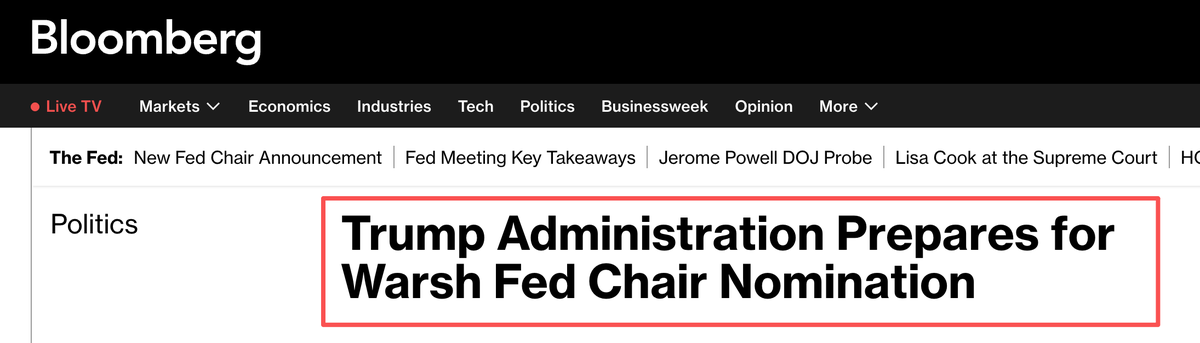
Bloomberg reports that the Trump administration is preparing to nominate Kevin Warsh as the next Chair of the Federal Reserve.
That alone is enough to make markets pause.
Investors are still waiting for rate cuts.
Yet Trump may be choosing one of the most vocal opponents of “central bank rescues” inside the Fed system.
So the real question isn’t whether Warsh is “crypto-friendly.”
It’s this:
When a rule-driven, anti-liquidity Fed chair collides with a fiscally aggressive, anti-establishment presidency — does Bitcoin behave like a risk asset, or like an escape valve?
Who Is Kevin Warsh?
Kevin Warsh (born 1970) represents a rare combination of Wall Street, the White House, and the Federal Reserve.
In one sentence:
He is widely seen as one of the most hawkish figures within the Fed ecosystem.
Career background (briefly):
Stanford (Public Policy, Economics & Statistics)
Harvard Law School (JD)
Early career at Morgan Stanley (M&A, capital markets)
Senior economic advisor in the George W. Bush White House
Appointed to the Federal Reserve Board in 2006 (youngest member at the time)
Active participant during the 2008 financial crisis
Later roles at Stanford (Hoover Institution), private family offices, and multiple corporate boards
What defines Warsh isn’t his résumé — it’s his worldview.
He witnessed firsthand how QE evolved from an emergency tool into a permanent crutch.
That experience shaped him.
Warsh’s Core Philosophy
Warsh is not “anti-markets.”
He is anti-dependence.
His positions are consistent:
Strong emphasis on monetary discipline
Defense of central bank independence
Skepticism toward prolonged asset purchases
Concern that easy money fuels asset bubbles and moral hazard
This puts him directly at odds with the market’s most comfortable assumption of the past decade:
“When things break, the Fed will step in.”
Under Warsh, that assumption would be tested.
Is Kevin Warsh Bad for Bitcoin?
Short-term: probably.
Long-term: not necessarily.
This is where most takes go wrong.
1. Short-term pressure is real
If Warsh leads the Fed, tighter policy is a real possibility:
Balance sheet reduction
Higher-for-longer rates
Less tolerance for financial stress
That means:
Lower liquidity
Higher volatility
Pressure on assets that depend on cheap leverage
Bitcoin would not be immune in the short run.
2. But Warsh is not anti-Bitcoin
Importantly, Warsh has publicly stated that Bitcoin “does not make him uneasy.”
He has compared it to gold:
Volatile, yes
But potentially a sustainable store of value
A source of market discipline rather than chaos
That matters.
Warsh’s objection isn’t to Bitcoin itself —
it’s to monetary systems without rules.
The Trump + Warsh Combination Matters
This is the part markets are underestimating.
Trump represents:
Fiscal expansion
Political disruption
Institutional friction
Pressure on global coordination
Warsh represents:
Rules
Discipline
Resistance to monetary shortcuts
That combination creates institutional tension, not stability.
Historically, such tension doesn’t favor equities or highly financialized assets.
It tends to favor one category:
Non-sovereign, non-manipulable hard assets.
In today’s market, that list is very short:
Gold
Bitcoin
Bitcoin’s Real Driver Isn’t Liquidity
This is the key misunderstanding.
Bitcoin doesn’t ultimately rise because money is easy.
It rises because trust in monetary coordination weakens.
Liquidity drives cycles
Institutional credibility drives adoption
A hawkish Fed chair combined with an aggressive fiscal presidency doesn’t remove risk.
It repackages it.
And that’s precisely where Bitcoin’s long-term narrative strengthens.
Where the Pressure Will Be Heaviest
While Bitcoin may benefit structurally, other parts of crypto face headwinds.
Kevin Warsh has:
Supported forms of central bank digital currency (CBDC), especially wholesale versions
Framed crypto less as “money” and more as software
Raised concerns about private stablecoins and payment reliability
This suggests:
Stablecoins may face regulatory tightening
DeFi leverage may face scrutiny
Meme-driven speculation becomes more vulnerable to liquidity withdrawal
Bitcoin and “everything else” will not trade the same.
Bottom Line
If Kevin Warsh becomes Fed Chair:
Short-term:Higher volatility, risk-off pressure, weaker liquidity conditions
Long-term:Stronger case for Bitcoin as a neutral store of value in a fractured system
The biggest mistake would be to treat this as a simple “hawk = bearish” story.
This isn’t about rates.
It’s about whether markets continue to believe in unlimited rescue — or are forced to confront institutional limits.
And historically, that’s when Bitcoin stops behaving like a tech stock
and starts behaving like an answer to the system itself.
⚡️ vePENDLE is officially gone — and Pendle @pendle_fi quietly fixed LP incentives at the same time.
The new model replaces human-driven allocation with a fully algorithmic system.
Incentives are now distributed based on just two signals: TVL and Trading fees .
Early on, the model leans toward TVL to attract liquidity.
Over time, it shifts weight toward fees, rewarding actual usage.
No manual voting.
No long-term subsidizing dead pools.
If a pool has real volume and fees, it keeps getting emissions.
If it doesn't, incentives are automatically pulled.
In other words, LP returns are forced back to what actually matters:
choosing the right pools, not playing governance games.
This also improves efficiency at the protocol level, with total $PENDLE emissions expected to drop by ~30%.
Under this setup, strategy becomes simpler:
👉 focus on the most actively traded pools right now.
And while ve-boosts are gone, Pendle can still co-incentivize with external protocols, unlocking up to ~1.4× rewards when others are willing to pay.
For long-term LPs, this is a cleaner, more predictable system — less babysitting, fewer gimmicks, better alignment!
@tn_pendle@pendle_fi
GM, a new era of $PENDLE is officially here ☀️
• vePENDLE locking is retired
• Snapshot completed for PENDLE locked → for calculation of sPENDLE Loyalty Bonus
• Algorithmic Incentive Model (AIM) is now live, bringing data-driven, performance-based incentives
• Clear pool APYs - no more ranges or "max APYs", what you see is what you get
• ATH PENDLE locked: 69.9M (24.8% of supply)
• ATH average lock duration: 1.66 years
• 29.7% of total $PENDLE now locked / staked
🔥A historic moment ——
The S&P 500 just broke 7,000 for the first time!
+26.18% in 2023
+24.89% in 2024
~16% in 2025
~17% annualized over the past five years
If you ask me what the best investment path for most people looks like,
it’s not about complexity or constant trading.
It’s about owning assets that compound over time
with the lowest possible cognitive cost.
That’s why the same names keep showing up:
Broad equity indices.
Gold.
Bitcoin.
Different assets,Same principle:
long-term exposure to high-quality growth, without needing perfect timing or genius-level insight.
Sometimes the smartest strategy is simply letting great assets do what they’ve always done.
⚡️A line from OKX’s founder @star_okx really stuck with me.
If you work in crypto, making money isn’t enough.
You also need to respect the industry — in how you think and how you act.
In many parts of the world, Web3 builders are already mainstream.
They’re treated no differently than people building AI or other frontier tech.
But there’s one prerequisite: You have to take your own work seriously first.
If deep down you think crypto is just a way to cash out,
don’t be surprised when society treats the entire industry as disposable.
Crypto isn’t just speculation.
It’s about transparency, reducing financial asymmetry, and expanding access.
And because of that, everyone inside the system carries responsibility —exchanges, founders, developers, and creators alike.
Respect the industry, and you’re really investing in your own long-term credibility.
@okx #OKX年夜饭
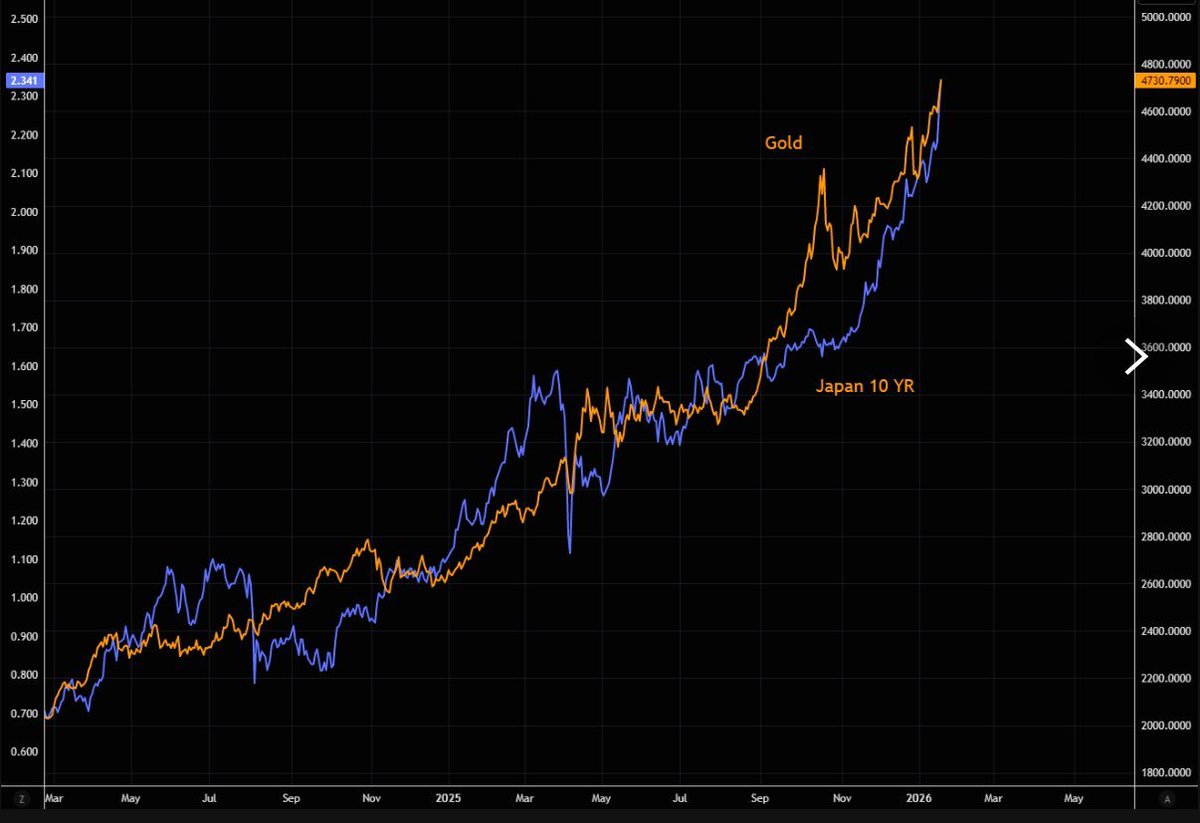
Japan’s bond market is flashing warning signals.
JGB yields are rising alongside gold —
a sign that the move isn’t about growth optimism,
but about credibility and inflation risk.
The current setup is fragile:
• Expansionary fiscal rhetoric
• Only marginal tightening from the BOJ
• Equity strength paired with bond and FX weakness
Japan’s fiscal math is unforgiving.
With debt accumulated decades ago,
even a 5% average funding cost would absorb nearly all government revenue.
This creates a reflexive loop:
1/ Fiscal expansion raises debt concerns
2/ Debt concerns push yields higher
3/ Higher yields constrain BOJ policy
4/ Policy constraints fuel inflation expectations
5/ Inflation expectations push yields higher again
In that loop, currency weakness isn’t the cause —
it’s the consequence.
⚡️Over the past 24 hours, more than $1B in liquidations hit the market —
mostly from the long side.
Brutal, and painful to watch.
But arguing about “long or short” here misses the point.
Short-term price action is chaotic.
Signals are noisy.
Predictions are cheap.
What actually matters is structure.
Leverage is still being flushed out.
Positioning is still being reset.
What remains after that process is simple:
• Spot holders
• Or traders with capital, patience, and margin discipline
Markets don’t reward certainty.
They reward survivability during uncertainty.
A Chinese IT Professional’s Bitcoin Seizure Raises Serious Questions About Due Process
Part 1|What happened (factual overview)
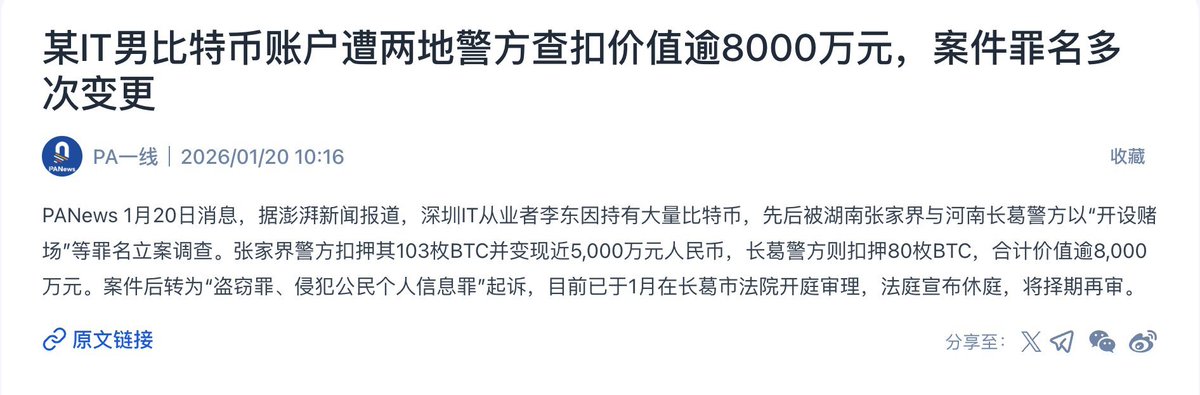
According to Chinese media reports, a Shenzhen-based IT professional (surname Li) has had a large amount of Bitcoin seized by two separate local law enforcement agencies, with the case involving multiple changes in charges.
The timeline, as reported, is roughly as follows:
Li was found to hold a significant amount of Bitcoin.
Police in Zhangjiajie (Hunan) and Changge (Henan) both opened criminal cases against him at different times.
Zhangjiajie police seized 103 BTC, later liquidated for nearly RMB 50 million.
Changge police separately seized 80 BTC.
The total value of seized assets reportedly exceeds RMB 80 million.
The case initially involved charges related to operating illegal gambling platforms, but was later reclassified to theft and infringement of citizens’ personal information.
The case has already gone to trial once, was adjourned, and is awaiting further proceedings.
Part 2|My assessment (legal and structural concerns)
After reviewing the available information, this case raises serious procedural and legal red flags, independent of any moral judgment about the underlying conduct.
1. Jurisdiction and double prosecution risks
Under basic principles of criminal procedure, a single criminal incident should be handled by one competent jurisdiction.
Here, two separate police departments:
Opened cases for the same underlying conduct
Applied different charges at different stages
Took independent coercive measures and asset seizures
This creates a real risk of repeated prosecution, which directly conflicts with fundamental due-process principles.
2. Highly questionable handling of seized assets
Criminal seizure does not automatically authorize liquidation.
Before a final court judgment:
The suspect is still legally presumed innocent
Property rights remain protected
Asset disposal should be strictly limited and proportionate
Liquidating large amounts of Bitcoin before conviction raises serious concerns around property rights protection and proportionality.
3. A core contradiction in the “theft” theory
The alleged “victims” in this case appear to be gambling websites, which are themselves illegal under Chinese law.
This raises unresolved doctrinal questions:
Do illegal business entities automatically enjoy full criminal-law protection?
Are gambling-related “rebate funds” considered lawful property under criminal law?
These issues are far from settled and cannot simply be assumed away.
4. Technical exploitation ≠ automatic theft
The reported conduct involves exploiting system vulnerabilities and redirecting commission addresses.
However, theft requires:
Clear intent of illegal possession
Secret appropriation of lawful property
Exclusive and unlawful control
Depending on facts and evidence, such conduct may instead fall under:
Unauthorized system access
Improper data use
Civil disputes or unjust enrichment
Without a complete, untampered electronic evidence chain, criminal qualification becomes highly questionable.
5. My conclusion
Stripping away emotion and enforcement incentives, this case does not resemble classic theft or gambling-related crimes.
At most, it appears closer to a computer systems or data-related offense, and even that conclusion depends heavily on evidence integrity.
When:
Jurisdiction overlaps
Charges repeatedly change
Assets are disposed of before judgment
Evidence handling lacks transparency
The real issue is no longer just individual guilt, but whether procedural boundaries are being stretched to fit outcomes.
And once that line is crossed, legal certainty itself becomes fragile.
⚡️Pendle @pendle_fi just upgraded its token model to sPENDLE !
This isn’t a pivot. It’s a natural evolution.
If you’ve followed Pendle long enough, this move shouldn’t surprise you.
Once a mechanism is fully stress-tested by the market, the next step isn’t more complexity — it’s preparing for a different user base.
That’s exactly what sPENDLE is doing.
🎯 Why vePENDLE made sense —— and why it started to show limits.
vePENDLE was brilliant for phase one.
It aggressively concentrated emissions into the hands of users willing to lock long-term,
which helped bootstrap liquidity, governance, and early alignment.
But as the protocol scaled, efficiency started to matter more than commitment theater.
Lockups became friction.
Incentives skewed toward governance games. And token holders and actual product users weren’t always the same people.
That’s the gap sPENDLE is designed to close.
🎯 What actually changes with sPENDLE ?
This upgrade isn’t cosmetic. It alters how value flows through the system:
1)Staked positions become liquid and transferable You’re no longer forced to pre-commit to long time horizons just to participate.
2)Unstaking is reduced to 14 days Capital efficiency improves. Optionality increases.
3) Protocol revenue starts flowing back more directly Pendle v2 fees are used to buy back $PENDLE and distribute to eligible sPENDLE holders. Cash flow becomes visible at the token layer.
4)Emissions move from voting games to algorithms With an expected ~30% reduction in overall emissions, incentives are pushed toward real usage, not manual optimization.
5)Early vePENDLE holders aren’t ignored Remaining lock durations convert into sPENDLE with up to a 4× boost — a clear acknowledgment of early risk.
The message is simple:less human gaming, more structural alignment.
🎯 Zooming out: Pendle’s two phases
Seen from a distance, Pendle’s roadmap looks clean:
Phase 1: Solve yield decomposition, pricing, and tradability. vePENDLE was perfect for this stage.
Phase 2: Turn rates, funding costs, and hedging into infrastructure. That requires flexibility, participation, and scale.
sPENDLE arrives at exactly the right time.
Whether this upgrade meaningfully re-rates won’t be decided by announcements.
It will be decided by:
V2 and Boros growth
Real fee generation
And actual sPENDLE participation rates over the next year
But structurally, this is the kind of change that protocols make when they’re preparing for the next order of magnitude.
2026 should be interesting !
NYSE is moving securities infrastructure into the blockchain era.
Not as a side experiment —
but as a system-level upgrade.
The key signals matter more than the headlines:
1/ Stablecoins as settlement rails
When NYSE explicitly mentions stablecoin-based settlement,
stablecoins graduate from trading tools to core financial infrastructure.
2/ Post-trade goes onchain
Matching may stay traditional,
but clearing, settlement, and reconciliation are the highest-certainty upgrade paths.
3/ Regulated custody and permissioned accounts
Securities require auditable, compliant, and custodiable onchain accounts —
not anonymous wallets.
4/ Fungible tokenized equities and ETFs
Tokenization only matters if assets can move freely
between onchain and traditional systems.
5/ 24/7 markets create new products
Continuous trading + T+0 settlement will force
entirely new yield and risk structures TradFi can’t easily build today.
This isn’t about blockchains competing with each other.
It’s about who can serve exchanges, clearinghouses, brokers, and custodians.
Boros @boros_fi just launched its first onchain US equity funding rate market — NVIDIA.
What’s interesting isn’t the ticker.
It’s the timing.
Less than two months ago, the debate was whether onchain US equities had real demand.
Now the market has already moved to:
• Funding rate hedging
• Position cost management
• 24×7 carry and risk control
That’s a fast jump.
The logic is straightforward:
Wherever perpetual markets expand,
funding rate markets inevitably follow.
BNB last week.
NVIDIA today.
Next likely candidates aren’t exotic —
they’re obvious:
• SOL
• XRP
• Then standardized equity RWAs like AAPL, TSLA, GOOGL, or index products
Like @tn_pendle said
This isn’t about price speculation.
It’s about giving traders a way to separate exposure from financing cost.
The most important company in the world, and now you can trade its heartbeat on Boros 💜
Introducing NVDAUSDC-Hyperliquid (USDT Collateral)
Speculate on market conviction in @NVIDIA, AI, GPUs....
Welcome to the future of sentiment trading
Dan Koe’s 1.2B-view post isn’t an accident. @thedankoe
It’s a near-perfect match between:
• Platform dynamics
• Collective anxiety
• Certainty packaging
The title says everything:
“How to fix your entire life in 1 day.”
Not “get slightly better.”
Not “think differently.”
It sells three things:
• Low cost → 1 day
• High payoff → your entire life
• Executability → steps, not philosophy
Of course it works.
Especially in January —
the global “I need to change something” window.
People hate New Year’s resolutions,
but they hate feeling lost even more.
The genius part?
Sharing this content isn’t just saying “this is useful.”
It’s saying:
“I’m someone who takes life seriously.”
Even if you don’t follow the steps,
the repost already completes half of the identity upgrade.
This is why checklists outperform essays.
Huge problems.
Simple cuts.
Immediate action.
Complexity is unbearable.
Buttons feel merciful.