Today I just want to take time to thank every Zimbabwean who has helped me over the past 11 years as I built the Boer goat breeding business that was inspired by the late Professor Sam Moyo.
One day, while sitting with him on his veranda at his Borrowdale home, he told me something I have never forgotten. He said, “You will never become wealthy by earning a salary. You can live comfortably, but real wealth often comes from building something of your own.”
When he discovered that my parents had left me a rural home, he and his partner, Beatrice Mtetwa, who is my lawyer, encouraged me to do something productive with that piece of land.
That conversation inspired me to start Hopewell’s Boer Goats, which by the time I left Zimbabwe in 2024 had become the third biggest Boer goat breeding business in the country.
Prof Sam Moyo then sent me to speak to Professor Lindela Ndlovu, a renowned Zimbabwean animal scientist and former Vice-Chancellor of the National University of Science and Technology. He specialised in animal science and livestock production, including goats. He is the one who truly opened my eyes to the business potential of Boer goats.
Initially, I thought I was simply going to do ordinary goat farming. But Prof Ndlovu advised me to focus on high-value breeds such as Boer goats, Kalahari Reds and Savannas. However, because I was coming from Murewa, he specifically recommended Boer goats, explaining that they would adapt well and perform strongly in that environment.
What struck me most was how he explained the business model. He told me that my target market should not be people buying goats for meat because pure Boer goats are expensive. Instead, my market should be farmers looking to breed and improve the quality of their own herds.
He explained that a mature male Boer goat can weigh between 100 and 120 kilograms live weight, while the average indigenous Mashona goat weighs around 20 kilograms. When you crossbreed the two, the offspring can weigh between 60 and 70 kilograms. That is where the commercial value comes in. Farmers buy a quality Boer buck (male), breed it with their indigenous goats, and then sell the heavier crossbreeds for meat production.
That conversation completely changed how I viewed livestock farming. It stopped being just farming and became genetics, business, strategy and long-term value creation. I remain forever indebted to Profe Lindela Ndlovu for his guidance, wisdom and generosity with knowledge. May his soul rest in peace.
So, I want to thank everyone who assisted me on that journey, especially during difficult periods when the business was moved from the village after ZANUPF thugs targeted my operation and tried to steal the goats, a story so embarrassing that it was broadcast internationally. But this post is not about that pain. It is about gratitude.
When I started in 2015, we were selling six-month-old Boer goats for US$450 each, and sometimes we would have 40 goats born in a single cycle inside one week. Forty multiplied by US$450 is US$18,000. Instead of spending the money, I reinvested it back into the business so it could grow.
That money helped me build world-class goat pens not only at my ancestral home, but also on two other pieces of land that I rented from people who had acquired farms through land reform but were not using them productively. Today, those properties remain with the owners, and I am genuinely happy because they are now successfully running their own goat businesses.
By the time I left Zimbabwe, I had developed such a strong genetic pool that I was now selling one-year-old Boer goats, commonly known in livestock breeding circles as “four-tooth” goats because of the stage of their permanent teeth development, for between US$2,000 and US$3,000 each.
What made these goats valuable was not just their size or appearance, but the quality and traceability of their genetics. Their bloodlines had been documented and officially recorded in South Africa, with lineage records that could be traced back nearly 30 years. Buyers were not simply purchasing a goat, they were investing in proven genetics, breeding quality and future herd improvement.
That is how the business evolved from ordinary goat farming into a serious livestock breeding operation built on genetics, record-keeping and long-term value.
Over time, I transitioned from breeding into trading and mobilisation after I left Zimbabwe. The business has evolved into sourcing quality goats from South Africa and supplying them to people in Zimbabwe who want to improve their own herds.
I also want to pay special tribute to Dr Gerald Manyatelo, a state veterinarian in Gauteng, originally from Zimbabwe, who helped me immensely when I imported my first batch of goats in 2015. Without his assistance at that crucial stage, things could easily have gone wrong and I might have given up altogether.
I hope my story inspires others. You can be a professional in one field and still build real wealth from something completely different. Too often, when people see someone succeed, they ask, “Where did he get the money from?” instead of asking, “How can we also learn and build something ourselves?” Zimbabweans are talented, hardworking and capable of building businesses if we support and encourage one another.
I was saddened recently when a UK-based lawyer wrote on Twitter saying, “Hopewell has a house in Zimbabwe, another in South Africa and now one in England. Where does he get the money from?” And yet I am 55 years old.
A decent house in areas like Chisipite, Borrowdale or similar middle to upper-income suburbs in Zimbabwe can cost between US$400,000 and US$500,000. By the time the Boer goat business had matured, one breeding cycle could generate around US$40,000 or more.
Ten good cycles and you can buy a house. For half that amount, you can buy property in South Africa. With proper planning, discipline and financing structures, the same business can help you acquire property elsewhere too.
The problem with many of us as black people is that we have been conditioned to question success instead of studying it. Instead of asking, “How did he build it and what can we learn from it?”, people ask, “Where did he get the money from?” We have normalised suspicion instead of inspiration.
I have worked for decades as a journalist, documentary filmmaker, consultant and businessman. I built businesses, invested money back into them and took risks when many people were sleeping. There were years when I was waking up before dawn to go and check on goats before doing journalism work. Wealth does not always come from salaries. Sometimes it comes from building something patiently over time.
At 55, I am now at a stage where I should be slowing down from some of the hard labour and beginning to enjoy the fruits of years of sacrifice, hard work and persistence. So for someone to act shocked that a man of my age has managed to build a comfortable life says more about what our country has become than it says about me. A society where success is treated as suspicious is a society that has been psychologically damaged by poverty and political failure.
So today, I simply want to say thank you to everyone who helped me along the way. I will never forget your support.
And to the man who inspired me to start this business, Professor Sam Moyo, rest in peace my dear brother. You were a great source of inspiration and wisdom. One conversation with you changed the direction of my life and taught me that true wealth is built through vision, hard work and creating something meaningful of your own. Your advice planted a seed that grew into something far bigger than I ever imagined. I will always remain grateful for your guidance and belief in me.
One day I will tell the story of how, when my journalism licence was revoked, I turned to selling mobile phones and supplying networks like NetOne and Econet, and how that became a dream business that made a lot of money.
While others were busy chasing useless things, a few of us, whom I shall name in my book, were flying to London three or four times a month to procure phones. That is the level of the journey some of us have walked quietly, without making noise about it.
People only want to see the success, but they ignore or deliberately turn a blind eye to the hard work, sacrifice and risks that were invested behind the scenes.
So once again, thank you to everyone who has walked with me on this journey in the Boer goat business, and thank you for supporting my work. You are simply too many for me to mention by name, but you know who you are.
You trusted me when I was still a little-known breeder, and together we built a business that became one of the dominant names in the industry. Your support gave me the confidence and credibility to evolve beyond breeding into trading, sourcing quality Boer goats from South Africa and supplying them to farmers in Zimbabwe. That transition was only possible because so many farmers developed trust and confidence in my work and knowledge of Boer goats.
For that, I will always remain grateful. I salute you all.
And I want to encourage people not to support only me. There are many other small Boer goat breeders in Zimbabwe trying to build something meaningful for themselves and their families. Support them as well. Help them grow the same way many of you supported me. When we support each other, we create industries, opportunities and wealth within our own communities instead of constantly waiting for governments to change our lives.
So I have a question for everyone from Zimbabwe who follows me on this timeline. How many of you have actually sat down with your family and discussed Constitutional Amendment No. 3, and what it means for you and your family members?
Have you talked about how it will affect you, whether positively or negatively, financially, politically, and in practical terms, not just now but next year, two years from now, four years from now, and even 10 years from now?
How many of you have had that conversation, whether on the phone, in family WhatsApp groups, or in person?
If you have done so, RETWEET. If you have not, do not retweet. I only want RETWEETS from those who have genuinely taken the time to engage their families on what Constitutional Amendment No. 3 means, not just in theory, but in real terms, including its financial, political, and long-term impact on your lives.
Do not cheat. If you have not done it, do not retweet.
Lee Israel is a great Zimbabwean content creator, one who tackles issues that are fundamental to our country, as he has done in this video and others.
In this video, he exposes the hypocrisy of the Zimbabwean government. Look at those two huge potholes, and there are many more around him. Then look behind him, there is a toll gate.
The government is collecting money from motorists at that toll gate behind him, and that money is being looted instead of being used to fix the road. Imagine the irony of taking money at the toll gate behind him and, just after the toll gate, there are these massive craters.
They are not even potholes. They are craters. It looks like a B-52 military plane has just bombed that road. That is how terrible it looks.
Now here is the joke. The government of Zimbabwe chose the Minister of Transport as the Minister of the Year for 2025, as if he is the one who has done the best work. You can imagine how the other ministers performed.
Here is someone presiding over a completely dilapidated road network, collecting money every day at toll gates, and yet motorists are forced to deal with a horrible, dangerous road.
Motorists have to pay for suspension repairs, shock absorber replacements, and tyres that burst when they hit these craters. That is the Zimbabwe we are living in today.
When you raise these issues, it is not that you are being unpatriotic. Raising these issues, as this man has done, is the highest form of patriotism.
You cannot have a situation where a government collects money, it is stolen by crooks, and citizens are left to live with the consequences. The real reason is simple. The president does not use this road. They only fix the roads that he uses. That is the level of selfishness of this government.
They are not bothered with fixing roads, they are only obsessed with fixing routes for power, and the rest of the country is left to drive through these ruins.
One of my followers posted this request on my Facebook page, and others inboxed me.
“Sir, please talk to the CEO from Mukuru, our money disappeared from our accounts this morning,” he said.
I sent a message to them and received a call from one of the directors. He said they had a software problem which is being attended to. He assured me that nobody will lose their money.
Everything will be back to normal tomorrow.
China is not Father Christmas. It operates like a business, you trade with anyone, and you assist those who genuinely need help.
I have said this repeatedly; China owes Africa nothing. It is Africa that must engage with China within the bounds of Africa’s interests.
You cannot blame China for Africa’s incompetence, corrupt behaviour, and cluelessness. China takes seriously those African leaders who are serious.
China has no obligation to spoon-feed Africans. It is our duty, as Africans, to appoint the right people who will bring positive change through meaningful engagement with China.
The world owes us nothing. We must stop embarrassing ourselves by blaming colonialism for our failures. Singapore was a colony, poorer than Zimbabwe, yet today it has a higher GDP per capita than its former colonial master, Britain.
It was only a matter of time, but it is still unbelievable that it happened in this way.
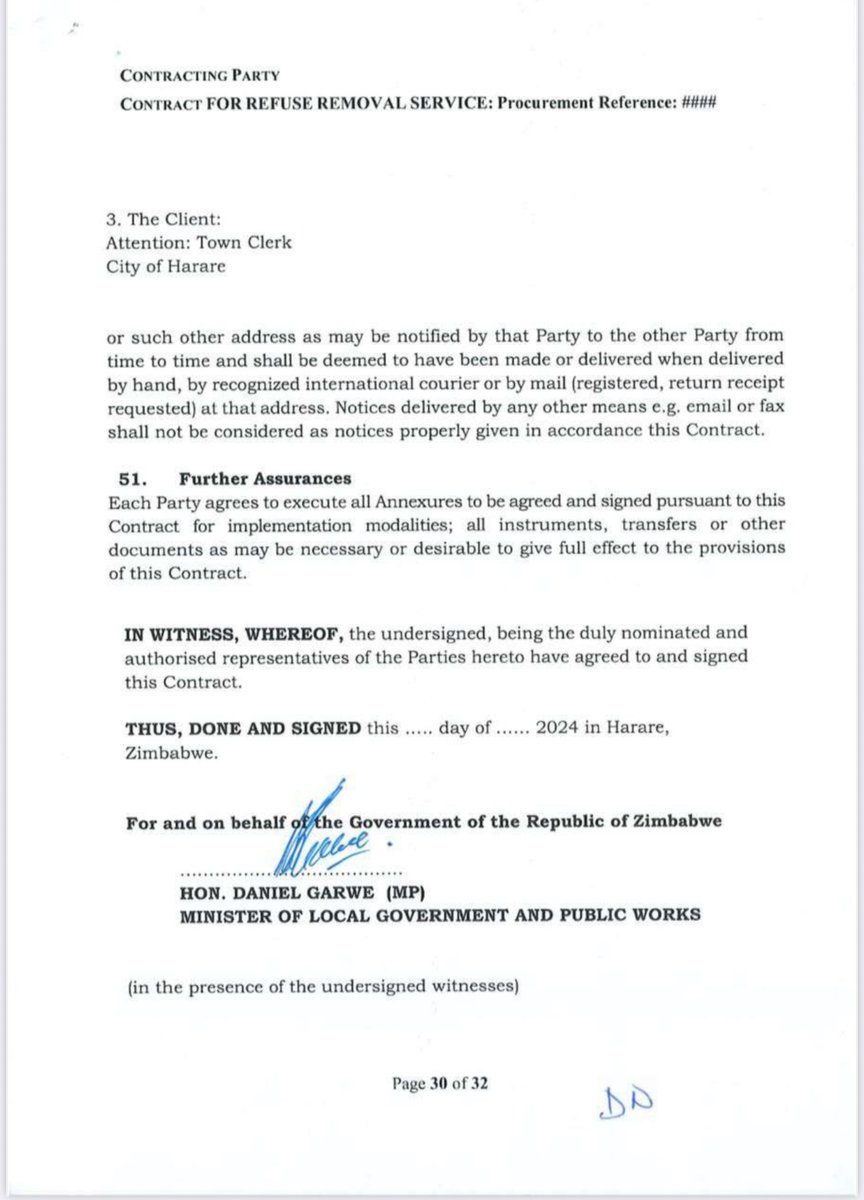
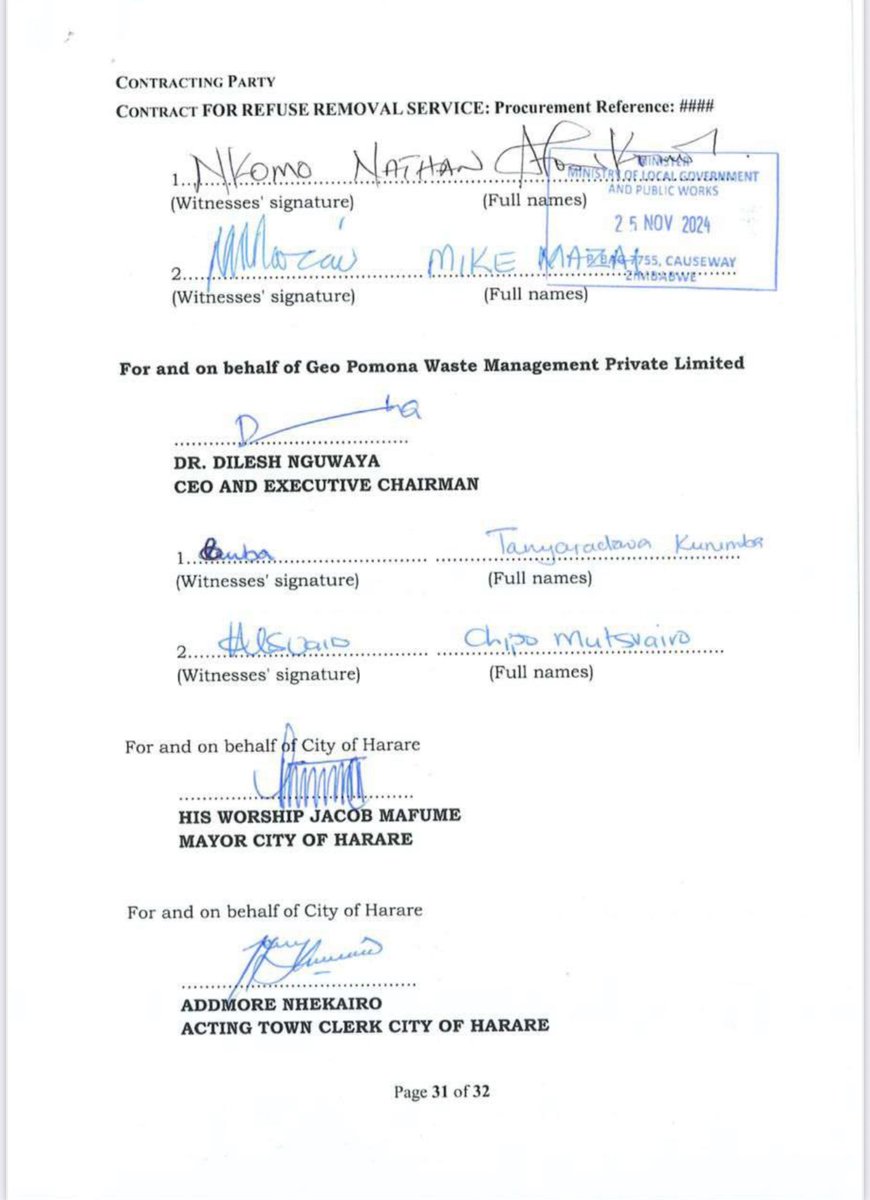
President Emmerson Mnangagwa has declared that nobody can remove the Harare Mayor, Jacob Mafume, from office after he facilitated the biggest money heist in the history of council funds theft in Zimbabwe.
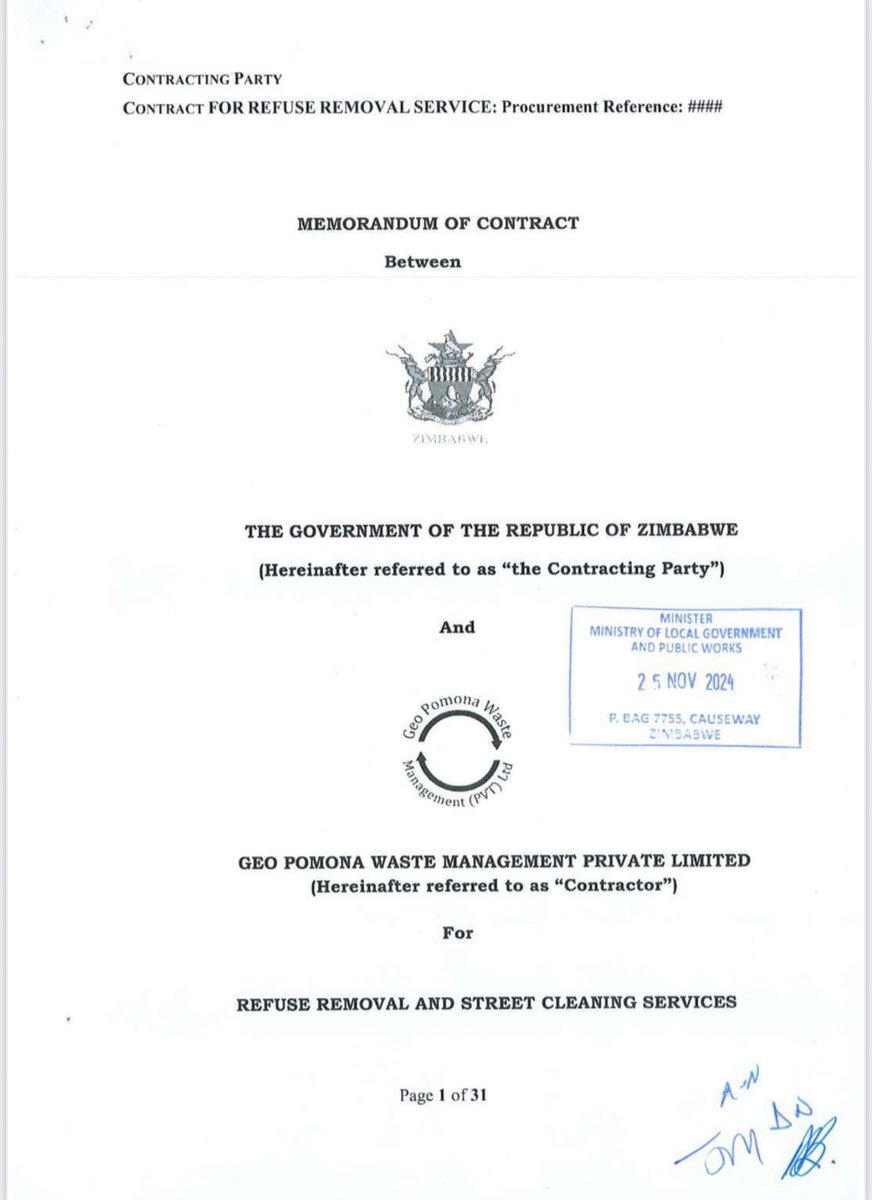
Mayor Mafume also expressed his admiration for Mnangagwa and the corrupt deal that will ultimately see Harare paying Mnangagwa’s family US$90,000 a day to clear rubbish through Geo Pomona—a task the city council could have carried out itself were it not for looting.
This grand theft is a calculated scheme to siphon public money from the devolution fund meant for councils.
That the Mayor of Harare endorsed and signed such a deal is truly astonishing.
Ladies and gentlemen, Harare City Council is now fully in ZANUPF’s hands.
The mayor openly said he was in a joyous mood as these funds were being looted—funds meant to give residents and their councils the independence to invest in priorities defined by their own communities.
What Mnangagwa does is deny councils and state departments funding.
He lets hospitals collapse while his family sets up crooked companies that then offer these services at inflated costs.
Citizens are told to rejoice simply because something has been offered, regardless of the cost. Banana republic stuff!
The guy did the same thing with Covid-19 by setting up Drax, and when it was exposed, he had me jailed three times without trial simply for telling the truth.
After the interchange looting, they moved to waste management. The next target is hospitals, where they plan to loot millions through inflated, corrupt contracts in a deal made in Belarus. Tragic!
Where is the so-called opposition in all this? Hiding and enjoying their kickbacks!
This is one of the most shameful and sinister corruption scandals in Zimbabwe by a president in our country's history.
It was masterminded by a man who is not only notoriously corrupt, but also dangerously destructive in his obsessive pursuit of illicit wealth.
His billion-dollar empire, built on looted public funds, continues to grow while millions of ordinary Zimbabweans suffer and die in penury without even painkillers in sight.
At the centre of this outrageous scandal is Mnangagwa’s family company, Geo Pomona Waste Management, a front for siphoning off public money from the devolution fund meant for local councils. Though Delish Nguwaya is paraded as the face of Geo Pomona, the real beneficiaries are the Mnangagwa family.
Emmerson Mnangagwa continues to use state resources to push this company to loot state coffers, today he is at Geo Pomona Waste to gloss over the new corrupt pathways this company it taking to loot public funds across Zimbabwe.
The City of Harare entered into a deeply corrupt 30-year deal with Geogenix BV, agreeing to pay US$40 per tonne of waste delivered to the Pomona facility run by a local subsidiary called Geo Pomona Waste.
This translates to a minimum of US$14.6 million annually, or US$41,000 per day.
These are guaranteed payments, even if no waste is delivered.
In 2022, the city was paying at least US$22,000 a day. After the rigged 2023 elections, the deal was revised, as reported by DugUp, doubling the daily payment to US$90,000.
All of this public money flows into the Mnangagwa family’s pockets.
This agreement is not just corrupt, it is financially suicidal for Harare residents.
It was crafted to bleed Harare dry, stripping it of assets and land if the deal collapses due to failed payments — and, most critically, devolution funds meant to empower local governance.
I asked the Mayor of Harare, Jacob Mafume, on Tuesday and Wednesday to comment on this corrupt deal, but he said he was not ready to do so.
Councillors who resisted the deal were recalled, first through the Douglas Mwonzora opposition capture project before the 2023 elections, and later via the Sengezo Tshabangu plot which orchestrated and masterminded by Jonathan Moyo, taking over the official opposition and making it a ZANUPF surrogate.
Some councillors were slapped with fake criminal charges and jailed briefly, just long enough to push the deal through ahead of the elections. The day it went to a council vote, Mnangagwa’s son, Sean, was at Harare City Council Town House to ensure it went through.
The deal was forced through by Mnangagwa’s enforcer, former Local Government Minister July Moyo, who directed the city to proceed without tenders or consultations.
It was later endorsed by Harare mayor Jacob Mafume and Local Government Minister Daniel Garwe, one of Mnangagwa’s chief campaigners for 2030.
As with most Mnangagwa linked contracts, this deal bypassed all legal procurement channels.
It was pushed through during a period when unelected ZANUPF aligned councillors controlled the city, thanks to a dubious court ruling by Mnangagwa’s captured judiciary, led by the corrupt and shameless Chief Justice, Luke Malaba.
Going to court is futile. The judiciary has been captured, it has been stacked with loyalists, many of them underqualified. What is needed now is mass civic action by the residents of Harare and a public demand backed by action on the streets (because the law allows that) to recall all the councillors paid bribes to push this corrupt deal through.
July Moyo also secured cabinet approval for central government to misuse devolution funds to service this criminal contract.
This not only misallocates resources, but fatally undermines local government autonomy.
The devolution funds that are being looted to fund this deal are constitutionally mandated financial public money transfers from the central government to local authorities, aimed at promoting equitable development across provinces and districts.
These funds are intended for capital projects that address local infrastructure and service delivery needs, such as building schools, clinics, roads, and water systems.
Using devolution funds intended for local development projects to finance a centrally negotiated contract undermines the very purpose of devolution. Furthermore as I said before, the contract was awarded without an open tender process.
After getting away with it in Harare using corrupt councillors and backed by a captured judiciary — which is in Mnangagwa’s pocket after receiving bribes disguised as fake housing loans, and by packing the bench with his unqualified cronies — Mnangagwa is now rolling out the same corrupt project across the entire country, siphoning devolution funds from Mashonaland to Matabeleland, from Masvingo to the Midlands, and across to Manicaland.
It is a corrupt scandal that demands immediate action. It must be stopped now, or the Mnangagwa family will end up owning most city council properties and land if the government becomes financially crippled deliberately and fails to service this outrageous and corrupt deal.
Geogenix BV, formerly Integrated Energy BV, has a tainted record in Europe.
It was embroiled in corruption scandals in Albania and accused of hiding its real ownership, as it is doing in Zimbabwe.
Unfortunately for Zimbabwe, there is no judiciary to turn to in order to stop this dirty, stinking deal.
These stolen funds are what Mnangagwa is using to finance his 2030 presidential term limit extension.
Now, Geo Pomona is preparing to roll out this criminal model across Zimbabwe’s cities and towns after realising that there was no resistance in Harare, it means millions of taxpayers money will be looted openly with fanfare.
Many councillors have told me that their silence is not because they agree, but because they are trapped.
Their political survival depends on Tshabangu, who has promised to illegally extend their terms by two or three years as part of Mnangagwa’s desperate push to remain in power until 2030 violating the constitution.
This is not just a scandal. It is state capture in broad daylight, looting on an industrial scale, sadly there is no opposition to push back, they have been bought.
Emmerson Mnangagwa, Zimbabwe’s corrupt dictator, uses state security forces to crush dissent.
Journalists and whistleblowers who expose his looting are jailed without trial on fabricated charges, while fake news websites are paid to smear them with lies and disinformation.
Parliament has been captured, the judiciary has been captured too, the police are just watching — and captured too. There is no opposition.
The only option left is for residents to oppose this corrupt and industrial-scale looting in the streets!
This corrupt scandal was authored by the Mnangagwas, and they are using Belarus to procure equipment, which will be paid for at inflated prices using devolution funds.
Everywhere you look, they are looting public funds. It is tragic, but it is the reality.
With all these millions being looted, Harare is still infested with huge disgusting piles of rubbish everywhere you look.
I have posted the disgusting contract in my telegram channel, you can get via this link;
https://t.co/f3TcNRwoAl
You can also watch this video by Dug-Up https://t.co/PuoIns9oBu
It is sad to see Food Lovers Avondale and Borrowdale shut down due to the collapse of the national economy in Zimbabwe.
Behind these tragic closures, the real human story is of the hundreds of Zimbabwean workers who will now join the 95% unemployed.
Also affected are the farmers who had been supplying these shops and who will now suffer economically.
The ripple effects of these closures extend beyond the immediate loss of jobs for the workers directly affected; they also impact suppliers, farmers, and the local economy as a whole.
Nobody closes a profitable business, and nobody stops shopping when they have money.
The late Professor George Kahari used to talk about the Relatedness of things.
When there is failed economic governance leading to the collapse of businesses because people do not have spending power due to unemployment, it defines the Relatedness of things.
It highlights how these economic challenges are interconnected.
Failed economic governance by ZANUPF, rampant unemployment, and the collapse of businesses are not isolated issues but are intimately connected and exacerbate one another.
The closure of these stores is an indicator of the broader economic struggles in Zimbabwe, as unemployment rates soar, and spending power diminishes.
The government can play propaganda with the ignorant and the uninformed, but the truth is that the closure of Food Lovers Avondale and Borrowdale reflects the harsh economic realities that Zimbabweans are currently facing.
Kenyan award-winning photojournalist and political activist @bonifacemwangi breaks down as he recounts the torture he endured alongside Ugandan human rights lawyer Agather Atuhaire @AAgather at the hands of Tanzanian state security two weeks ago.
The two had traveled to Dar es Salaam to attend the court appearance of Tanzanian opposition leader Tundu Lissu, who was facing treason charges.
They were apprehended at their hotel, blindfolded, and taken to an undisclosed location where they were interrogated, stripped, and sexually assaulted.
How did Emmerson Mnangagwa and his corrupt business cronies use the Mbudzi Interchange to loot millions in public funds?
The interchange, shamefully named “Trabablas” (which means “nonsense” in Spanish), was designed in South Africa, with the cost originally pegged at US$42 million. This amount included compensation for landowners affected by the project.
Mnangagwa and his associates then inflated the cost to US$88 million from US$42 million.
In a 2023 government gazette (see document below), they declared that the funding was a loan from one of Kudakwashe Tagwirei’s companies, Fossil Mines, which is run by his close ally, Obey Chimuka.
The loan is due to be fully repaid by 6 June 2025 at the London Interbank Offered Rate (LIBOR) plus an additional 5%.
LIBOR was a benchmark interest rate at which major global banks used to lend money to one another in the international interbank market.
This rate is unusually high for a sovereign loan. Moreover, LIBOR was officially discontinued in 2023, making its use in a 2022 loan deal highly questionable and suggestive of financial manipulation or incompetence.
As if that were not enough, Mnangagwa also instructed his equally corrupt Finance Minister, Mthuli Ncube, to draw funds from the International Monetary Fund’s Special Drawing Rights (SDRs) and allocate them to the construction of the interchange (see document below).
Zimbabwe received SDR allocations from the IMF in 2021. The government did allocate part of these to infrastructure, and a portion of the SDRs was directed to the Mbudzi project.
The project therefore received a double allocation; a loan of US$88 million plus huge interest that you, the taxpayer, are expected to repay, and funds from the IMF’s Special Drawing Rights.
When asked how much of the IMF money was allocated to the Mbudzi Interchange, government officials refused to respond, having received instructions from Mnangagwa’s office not to entertain such questions.
So, the cost ballooned from US$42 million to US$88 million, followed by double allocation using SDRs.
As for the landowners, the actual value of the land was also overstated. A piece of land worth US$100,000 was valued at US$500,000 in exchange for kickbacks.
When I asked a source in the Ministry of Finance why Mnangagwa allocated IMF money when there was already a loan with Fossil, the official told me they had been instructed to tell the media that the IMF money was meant to service the Tagwirei loan.
When I asked why they needed a loan at all when it would have been cheaper to simply use the IMF money to fund the project at US$42 million, the official replied, “Ndokudya kunoitwa nevakuru.”
It means “That’s how the powerful eat” or “That’s how the elites benefit,” implying corruption and self-enrichment by those in power.
This was the equivalent of your father giving you money to pay school fees, then you go and borrow money to pay those same fees, justifying it by saying you will repay the loan using the money your father already gave you—and you are even happy to pay interest on top. Completely meaningless.
In a country with only one terrestrial television station, where journalists are jailed without trial for exposing corruption, it is no surprise that Mnangagwa believed he could excite Zimbabweans with an interchange—hoping that such misplaced excitement would distract citizens from realising how the same misnamed project was used to loot public money (millions of dollars) meant for hospitals, schools, and clean drinking water.
Please find the documentation which proves all this below here👇🏿
All this information would have been very useful if we had a genuine Parliament, judiciary, Anti-Corruption Commission, and an independent police service.
But Mnangagwa has captured all these institutions, and just this week, he threatened journalists with violence for writing what he does not like.
Efforts to recover it were futile because you are a bunch of incompetent people appointed based on where you come from or who you are related to, not on what you are capable of doing.
This is what we mean when we talk about an incompetent government. How can a whole government anticorruption commission fail to recover its Twitter account? 🤣🤣🤣🤣🤣
Useless people!!
This is Zambia’s current president, Hakainde Hichilema, when he was an opposition leader up against former president Edgar Lungu.
He was being chased from a radio station by members of former President Lungu’s party, PF. He had to use the roof to escape.
Now I have some questions for Zimbabwe’s opposition politicians.
What is your role in society? What do you think you should be doing?
What do you believe your role is when the media exposes corruption? What do you think your responsibility is when you find out that billions have been stolen?
Do you think your role is to fight in all available spaces, as Hichilema did, or is it to post selfies and remind us how good you will be once in power?
Should your timelines read like those of motivational speakers or of opposition politicians? Do you think it is normal that people are building on top of railway lines while key opposition players remain silent? What are you there for, then?
Do you think your role is simply to appear during election time, ask for votes, and then disappear into hibernation until the next election?
Do you think you have a role to play in mobilising resources in the constituencies where you were voted into power, or do you believe your role is to say one or two things over a five-year period in Parliament while collecting your cars and other trinkets on offer?
I want every opposition politician to ask themselves this question; are you there because you should be there and have the competence, or, like Mnangagwa, are you merely a product of unfortunate historical circumstances?
Do you have leadership qualities? Do you ever ask yourselves this central question: “Am I a real leader, or am I just there?”
To the Zimbabwean populace, my question is very simple: do you understand the role of the opposition in politics?
Is it true, as Dr Solomon Guramatunhu once said, that our leaders are a reflection of the communities they come from?
If a journalist can mobilise money to bury opposition victims of state brutality, fundraise for your election campaign, bring goods worth millions into hospitals, and expose corruption and more, what stops you, as a leader, from doing that and even more?
Should we just vote for you simply because we do not like ZANUPF? It seems there is nothing else on offer beyond that.
How can leaders who claim to have millions of supporters fail to address those millions on meaningful issues, like Hakainde Hichilema did?
With that level of opposition support, what stops you from declaring that you will ensure every child has books, and using your star power to fundraise so that the suffering who support you can see you are indeed a leader?
I hope this is a small way of starting a big conversation that leads somewhere.
We are now in a situation where citizens are looking for salvation from Blessing Geza, a ZANUPF factional leader, who is doing what real opposition leaders should be doing. Does that not embarrass opposition politicians?
Until when will you keep using lame excuses to justify failed leadership?
To the youths, I say; in the absence of real leadership to turn around your fortunes, get a passport and go. You will not be the first to do it, and you will not be the last either.
Donald Trump’s grandfather, Friedrich Trump, left Germany for America. His mother, Mary Anne MacLeod, left Scotland in 1930 for America, they were all looking for better opportunities in life.
That is how nations evolve, go to places that offer you better opportunities in order to be able to fight another day.
I left Zimbabwe when I was 23 years old. Today, I can live in any country I want because moving to Britain gave me the necessary foundation and economic strength to live as I do now.
If we are in times where there is zero capable leadership, both in the opposition and in ZANUPF, do not sacrifice your future by sitting and rotting away doing nothing.
You can’t spend your life defending politicians who have failed you dismally! It is madness!
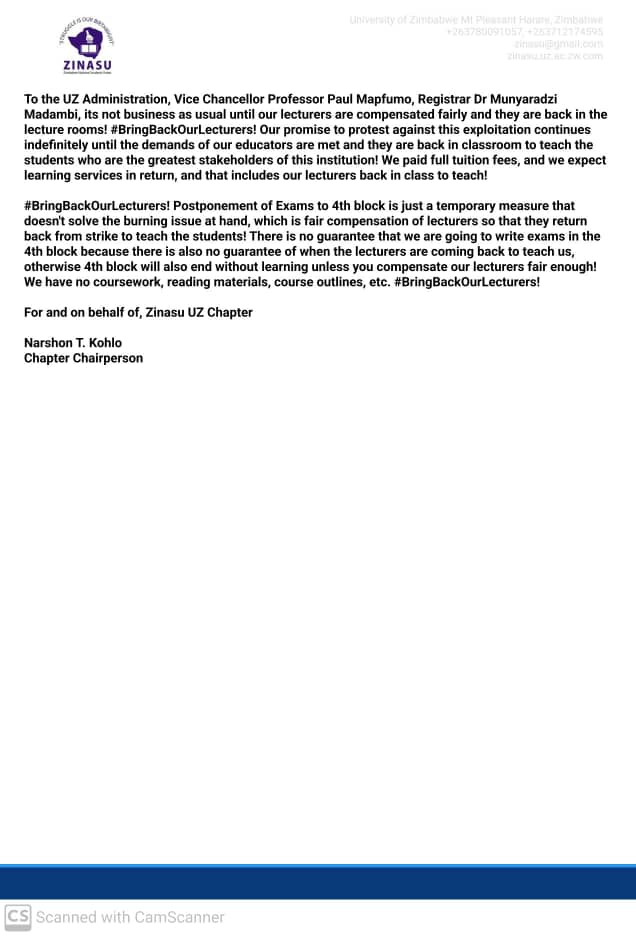
🧾ZINASU UZ chapter has responded to the recent communique by the UZ Registrar & his deputy,which sought to create a divide between students and lecturers.
We firmly believe that the status quo cannot continue until lecturers are properly remunerated.Students are compromised.
Thank you to the donors.
Now I wonder how this makes anyone sane in ZANUPF feel, that foreign governments, which had similar health metrics to Zimbabwe in 1980, are now funding our health services out of pity and need to save lives.
Zimbabwean ministers have five cars each in their driveways, paid for my tax dollars. Four of those cars in one minister’s driveway could fund the construction of more than 15 maternity theatres at Zimbabwe’s biggest hospital, which still has only one, built by Ian Smith in 1977 and later refurbished by Stanbic Bank after it had stopped functioning.
ZANUPF has never built a single maternity theatre at Sally Mugabe Hospital in the 45 years it has been in power. It offers countless excuses, but we all know the real cause is corruption.
A Zimbabwean nurse sent this message to me in response to an arrogant statement by the Ministry of Health and Child Care (MOHCC) @MoHCCZim this morning on its Facebook page, dismissing complaints about the dilapidated healthcare system as “unwarranted negative attacks”.
I have attached the Ministry of Health’s Facebook post below in the pictures section.
Letter from Nurse👇🏿👇🏿👇🏿👇🏿
Goodmorning mkoma Hope.
Just woke up to the Ministry of Health and Child Care (MOHCC) post and as a nurse am hurt to the core.
Clearly, they don't know the pain yekutarisa people's relatives in the eyes to tell them their loved one has died due to lack of proper care.
Clearly they don't know the pain we feel watching patients vachirwara but unable to help them because we don't have the resources to do so..
We do vital observations (using monitors that are faulty most of the times!) The monitors are like refrigerators they only work when connected to a power supply and most of the sockets at the hospitals don't work then magetsi akaenda(which is a common occurrence) it means we can't even do the vital observations..
Okay taita the vital observations even if we note kuti the BP is elevated there is nothing we can do except just look at the patients because we don't have medication to manage the elevated BPs.
Ndarwadziwa because they don't know the pain of watching patients die after vapedza kutenga theatre sundries and theatre fee but operation ichi postponwer because Hapana electricity or the machines are not working.
They don't know the pain of carrying patients nemastretcher or wheelchairs up 2 floors of stairs because the elevators are not working.
They don't know the pain of letting patients lie on wet blankets which reek of urine because the laundry machine is not working for 2 weeks (kana paipa towaridza nema curtain until aperao)
My prayer ndichirarama kuti ndisarware because kurwara muZimbabwe is a death sentence especially if you a civil servant.
CT scan machines not working at our hospitals so they are done at private institutions at $350..pay yemucivil servant 300 minus tax haitokwane..
Ndabatikana🙌