BREAKING: One Nation just dropped an election winning policy that proves they’re actually listening.
While Labor keeps locking Australians into hundreds of billions in migration costs, Pauline Hanson has announced a hard reset:
• Humanitarian intake slashed by 90%, from 20,000 down to 2,000 places.
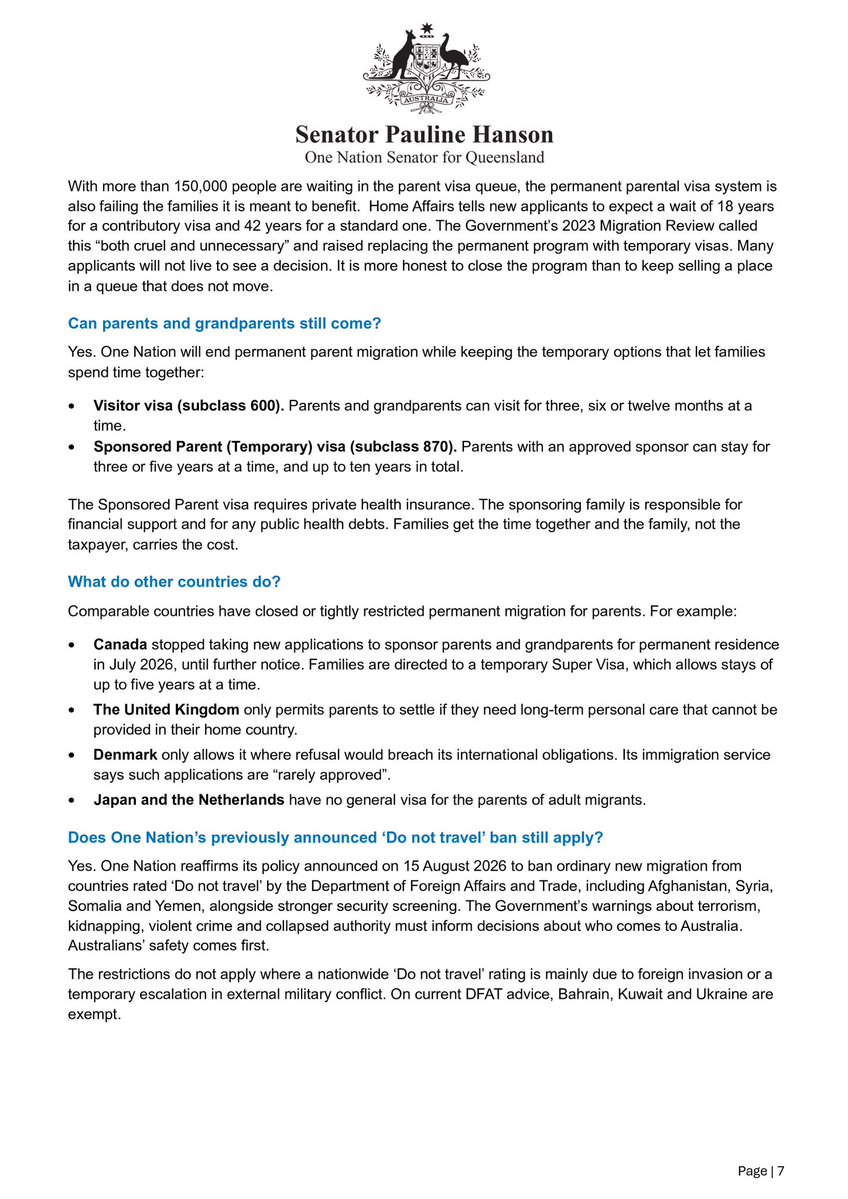
• Permanent parent visas abolished.
• Net negative migration for three years, then a hard ceiling of 100,000.
• Ordinary new migration banned from DFAT “Do Not Travel” countries, Afghanistan, Syria, Somalia, Yemen and others.
Treasury modelling shows the current settings would cost taxpayers a net $141 billion over the next decade.
Each humanitarian entrant: $523,000 lifetime cost.
Each permanent parent migrant: $515,000.
Australians are already struggling to pay rent, buy groceries or get a hospital bed. A government that can’t house its own people has no business running a refugee program ten times the OECD average.
Temporary parent visas stay available so families can still visit, but they’ll cover their own costs.
A recent Scanlon survey found 59% of Australians now say we’re taking too many migrants, more than double the figure from four years ago.
One Nation is the only party treating that as a clear mandate.
Pauline has now pledged to shut the border gates, no more free for alls.
This is what listening looks like.
Media Release: One Nation to slash Labor’s $141 Billion Migration Bill
One Nation will cut costly humanitarian and permanent parent migration programs to put Australians struggling through the cost-of-living crisis first.
The humanitarian intake will be cut by 90 per cent to 2,000 places a year, bringing Australia’s refugee resettlement intake down to just above the OECD average on a per capita basis. The incredibly costly permanent parent visa program will be scrapped, saving taxpayers billions in long-term costs while retaining existing long-term temporary visas for family visits.
One Nation leader Senator Pauline Hanson said continuing Labor’s current humanitarian and parent visa intakes for another decade would carry an estimated $141 billion net lifetime cost to struggling Australian taxpayers.
“Australians are hurting. They are struggling to pay their rent, afford groceries or get a hospital bed. Meanwhile, Labor keeps signing taxpayers up for migration commitments costing hundreds of billions,” Senator Hanson said.
“Taxpayers can no longer afford to pay for reckless and costly migration programs of the Labor Party and the Coalition. That money must come from higher taxes, more debt or funding that could otherwise support Australians doing it tough.
“It’s common sense that people who come to this country should make a positive economic contribution. Migrants have helped build Australia, and we remain a generous country, but we must look after Australians first.”
Analysis based on Treasury modelling, adjusted for inflation, puts the average net lifetime cost of each humanitarian entrant at around $523,000 and each permanent parent migrant at $515,000, even after taxes and visa charges are counted.
“Each humanitarian entrant carries an estimated lifetime bill for Australian taxpayers of more than half a million dollars,” Senator Hanson said.
“A government that cannot house its own people has no business running a refugee resettlement program at 20,000 places a year. Australia’s refugee resettlement rate is already roughly ten times the OECD-wide per capita average.
“Permanent parent migration puts a huge strain on taxpayers through health care, pensions and aged care, because parents generally arrive later in life without decades of Australian tax contributions behind them. We will retain generous temporary visa options so parents can spend extended time with their families while meeting their own costs.
“Successive governments have admitted hundreds of thousands of refugees and humanitarian migrants, costing taxpayers hundreds of billions of dollars, while hardworking Australians go without. With record deficits and more than $1 trillion in national debt, Australian taxpayers cannot afford to fund these programs anymore.”
The proposals further build on One Nation’s plan to restore Australian living standards by reducing the temporary migrant population by more than 750,000, delivering net-negative migration over three years and then enforcing an annual net overseas migration ceiling of 130,000.
One Nation also reaffirmed stronger security screening and a ban on ordinary new migration from countries rated “Do not travel” by the Department of Foreign Affairs and Trade, including Afghanistan, Syria, Somalia and Yemen.
“We will stop ordinary new migration from countries our own government deems too dangerous to visit,” Senator Hanson said.
“The Government cannot warn Australians about terrorism, kidnapping, violent crime and collapsed authority overseas, then pretend those conditions do not matter when deciding who comes here.
“Under One Nation, Australians’ safety and living standards will always come first.”
Full policy explainer below.
😮 Wow. BrainChip Akida and genetics. 😮
Akida can change its learned memory right where it runs.
"We fed a AKD1500 patterns from mouse brain cells, plus their known cell types. "
Akida knows no limits!!!
@BrainChip_inc#Akida
⭐️ BrainChip - Frontgrade Gaisler / GR801 at Space Tech Expo Europe
What if satellites could make critical decisions in orbit without waiting for instructions from Earth?
Frontgrade Gaisler is working to make that possible through neuromorphic processing➡️#Akida@BrainChip_inc
While these kids skip school to protest against democratically elected MPs, their parents are struggling to pay the bills, put food on the table and keep a roof over their heads.
And given that 51% of Australian 15-year-olds fail to meet national standards in maths and 40% in science, these kids really need to get back to class.
Millions of Australians are supporting One Nation because they’re sick of being priced out of their own country and want a better future.
Aussie taxpayers are footing a $32,000 bill so that international delegates at the Climate Change talkfest COP31 in Turkey can drink free Australian coffee.
Australians with a mortgage or renting are paying thousands more this year and this is where the government’s priorities are.
Chris Bowen and Anthony Albanese need to get on their taxpayer funded plane home and start looking after Australians first.
C/ Sophie Elsworth
I've successfully built Secure Akida, a first in the neuromorphic world in terms of known published work, built to be FIPS 140-3 capable: every cryptographic operation that protects a model, a token, or a connection is designed to run inside a validated module.
A model reaches an Akida chip here only as a signed, verified, released artifact, and only for a tenant allowed to use it. Every model is built with a central build service, which records its inputs and checks it on silicon: the result must be bit-exact on multiple reserved verification chips of each generation (AKD1500 and AKD1000).
The builder key then signs the model card, which carries a SHA-256 hash of the chip's output. A human releaser, logged in with a password and a one-time code, signs the release with a separate key held in a secrets vault, and every publish and retire is written to a hash-chained ledger. Serving nodes load only published models by their names and version. Before trusting a chip, clients compare its SHA-256 fingerprint with the card.
Access is deny-by-default for each tenant: tokens from the identity provider carry roles and tenant groups, nodes refuse any tenant the token does not name. On the storage side, each tenant has its own volume on the distributed file system, with a key fenced to its path and its object-store namespace. One tenant cannot reach another's data through the file system or directly through the object store.
All of this is built from standard parts (an identity provider, a secrets vault, TLS, and a distributed file system) and adds well under a millisecond to a call while leaving chip time unchanged, so it is practical to run in production today.
FIPS 140-3 and this capability matters because many neuromorphic chips are headed for defense or other regulated settings, where the model and the answer have to be verifiable and secure.
Enterprise LLM serving typically secures who can reach the endpoint. This design secures that too, proves which model is running, that the chip computing it answers correctly, and that one tenant's data stays out of another's reach.
I will publish a full paper with the necessary details soon, but I wanted to at least announce that secure neuromorphic computing is now available.
⭐️ Brainchip - The AI Cowboys
"We held the same accuracy at 9 watts that a Jetson alone needed 120 watts to reach."
#Akida "is for perception, anomaly detection, and always-on sensing - the work that has to run when the machine cannot phone home."
@BrainChip_inc@NVIDIA
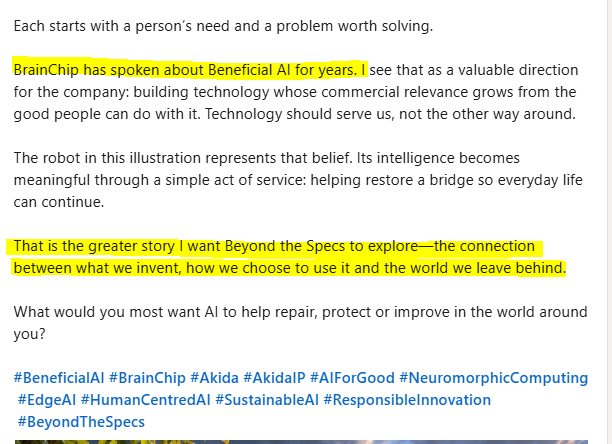
⭐️ BrainChip - Beyond The Specs
Someone living more independently. A warning arriving early enough to matter. A community becoming safer. Technology doing useful work while consuming fewer resources.
BrainChip’s story reaches beyond its commercial opportunity.
@BrainChip_inc
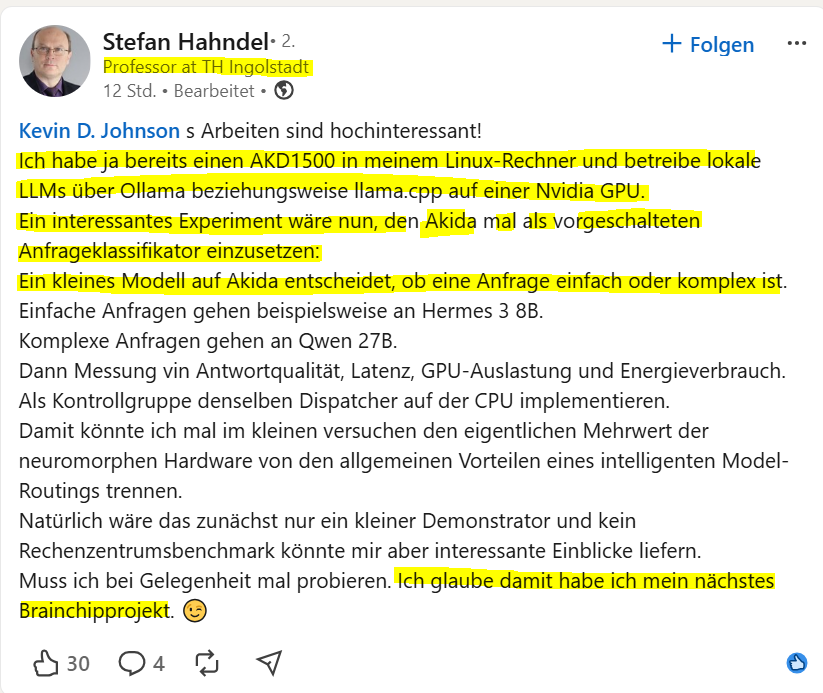
⭐️ BrainChip - Prof. Stefan Hahndel/TH Ingolstadt
Another one got addicted to #Akida 😂. Once they start using it, they can't stop 🤣. I love it.
It is time for all programmers to understand what a gem Akida is.
(see attached translation)
@BrainChip_inc
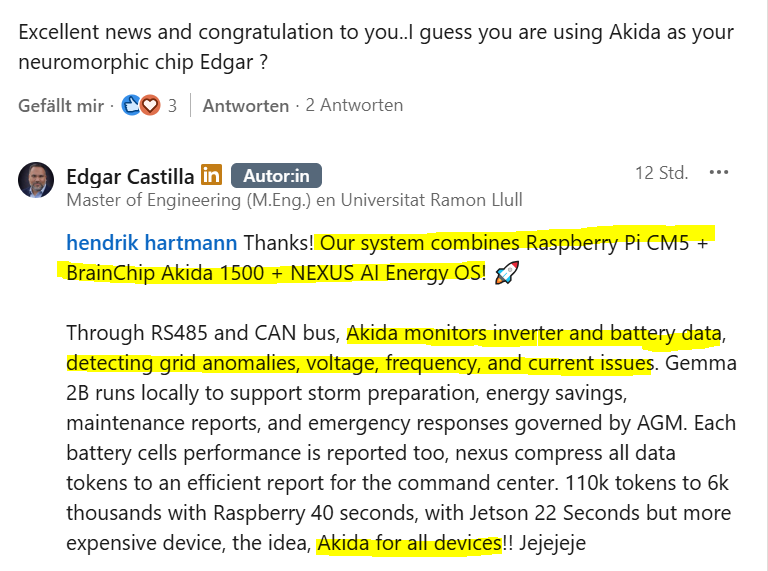
⭐️ BrainChip - ABBA NEXUS AI
Finished product!
7000 pcs built and now taken to the trade fair ... Ready for the market! 👏
"In a few days, we’ll be in Las Vegas for RE+ 2026, sharing our vision for the future of energy and artificial intelligence."
@BrainChip_inc#Akida
⭐️ Kevin D. Johnson/EX-IBM Field CTO (@computeontology), who made over 80 demos with BrainChip #Akida left IBM. 😮😮😮
Wow, Kevin, that's quite some news.
Going all in on neuromorphic computing after testing Akida in all variations is more than understandable.
Great Success!👏