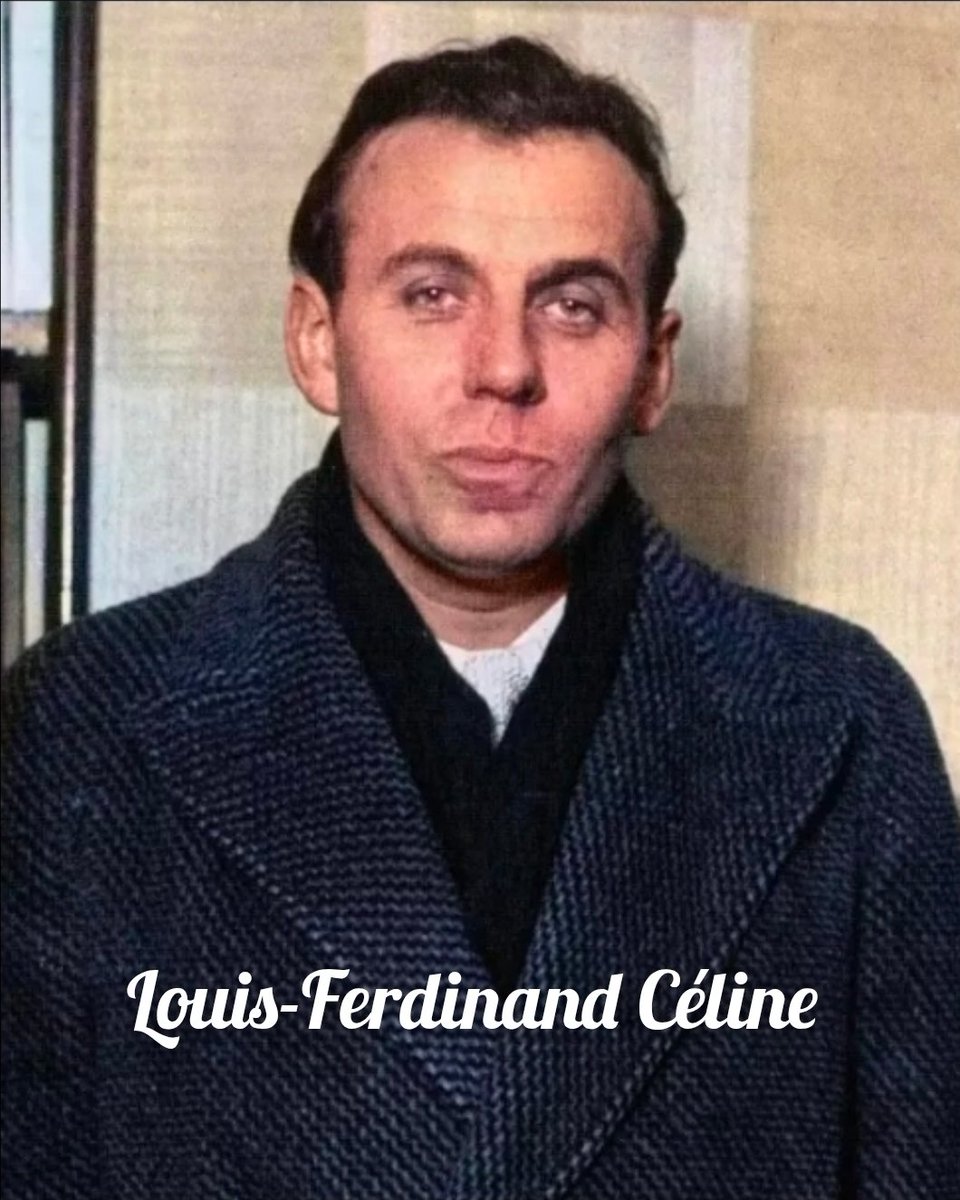
«Qu'est-ce que ça peut bien leur foutre que les barbares dans les grilles s'agitent, se bigornent, secouent leurs chaînes et leurs entraves ?
Il faut remonter les boulets de qq crans et puis c'est marre...de temps à autre.
Les révolutions servent à cela... ne servent qu'à cela..»
Grandes retratos de la historia del arte vuelven a la vida a través de uno de los mayores avances tecnológicos de la historia de la humanidad…
Cuál es tu favorito?
Faltó alguno? 🤔😱
This video captures a live performance of the classic piece "Baby Elephant Walk" by the talented composer Henry Mancini and his orchestra on the program Best Of Both Worlds in October 1964.
Mancini explains that the song was inspired by a film he worked on a few seasons prior titled "Hatari", starring John Wayne. He also playfully shares that while many people assume the song was inspired by a scene featuring baby elephants, he actually had 'three baby elephants of his own' at home and dedicated this piece to the elephants in Africa as well as his own "little ones" at home.
Albert Moukheiber (docteur en neurosciences cognitives) : le cerveau est "un organe prédictif et approximatif", complétant en permanence les trous informationnels de notre environnement incertain à partir de nos biais et a priori.
Comme l'IA, nous faisons de l'auto-complétion 🧠
@VictorSinclair3 C'est mesurable, en 100 ans la terre c'est réchauffée de 1,5° en moyenne, je ne sais plus exactement le chiffre - après le raison c'est une autre histoire
@AbouQalypse Quelque part n'est-ont pas en train de faire renaitre le polythéisme, Allah, dieu, le dieu juif, sont-ils le même dieu ? - Le monothéisme est aussi "peut-être" le rêve d'unifier les croyances - le schisme apporte la guerre, le catholique et le protestant, le sunnite et le chiite
In 1880, a reclusive, self-taught telegraph operator with no university degree went to war with the greatest scientific minds in the British Empire.
He won, changed the mathematics of physics forever, and quietly built the foundation for the entire modern electrical grid.
Yet today, almost no one outside of electrical engineering and applied mathematics even knows his name.
His name was Oliver Heaviside.
The story of how he solved one of the hardest engineering problems in human history is a masterclass in why book smarts fail where deep, messy intuition succeeds.
In the late 19th century, the world was trying to lay massive underwater telegraph cables across the Atlantic Ocean. But they had a crippling problem: the signals kept distorting. You would type a message in London, and by the time it reached New York, it was a smeared, unreadable mess of electricity.
The top physicists of the day, using traditional university math, said the solution was simple: make the cables purer and reduce resistance. They spent millions of dollars trying to make the lines perfect.
It didn't work. The signals still broke.
Heaviside looked at the exact same problem from his messy, self-taught perspective and realized the elite academic establishment was blind.
They were treating an electrical wire like a water pipe. They thought the electricity was inside the copper.
Heaviside figured out that electricity doesn’t flow inside the wire; it flows in the electromagnetic field around the wire.
Then, he did something that made mainstream mathematicians furious. He invented a bizarre shortcut called operational calculus. Instead of spending weeks solving complex, multi-page differential equations to map these fields, he treated calculus like basic algebra.
To the professors at Cambridge, this was a sin. They called his math clumsy, unrigorous, and nonsense.
Heaviside didn't care. His famous response to them was: "Should I refuse my dinner because I do not fully understand the process of digestion?"
He used his illegal math to propose a mind-bending solution: to fix the distorted signal, engineers didn't need to make the cable cleaner. They needed to deliberately add more corruption to it. He suggested wrapping the cables in iron wire to introduce "inductance", intentionally fighting one distortion with another.
The establishment ignored him for years. But when AT&T finally tried his method, the results were instant. Long-distance communication was solved.
Heaviside wasn't trying to pass a math exam or impress a peer-review board. He wanted to solve a real-world problem.
In the process, he took James Clerk Maxwell’s famously complex 20 equations of electromagnetism and condensed them into the 4 beautiful formulas that every single physics student is forced to memorize today. Heaviside did the heavy lifting, but Maxwell got the name.
The lesson Heaviside left behind is a philosophical blueprint for navigating a complex world:
The people who memorize the proper formulas are excellent at solving textbook problems. But they are entirely dependent on the rules staying the same.
The people who understand the underlying system don't care about the rules. They break them to find what actually works.
Most of us approach our life's problems like the 19th-century British establishment. When something goes wrong in our career or relationships, we try to make our existing wire purer. We try harder at a broken method.
But sometimes, the problem isn't that you aren't trying hard enough. The problem is that you are looking inside the wire instead of looking at the field around it.
What is a distortion in your life right now that you keep trying to fix with the standard advice? What happens if you stop trying to follow the textbook formula and start looking at the hidden forces causing the noise?