Every month, food inflation data come out.
Economists assure Canadians it’s temporary and that prices will soon stabilize. Never blame Ottawa's policies.
The next month, food prices rise again.
Media return to the same experts, who offer the same explanation.
Rise, repeat.
When condos were making money, taxpayers didn’t get a cut.
Now they’re losing money, and taxpayers are expected to cover the bill.
Poilievre’s argument is simple: if developers took the risk, developers should take the loss.🇨🇦
Carneys $2.5B condo bailout should enrage everyone.
Tax payers footing the bill into developers pockets who made more money than god for many years. Now their risk fails and tax payers foot the bill.
Shame on you @MarkJCarney
Mark Carney. Condo bailout. Public record.
📌 $3B to buy vacant condos developers won’t discount
📌 4,376 empty units in Vancouver - 76% jump year over year
📌 A third cost over $1 million
📌 Carney holds $6.8M USD Brookfield options
📌 Brookfield embedded in Canadian real estate and infrastructure
📌 Zero conflict of interest investigation
📌 Zero CBC inquiry
📌 Zero opposition from Liberal commentators
Imagine the headlines if Harper’s name was on this file.
#CdnPoli #Carney #Brookfield #HousingCrisis
Canadians: “Inflation crushed us. Interest rates sent our mortgage payments through the roof. Housing became unaffordable.”
Carney: “That’s the market.”
Vancouver developers: “We’re losing money.”
Carney: “Don’t worry. Taxpayers will bail you out.”
Canadians: “Wait… so we absorb our losses, but developers get bailed out?”
Make it make sense.
What's Mainstream Media's Opinion Of Carney's Condo Bailout In BC?
Not one Fucking WORD about a Bailout
I checked out every News Show on MSM last night
No mention of a Bailout at all, it's a new Affordable Housing Initiative
Just a good thing right?
Thank Christ for X
@GadSaad 49% is the absolute maximum, and I think that is even too much. It's highway robbery to take that much of something someone has worked so hard for. If the return matched the investment I may consider it fair. But they just squander it away and we have nothing to show for it.
The problem with the welfare state and its confiscatory taxation system is that there are ZERO repercussions if politicians steal your money "legally" and squander it accordingly. Any system that decouples the natural link between causes and effects will lead to disaster. This is why what starts off as a small temporary levying of taxes more than 100 years ago becomes the tax code that we see today. Politicians do not view an individual's hard-earned money as theirs to keep. Rather they view your money as something that they allow you to keep a small portion of. Accordingly, you should be "thankful" that the government allows you to keep any of your money. This "proves" that they are kind and empathetic. It is a complete moral inversion of personal agency, liberty, and freedom. No system should take so much taxes from you that it forces you to work 10 extra years to make up for what was taken from you.
People are astoundingly stupid. My comments about the departure tax is not that I should be treated differently from anyone else. I am making a point about the extent to which taxes are confiscatory. As I have previously explained, there was a time when ZERO cents of income tax were levied in Canada and the US. Then bit by bit, that "temporary" measure, to be applied to only a few, and at a very low percentage rate of your income, becomes a mammoth monster that takes more than 50% of your earnings. It can occur because there are no repercussions if governments do not balance their budgets (other than voting them out). Hence, what starts off as a small temporary tax on a few becomes an existential theft that is orders of magnitude larger than the so-called illegal extortion tax of the Mafia. It can exist only because the great majority of people BENEFIT from this form of parasitic taxation. But someone has to pay for everyone else, and when you are that someone, you are not necessarily pleased to be funding the ultimate Ponzi scheme. I'm making a moral, philosophical, and ethical argument. It's not just about me.
In a sane world, governments exist to improve the lives of people (at a minimum). The worst incidents of my life all stem from the provincial and federal governments repeatedly punishing me financially for being successful in ways that make you feel trapped in a Kafkaesque prison of despair. I realize that many Canadians benefit from the system, and hence will exhibit zero empathy but in a just world, this reality should not be tolerated. It can't be that a government owns 65%+ of all of your worth once all taxes are added up. Send me good vibes. Going through a very difficult time.
The Unsold Condos that your Tax Money is buying will be used for Social Housing
But how do all Canadian Tax Payers feel about that?
Did you want your taxes to go for Healthcare & Pensions or to bailout Condo Developers?
What's your opinion Canada
Doesn't matter
3/
Listening to @GadSaad break down Canadian taxes on Sean Hannity… aren’t you just excited to be Canadian??
From January 1st until the end of August, you work for free for the government.
Only starting in September do you finally get to keep what you actually earned.
Provincial tax capped at 25.75%. Federal tax at 33%. Already deep into the 50s before you even spend a dollar.
Then add the double sales tax, carbon tax, gas tax, property tax, and school tax — and you’re left with roughly 30 cents on every dollar you make.
This isn’t “contributing to society.” This is modern serfdom dressed up as compassion.
The same government that wastes billions on ArrivScam, failed apps, and fax machine replacement programs now expects you to hand over eight months of your life every single year.
And they still have the nerve to tell you there’s no money left for actual Canadians.
Wake up. This didn’t happen by accident.
#cdnpoli #TaxFreedomDay #LiberalFail #CanadaFirst
A new poll suggests that 33% of Canadians support the idea of government-run grocery stores.
My guess is that many within that 33% also believe that the primary reason food prices have risen over the past few years is grocer greed.
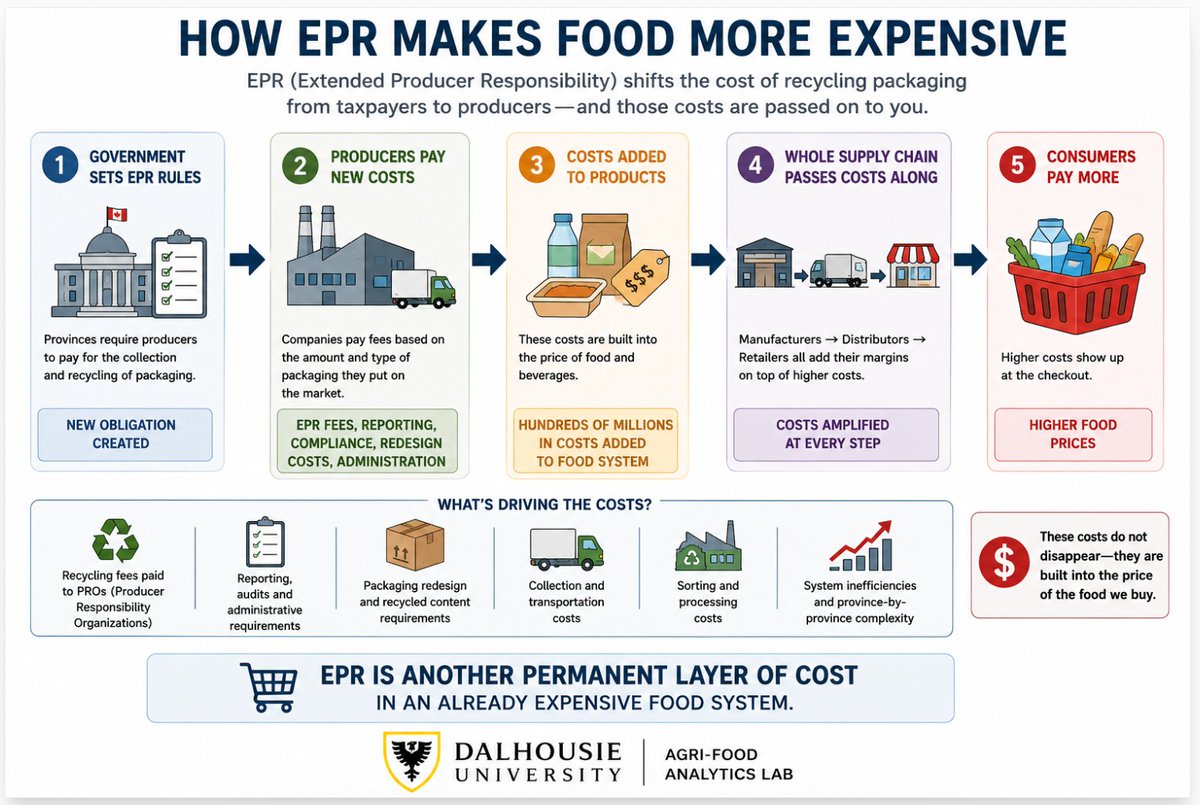
Did you know that recent changes to recycling rules are quietly making your food more expensive? Here’s why.
It’s called EPR — Extended Producer Responsibility.
Under EPR programs, companies are now paying much more to recycle packaging and manage waste. Those added costs don’t just disappear. They move through the supply chain and eventually show up at the checkout counter.
Few people are talking about it, but recycling policy is becoming another permanent cost layer in our food system.
The Bank of Canada is now reporting that the counter-tariffs implemented by the Liberals last year did impact both inflation and food inflation.
This is exactly what our Lab had been saying for months, but few reporters wanted to hear it. Sad.
Interesting how Canadian media largely ignored this new climate scenarios paper published by mainstream climate scientists (Link below).
The study doesn’t deny climate change, but it does acknowledge that some of the extreme warming pathways heavily used for years are now viewed as less plausible.
That matters enormously for energy policy, agriculture, food security, infrastructure, and affordability debates.
Instead of discussing how climate modelling assumptions are evolving, we continue to get simplistic “net zero at all costs” narratives.
Science is supposed to evolve. Public debate should too.
Toronto’s shelter division has consumed 3.2 billion tax dollars in the last four years alone, with more and more public money being used to feed this expanding financial albatross. Yesterday, I delivered a critique of this division - that has yet to undergo a third-party forensic audit.
You want change, have transparency and bind it with financial consequences. Here is one idea.
Alberta sends roughly $13 billion a year in net fiscal transfers to the rest of the country. The largest recipient is Quebec, followed by Manitoba, Nova Scotia, New Brunswick, Prince Edward Island, and, to a much smaller extent, Ontario.
What if accepting its share of that transfer came with a simple condition: provinces must publicly affirm that they will not oppose Canadian resource development, including pipelines or other infrastructure that may require right-of-way access through their jurisdiction.
If a province chooses to object, it would forfeit its share of those funds, which would then be redistributed among the provinces that are prepared to support national resource development.
Then watch what would happen. Think this would work?