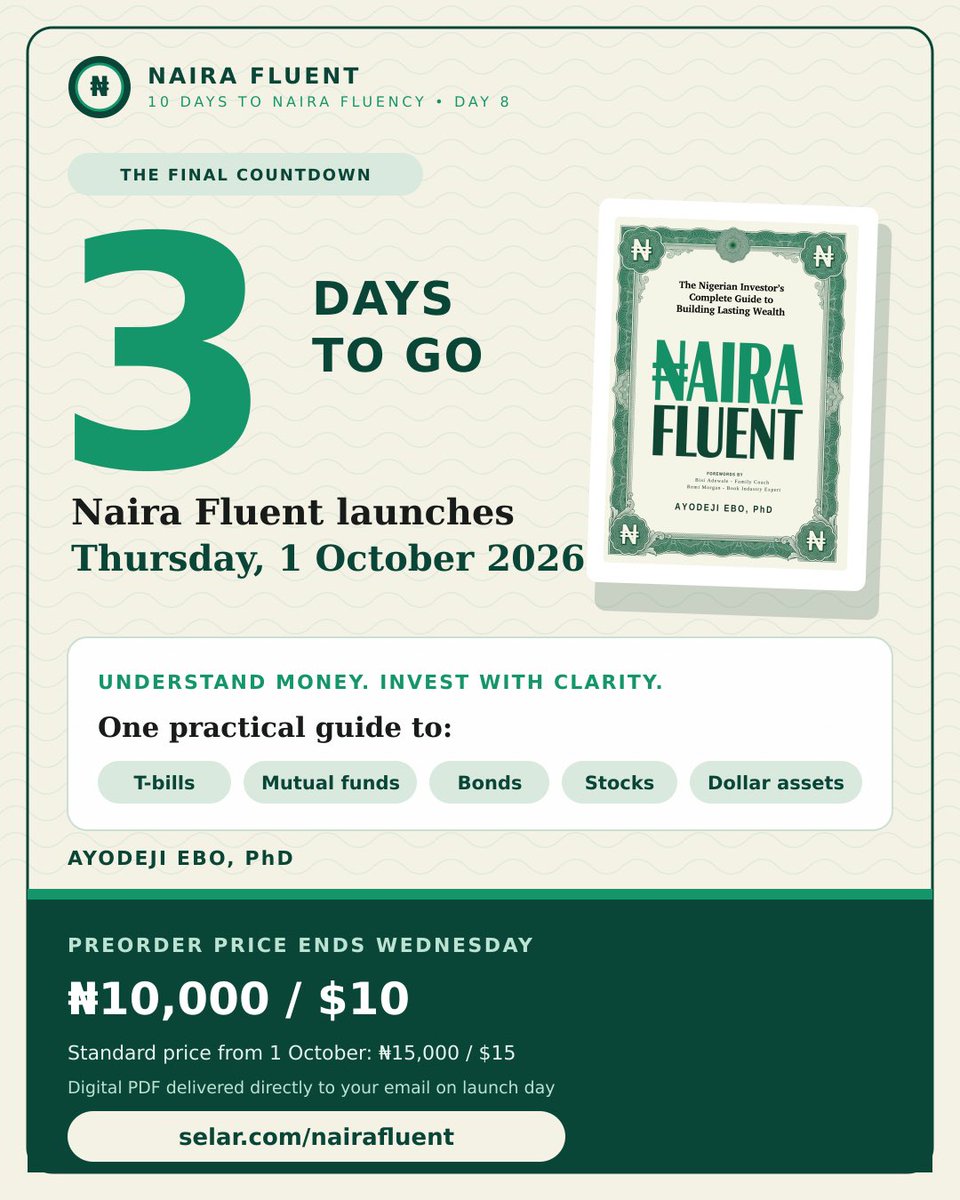
3 DAYS TO GO! 🎉
Naira Fluent is almost here. I wrote it to help investors understand their options, cut through the jargon and make more informed decisions.
Preorder for ₦10k/$10 until Sept. 30. From Oct. 1: ₦15k/$15.
🔗 https://t.co/nDKcoBh0xa
GTI Research has put Dangote Petroleum Refinery and Petrochemicals’ (DPRP) probability-weighted fair value at approximately N493 per share, below the N525 offer price at which the company is currently selling shares in Africa’s largest-ever public share sale.
This is according to a 22-page valuation report by GTI Research analysts led by Mr. Abiodun Ogunniyi, which was published on Wednesday, September 16, 2026 and obtained by Nairametrics.
10 Google search tricks for finding opportunities that you may not know:
1. Use quotation marks (" ")
Searching "fully funded fellowship" tells Google to look for that exact phrase instead of treating the words separately.
2. Use the minus sign (-)
Searching fellowship -medical removes results containing “medical.” Useful when irrelevant opportunities keep appearing.
3. Use OR
Search fellowship OR conference OR training to get results containing any of those terms without doing three separate searches.
4. Use site:
If you want to search only one website, type something like fellowship site:https://t.co/E1zxhPxDuq. Google will return relevant pages from that particular website instead of searching the entire internet.
5. Use filetype:pdf
Search "call for applications" filetype:pdf to find calls, guidelines and programme documents published as PDFs.
6. Use intitle:
Searching intitle:fellowship Africa 2026 looks specifically for pages with “fellowship” in their title, which can reduce unrelated results.
7. Search by deadline
Try "fellowship" "deadline" "September 2026" instead of searching “fellowships 2026.” This can help you find opportunities that are currently accepting applications.
8. Search a particular platform through Google
For example, "fully funded fellowship" site:https://t.co/Jt0OUTxBd4 can help you find relevant posts without relying only on the platform’s search function.
9. Combine search commands
Try "call for applications" Africa 2026 filetype:pdf -scholarship. This asks Google to find that phrase, prioritize PDFs and exclude scholarship results.
10. Search in another language
If you speak another language, use it. For example, "appel à candidatures", "entièrement financé" or "programme de jeunes" can uncover Francophone opportunities that may never appear on your English-speaking timeline.
Finding opportunities is a skill in itself. Sometimes the opportunity is out there; you just need to know how to search for it.
📣The holidays are coming, get your phone repaired 🔧 and enjoy a 50% off service fee or a branded new 2023 calendar.🎁🥳
Offer valid from 19 Dec. 2022 to 08 Jan. 2023
Eligible for Xiaomi Authorized Store, 4 Kodesho Street opposite computer village, Ikeja, Lagos.
Upgrade to the Redmi Note 14 Pro and save big! 🌟
From now until May 11th, get up to N10,000 OFF when you buy from our authorized retail stores like FINET, RAYA, SLOT, 3C HUB, KOLIA ANGEL, CALLUS MILLER, MICRO STATION or your nearest Xiaomi authorized store.🛒
This deal is just what you need to take your phone game to the next level. 🛍️
#RedmiNote14Pro #LimitedOffer
Splashes can’t stop this star! 💦 With Redmi Note 14’s #AllStarDurability, you’re ready for whatever life throws your way. ✨
Get yours today at FINET, RAYA, JUMIA, SLOT, 3C HUB, KOLIA ANGEL, POINTEK or your nearest Xiaomi authorized store.🛒
#AllStarDurability#RedmiNote14
First HoldCo Plc reported profit before tax of N653.54bn for the six months ended 30 June 2026, an increase of 83.50% on the N356.15bn recorded in H1 2025 and the strongest half-year in the Group's history. The cost-to-income ratio improved by 633 basis points to 44.19%, and management reported that @FirstBankngr's capital adequacy ratio had been restored to 16.70% ahead of the 120-day plan, with the subsidiary liquidity ratio at 52.20%.
The composition of the improvement carries as much information as its scale. Net interest income contracted by 2.84% to N879.13bn while non-interest income rose by 162.49% to N497.08bn. Trading-related income and other operating income together supplied about 87% of that increase, and other operating income is not disaggregated in the reviewed filing. The impairment charge fell by 37.36% to N116.14bn in the same six months in which the non-performing loan ratio rose from 12.00% to 14.60%, coverage fell from 98.70% to 78.90%, and stage 2 allowances rose by 143.24%.
The shares closed at N105.50 on 20 July 2026 after rising by 100.95% from N52.50 on 2 July, valuing the Group at about N4.80trn and at 1.32 times book value, above the 0.99x African peer median recorded in Proshare's fifth Tier 1 Banks Report. Turnover peaked at about 36 times the three-month daily average. The market has priced a recovery that the disclosed numbers do not yet confirm. What H2 2026 delivers on recurring earnings, provisioning adequacy and consolidated capital disclosure will supply that evidence.
https://t.co/hY8hQ0Fn3k
.@BUACement's H1 2026 results underscore the company's ability to translate revenue growth into significantly stronger profitability through disciplined cost management and operational efficiency. While revenue expanded by a solid 25.6%, the sharper growth in profit before tax (79%) and profit after tax (79.6%) reflects improved margins and lower production costs.
https://t.co/DGInCvNzts
Asset of the Day:
Dangote Sugar Refinery Plc (DANGSUGAR) on NGX
Dangote Sugar is Nigeria’s leading refined sugar producer — a household name in the consumer staples sector.
It dominates through scale, nationwide distribution, and vitamin-A fortified white sugar. The company is pushing hard on backward integration (Numan plantation and new sites) to cut import dependence and grow local cane-to-sugar capacity toward 600,000+ tonnes annually by 2030.
Key Fundamentals (latest available):
• Revenue (FY 2025): ₦829.2B (+24.6% YoY)
• EPS: FY 2025 –₦5.28 (loss narrowed sharply from –₦15.86); Q1 2026 +₦1.58 (strong turnaround vs –₦1.95 prior year)
• ROE: Still negative (~–12% to –38% range recently) but improving
• ROIC: Positive ~12–18% as operations recover
• Debt/Equity: Elevated ~4–5.6x (high leverage from FX losses and expansion)
• Dividend Yield: None currently (last paid 2023)
• P/S: ~1.05–1.1x; P/B: ~5.8–6.8x
• Forward PE: Elevated (~20–32x) as profits return
Gross margins rebounded sharply in Q1 2026 on better cost control and lower raw-material pressure.
Risks:
High debt load and finance costs, naira/FX volatility (raw sugar still partly imported), input-cost spikes, and weaker consumer spending. Rights issue aimed at deleveraging is in progress.
Market position & expansion: Clear leader with strong brand and distribution. Expanding local cane production and refining capacity — classic scale advantage in an essential food category.
This is a turnaround / recovery play rather than a pure growth champion, value stock, or dividend king. Think “cyclical recovery” with focus on the economic moat of scale in a basic consumer staple.
Profits are returning, margins are healing, and backward integration could strengthen the long-term story — but leverage remains the big watch item.
Interested? It's available on @investbamboo
Not financial advice. Do your own research or speak with a licensed adviser. Past performance is not a guide to future results.
NDIC has started paying depositors of the 46 microfinance banks CBN shut down on 1 July.
Nobody is queuing. They are using your BVN to find your other accounts and paying you directly.
The insured maximum here is ₦2m.
That is the part to note. Microfinance banks are covered up to ₦2m. Commercial banks, ₦5m. Anything above that waits on whatever assets get recovered.
If your money sits in a microfinance bank because the interest looked sweeter, know what is actually covered.
Before you touch one kobo, understand your risk tolerance and have a direction.
Here’s how I would structure ₦100m based on my own risk tolerance and strategy:
1. Emergency fund
₦4.8m into a money market fund on @ZedcrestWealth . My monthly living cost is around ₦400k, and I want 12 months of cover because my income isn’t a fixed salary. (Salary earners can usually run with 3 to 6 months.)
2. Equity fund
₦10m into the @ZedcrestWealth Equity Fund. A professionally managed basket of Nigerian stocks. This is the part I don’t have to think about.
3. Individual stocks (higher risk bucket, because I can afford it)
Nigerian stocks via @ZedcrestWealth (₦19.5m total):
- MTN, ₦2.5m
- Zenith Bank, ₦3m
- Nigerian Breweries, ₦2m
- HBMNG (ex-Lafarge Africa), ₦2m
- Aradel, ₦3m
- UBA, ₦1.5m
- Presco, ₦3m
- Fidson, ₦2.5m
US stocks via @hisanigeria (₦15m total):
- S&P 500 ETF, ₦3m
- Nvidia, ₦2m
- Alphabet, ₦2m
- SCHD ETF, ₦2m
- Johnson & Johnson, ₦1.5m
- TSM, ₦1.5m
- Tesla, ₦1.5m
- Netflix, ₦1.5m
4. US REITs
₦5m through @Risevest . Passive dollar income from real estate, without tenants, agents or local headaches, and a decent hedge against naira volatility.
5. Business
₦10m to set up something real after proper research and planning. A business with a break-even point I can calculate before I start.
6. Dry powder
₦10m held for market downturns and opportunities, parked in a money market fund so it earns while it waits. Cash sitting idle in a regular savings account is not patience. It’s a leak.
7. Short-term instruments
₦25.7m rotating between treasury bills and commercial papers. I ladder the maturities so something matures every few months and the interest can handle needs without touching the capital.
Total: ₦100m
Roughly:
- 50% in equities and growth assets (equity fund, individual stocks, REITs)
- 40% in fixed income and cash equivalents
- 10% in business
This is my personal structure, not financial advice or a recommendation. Your risk tolerance, age, responsibilities and goals are different from mine. Do your own research.
Dividends are one of the most underrated forms of income in Nigeria.
Guaranty Trust Holding Company, Zenith Bank, Stanbic IBTC Holdings, Dangote Cement, and MTN Nigeria have consistently rewarded shareholders with dividends over the years. Hold enough shares across 4 to 5 quality dividend-paying companies in banking, cement, consumer goods, and telecoms, and you’ve built yourself a second income stream.
That income is built on ownership. You didn’t work extra hours for it. You didn’t trade more of your time for money. You simply owned a piece of great businesses and stayed invested.
Dividend investing isn’t flashy. But quiet, compounding dividend income is one of the most reliable ways to build long-term wealth in Nigeria and anywhere else.
You should constantly ask yourself this: Are you utilizing every minute of your life to its full capacity to push you towards the person you wish to become or are you wasting it away on frivolities?
Nigeria's capital market delivered one of its strongest first-half performances in recent history, demonstrating resilience despite a sharp correction in June. The NGX All-Share Index (ASI) advanced 47.43% to close at 229,419.18 points, while market capitalisation rose to N147.28trn, supported by strong corporate earnings, banking and insurance recapitalisation, robust domestic liquidity, dividend expectations, and sustained institutional participation.
The first four months of 2026 were characterised by a powerful bull run. January opened with renewed investor positioning; February gained momentum on banking recapitalisation; March recorded healthy consolidation; and April emerged as the standout month, with a 20.36% gain, driven by renewed confidence and strong demand for fundamentally sound stocks.
Sentiment turned in June. The migration to a T+1 settlement cycle, revised CBN guidelines for financial holding companies, quarter-end rebalancing, and the SEC intervention against the unauthorised marketing of a purported Dangote Refinery offer combined to pull the index down 8.37% for the month. The correction read as valuation discipline rather than a change in trend.
In this review, we set out the half-year performance across the NGX, NASD and FMDQ, the regulatory reforms that reshaped the market, and the outlook for H2 2026.
Cc: @ngxgrp, @NASDNG, @FMDQGroup, @cenbank, @SECNigeria, @ngxregco, @CSCSNigeria, @AFEXNigeria, @LCFE_NG, @jchiemeka2
Read more: https://t.co/migeew8Wfn
As a founder, If you’re raising venture capital, sitting in board meetings, or speaking with institutional investors, there are about 30-40 business terms you should know cold. I have been doing this for more than 10years so these are the ones that matter.
⸻
1. WACC — Weighted Average Cost of Capital
This is one of the most important concepts in corporate finance.
Meaning
The average cost of every dollar the company uses to finance itself.
Money isn’t free.
A company can obtain money from:
Equity (selling shares)
Debt (bank loans, bonds)
Each has a cost.
WACC combines both.
Example:
You need ₦100 million.
You raise
₦60m from investors
₦40m from the bank
Investor expects 20% return.
Bank charges 10% interest.
Your WACC is
(60% × 20%) + (40% × 10%)
= 12% + 4%
= 16%
Meaning:
Every project you invest in should ideally earn more than 16%.
If not, you’re destroying value.
⸻
Why VCs care
Suppose you tell a VC
“Our expansion will generate 8% yearly.”
If your WACC is 16%
The VC thinks
“Why are you investing in something earning less than your cost of capital?”
Bad management.
⸻
2. CAC — Customer Acquisition Cost
One of the first numbers investors ask.
Formula
CAC = Marketing Spend ÷ Customers Acquired
Example
You spend
₦5 million on ads
Acquire
500 customers
CAC
= ₦10,000
Meaning
It costs you ₦10k to get one customer.
⸻
3. LTV — Lifetime Value
How much one customer generates before leaving.
Example
Customer pays
₦10,000/month
Average customer stays
36 months
Revenue
= ₦360,000
Gross margin
70%
LTV
≈ ₦252,000
⸻
Investors love
LTV : CAC
If
LTV = ₦250k
CAC = ₦10k
Ratio
25:1
Fantastic.
Generally:
Below 1:1 → Losing money
Around 3:1 → Healthy
5:1+ → Excellent (assuming the numbers are sustainable)
⸻
4. Burn Rate
How fast you’re spending money.
Example
Cash in bank
₦120m
Monthly expenses
₦10m
Burn rate
₦10m/month
⸻
5. Runway
How long before you run out of cash.
Cash
₦120m
Burn
₦10m/month
Runway
12 months
VCs almost always ask
“How much runway do you have?”
⸻
6. EBITDA
Earnings Before Interest, Taxes, Depreciation and Amortisation
Measures operating profitability before financing and certain accounting charges.
Think of it as
“How much does the business generate from operations?”
Very common in acquisitions.
⸻
7. ARR
Annual Recurring Revenue.
Critical for SaaS.
Monthly subscriptions
₦2m
ARR
₦24m
Investors love growing ARR.
⸻
8. MRR
Monthly Recurring Revenue.
If subscriptions
₦500k
Next month
₦700k
MRR increased.
⸻
9. Gross Margin
How much remains after direct costs.
Example
Revenue
₦100m
Cost to deliver
₦30m
Gross margin
70%
High gross margins usually make companies more scalable.
⸻
10. EBITDA Margin
EBITDA ÷ Revenue
Shows operational efficiency.
⸻
11. ROI
Return on Investment.
Simple.
Invest
₦1m
Earn
₦1.5m
ROI
50%
⸻
12. IRR
Internal Rate of Return.
Measures the annualised return of an investment over time.
Private equity firms use this constantly.
Higher IRR = better investment.
⸻
13. NPV
Net Present Value.
Money today is worth more than money tomorrow.
NPV discounts future cash flows to today’s value.
Positive NPV
Good investment.
Negative
Reject.
⸻
14. Cap Table
Capitalisation Table.
Shows
Founders
Investors
Employee stock options
Ownership percentages
Every startup should have one.
⸻
15. Dilution
Every fundraising round usually reduces existing shareholders’ percentage ownership.
Example
You own
100%
Raise investment
Now own
80%
You’ve been diluted.
⸻
16. Valuation
What the company is worth.
Pre-money
Value before investment.
Post-money
Value after investment.
Example
Company worth
₦900m
Investor puts
₦100m
Post-money valuation
₦1 billion
Investor owns
10%
⸻
17. TAM
Total Addressable Market.
Entire possible market.
Example
Nigeria spends
₦5 trillion yearly on facilities management.
TAM
₦5 trillion.
⸻
.@fidelitybankplc's FY 2025 results tell two stories. The core banking franchise hit record highs, gross earnings surged 45.65% to N1.52trn, NPL ratio improved to a sector-best 2.38%, and impairment charges dropped 61.71%. A genuinely strong performance.
But a N223.79bn derivative mark-to-market loss flipped non-interest revenue negative and dragged PAT down 12.82% to N242.44bn, with no dividend declared for the year. The recapitalisation milestone is done. FY 2026 is now about earnings recovery, derivative resolution, and cost-efficiency.
At a P/E of 3.84x, analysts remain split, but the structural case is hard to ignore.
https://t.co/YYlqTZvosF