Meet Jensen Huang: The engineer who turned a startup into one of the most influential technology companies in the world.
Huang co-founded in 1993 alongside Chris Malachowsky and Curtis Priem, serving as its CEO for more than three decades.
An electrical engineer with degrees from Oregon State University and Stanford University, he helped transform NVIDIA from a graphics chipmaker into a global powerhouse in GPUs, accelerated computing and artificial intelligence.
Under his leadership, NVIDIA developed technologies such as GeForce GPUs and CUDA, helping reshape gaming, scientific computing, cryptocurrency mining and the AI industry.
His biggest achievement was positioning NVIDIA at the centre of the global #AI boom, making its chips essential infrastructure for the development and deployment of modern AI models.
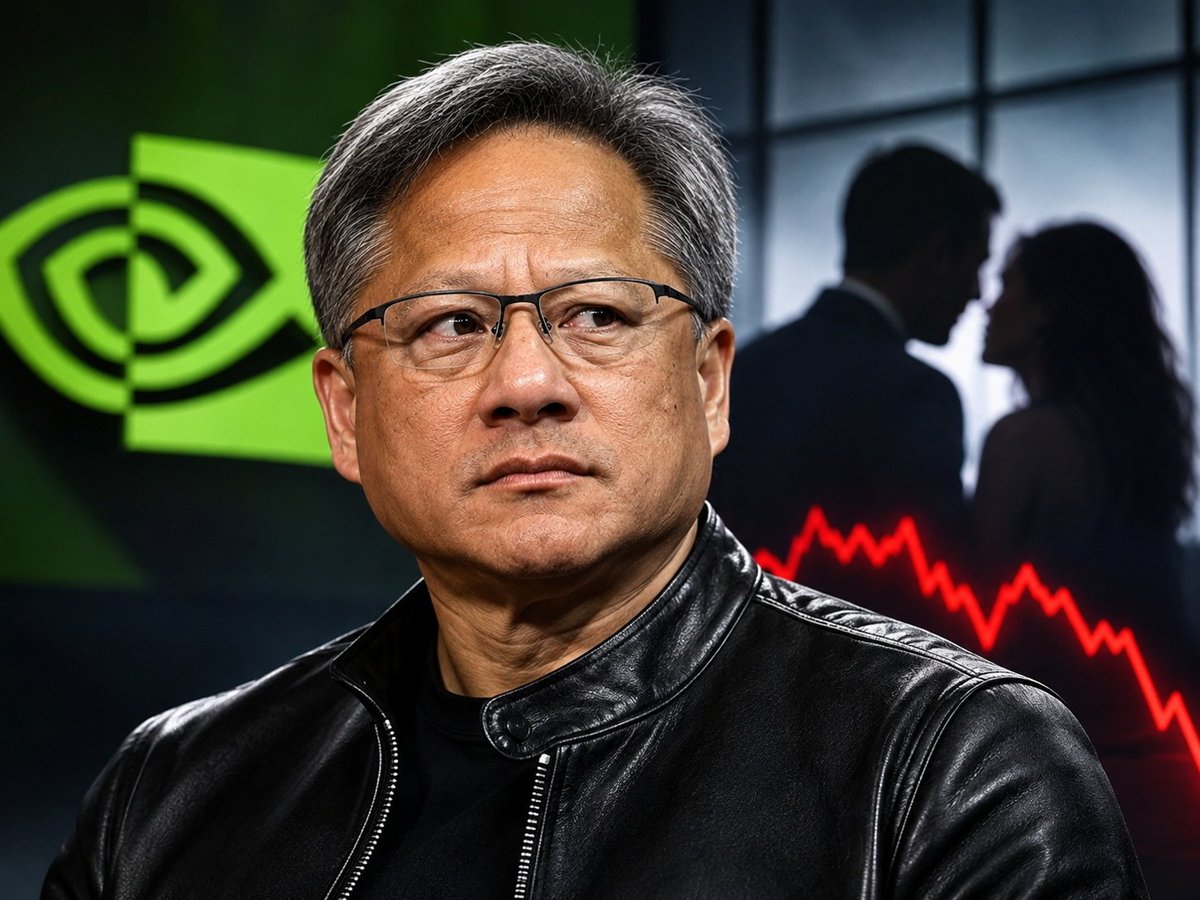
After 33 years at the helm, Jensen Huang has resigned as NVIDIA's CEO, president and board member, effective immediately.
🚨 BREAKING: Hackers have hijacked 4,837 #GitHub accounts to steal credentials across more than 61,000 repositories.
The campaign is particularly dangerous because attackers are using legitimate developer accounts rather than exploiting GitHub itself.
Here's how it works:
Attackers use stolen GitHub tokens to open seemingly harmless pull requests from a branch called wfx-docs.
Once write access is confirmed, they inject malicious code into CI/CD workflows.
The malware harvests GitHub Actions secrets, cloud credentials, API keys and other sensitive data.
Attackers then revert their changes and delete workflow logs to cover their tracks.
At least 1,806 repositories have executed the credential-stealing payload.
Even more concerning, the malware can target AWS, Azure and Google Cloud credentials, potentially giving attackers access far beyond the compromised repositories.
How to check if you're affected:
Look for:
Pull requests titled docs: dependency audit notes
A branch named wfx-docs
Suspicious commits such as ci: refresh build cache
The campaign began on November 10, with security researchers warning that deleted logs can make detection difficult.
The bigger lesson? Your software supply chain can be compromised without hackers ever breaking into your infrastructure directly.
Sometimes, they simply borrow a developer's identity.
Everyone is asking what would happen if Jensen Huang left #NVIDIA .
But here's the question nobody seems to be asking:
Who would benefit the MOST from his departure?
Because in a trillion-dollar AI race, one man's exit could change everything.
🚨 BREAKING: MSCI IS DROPPING MICHAEL SAYLOR'S STRATEGY FROM ITS GLOBAL INDEXES.
This is bigger than an #MSTR stock sell-off. It raises a fundamental question about how traditional finance classifies companies that hold Bitcoin as their primary treasury asset.
Here's what happened and why it matters. 🧵
1/ Why did MSCI remove Strategy?
MSCI has decided that Strategy and certain other companies resemble investment funds rather than operating businesses.
Its new eligibility rules target companies whose balance sheets are dominated by non-operating assets.
Strategy's massive Bitcoin holdings put it in the firing line.
2/ What happens next?
MSCI will remove #Strategy from its MSCI USA and MSCI World indexes effective December 1.
Funds that passively track these indexes will have to adjust their portfolios and sell their MSTR holdings.
JPMorgan previously estimated potential outflows of $2.8 billion under an earlier proposal.
3/ Could this trigger a bigger problem?
Potentially.
Strategy's Bitcoin model relies heavily on raising capital through equity and debt to purchase more $BTC.
If index exclusion reduces institutional demand, future share issuance could become more difficult or expensive.
And that could weaken the financial engine behind Saylor's Bitcoin accumulation strategy.
4/ But Michael Saylor has faced a corporate crisis before.
One important historical correction: MicroStrategy's defining crisis came during the 2000 dot-com crash, not the 2008 financial crisis.
In March 2000, the company restated its financial results following accounting problems. Its stock plunged from around $260 to $86 in a single session.
Saylor's personal fortune reportedly lost more than $6 billion in one day.
5/ What about the 2008 financial crisis?
MicroStrategy was still a software business at the time, not a Bitcoin treasury company.
Its business intelligence software operations survived the global financial crisis. In 2009, revenue reached $377.8 million, up 5% from 2008, while operating income increased from $67.8 million to $86.3 million.
That was a very different business model from today's Strategy.
6/ The real question is whether history repeats itself.
In 2000, Saylor had to rebuild a software company after a devastating collapse.
Today, he has built a financial model around Bitcoin, using capital markets to expand one of the world's largest corporate BTC treasuries.
The risks are different, but the underlying challenge is familiar: can the company sustain its model when market confidence weakens?
7/ This is not the end of Strategy.
MSCI exclusion does not mean Nasdaq delisting, forced Bitcoin liquidation or an immediate balance-sheet crisis.
But it is a warning that traditional financial institutions are still debating whether Bitcoin treasury companies belong in conventional equity indexes.
And that debate could affect the entire digital asset treasury industry.
The bigger test for Saylor may not be how much Bitcoin he can buy during a bull market, but how resilient his model proves to be when capital becomes harder to access.
🚨 Strategy ($MSTR) is facing one of its biggest tests yet. And the MSCI decision could have implications far beyond Michael Saylor.
MSCI is set to publish its November index review tonight, with Strategy potentially facing exclusion under its new rules for non-operating companies.
The stakes are significant.
JPMorgan previously estimated that exclusion could trigger up to $2.8 billion in passive fund outflows.
But here's the bigger question:
If a company holding billions in Bitcoin can be classified as an investment vehicle rather than an operating business, what does that mean for the future of corporate Bitcoin treasuries?
This isn't just about MSTR losing index exposure.
It's about whether traditional financial benchmarks are ready to recognise Bitcoin treasury companies as a legitimate corporate model.
And that debate could shape the next chapter of institutional Bitcoin adoption.
All eyes on MSCI tonight. 👀
In 2009, a man spent just $27 on Bitcoin.
Four years later, he remembered something that would change his life forever.
His name was Kristoffer Koch, a Norwegian student researching encryption for his university thesis.
During his research, he stumbled upon something called Bitcoin.
At the time, almost nobody cared about it.
One BTC cost less than a penny.
Koch found the technology interesting enough to spend 150 Norwegian kroner, roughly $26.60, buying 5,000 BTC.
Not because he expected to become rich.
Not because someone told him to invest.
He simply wanted to understand how it worked.
His girlfriend wasn't impressed. To her, it was just another pointless tech purchase.
And eventually, Koch forgot about it too.
For the next four years, his 5,000 Bitcoin sat untouched in an encrypted wallet.
Then came 2013.
Bitcoin was suddenly making headlines around the world.
Koch saw the news and remembered his little experiment from 2009.
There was just one problem.
He couldn't remember his wallet password.
Imagine knowing you might have a fortune sitting somewhere, but being unable to access it.
After spending an entire day trying to recover his password, he finally got in.
And what he discovered was almost unbelievable.
His $26.60 had turned into roughly $886,000.
He sold about 1,000 BTC and used the proceeds to help buy an apartment in Oslo.
But here's where the story gets even crazier.
At a Bitcoin price of $74,000, those original 5,000 BTC would be worth $370 MILLION.
All from a $27 purchase he nearly forgot existed.
The most fascinating part?
Koch wasn't trying to predict the future of money.
He wasn't chasing profits or following investment advice.
He was simply curious about an idea that almost everyone else ignored.
Sometimes, the biggest opportunities don't look like opportunities when they first appear.
#Bitcoin #BTC
Ripple’s David Schwartz sold 23 million $XRP, 1,499 $BTC and 34,000 $ETH.
Not because he lost faith in crypto, but because he hates risk.
His wife had a deal: sell at all-time highs.
The twist? He now regrets selling.
🚨 XRP's biggest problem might not be its price.
Ripple can win banking deals, expand globally and grow its infrastructure without creating equivalent demand for $XRP.
That's the question nobody should ignore:
What if #Ripple wins, but $XRP holders don't? 👀
🚨 #Bitcoin was just $15,291 exactly 6 years ago today.
Today: $73,811.
That's a 379% gain despite countless crashes and “Bitcoin is dead” headlines.
Will today's $BTC price look cheap in 2032? 👀
🚨 Bank of America reportedly removes Nvidia ($NVDA) and Micron ($MU) from its list of top stock picks.
Two major AI chip stocks dropped from the list.
Is Wall Street becoming more cautious about the AI trade?
Silicon Valley's Asian connection 👀
Zuckerberg × Priscilla Chan
Ellison × Jolin Zhu
Jensen Huang × Lori Huang
Coinbase's Armstrong × Angela Meng
Four tech billionaires. From AI chips to crypto exchanges, their companies shape the digital economy.
Interesting pattern?
🚨 WALL STREET IS TURNING ETHEREUM INTO A YIELD-GENERATING MACHINE, AND LIDO SAYS INSTITUTIONAL DEMAND IS GROWING.
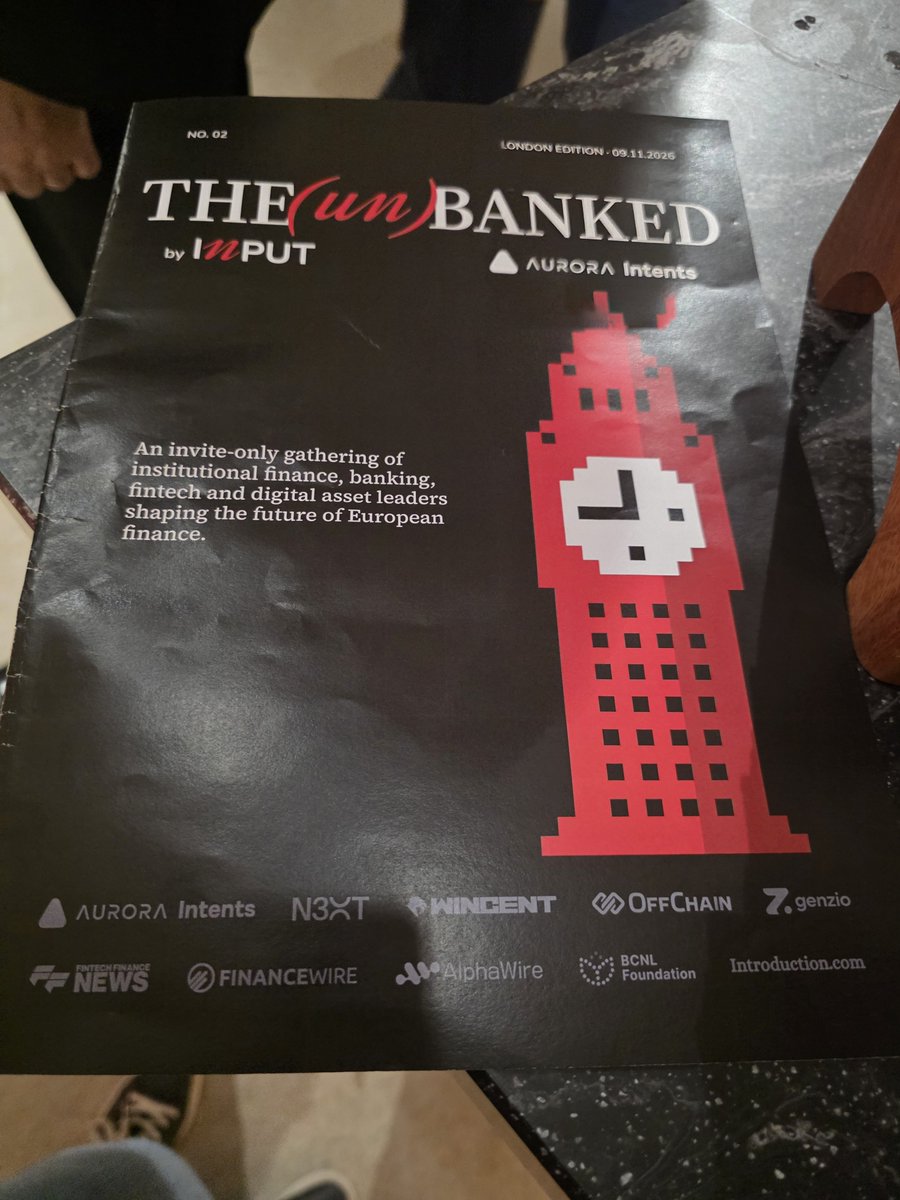
Speaking exclusively to AlphaWire at The (un)banked Conference in London, Kean Gilbert (@Kean_Gilbert), Head of Institutional Relations at @LidoFinance, revealed why major investors are increasingly turning to ETH staking.
“When we speak to people, they want to sweat the asset. They want to put the asset to work.”
Gilbert explained that institutions holding unstaked ETH could be missing out on an estimated 2.5%–4% in annual staking rewards.
Here's what's happening:
• $200 MILLION: SharpLink allocated $200M in ETH to Lido.
• INSTITUTIONAL ADOPTION: Custody integrations with Anchorage, Fireblocks and Copper are making staking more accessible.
• CAPITAL EFFICIENCY: Institutions can earn staking rewards while potentially using staked ETH as collateral.
But Gilbert also warned about the risks of growing staking concentration, arguing that no single provider should become too dominant.
The message: Wall Street doesn't just want exposure to Ethereum anymore. It wants Ethereum working for it.
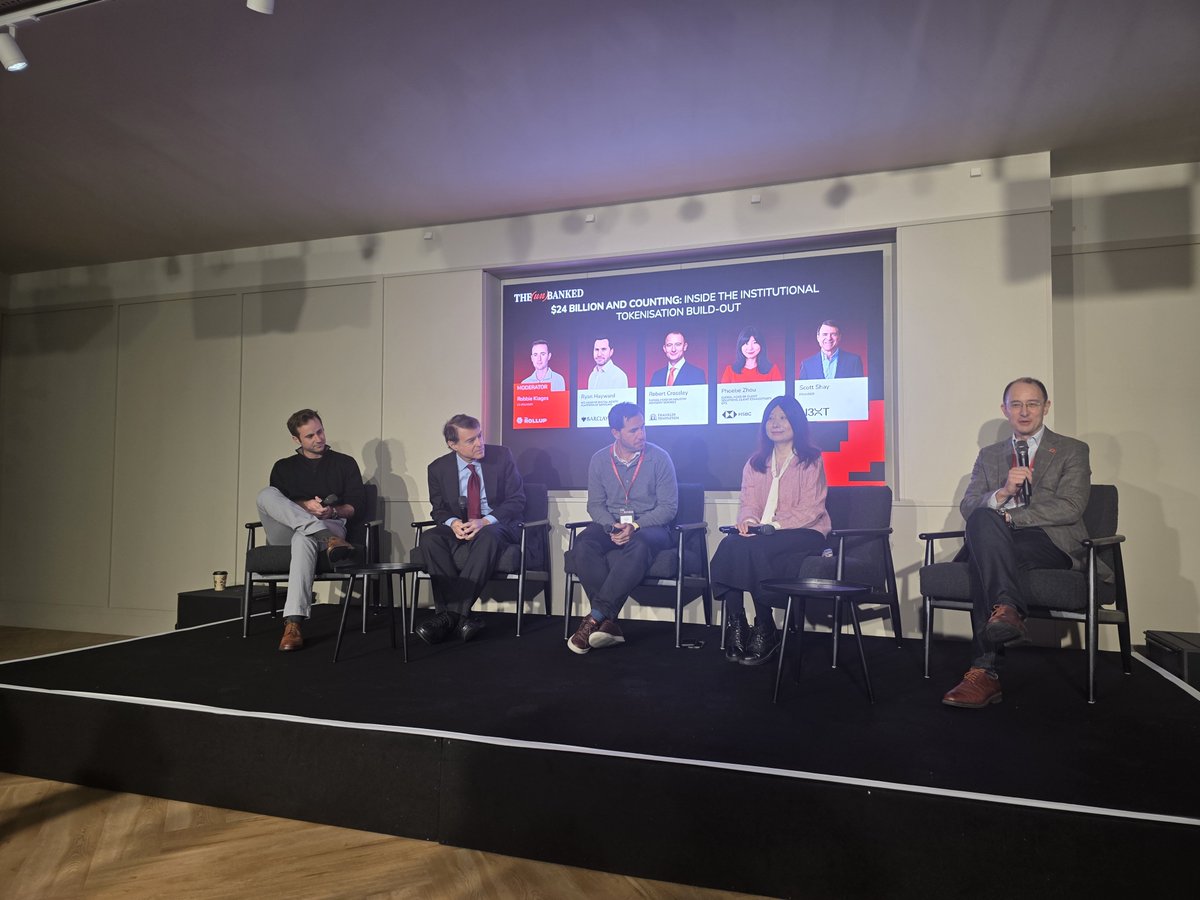
🚨 NEW: HSBC REVEALS ITS NEXT MOVE INTO TOKENIZED FINANCE.
Speaking at The (un)Banked Conference in London, HSBC’s Phoebe Zhou revealed that the bank has supported multiple governments in issuing digital bonds, including Hong Kong and the European Investment Bank.
HSBC has also developed a digital gold platform allowing institutional and retail customers in Hong Kong to buy and trade tokenized gold.
The bank is now working on another digital bond initiative in the UK, with a potential issuance next year.
"People and clients are just looking for an experience that is very much like selecting an option to continue on from their traditional banking partners" ~ Dr. Giovanni Cuti, CEO @GateEU_Official at The (un)banked conference @AlphaWireHQ@INPUT_global
The #future of #finance is being built now. 🇬🇧
Great to be at The (un)Banked Conference in London, where banking, #fintech and digital assets come together to discuss what’s next for finance. @INPUT_global@AlphaWireHQ is supporting the conversation as a media partner. 🚀
🚨 EXCLUSIVE: MEXC CEO ON HOW AI COULD BRING PRIVATE BANKING TO EVERYONE
Vugar Usi (@usithetalk), CEO of @MEXC, explains how AI could transform personal banking by delivering financial advice tailored to each individual.
Rather than relying on traditional bankers, AI could analyse spending habits, identify savings opportunities, and provide personalised financial recommendations in real time.
According to Usi, this could give everyday customers access to the kind of financial concierge services traditionally reserved for wealthy clients.
The future of banking could be a personal AI financial advisor for everyone. 🎥