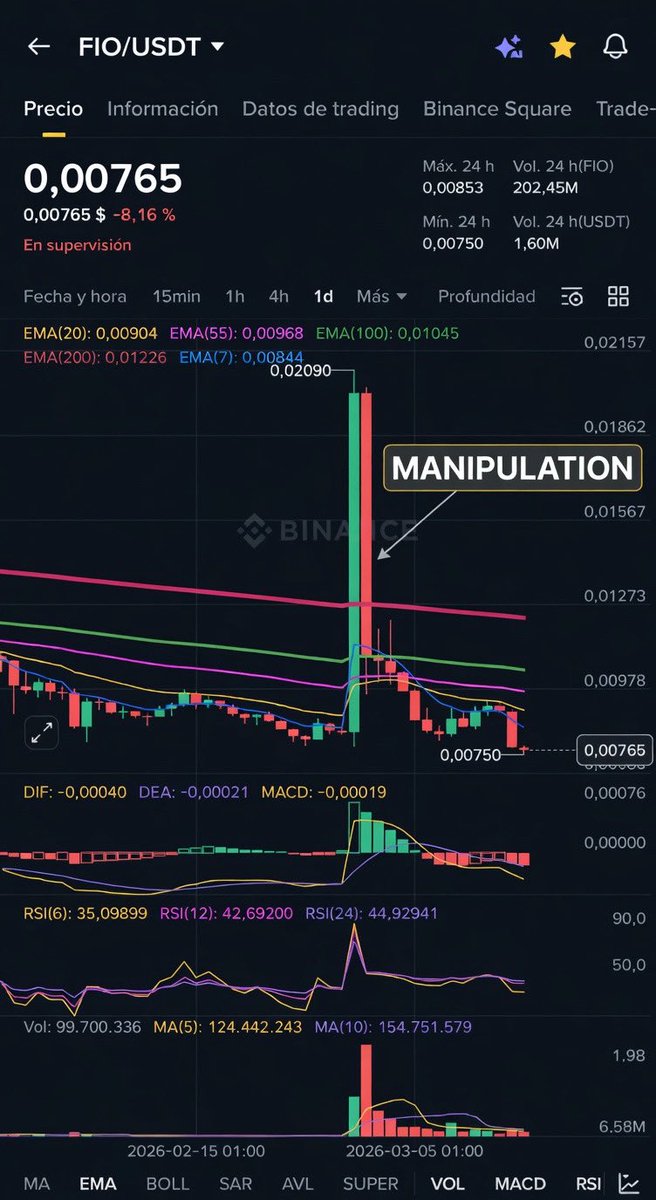
Stay away from the $FIO token.
This manipulated token was recently added and is under Binance's supervision. It will be removed within the next 4 weeks.
$FIO = Market Manipulation
#FIO#MANIPULATION#BINANCE@joinFIO
@jordanw24@RjeyTech You're not an Apple fan. You're naive. Besides, you don't have an iPhone Duo to speak with authority or knowledge. I do, that's why I'm telling you the truth.
This sounds confident until you separate the technologies you just lumped together.
“Zama is just Aleo with better dress” is simply wrong.
Aleo is an L1 built around zero-knowledge execution: private computation happens off-chain and a proof of correct execution is verified on Aleo.
Zama is a confidentiality layer designed to sit on existing chains. It uses FHE so contracts can compute on encrypted shared state without exposing the underlying data.
ZK: prove a computation was correct without revealing the inputs.
FHE: compute directly on encrypted inputs/state.
Different architecture. Different trust/computation model. Different product. Different market.
And merchant adoption of Zcash has almost nothing to do with Zama.
ZEC is trying to be private money.
ZAMA does not need people buying coffee with ZAMA.
Zama’s thesis is that the money and assets people already use — USDC, USDT, BTC wrappers, RWAs, DeFi positions, payroll, OTC trades, treasury assets — need confidentiality when moved onto public blockchains.
Ironically, your “stablecoins will win” argument strengthens that thesis.
If trillions eventually move through stablecoins and tokenized assets on public ledgers, institutions are not going to happily broadcast balances, salaries, counterparties, order sizes, treasury movements and trading strategies to the world.
That is precisely the problem confidentiality infrastructure is trying to solve.
“ETH lost the plot on privacy” is also outdated.
Ethereum’s current privacy roadmap explicitly discusses FHE and cryptographic coprocessors for applications requiring shared hidden state: private AMMs, confidential lending and sealed-bid markets.
That is almost a description of the design space Zama has been building for.
And “they’re onboarding gamblers, nothing else” is demonstrably false.
Zama has already moved beyond a testnet narrative:
• confidential USDC/USDT on Ethereum
• 16 confidential Morpho vaults across multiple assets and institutional curators
• >$90M shielded TVL reported by September
• confidential payroll on Ethereum mainnet
• a confidential OTC trade with GSR
• confidential RWA infrastructure through T-REX
You can absolutely make a serious bearish case against Zama.
Question FHE performance.
Question decentralization assumptions.
Question KMS/coprocessor architecture.
Question token value capture.
Question whether institutional demand becomes large enough.
Question whether Ethereum eventually absorbs part of this functionality natively.
Those are real arguments.
But “Aleo with better clothes + Zcash merchant adoption is slow + crypto is a casino” is not a technical critique of Zama.
It’s three unrelated narratives stitched together.
And the funniest part is that your strongest prediction — stablecoins becoming the dominant onchain money — creates MORE need for confidential computation, not less.