The oats provide soluble fiber (beta-glucan), which helps lower LDL cholesterol by binding cholesterol and aiding its removal.
Chia seeds also contribute to soluble fiber, further supporting heart health.
The meal is low in saturated fat, containing only 3 grams per serving. Most fats come from plant-based sources like nut butter, which are heart-healthy.
ETF flows are becoming the cleanest crypto market signal right now.
When BTC, ETH, SOL, and XRP funds all see sustained redemptions, the question is not which chart looks worst. It is whether marginal institutional demand is still there.
@CoinMarketCap Verifiable settlement is the future.
The real unlock is not hype. It is assets, reserves, and ownership records that can be audited in real time.
One useful stress metric: how much BTC supply is in loss versus profit. If underwater supply rises above profitable supply, sentiment usually looks awful, but the duration of that stress matters more than the headline.
Bitcoin-backed mortgages are an adoption headline, but the real signal is credit design: collateral treatment, liquidation rules, borrower risk, and whether lenders can scale without turning volatility into hidden leverage.
Policy timing is becoming a crypto market variable again. Reports that a crypto bill has only a narrow passage window this year matter because regulatory clarity can move slower than market narratives.
ETH weakness is easy to turn into a narrative. The better question: is this protocol risk, macro risk, or liquidity risk? If the answer is mostly liquidity, the signal is broader than Ethereum.
DeFiLlama shows stablecoin market cap around $320B. In a weak tape, that matters: stablecoins are the dry powder layer. The signal is not just price action, but whether on-chain dollar liquidity expands or contracts.
Crypto is trading like a liquidity story today: BTC weakness, ETF outflow pressure, and macro risk are all pointing in the same direction. Watch whether spot demand returns before calling this a clean reversal.
Google's AI agent ecosystem pitch faces consumer doubt. This underscores a key Web3 truth: user trust and data sovereignty are make-or-break for adoption, even for tech giants. The centralized approach hits a wall. via TechCrunch
Private credit's rapid expansion is now raising red flags for financial stability. The core issue isn't just size, but systemic illiquidity and opaque valuations – challenges that tokenized RWA aims to address. 🤔 #RWA
What's the bigger barrier to onboarding the next 100M crypto users?
🟢 Gas fees / failed tx
🟢 Chain confusion
🟢 Self-custody anxiety
🟢 Just price volatility
What this means in practice: when evaluating an RWA token, the questions are not "audit?" and "TVL?" — they're:
— Who's the issuer?
— What jurisdiction?
— What happens if they go under?
Crypto-native diligence doesn't apply here. Trad finance diligence does.
"Tokenized" doesn't mean "decentralized." Most #RWA tokens today are issued by regulated entities holding the underlying asset off-chain. The token is a claim — not the asset itself.
The legal layer matters more than the smart contract layer.
The 124,000x framing skips the actual bottleneck.
#Tokenized equities need wallets that handle compliance-aware, jurisdiction-restricted, transfer-gated assets at retail scale.
That layer doesn't exist yet — and it's the gating function on this whole curve, not issuance.
J.P. Morgan is betting big on tokenized ETFs.
In a recent insight, J.P. Morgan outlined its thinking on the future of ETFs and the role tokenization will play in reshaping them.
“We believe tokenization will certainly drive how the market changes, not just for ETFs but across the funds industry as a whole.”
Per the report, tokenization could enable:
→ 24/7 market access
→ Near-instant settlement
→ Lower costs and fewer intermediaries
→ Streamlined creation and redemption
The global ETF market is expected to reach $35 trillion by 2030, up from $19.5 trillion today. J.P. Morgan is already running proof-of-concepts on tokenized ETFs through its Kinexys platform.
@CamiRusso The thing TBTF analogies miss: which protocols get rescued and which quietly die?
Popular and well-connected = saved. Niche and unloved = ghost.
It's not "too big to fail." It's "too connected to fail." Joining tomorrow.
On "who's the liquidator" — the cleaner parallel might be Curve/Egorov on Aave (2023). Positions too large to liquidate openly without cascading the asset. Resolved via OTC + whitelist, not free markets.
If DeFi United hasn't disclosed, the answer is almost always "the team itself."
The honest version of the RWA thesis isn't "wrap a Treasury onchain." It's "route a yield stream that was structurally inaccessible to crypto holders."
The $247B gold futures OI line is the insight most pitches miss.
Open question: at what AUM does contango start compressing the yield?
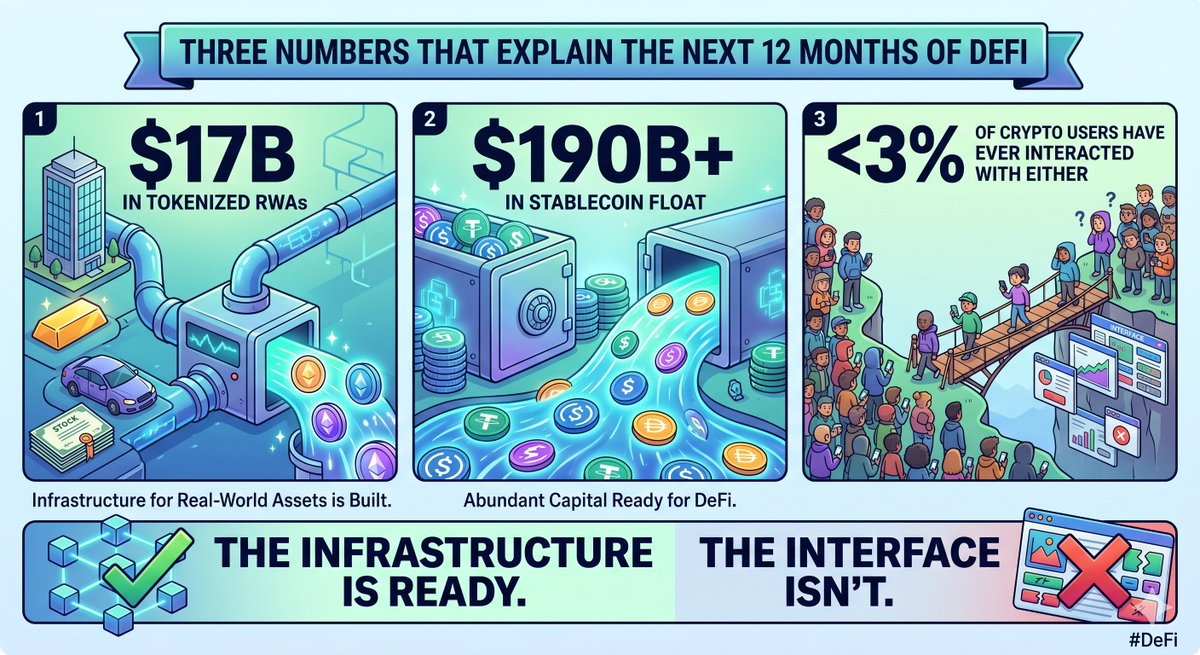
Three numbers that explain the next 12 months of DeFi:
— $17B in tokenized RWAs — $190B+ in stablecoin float
— <3% of crypto users have ever interacted with either
The infrastructure is ready. The interface isn't.
#DeFi
What survives this: crypto-as-infrastructure. #Stablecoins. Tokenized #RWAs. On-chain settlement.
What gets eaten: crypto-as-retail-trading-product.
Analysts have lumped these into one line item for years. They're about to diverge.
#Robinhood Q1: crypto revenue down 47%. Event betting up massively. Stock unfazed.
The signal isn't "retail left crypto." It's that retail's binary-speculation appetite found a more efficient venue.
https://t.co/GWtHVmYD4b
#Crypto, on retail rails, was always a leveraged casino with poor UX.
Prediction markets are the same product — without the gas fees, the seed phrase risk, or the 100 chains to choose between.
The trade was never about #Bitcoin. It was about the dopamine.