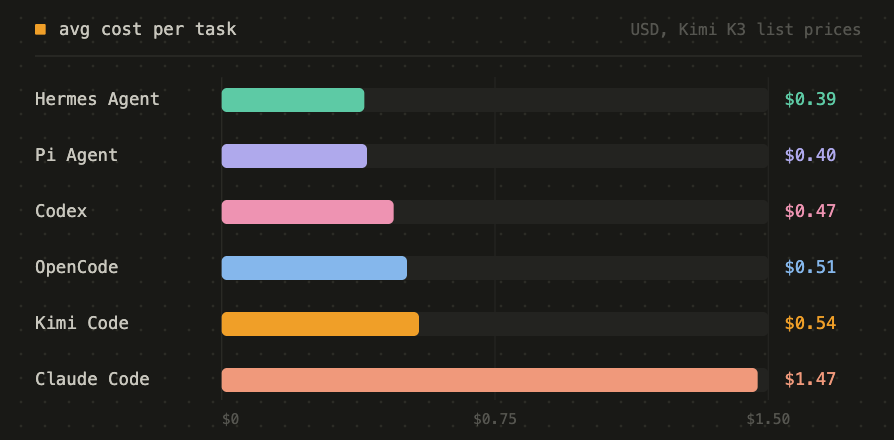
Hermes and Pi Agent led on the average cost per task, while Claude Code cost about 3.7x as much as Pi:
- $0.39 Hermes Agent
- $0.40 Pi Agent
- $0.47 Codex
- $0.51 OpenCode
- $0.54 Kimi Code
- $1.47 Claude Code
The median cost tells the same story: $0.29 in Pi Agent and Hermes, $0.35 in OpenCode, $0.38 in Kimi Code, $0.39 in Codex and $0.72 in Claude Code, so the cost gap holds for a typical task and is not driven by a few expensive runs.
We calculated these costs using Kimi K3’s list prices: $3/1M input tokens, $0.30/1M cached input tokens, and $15/1M output tokens.
Someone asks, "At what point do you create multiple agents?"
Any time you have a task that can't be done within a single context window of your model, you should consider how you might be able to define agents to do a smaller portion of the work.
One of the most OP AI techniques I know of is:
Instead of asking AI to do X, ask it to make you a script to do X. Then you use the script to do the task instead of AI.
This idea is less intuitive for non-software people, but it's extremely useful and easier than it seems.
When I'm giving AI advice to non-technical people, I think one of the most important pieces of advice that can be given...is the opening line of this project:
https://t.co/AVbR6OT7uZ
"[Use] LLMs to teach you, rather than think for you."
@MikeTyson A longtime master wanted to test himself to see how much of the old skillset he still had. That’s just cool, and none of us should try to take that away from him.
Mad respect for you, Mike. You’re an inspiration. I enjoyed watching no matter how intense you chose to fight.
I used to think I was rational.
Then I read Daniel Kahneman's Nobel Prize-winning work on human decision-making.
He routinely asks 8 questions to expose cognitive traps you fall into daily.
Test yourself with these questions (it's the ultimate BS detector for your brain):
@0xASK > the path we could pursue as an industry is to have parties "lend" funds on the destination chain, then eventually get repaid on the origin chain.
Getting repaid on the origin chain is still too restrictive. What you really want is to not care what chain you get repaid on.
@Apple In this case it was actually worth it to force the user to have a worse experience in installing the application in exchange for not having the application completely cease to run if some key is revoked somewhere.
The Microsoft / CrowdStrike BSOD illustrates the dangers of these kinds of global kill switches. I have previously elected to not sign macOS applications binaries that I have distributed because that gives @Apple a trivial kill switch on my application.
@mert "Our emotions are not designed to understand the point. The dentist did better when he dealt with monthly statements rather than more frequent ones. Perhaps it would be even better for him if he limited himself to yearly statements."
@mert "Over a short time increment one observes the variability of the portfolio, not the returns. In other words, one sees the variance, little else." -- Nassim Taleb, Fooled by Randomness
@0xASK Chain-agnostic liquidity is definitely the direction crypto needs to move towards. Your grandparents don't want to care what blockchain their money is on. They just want to use it for real-world transactions.