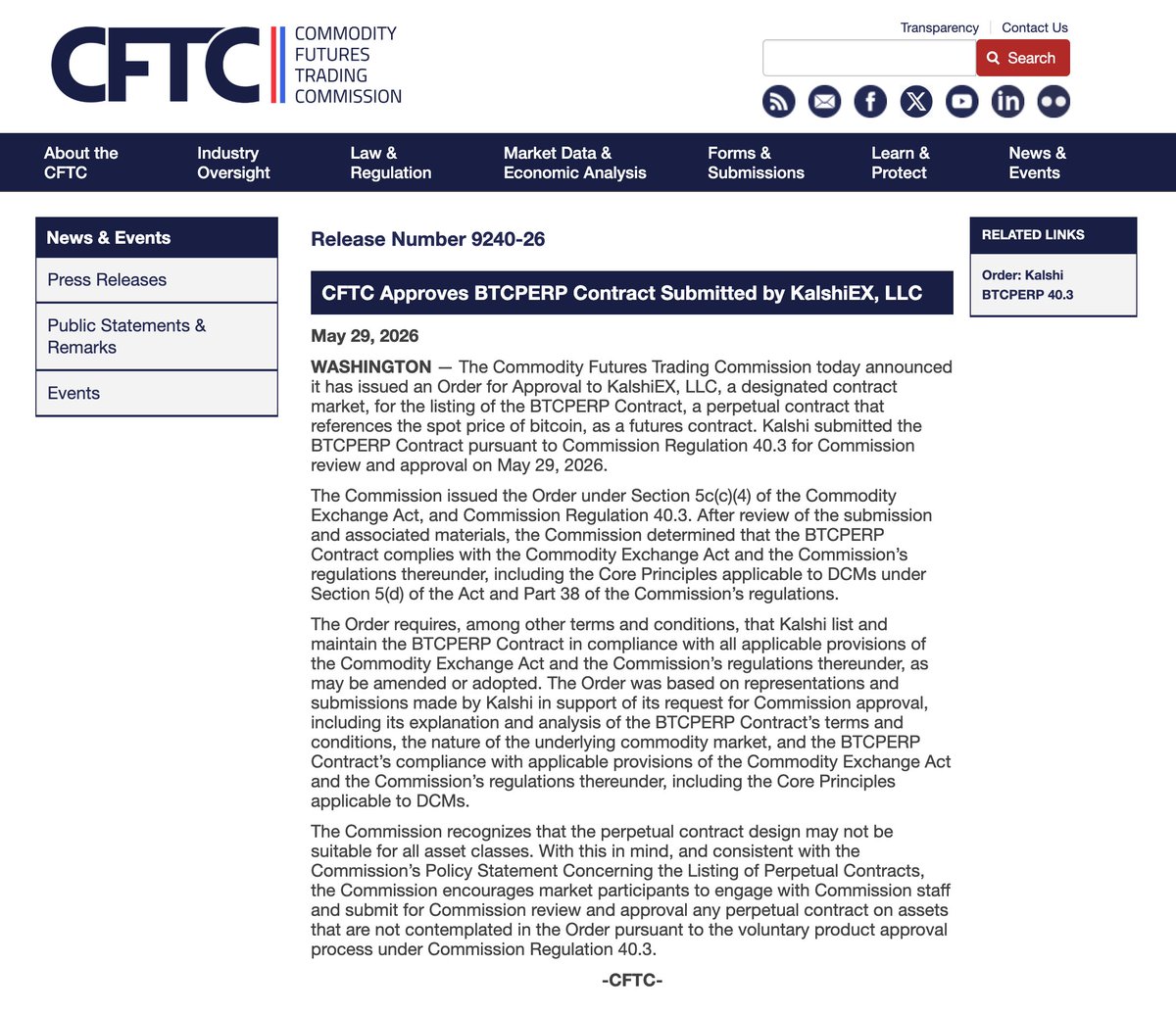
The CFTC just approved the first US-regulated bitcoin perpetual futures contract.
A perp is a futures contract that never expires.
Unlike traditional futures that settle on a fixed date and force you to roll into a new contract, a perp lets you hold the position indefinitely.
This works because to keep the price anchored to spot, longs and shorts exchange a funding rate every few hours. Whichever side is over-positioned pays the other.
Globally, perps did ~$85T in volume in 2025. The dominant crypto derivative globally - EXCEPT the US.
Perps were banned by the CTFC, whose framework was built for expiring futures - set settlement, basis convergence, weekday hours. Perps didn't fit.
As a result, for years, offshore exchanges built the deepest derivative market in crypto while US exchanges and trading firms were locked out entirely.
Billions in trading fees and funding rate yield got captured by foreign entities and capital. None of it could touch a US balance sheet.
Today, that has changed and the door has finally opened.
US based allocators that couldn't legally touch offshore venues can now get exposure to the most liquid derivative in crypto, and as more US exchanges list perps - that access only deepens.
At Blockhouse, we look forward to onboarding the asset managers, here at home, and closest to us. This is exactly the market we built our infrastructure to serve.
Every trader should be aware of two forces converging in capital markets.
1. Capital is getting more sophisticated:
> Quantitative strategies comprised of 70% of net hedge fund inflows in 2025.
> Industry crossed $5T
2. Capital is moving on-chain:
> Stables: $320B -> $2T by 2028
> Tokenized equities / commodities -> $2T by 2030
> Prediction markets -> $44B in 2 years.
As technology evolves and markets sophisticate, on-chain capital will concentrate in quantitative products.
TradFi gates data behind Bloomberg and colo, closes on weekends, and siloes every asset class behind a different license and venue.
On-chain: data is universally available, markets are multi-asset, 24/7, API-native, and the infrastructure is code-first. These are the exact conditions systematic strategies were built for.
As markets evolve, quantitative trading won't just be a strategy bucket. It's the default operating system for trading on capital markets.
Many of the biggest wins in capital markets infrastructure started as trading desks.
>Thomas Peterffy ran Timber Hill, an options market maker that generated billions in trading profits.
> Spun the tech out as Interactive Brokers. $130B MC.
You run a book, generate IP, and spin out valuable software that compounds beyond alpha. However, in TradFi, this was rare. Gated by capital intensity and access.
DeFi turned exchanges, clearing, and distribution into open-source primitives. Instead of needing licenses and capital, anyone with code could ship infrastructure.
And traders had the unfair advantage: they knew what was broken, and already had the volume, distribution, and infrastructure to ship into.
>Talos went from crypto hedge fund to OEMS. $1B MC.
>Chameleon Trading ported their market making strategies onto HLP vault, and pointed flow at exchange - Hyperliquid. $15B MC.
>Ethena - Stablecoin built on basis trade. $4.4B MC.
Trading businesses today might be undervalued if their IP compounds past alpha, and into infrastructure. In DeFi, these financial products ship globally and permisionlessly from day one.
The desk becomes the product surface, and the product becomes the next generation of financial infrastructure. The biggest asset management businesses didn't win on returns alone. They won on infrastructure and distribution.
Most great DeFi projects over the last few years found a good but operationally challenging trade and simply scaled it better than anyone else
Find your trade
VCs underwriting "AI trading" assume a random amalgamation of software will magically print risk-adjusted returns at scale.
This is a misunderstanding of the trading business, which at scale, is an infrastructure and operations problem - thats mostly solved. Especially the kind done by CitSec.
AI will ship features faster and run the stack cheaper. The game is definitely getting harder.
But you can't vibe-code a performant systematic stack. Not yet. Not at the latency, precision, or risk discipline required to actually compete.
Ken Griffin doesn’t understand the ceiling just got raised. Some 20-something maybe reading this will build the cracked AI-human-computer-symbiosis team that will supersede his whole operation because he is too distracted about lowering cost
Boil the ocean don’t cut your costs
Many 8-9-figure allocators whose accounts we manage come in with prime brokers.
The benefits make sense: 3:1 leverage on capital, cross-margining infrastructure, 4% borrow on BTC, and top VIP fee tiers on all exchanges.
But doing this at scale is a headache:
> Setting up an exchange account? 2 week approval.
>Need to borrow? 3 month strategy monitoring.
>Exchange rules change? Reconfigure every account.
All while token and leverage restrictions handicap your returns. Want to trade RWAs, on DEXs, or prediction markets? Forget it.
A new fund deploying $50M at 15% APY should clear $7.5M. But 3 months without borrow, capped leverage, and a limited token universe. You land at 9%.
$4.5M. $3M gone to ops, not the market. Payroll doesn't pause. LPs won't re-up on a fund underperforming. They don't care about your set up.
That's why billion dollar allocators that have never touched crypto, started with Blockhouse.
Our product and relationships plug them into the best infrastructure at the best terms - generating returns from day one with minimal operational lift.
The exchange launches with day-one volume from depositors and services clients already routing through us. The stablecoin becomes preferred collateral across markets, earning yield while it sits as margin and feeding flow back into the strategies that back it. That's the loop Bybit ran with USDe.
Each phase compounds the next, and owning the stack means we capture meaningful economics on every dollar of institutional capital that touches Blockhouse.
This is the platform we're building, and the work that defines it is still ahead of us. We've lived through enough of the last 4 years to know we're the right team to build it.
Full retrospective: https://t.co/lp6bUzB1Id
Blockhouse went from $0 to $16M in deposits in 8 months.
Our clients (asset managers, funds of funds, on-chain vaults) represent $5B+ in AUM.
Looks like overnight growth. It's actually 4 years of work across 2 industries finally lining up.
Here's the story 🧵
The long play is to productize the full stack as institutional SaaS, released in 3 sequential phases:
Phase 1: Tokenized vaults wrapping our strategies, anchored by a yield-bearing stablecoin similar to Ethena's USDe.
Phase 2: An institutional services layer exposing our internal execution, margining, and reporting stack to clients.
Phase 3: The exchange itself. A matching engine for tokenized assets.