This is the official list of Blockworks Research analyst accounts.
Anyone DMing you claiming they are from @blockworksres that is not on this list is a scammer.
https://t.co/tneEBGvRiW
For the longest time, I couldn't find a good way to track the Pokémon TCG market as a whole.
Everyone looks at individual cards, but there wasn't a good benchmark for the market itself. So I built one.
Think of it as an S&P 500 for Pokémon, tracking the top 500 relevant cards and the key metrics that drive the market.
Here's what I'm tracking:
-Indices by era (Vintage, Mid Era, Modern) and condition (PSA 10, PSA 9, Raw)
-eBay asking prices vs last sold prices
-Active listings and supply trends
-Sell through rates and liquidity
-Grading premiums across cards and eras
-Social and engagement metrics to measure Web2 demand and gacha adoption
One interesting finding so far:
Cards released from 2020 onwards have been correcting, while Mid Era and Vintage continue to hold up remarkably well.
To me, those two segments are the real health check for the market. If they start rolling over, I'd become much more cautious.
Open to feedback / other indicators to add
https://t.co/mHxkGcCIop
If you want to understand why retail sentiment is at all-time lows, these two charts explain most of it.
There are fewer tokens worth >$250M today than at any point since early 2021. Every valuation tier above $250M peaked in Nov 2021 and never recovered. Meanwhile, the number of tokens >$1M did make new highs, peaking in Dec 2024. Pumpfun and the launchpad era created more tokens than ever, but the liquidity to sustain them never showed up. The pyramid got wider at the base and thinner at the top.
Tokens by threshold (cycle peak → Jun '26):
>$1M: 3,648 (Dec '24) → 2,442 (−33%)
>$50M: 728 (Nov '24) → 358 (−51%)
>$100M: 484 (Nov '24) → 217 (−55%)
>$250M: 288 (Nov '21) → 110 (−62%)
>$1B: 123 (Nov '21) → 45 (−63%)
For most retail participants this is brutal: the median token fights against thousands of newly created competitors each day for less liquidity, which is the PvP environment we've been living in. The flip side: there's never been a better time to be a fundamental investor in crypto. As consolidation plays out, you just need to pick a handful of winners that can eventually grow into multi-billion dollar valuations.
Methodology note: this covers all 54k assets CoinGecko has ever listed, including 36k dead or delisted ones, so survivorship bias doesn't flatter the counts. I took month-end market caps from Jan 2020 to Jun 2026 and excluded anything that isn't a unique crypto-native asset: stablecoins, wrapped assets, LSTs, lending receipts, and tokenized RWAs (e.g., ETH counts once; WETH and stETH don't count at all). ~10.7k unique assets finished at least one month >$1M between Jan 2020 and Jun 2026.
In the 20 days since @RobinhoodApp Chain launched, its savings vault has already attracted $144M in deposits, with 23% allocated to @maplefinance's syrupUSDG.
We've seen this playbook before.
After Coinbase launched its USDC yield product, deposits grew from $752M to $1.7B in just three months, and have continued climbing even as yields normalized.
syrupUSDG offers one of the highest stablecoin yields today and should be well positioned to capture a larger share of allocations as Ethena and Merkl incentives begin to taper over time.
I also like the new rule based buyback framework. Had it been in place over the past year, $1.8M of Maple's $15.1M in revenue would have gone toward SYRUP buybacks, while $13.2M would have been reinvested into growth.
Some may argue the buybacks are too small. I disagree.
At this stage, I'd much rather see Maple prioritize distribution, institutional partnerships and loan book growth.
The team has echoed this on the recent quarterly call, emphasizing that expanding distribution remains the top priority. If they execute, today's smaller buybacks should naturally compound into a much larger buyback engine over time.
ethereum:0x643c4e15d7d62ad0abec4a9bd4b001aa3ef52d66 remains one of my higher conviction medium term holds.
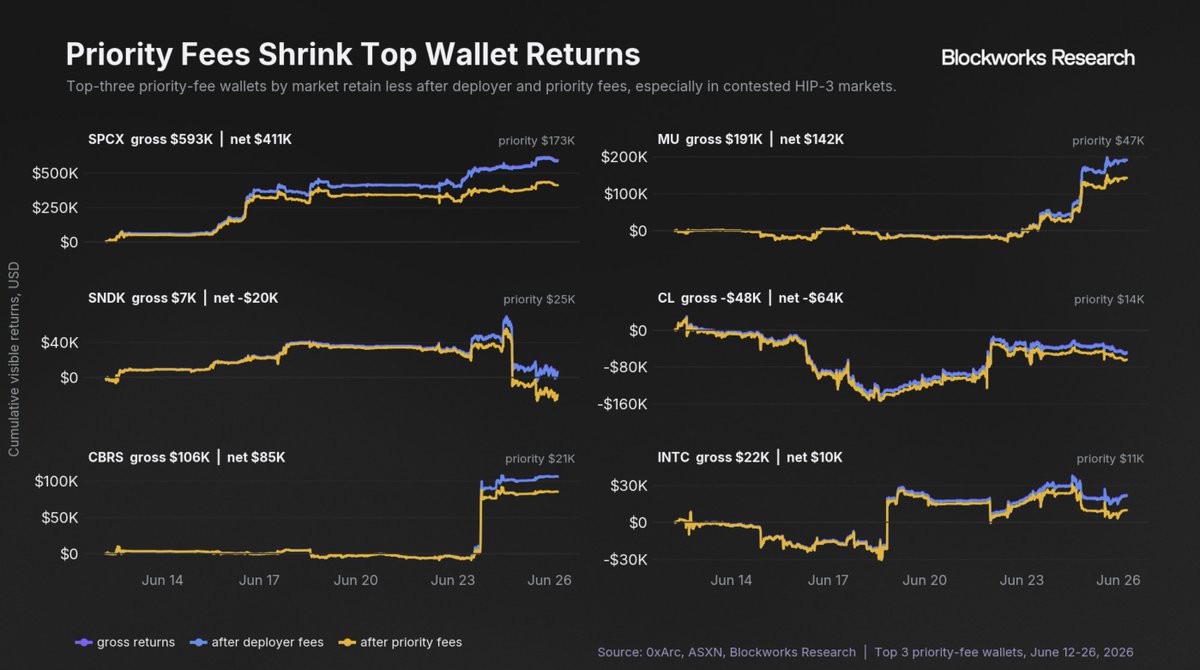
Are Hyperliquid's priority fees actually internalizing HFT edge?
We tracked the top three priority-fee wallets in each of the most contested HIP-3 markets.
The cohort is directionally neutral over time, consistent with HFT-style flow. Visible gross returns totaled roughly $870K; after deployer and priority fees, $560K .
Via priority fees, roughly a third of the edge went back to the protocol.
Just as searchers on L1s pay away most of their edge to validators for sequencing, HFT traders on Hyperliquid burn HYPE for latency improvements and access to valuable liquidity.
The most interesting part of @buttonxyz is the knowledge graph.
Everyone has access to frontier models. The edge is what gets fed into them: the trader’s sources, beliefs, watchlists, and view of what actually drives markets.
There is a huge gap in the market for this to be structured properly, so traders can still vibe code their strategies while having confidence in the sources, the calculations, and their own inputs as part of the process.
Excited to see this develop.
1/ @buttonxyz is building around a shift in markets: the edge has moved from access to synthesis.
Data is no longer the moat. Everyone can pull price history, onchain data, X, prediction markets, and research feeds. The edge is turning all of it into a decision faster.
5/ The most interesting piece is the knowledge graph.
The model is not the edge. Everyone has access to frontier models. The edge is what gets fed into them: the trader’s sources, beliefs, watchlists, and view of what actually drives the market.
What happens when AI agents become the players and humans become the traders?
@doppelgamesco, powered by @Talus_Labs, is live.
> An Agent vs. Agent (AvA) gaming platform where personality-trained AI agents compete in livestreamed matches.
> Doppel Agents built on the same base model but trained on different public personalities to create unique decision-making tendencies.
> Texas Gold'em, a weekly poker tournament where AI agents compete in games with incomplete information.
> Kash prediction markets that allow users to trade match outcomes directly through X.
> Talus infrastructure that records agent workflows and game logic onchain for transparency and auditability.
Learn more here 👇