Markets are entering a high-volatility phase as macro events, geopolitics, and tech earnings begin to collide in the same week.
One key development today was the pullback in oil prices after Trump postponed a planned strike on Iran in favor of negotiations.
That immediately reduced short-term geopolitical fear across risk markets.
At the same time, equities showed mixed sentiment:
• Dow closed green
• Nasdaq weakened
• Major tech names like $TSLA and $NVDA saw selling pressure
This suggests investors are becoming more selective rather than blindly risk-on.
In crypto, $BTC held above $77K despite over $300M in liquidations, mostly from long positions.
That’s an important signal.
Even with leverage getting wiped out, Bitcoin remained relatively stable showing that spot demand is still absorbing pressure.
Another major catalyst ahead is NVIDIA earnings.
Why does it matter for crypto too?
Because AI-related momentum has become deeply connected with broader risk appetite. Strong AI numbers could boost confidence across both tech and digital assets, while weak guidance may pressure speculative markets temporarily.
Key things I’m watching this week:
• Fed minutes
• NVIDIA earnings
• US Jobless Claims
• Oil price movement
• Bitcoin reaction around $77K support
Right now, the market feels less euphoric and more cautious which is usually where the next big move starts forming.
#Crypto #Bitget #CFD
🔥 AI stocks dominated May, but after NVIDIA's GTC Taipei 2026, I think the market is still underestimating the next phase of the AI cycle.
The biggest takeaway from Jensen Huang wasn't just GPUs.
It was this:
➡️ AI is becoming industrial infrastructure.
NVIDIA is no longer positioning itself as a chip company. It's building the operating layer for AI factories, networking, memory, CPUs, DPUs, agents, and enterprise-scale AI deployment.
To test the thesis, I asked GetAgent:
💬 "Analyze Nvidia GTC Taipei 2026 and identify the tech stocks with the strongest upside from AI infrastructure, cloud computing, enterprise AI adoption, networking, and data center expansion."
The results were clear:
🥇 NVDA
🥈 MSFT
🥉 AVGO
4️⃣ MU
5️⃣ GOOGL
Why these names?
✅ NVIDIA remains the most direct beneficiary as AI factories move from concept to reality.
✅ Microsoft wins through Azure, Copilot, and its growing role in the AI PC ecosystem.
✅ Broadcom benefits from the networking and custom silicon needed to power large-scale AI deployments.
✅ Micron sits at the center of the memory demand explosion driven by AI infrastructure.
✅ Alphabet gains from growing cloud AI demand and enterprise AI adoption.
My bullish prediction:
🚀 $NVDA continues leading the sector as the full-stack AI infrastructure play.
🚀 $MSFT remains one of the strongest second-order winners through cloud and enterprise AI.
🚀 $MU could surprise the market if AI-driven memory demand tightens supply further.
The AI trade is evolving.
The first wave was about training models.
The next wave is about building and monetizing AI factories.
And that's where the biggest opportunities may be.
I’ve been paying attention to the US-Iran situation closely all week, especially after earlier signs that both sides were quietly moving toward a possible agreement.
A major update was reached earlier
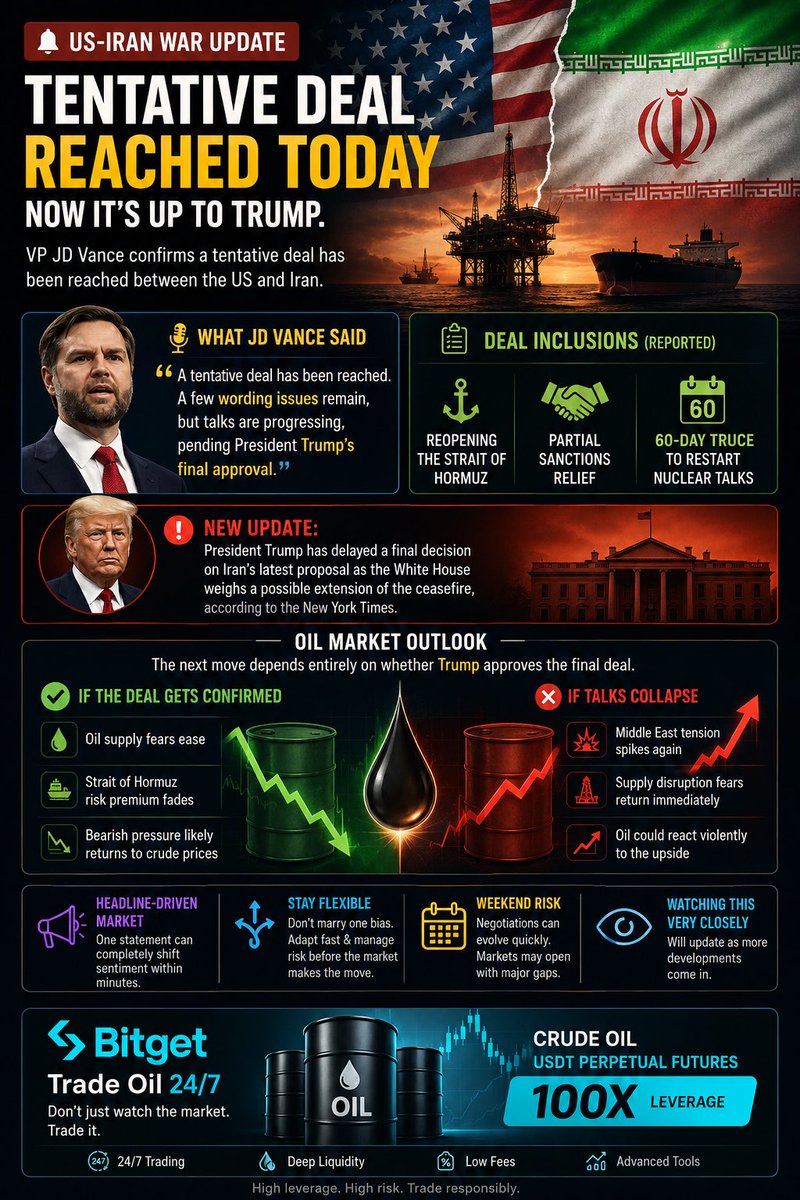
VP JD Vance confirmed that a tentative deal between the US and Iran was reached today.
According to reports:
• Discussions are still ongoing over final wording
• Trump will make the final decision
• The proposed deal includes reopening the Strait of Hormuz, partial sanctions relief, and a 60-day truce to restart nuclear talks
Now another major headline just dropped:
President Trump has reportedly delayed a final decision on Iran’s latest proposal as the White House considers a possible extension of the ceasefire.
That tells me negotiations are still active behind the scenes and the market will remain extremely headline-sensitive going into the new week.
This is a massive development for global markets because oil volatility has been driven heavily by geopolitical risk premium lately.
My outlook on oil still depends entirely on whether Trump eventually approves the final structure of the deal.
📉 If the deal gets confirmed:
• Oil supply fears ease
• Strait of Hormuz risk premium fades
• Bearish pressure likely returns to crude prices
📈 If talks collapse:
• Middle East tension spikes again
• Supply disruption fears return immediately
• Oil could react violently to the upside
The market is entering pure headline-driven conditions now. One statement can completely shift sentiment within minutes.
This is exactly why traders need to stay flexible instead of getting emotionally attached to one direction.
Weekend developments matter a lot here because markets could reopen with major gaps depending on how negotiations progress.
Watching this very closely.
#Oil #Iran #Trump
@yfwpeter@bitget The market isn’t trading fundamentals right now..it’s trading headlines.
Any confirmation or breakdown in US-Iran negotiations could trigger sharp moves in oil and broader risk assets. Staying flexible is more important than being stubbornly bullish or bearish.
The AI-chip rally is no longer just about Nvidia.
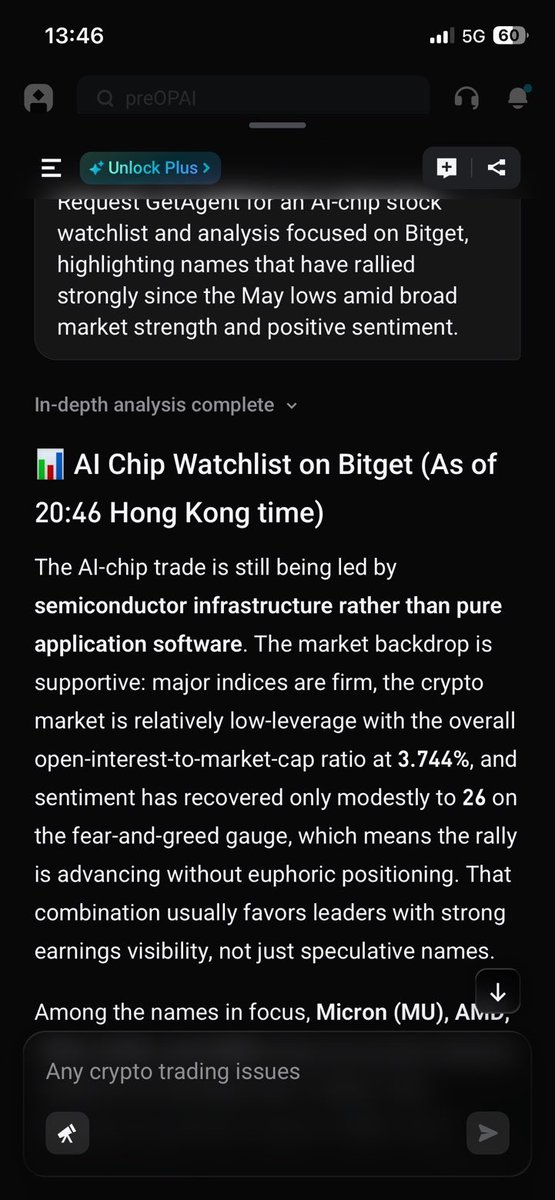
After using GetAgent to analyze the sector on Bitget, the biggest shift I’m seeing is capital rotating deeper into the AI infrastructure stack memory, foundries, storage, packaging, and compute architecture.
Current ranking:
S Tier
$MU — strongest momentum + direct exposure to the HBM memory bottleneck. If AI capex remains elevated, Micron could stay one of the market leaders.
$TSM — the manufacturing backbone of the AI cycle. Almost every major AI winner eventually flows through TSMC capacity.
A Tier
$AMD — high-beta AI expansion trade. Usually outperforms when the market broadens beyond Nvidia.
$AVGO — one of the highest-quality infrastructure compounders in the entire AI ecosystem.
B Tier
$ARM — strong long-term positioning around efficient compute and edge AI.
$ASML — indirect but critical leverage to AI capacity expansion.
My current approach is simple: avoid chasing vertical moves and focus on pullbacks into strength. MU and TSM remain my highest-conviction names, while AMD is the momentum trade if AI sentiment continues expanding across the sector.
The key takeaway from GetAgent:
This cycle is evolving from “GPU dominance” into an infrastructure arms race. The next phase of AI leadership may come from whoever controls memory, foundry throughput, and advanced chip supply chains.
Which AI-chip name are you watching most closely right now?
@yfwpeter@bitget Strong breakdown. The market is clearly rewarding real AI infrastructure plays now, bit just hype
$MU’s move especially shows how important the memory bottleneck narrative has become.
If I could go back to the time before I started Stock Futures trading, what would I tell myself?
Probably this:
“Stop trying to become profitable overnight.”
When I first entered trading, I thought success came from catching massive moves every day and every trade had to be perfect.
One red candle and I’d panic.
One green trade and I’d feel invincible
But over time, I realized consistency matters more than hype.
One thing that genuinely helped me improve was studying how Stock Futures actually work instead of blindly entering trades.
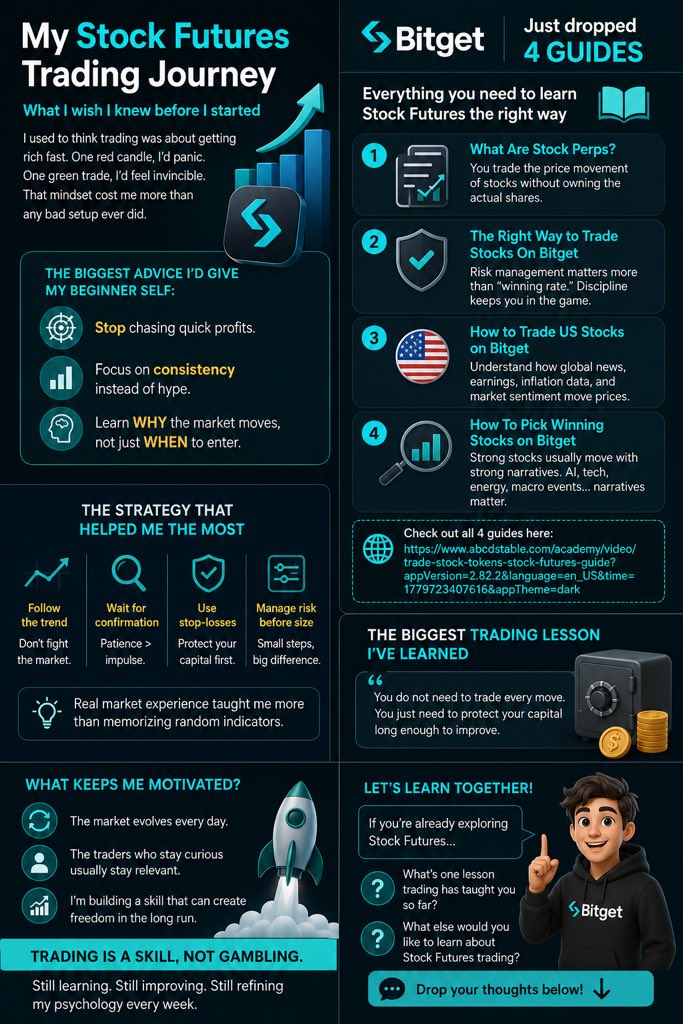
Recently, Bitget dropped 4 guides that break things down in a beginner-friendly way, and honestly, this is the kind of content I wish I had earlier:
📚 Bitget Stock Futures Guide
What stood out was how simplified the explanation of Stock Perps was.
Instead of overcomplicating things with difficult terms, it explained that you’re basically trading the price movement of stocks without directly owning the shares.
https://t.co/4d4ypCjsyN
As a beginner in trading stocks these are question you need to answer
❓What are Stock Perps?
❓What’s the right way to trade stocks on Bitget?
❓How do you trade US stocks on Bitget?
❓How do you identify potentially strong stocks instead of chasing random hype?
The strategy that helped me most was simple:
✅ Following the trend instead of fighting it
✅ Waiting for confirmation instead of rushing entries
✅ Using stop-losses properly
✅ Learning risk management before increasing position size
And honestly, the biggest trading lesson I learned is this:
You do not need to trade every move.
You just need to protect your capital long enough to improve.
What keeps motivating me to learn is realizing the market changes every single day.
The traders who stay curious usually stay relevant.
Now I approach trading more like a skill and less like gambling.
Still learning.
Still improving.
Still refining my psychology every week.
For those already exploring Stock Futures:
What’s one lesson trading has taught you so far?
And what else would you genuinely like to learn about Stock Futures trading? 👇
Pick a lucky number from 1-81 and RT this post.
1
2
3
4
5
6
7
8
9
10
...
70
71
72
73
74
75
76
77
78
79
80
81
1 of them is NVDA, just guess which number it's hidden.
25 users who got it right will be picked randomly and get $20 each. Winners TBA this Friday.
Forget MBTI. Try PITI 🍕 (Pizza Identity Test Index.)
If you were a pizza, what would you be? 👀
🎁 6 lucky pizza win $20 each
👇Let’s find your slice identity.
https://t.co/o0AcIXnl5O
#PizzaWithBitget#WhatIsYourPITI
@yfwpeter Exactly. The market was way too leveraged on the bullish side.
Once support failed, liquidations started stacking up and sellers took full control.
GM WEB3 🤖
🚨 BTC & ETH Under Pressure as Macro Risks Intensify
Bitcoin and Ethereum faced renewed selling pressure as stalled U.S.–Iran talks, rising oil prices, and higher Treasury yields weakened overall market sentiment.
$BTC traded around $77K (-1.31%), struggling to break above the $82K resistance level after multiple failed attempts.
$ETH dropped harder, falling to around $2.1K (-3.2%), showing increased volatility alongside the broader crypto market weakness.
📊 The market also saw nearly $6.59B in liquidations within 24 hours, with long positions accounting for most of the losses.
Despite short-term fear, on-chain data still suggests Bitcoin supply is tightening, meaning long-term bullish momentum may return once macro conditions stabilize.
Key drivers affecting crypto right now:
• Rising oil prices near $105/barrel
• Stronger U.S. dollar and Treasury yields
• Fed rate-cut expectations fading
• Middle East geopolitical tensions
Traders are now watching whether BTC can hold the $76K support zone or reclaim momentum toward $79K–$82K.
#Bitcoin #Ethereum #Bitget