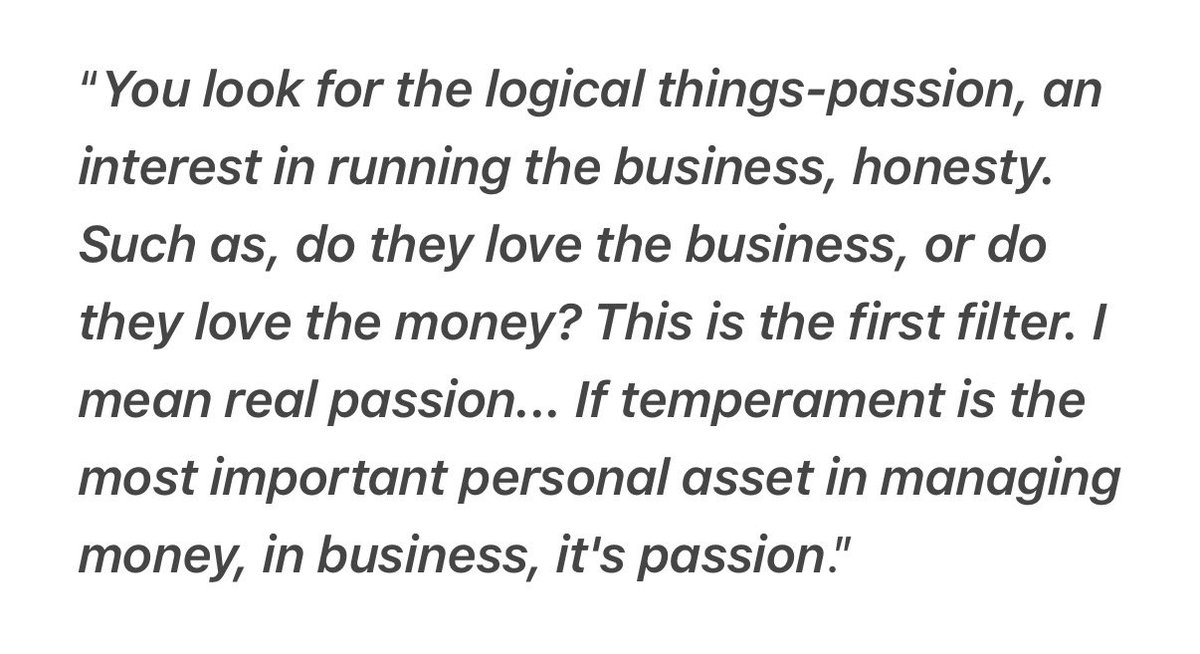
I'm still twitching from having sold Pool Corp many years ago because I had calculated that it was trading well in excess of its intrinsic value and was too big a part of the portfolio.Pool Corp is up 8fold from where I sold it.I've learned not to sell the great businesses.PKeefe
During a Bloomberg interview, Yann LeCun (@ylecun ) explains why LLMs are limited in terms of real-world intelligence during a Bloomberg interview.
"Language is a very approximate, reduced, quantized, and simplified description of the world, and LLMs can only deal with discrete sequences of symbols. The world is much more complicated than language.
The biggest LLMs are pre-trained on the totality of all the publicly available text on the internet. That’s about 20 trillion words, or 30 trillion tokens.
A token is about 3 bytes. So total 10¹⁴ bytes of text.
This is the amount of data a four-year-old has seen through vision during four years. Now, the text, though, would take 400,000 years to read?
So, there is enormously more data from sensory input, like vision, touch, and everything else, than there could ever be through language."
A child does not need 400,000 years of reading to understand cups, doors, balance, faces, falls, or heat, because the body is already collecting dense feedback from vision, touch, motion, and consequence.
Text strips most of that away.
It turns a living scene into symbols, then asks the model to infer the missing world from traces left by people describing it.
That is why an LLM can sound fluent about physics and still have no native sense of how fragile glass feels in a hand.
Moravec’s paradox names this reversal: the things humans find intellectual can be easier for machines than the things toddlers do without applause.
The hard part is not producing an answer, but building a model of the world that survives contact with weight, friction, surprise, and failure.
----
Link to the full video on Bloomberg's site. Link in comment.
Don't sell your compounders too early. @MohnishPabrai explains why a strict application of Ben Graham’s valuation framework could have led investors to sell Walmart in the 1970s, causing them to miss the extraordinary compounding that followed.
https://t.co/dVBClDYX9b
How Europe Is Designing a Tax System You Can’t Escape.
The Netherlands is introducing a 36% tax on unrealized investment gains in 2028, even if you don’t sell your assets.
The tax will be due each year on paper profits.
Charlie Munger’s lessons from Kodak:
“If somebody as brilliant as old Eastman… who hired as many brilliant people… could take the company into bankruptcy, I figured that lesser people could easily take big companies into bankruptcy, eventually…”
Brilliant explanation from Nvidia CEO Jensen Huang on AI's job effect:
In software, AI makes coding faster, but that does not mean fewer engineers are needed.
Before AI, we could write 1 billion lines of code; now, with AI, we can aim for 1 trillion.
AI will create more jobs than any other technology in history.
The doomers' fundamental error isn't just the lump of labor fallacy. It's deeper than that.
They assume a finite problem space.
This is the fundamental error of AI and job doomers. They look at the economy and see a fixed amount of work to be done, a pie that can only be sliced thinner as machines take bigger bites. They see humans a competitive resource for a finite amount of work and a finite amount of problems to solve that must be eliminated.
This is fundamentally, totally and completely wrong.
The pie isn't fixed. It never was. And the reason it isn't fixed is baked into the very nature of technology itself.
Technology is nothing but abstraction stacking. And abstraction stacking is infinite. Therefore the work is infinite.
The hammer didn't reduce the amount of work. It moved the work up the stack. And the new work was more complex, more varied, and more interesting than the old work.
Complexity breeds more complexity and more variety.
Once you have houses instead of mud huts, you have a cascade of new problems that didn't exist before. Plumbing. Wiring. Insulation. Roofing materials that don't rot. Drainage systems so the foundation doesn't flood. Fire codes so your neighbor's bad wiring doesn't burn down the whole block.
Each of those problems becomes a job. A plumber. An electrician. An insulator. A roofer. A civil engineer. A building inspector. None of those jobs existed when we lived in mud huts.
They exist because we solved the mud hut problem.
Think of all of human technological development as a stack of abstraction layers, each one built on top of the ones below it.
At the bottom: raw survival. Finding food. Building shelter. Making fire. These are the base-layer problems.
Each major technology wave solved a base-layer problem and in doing so created an entirely new layer of problems above it:
Agriculture solved "how do we reliably eat?" — and created problems of land ownership, irrigation, crop rotation, storage, trade, taxation, and governance.
Writing solved "how do we remember things across generations?" — and created problems of literacy, education, record-keeping, law, bureaucracy, and literature.
The printing press solved "how do we spread knowledge at scale?" — and created problems of intellectual property, censorship, journalism, publishing, public opinion, and democratic discourse.
The steam engine solved "how do we generate mechanical power without muscles?" — and created problems of factory design, worker safety, urban planning, railroad engineering, coal mining, labor relations, and environmental pollution.
Electricity solved "how do we deliver energy anywhere?" — and created problems of grid design, power generation, appliance manufacturing, electrical safety codes, utility regulation, and an entire consumer electronics industry.
The Internet solved "how do we connect all human knowledge?" — and created problems of cybersecurity, digital privacy, online commerce, content moderation, network infrastructure, cloud computing, social media dynamics, and an entire digital economy that employs tens of millions.
Notice the pattern?
Each solution didn't just solve a problem.
It created an entirely new problem space that was larger, more complex, and more varied than the one it replaced.
The stack grows. It never shrinks.
It's turtles all the way down and all the way up.
WATCH: Taiwanese grandmothers aged 89 and 91 train at the gym. An increasing number of elderly people in Taiwan’s super-aged society are hitting the gym to stay healthy, both physically and mentally.
I've always liked the story of Charlie Munger.
At 31, he was basically at rock bottom.
He was freshly divorced, had lost the house, and his son died of leukemia. Munger paid for every treatment out of pocket and was left with almost nothing.
Yet he kept going.
Instead of drowning in bitterness, he worked, he read, and he kept his head down.
With a new marriage and some stability, he began investing his lawyer's salary into stocks and real estate.
Then in 1959 he met Buffett.
Inspired by someone who was already running his own partnership, Munger founded Wheeler, Munger & Company in 1962.
The wealth started to accumulate. Through real estate projects and his growing investment partnership, Munger became a millionaire around age 43.
Many successful investments followed, many alongside Buffett, and the relationship grew close enough that working together was the only thing that made sense.
Munger wound down his partnership in 1975. Over 13 years, he had compounded at 19.8% annually, against 5% for the Dow.
In 1978, he became Vice Chairman of Berkshire Hathaway and helped build the empire it was set to become.
Somewhere along the way he lost an eye to a failed surgery, but that didn't bother him much. He still had one left. Plenty enough to read annual reports.
When most people think of Munger, they just see a rich old wise man who almost stood in Buffett's shadow. But the truth is that Munger's wisdom didn't come from nowhere.
He worked himself up from rock bottom, a place where many others would have stayed down, to become one of the most respected investors in history. And a billionaire on top of that.
He never let it go to his head. He lived in the same house in Pasadena for decades. The place didn't even have AC. He cooled it with ice and fans.
Hard to find a better role model than that.
Warren Buffett's "Cockroach Theory":
When a company begins to show signs of its own internal missteps (management mishaps, accounting irregularities, etc.), Buffett has a simple rule:
"What you find is there's never just one cockroach in the kitchen when you start looking around."
"Because any time you put the focus on an organization that's hundreds of thousands of people working for it, you may very well find it wasn't just the one who misbehaved that you found out about it…"
It's safer to assume the issues might be pervasive and adjust your investing actions accordingly going forward.
As Munger colorfully cautions:
"Never wrestle with a pig because if you do you'll both get dirty, but the pig will enjoy it."
consultar como has evolucionado en la distribución de salarios en España, comparación de tu sueldo bruto respecto a la media de la OCDE y la deuda pública per cápita.
https://t.co/ab84boUqyF
Howard Marks on holding onto winners in your stock portfolio
From his recent interview at Wharton
"Buffett says he made all of his money on 12 ideas. Guy invested for 70 years and said he made all his money on 12 ideas. Charlie Munger used to say he made all his money on 4 ideas. He didn't have as many good ideas as Warren"
This AI whistleblower just EXPOSED Sam Altman for manipulating his way into becoming OpenAI’s CEO.
Everyone who helped him build it has left because they felt used.
Karen Hao interviewed 300 people including 90 current and former OpenAI employees.
And she just told Steven Bartlett what she discovered:
In 2015, Altman needed Elon Musk to co-found OpenAI. Problem was, Musk was obsessed with AI as an existential threat.
So Altman wrote a blog post calling AI "probably the greatest threat to the continued existence of humanity."
Before that blog post? Altman's biggest fear was engineered viruses. Not AI.
He literally rewrote his worldview overnight to mirror Musk's language word for word. Musk bought in. Donated millions. Co-founded the company.
Then Altman stabbed him in the back.
When OpenAI needed a CEO for its new for-profit arm, the co-founders Ilia Sutskever and Greg Brockman initially chose Musk.
Altman went directly to Brockman, a personal friend, and said: "Do we really want someone this erratic and unpredictable to control a technology that could be super powerful?"
Brockman flipped. Then convinced Ilia to flip.
Musk found out he wasn't getting the role and left.
That's how the biggest rivalry in tech actually started. Not over ideology... Over a backroom power play.
But here's where it gets darker:
Every single person who built OpenAI alongside Altman eventually felt the same thing Musk felt. Used. Manipulated. Discarded.
Dario Amodei, VP of Research, thought Altman shared his vision. Over time he realized Altman was on "exactly the opposite page" and had used his intelligence to build things he fundamentally disagreed with. He left and founded Anthropic.
Ilia Sutskever, co-founder and chief scientist, tried to get Altman fired. He told colleagues: "I don't think Sam is the guy who should have the finger on the button for AGI." He was pushed outounded Safe Super Intelligence. That name alone tells you everything.
Mira Murati, CTO, left and started Thinking Machines Lab.
No other tech company in history has had every single co-builder leave and start a direct competitor.
Not Google. Not Meta. Not Apple. NOBODY.
300 interviews exposed one consistent pattern:
If you align with Altman's vision, you think he's the Steve Jobs of AI. If you don't, you feel like you were manipulated by someone who will say whatever is needed to whoever is listening.
When talking to Congress? AGI will cure cancer and solve poverty.
When talking to consumers? It's the best digital assistant you'll ever have.
When talking to Microsoft? AGI is a system that generates $100 billion in revenue.
Three completely different definitions of the same technology sold to three completely different audiences.
And if you publicly disagree with any of it?
OpenAI subpoenaed 7 nonprofit organizations that criticized them. Sent a sheriff to a 29yo nonprofit lawyer's door during dinner demanding every text, email, and document he'd ever sent about OpenAI.
A one-man watchdog nonprofit got papers demanding all communications with anyone who questioned the company.
OpenAI's own head of mission alignment publicly said "this doesn't seem great." That's the guy whose literal job is making sure OpenAI BENEFITS humanity.
Former employees who spoke up about secret non-disparagement clauses that threatened to strip their equity described the psychological pressure as "crushing."
This is the company that tells us it's building technology "for the benefit of humanity."
Same company that mirrors whatever language gets them funded.
Same company where every builder eventually walks away feeling deceived.
Same company sending law enforcement to silence critics.
The biggest AI company on Earth wasn't built on technology.
It was built on one man's ability to tell everyone exactly what they needed to hear.
And the scariest part is that it worked.