For the first time, institutions are really coming on-chain in size, and they chose @0xfluid.
We are working deeply with the biggest TradFi asset managers and co-designing markets with them. The reason why they want to deploy with us is simple - Fluid has the most advanced and flexible infrastructure in DeFi.
Institutions want to be in full control of their markets. No institution can work within a limited, immutable system where they can not change the oracles or LTVs if required.
Fluid provides them with full control over every parameter, gives access to the most advanced lending market algorithms, extreme DEX efficiency, and many more tools within the same liquidity layer. And Fluid is the only DeFi protocol with an equivalent deployment across EVM and Solana.
We are also creating bespoke solutions for them, including a legal framework for their markets. Our goal is to work with a few, very valuable partners and grow their markets to tens of billions instead of trying to onboard every DeFi risk curator with small, fragmented markets.
We are proud that @Bitwise is our first partner, and they will become a multibillion risk curator onchain within a few weeks, with many new RWA markets in the pipeline.
Stay Fluid 🌊
+10% on USDC, one of best yields on stables in DeFi right now 🌊🌊🌊
Lite USD vault has incurred no losses to users and realtime reserves and active positions can be tracked on our status page: https://t.co/UpIjDnpero
The Arbitrum Security Council has taken emergency action to freeze the 30,766 ETH being held in the address on Arbitrum One that is connected to the KelpDAO exploit. The Security Council acted with input from law enforcement as to the exploiter’s identity, and, at all times, weighed its commitment to the security and integrity of the Arbitrum community without impacting any Arbitrum users or applications.
After significant technical diligence and deliberation, the Security Council identified and executed a technical approach to move funds to safety without affecting any other chain state or Arbitrum users.
As of April 20 11:26pm ET the funds have been successfully transferred to an intermediary frozen wallet. They are no longer accessible to the address that originally held the funds, and can only be moved by further action by Arbitrum governance, which will be coordinated with relevant parties.
There are two apps I’m currently lending ETH for absurdly high rates, not suffering from any rsETH bad debt afaik but benefitting from the huge surge in ETH lending APYs.
@0xfluid@sparkfinance Lend
Waiting for more information to come from Kelp and then more importantly from Aave. Aave will survive all this but it’s a big stress test for Umbrella (which can’t cover the total estimated bad debt).
There is nothing wrong with doing nothing here. Wait for more info.
The fallout from the Kelp rsETH exploit is going to be messy and could potentially be quite a bit more severe than some people are making out right now.
It seems rsETH on mainnet is technically still backed, but, there's no liquidity to sell rsETH, and with rsETH contracts paused, there’s currently no usable redemption path either.
In the unlikely case they socialised the loss across all rsETH holders, it would be worth something like 81.25% (1 - $300m/$1.6b) of its original value.
I don't think they will do that though. It would likely push a number of large positions on Aave towards undercollateralisation and risk creating bad debt. That alone would be enough to trigger a long and painful lawsuit.
So realistically rsETH holders on L2s are likely going to swallow the loss. Who are they? Why did they have rsETH on L2s in the first place? Could be other DAOs or funds etc who've taken a huge hit. That alone could have consequences we won't know about for some time.
Impacted individuals on L2s will likely consider their own legal action to force socialisation, potentially prolonging the delay before redemptions are opened.
Either way, once redemptions are eventually opened, it's unlikely any lending protocols would re-allow collateralisation, so there will be need to be a massive unwind of huge volume of rsETH/ETH looping trades.
All those looping trades are currently massively negative ROE. Aave ETH utilisation is currently at 100% with ETH borrow rate at 8.71%. Since staked ETH yield is around 2.5%, the ROE for any LST or LRT borrow or looped borrow is anywhere between -6.21% and around -90%, depending how degen people are. So we could see an unwind of lots of LST loops aside from just rsETH/ETH ones.
The normal path to unwind a loop is to swap collateral and repay, but this is unlikely to be possible for such a large amount of unwinds at once, and certainly won't be feasible for rsETH unless someone puts up significant liquidity for it.
When the swap and repay path fails, you normally have to withdraw as much collateral as you can, manually redeem, repay some debt, withdraw more collateral, and so on.
Here's the kicker. If rsETH is no longer collateral and no longer has borrowing power, this makes it much more difficult for people to manually unwind as well.
If people get stuck for longer periods paying huge negative ROE for too long, and there’s no liquidity to liquidate them, their equity gets eroded. Once debt exceeds recoverable collateral value, bad debt appears, and can keep worsening as interest accrues and the position remains unresolved.
The Euler Vault Kit (EVK) is the factory for onchain lending markets.
One vault per asset. Fully isolated. Permissionless to create.
Vaults connect through the EVC to enable cross-collateralization, multi-vault strategies, and composable lending positions.
Every lending market on Euler starts here.
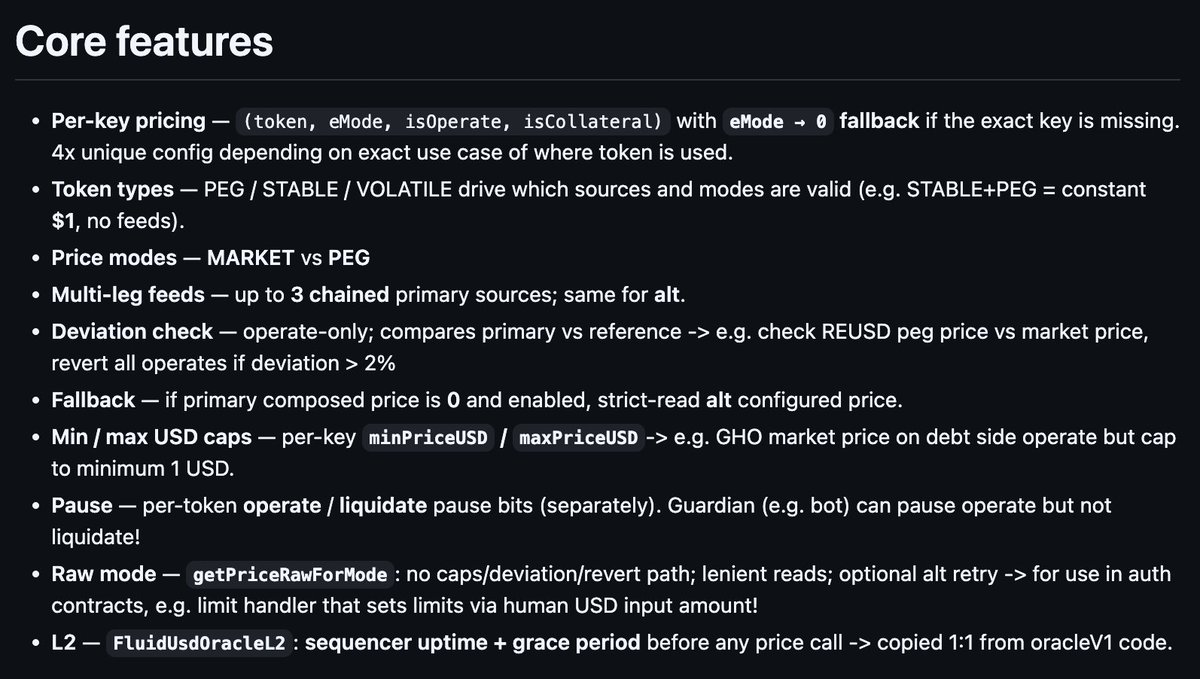
At @0xfluid, we are working on most advanced oracles in DeFi which will allow us to configure every small config on: What pricing to use, when to use it and how to use it.
Here what we will be able to control:
- Use different price for user's operation & liquidations. For peg assets, use market pricing for user's operation and fundamental pricing for liquidation. If market price differs more than 2% than fundamental pricing then pause withdrawals & borrowings. Allowing protocol to not take any extra risk.
- For an asset used on collateral side, use more "conservative pricing" for user's operations while "realistic pricing" for liquidation.
- For an asset used on debt side, use more "aggressive pricing" for user's operations while "realistic pricing" for liquidation.
At any time, the pricing between liquidate & operate (user based operations) differs by x%. Then limit protocol from taking any new risk.
----------
In short, protocol will use both market price and fundamental price depending on action and go into temporary partial lockdown when pricing deviates by certain %.