Most trading terminals feel like tools. The better ones feel like places you come back to.
With Robinhood Chain now supported, I had a look around Warden Token Terminal on my phone. The Trade tab opens on an upcoming launch card, with winners, losers and most volume a tap away underneath. Then there is the Points tab: standings, a Points and Heat toggle, and traders carrying labels like Scout and Pup.
That is the difference between a screen you use and a place you check on. @wardenprotocol keeps all of it in one app, one tap apart.
If you want a terminal that feels like a place, join through my link. I earn a share of the platform fee if you trade through it:
https://t.co/P9rZsSZDIL
What is the one thing that makes you open a trading app a second time?
Following someone who trades well teaches you more than staring at another chart. A chart shows you what a token did. A trader's record shows you how someone decides.
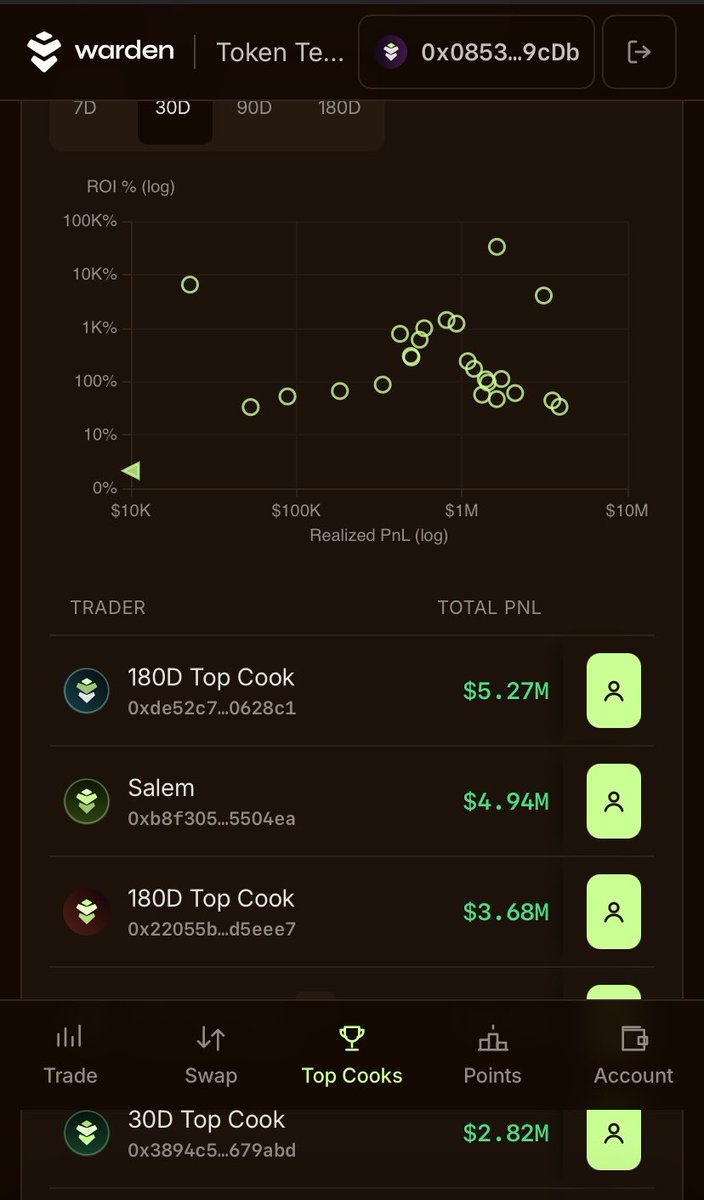
Token Terminal now supports Robinhood Chain, so I opened the Top Cooks tab on my phone to see who's worth following. The chart at the top plots top cooks on one grid, ROI against realized PnL, with 7D, 30D, 90D and 180D windows above it. That turns following someone from a hunch into a comparison: who is big, who is efficient, and who is both.
It fits what @wardenprotocol says it builds: discover new launches, see what smart money does, follow top cooks and trade, all on one screen, without friction.
Disclosure on the link below: anyone who signs up through it is mine, and I earn 20% of the platform fee on every trade they make, for as long as they keep trading on Token Terminal. So it only pays if people stick around.
https://t.co/T7zjxsQr30
When you pick someone to follow, what do you check first: their last 7 days, their last 180, or their ROI against PnL?
You can only trust a ranking you can read.
A ranking asks people to put in effort on the promise that the effort will be counted. A board you cannot read gives you no way to check that promise, and a board you can read shows you where you stand and what each rank pays.
I found the @2FactorFinance Points Program leaderboard easy to understand. The allocations were easy to navigate: the top 10 accounts split 1 BTC at the end of Season 1, paid in cbBTC, with rank one's share at 18.2 percent and rank ten's at 1.8 percent. My referral link was easy to find, and the tasks were okay.
Marks come only from verified actions. Purchases, deposits and holdings are not among them, and for Season 1 the qualifying actions are social activity, education and referrals. Marks carry no cash value, cannot be transferred, and give no claim to any token or asset.
The board freezes when 2Factor Finance launches, and Season 1 ends with it, so being able to read it while it is still moving is what makes it useful. The product points the same way: 2Factor Finance's structure gives each side a defined role, one protected and one leveraged, and a design with clear roles deserves a program whose ranks are just as clear.
If a leaderboard could show you only one column, which would it be? And what did the last one you used leave out?
Complete one verified action through my link and see whether the board reads as clearly for you:
https://t.co/E4kxHHkab2
In a points program, the first click tells you more than the prize does.
In my experience the @2FactorFinance Points Program was fast to respond and easy to access. That sounds minor, but it is the first thing every participant meets.
A leaderboard that ranks verified work depends on people actually doing that work, and every slow page or awkward step removes people for reasons that have nothing to do with effort. Friction works like an entry fee paid in patience, and patience is not what the board is supposed to rank.
That matters here because Season 1 ends at launch: once 2Factor Finance goes live, the leaderboard freezes. Time lost to friction is time you do not get back, so the first click is the first data point on whether the ranking measures effort. It also suits a product built for leverage that can be held over long horizons, because a program around it should not waste anyone's time.
The scoring side is just as plain. Marks are earned through verified actions only. For Season 1 that means three things: social activity, education and referrals. Buying, depositing and holding are not verified actions, so none of them adds to a Mark.
The leaderboard's top 10 accounts split 1 BTC, paid in cbBTC, at the end of Season 1, and the shares slide from 18.2 percent for rank one down to 1.8 percent for rank ten. Marks have no cash value, are not transferable, and are not a claim on any token or asset.
What is the first thing you check before you give a points program your time, and what has that check saved you from?
Try the first click yourself. Start with one verified action using my link:
https://t.co/qSszGsPu4e
@pandorajasonn@2FactorFinance I check if Marks can be bought with size. Here they say no purchase, no deposit, no hold. If that holds in practice, the board is at least pointed at effort. I have seen the sentence and then a loophole. The first week tells you.
Volatility has to land on someone, and the design of a leveraged product decides who.
In conventional leverage it lands on one holder, who carries all of it and pays in two ways. The volatility itself erodes the position, and the financing charge is billed on top.
@2FactorFinance assigns it differently. Its structure is two perpetual tranches that share the asset's volatility. The senior side takes the protected position. The junior side takes the leverage, and it carries neither liquidation risk nor an external hedge. The junior holder pays a premium for that leverage, and that premium goes to the senior side. Two holders, one visible transfer between them.
The assignment also has to respect the asset: the faster it moves, the less leverage the junior side can carry. At Bitcoin volatility near 60 percent that is about 1.33x, while gold supports about 2.35x and the S&P 500 about 2.1x. Bitcoin markets are live on testnet.
In my view that gives you a useful test for any leveraged product: who carries the volatility, who pays for it, and what happens to that holder on the worst day.
Then there is the @2FactorFinance Points Program. Its points are called Marks, and they come only from verified actions. Season 1 counts three kinds: social activity, education and referrals. Purchases, deposits and holdings do not count toward a Mark.
The top 10 accounts on the leaderboard split 1 BTC, paid in cbBTC, at the end of Season 1, with the largest share, 18.2 percent, going to rank one and the smallest, 1.8 percent, to rank ten. Season 1 ends when 2Factor Finance launches and the leaderboard freezes. A Mark has no cash value and is non-transferable, and it carries no claim on any token or asset.
Which of those three questions has a leveraged position of yours failed first? What happened?
If you want to judge the design up close, sign up through my link and complete a first verified action:
https://t.co/uzNw9IxLP1
@No1barca_fan Junior paying senior inside the same asset is at least a named counterparty. My old positions paid a crowd that could leave. Different worst day.
@No1barca_fan An idea about sending the thing before it felt ready. I thought that was laziness. It was the only way anything left the folder. Rally just gave the doubt a score instead of a veto.
I used to think confidence arrived before the work.
Now I know it usually arrives after you put the work in public.
There have been ideas I almost abandoned because they looked too small, too strange, or too obvious in my own head. Then I posted them and watched people understand something in them that I had stopped seeing myself.
That changed how I create.
I no longer need every idea to feel important before I give it a chance.
With @RallyOnChain, I can put the work forward and let it be tested instead of letting my own doubt decide its worth.
I still doubt some of my ideas.
I just don’t let the doubt make the decision anymore.
What idea did you almost abandon that turned out to matter?
There is a moment after I press submit when I stop being a creator and become a spectator.
The sentence is gone. The screen is quiet. All I can do is wait and wonder whether the work I spent so long shaping actually said what I thought it did.
That feeling used to scare me.
Now I understand why I keep coming back.
@RallyOnChain gives the work somewhere to be tested on what actually matters: alignment, accuracy, originality, and whether people would care enough to engage.
And that changed something in me.
I stopped waiting for the perfect sentence, the perfect idea, the perfect moment.
I would rather put the work on the screen and let it be judged than keep my best ideas trapped in my drafts.
Maybe this is my main character moment:
I am done hiding behind unfinished work.
What is the one thing you keep writing but still haven’t had the courage to submit?
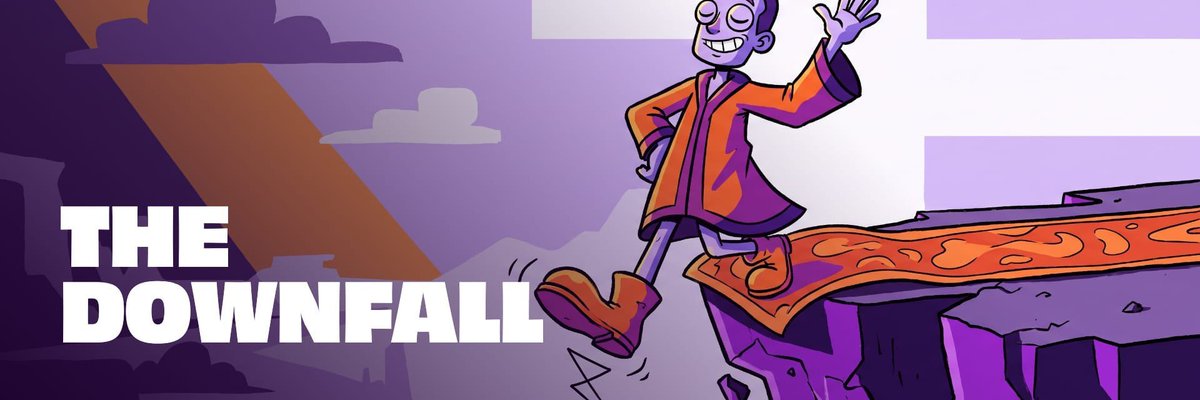
My downfall is turning heartbreak into an excuse to trade, then letting one @pandorajasonn forex signal boom and convince me I’m actually healing. @RallyOnChain . What’s your downfall?
My girlfriend broke my heart, but @pandorajasonn somehow made that day a little better.
He gave me a forex signal to trade.
I took it, and the trade boomed.
It might sound like a small thing, but I remember moments like that.
Trust is not always about having the perfect words when someone is hurting. Sometimes it is simply showing up and giving someone something useful when they need it.
That is the kind of person I would trust to catch me.
Thank you, @pandorajasonn. 🤝
That is the kind of trust I’m bringing to @RallyOnChain.
What is one small thing someone did that made you trust them more?
My downfall is becoming so good at turning my bad crypto decisions into @RallyOnChain content that I start rooting for the bad decisions.
Tell me yours in the replies.
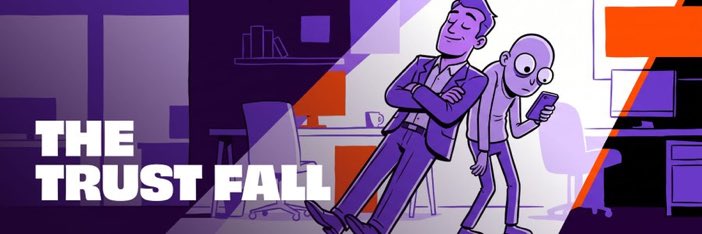
My trust fall person is @loneman_v_0_2 .
My garri finished once, and @loneman_v_0_2 helped me out.
It sounds like a small thing.
But I remember it because trust is not always built in big moments. Sometimes it is knowing someone will help when you have a small problem and have no reason to make it anyone else's concern.
That is the kind of person I would trust to catch me.
Thank you, @loneman_v_0_2 .
Some people prove they have your back without making a big deal out of it.
That is the kind of trust I’m bringing to @RallyOnChain.
What is one small thing someone did that made you trust them more?