🚨🇺🇸 Palmer Luckey and the man who brought back the dire wolf are building CAPTAIN AMERICA PUPS... $200 million worth of cloned and gene-edited good boys for the Pentagon
The problem Warhound is solving is real: the Pentagon runs 2,200 dog teams, buys 80% of them from Europe while bidding against China and Russia for the same litters, and has to purchase 200 dogs to field 100 because the rest wash out with bad hips, bad eyes or cancer.
Warhound biobanks the best Malinois and Shepherds that already passed, clones them, edits out the career-ending genes, and straps on Anduril armor, eye and ear protection and goggles tied into its battlefield network so dog, handler and drones share one picture.
First dogs in two years, sold as “Canine-as-a-Service,” with the Humane Society certifying training and reuniting retirees with their handlers.
Anyone who has worked next to a military dog knows they find what sensors miss and go where machines can’t, and losing half of them to genetics before they deploy is a waste the troops have eaten for decades. Lamm calls it the Captain America dog program.
A $1.2 billion valuation for the goodest boys ever made, and WORTH EVERY CENT.
Source: TechCrunch / Writer: Daniel
ICP "cloud engines" launch trajectory:
DFINITY will soon begin disbursing coupons with enough cycles to create and power an engine for 1 month+, unlocking in sequence:
1. Agentic infrastructure ⚡️ Quickly build secure, sovereign onchain production apps using Claude Code, Codex, Caffeine, ...
2. Open SaaS beta release ⚡️ Install AIware apps that can run any enterprise, as easily as installing phone apps...
3. Unlimited growth ⚡️ A new end-to-end, mainstream onchain cloud tech stack will come into being.
*** What this means ***
ICP cloud engines are a new development on the Internet Computer designed to allow it to play the role of a revolutionary new cloud tech stack for the AI era.
Currently, the Internet Computer scales by combining internal subnets, which are akin to individual, high performance blockchains hosting secure serverless software called canisters (something like smart contracts, but much more powerful, which can be used to create huge onchain apps, which serve their web screens directly to users)
Cloud engines allow enterprises to create their own subnets that belong exclusively to them, which they control and configure — while their canister software can still seamlessly interoperate with software on the main network, and engines run by others.
An enterprise creates a cloud engine by choosing nodes from a marketplace, which the ICP protocol combines into a revolutionary serverless cloud platform for them, where the computation and data of their hosted apps and services is tamperproof (immune to infrastructure hacks) and always on (incredibly resilient), AI agents can build and update apps far more effectively than on traditional tech, and next generation AIware software can be created.
Today, enterprises demand to be able to control where their sotware and data lives, and cloud engines make that possible with no loss of flexibility. Cloud engines can even be re-configured with new nodes, without interrupting the hosted apps and services — the ICP protocol just handles it, granting complete sovereignty and freedom from vendor lock-in.
In advance of general release, cloud engines are already being used by governments and NGOs seeking to create sovereign cloud tech stacks and apps. On general release, they will be used in far more mainstream ways too.
Here are the details of what's coming.
*** Agentic Infrastructure ***
In the future, and really already today, nearly all of our apps and services will be created by AI agents rather than humans. Further, next generation software is "AIware," which has AI deeply integrated on the inside, which allows it to provide superpowers relative to traditional software.
Agents have different needs when they building things. They can write software orders of magnitude faster than humans, and we will demand they update our production apps and services at the speed of conversation. Functionality will be fluid and its shape will change to match what we want.
On traditional tech stacks, updating apps and services is a necessarily laborious and risky process for three reasons: 1) a security flaw might be introduced, 2) a systems configuration change might break them, and 3) the way that data is migrated might cause some to be lost, often in subtle ways that aren't detected at the time of the upgrade. This means that AI agents can't just be let of the leash to build and update at the speed they can.
ICP cloud engines solve this. Hosted software is tamperproof, so agents can update without needing security teams in the loop. Hosted software is serverless, and the data lives in the logic, so apps don't. need things like operating systems and databases configured to run, so agents can update apps without having sysadmin teams in the loop either. And, if Motoko 2.0, the world's first languge targeting agents is used as the backend language, its framework is able to detect when an app update by AI might cause data loss, and simply require the agent writing the code to try again, reducing potentially catastrophic data loss to a harmless retry.
Crucially, apps built with Motoko can also put AI agents on the inside, so that subject to permissions, they can see the data graph in the persistent memory used by serverless software on ICP, and access its functions. This enables you to instruct agents to do things in the apps for you, such as analyzing data, or performing actions, with great flexibility and power.
ICP cloud engines are agentic infrastructure that change the game — and it will be possible to use them as such from the moment they are released.
There is already a government using internal production software built on a cloud engine using Caffeine. But cloud engines will meet a wide range of mainstream needs, from solorpeneurs to startups, SMEs to corporations, governments and NGOs.
*** Open SaaS ***
The obvious question, is if AIware is so much better, shouldn't all enterprises be running on it? We believe they should, and that his must be enabled.
This has been a labor of love for me. A new venture associated with me will release the Open SaaS suite for use on cloud engines once they have been running a short while, which suite, as you've probably guessed from the name, is open source and free.
Open SaaS is a suite of every important SaaS (Software-as-a-Service) app used to run enterprises around the world today, reimagined as onchain AIware that runs on ICP cloud engines. Because of the unique nature of the software that ICP hosts, installing and maintaining these sophisticated enterprise apps on a cloud engine is as easy as installing and managing a phone app.
A small selection of the apps: Open Team, Open HR, Open Accounts, Open CRM, Open Projects, Open Email, Open Messaging, Open Signing, Open Knowledge, Op... etc. There are many more, and there will be surprises.
The user experiences are beautiful, and easily compete with the big money SaaS screens many enterprises are used to. Moreover, the are linked to what I called a "software factory" driven by AI, and the more enterprises that use them and provide feedback, the better they will get, in realtime.
Today's expensive SaaS silos make it hard to integrate and combine enterprise data, and to unleash the full power of AI. They are the opposite to Open SaaS.
In the future, enterprise users will spend far more time in AI chat than on SaaS screens. That's the future that Open SaaS enables and unlocks. Enterprise users can even say to their Open SaaS suite, "make me more profitable," and it will have a go.
The big surprise coming for the world: once you run your enterprise on AIware, and AI can access all your data in realtime, and is integrated with your software's actual functions — it can become as good at running your enterprise as writing software for you.
It's revolutionary, and ICP is pioneering this. Not a narrative, but real decentralized network tech.
Something I can share: DFINITY is in the process of migrating to Open SaaS from a vast suite of expensive SaaS silos, and is already reaping big benefits as we refocus ourselves for the era of AI.
****
What does this mean for the project?
I believe ICP cloud engines are the vector that will transform the the Internet Computer into a mainstream agentic infrastructure tech platform for enterprise— which direction platforms like Caffeine have already helped the network travel, by enabling many tens of thousands of users and enterprises to create onchain apps on the shared network through online conversation. Now, the next and most important phase is approaching.
Our go-to-market will proceed quietly as we rollout coupons and work to fettle the new network functionality, but I think that in hindsight, the launch of cloud engines will be seen as the most pivotal moment in Internet Computer history since network launch.
With this, ICP shall show the industry how networks can provide real agentic infrastructure.
Bear with us as we tie up loose ends. We never stop working, and you can be sure that we're trying to get this out as fast as possible 💪⚡️💥
@_Crypto_Barbie Proof-of-Stake (PoS) blockchains like Solana face structural challenges that make them poorly suited for traditional capital markets, primarily due to vulnerabilities surrounding front-running and Maximum Extractable Value (MEV).
@Jason I get so sick of hearing this. Truck driving takes more than just driving. These vehicles will still need an operator to strap down loads monitor systems and do other functions of truck driving. Having the driving part automated is just a portion of the job.
@MarioNawfal Im sorry but this is shit that 13 year old do. Grown as people acting like confused children is annoying. Much like Disney adults. I guess when you don't live in the real world you can afford to act like a child.
🎵🇭🇷 Croacia irrumpe en la final de Eurovisión con un himno histórico que denuncia la ocupación otomana y revive la tradición de tatuajes cristianos para proteger a las jóvenes.
La canción para la final interpretada en su idioma materno que no tiene nada de woke denuncia la ocupación turca islámica de sus tierras durante siglos y recuerda la antigua tradición croata de tatuar motivos cristianos en las niñas católicas para evitar que fueran raptadas, convertidas al islam y sometidas a esclavitud sexual.
El tema, que incluye versos como “por eso muchos eligieron la tumba, nuestras madres no parieron esclavos”, ha sido aplaudido como un acto de valentía cultural en plena era de corrección política, mientras Turquía ya elevó quejas oficiales.
Los vecinos croatas, lejos de autocensurarse, han convertido el escenario europeo en una lección de memoria histórica porque la historia se respeta.
The UAE will show the world what strength is made of. The UAE will show the EU and NATO how to be brave. The UAE will make sure the Islamic regime in Iran never, ever targets us again. Never again. We lead. We protect. We win. And the Middle East moves forward without Islamist terrorists.
By publishing this explicitly false story, the @FT has officially become tabloid trash for market participants.
Despite my direct, on-the-record denial of ever having advocated, explored, or espoused the idea that Chancellor-Bank of England statute serving as a prototype for a Treasury-Federal Reserve relationship, FT journalists manufactured a story with the headline, “Scott Bessent praised Bank of England as model for tighter oversight of the Federal Reserve.”
These pathetic journalists have clearly fabricated a story to give the impression that both I and the Trump Administration are setting “about restructuring the relationship… at a time when President Donald Trump has launched an unprecedented assault on the world’s most important central bank.”
Their mendacious assertion is based on vague statements from unnamed “financial industry executives familiar with the matter.”
In short, FT has literally manufactured an entirely fake policy position for me and the Administration. Other than furthering a maliciously false narrative of dysfunction and divisiveness, it baffles the mind as to why they would shred their already diminished journalistic credibility.
Over the past 10 years, I have written more than 20,000 words opining on the Federal Reserve decisions, personnel, structure, and modifications. Nowhere have I ever mentioned this ridiculous notion.
The Governor’s letters to the Chancellor have proven to be a useless and perfunctory device.
There is much to be said about the storied Bank of England, but any recreation of its operating framework on this side of the Atlantic has never been contemplated.
The shameful journalists and editors at the FT are shocking in their meretriciousness, lack of standards, and general intellectual libertinism. It is the worst tradition of Fleet Street to manufacture news rather than report on it.
They have brought irredeemable shame to their parent organization, Nikkei Inc., with whom I had previously held excellent relations.
In 2025, I laid out a comprehensive 6,000+ word review of each and every policy reform that I believe should be adopted by the Federal Reserve.
Read my actual, real thoughts on and proposals for Federal Reserve reform at the International Economy: https://t.co/0yQRXpMnK3
Coinbase has 100M+ users… and they’re trying to control crypto’s future.
Let that sink in.
Coinbase is slowing down the Clarity Act… not to protect you…
but to protect their idle yield machine.
👉 Park your stablecoins
👉 Do nothing
👉 They profit off your liquidity
Meanwhile…
Banks are already preparing for DeFi.
Not theory. Not “maybe.”
They’re building rails to:
• Offer lending & borrowing on-chain
• Integrate stablecoins directly into apps
• Let users earn yield through actual participation
This bill?
It’s PRO DeFi.
It forces a shift from:
❌ Passive yield on centralized exchanges
✅ Active yield through decentralized networks
Translation:
They don’t want you sitting still…
They want you in the system… earning.
So ask yourself...
Since when did Coinbase become the voice of crypto?
Wasn’t this about decentralization?
100 million users…
If even 10% decide pull their assets, and go on-chain…
That whole model collapses.
We don’t beg for change.
We don’t protest.
We exit… and build where the future is already happening.
Coinbase Acaba de detener de nuevo la ley Clarity....
No están de acuerdo con que no se compartan los yields de las stablecoins, ya que afecta directamente a su negocio.
Dicen que esto perturbará la adopción de las Criptomonedas y tecnología blockchain.
Yo no me lo creo y aquí te explico porqué.
1- Si para generar adopción de una tecnología como esta, necesitas dar incentivos por uso, lo siento, pero eso no se llama adopción, se llama pagar para que te usen.
2- Ahora parece que la adopción cripto depende totalmente de que se compartan los Yields.
¿¿Estamos Locos????
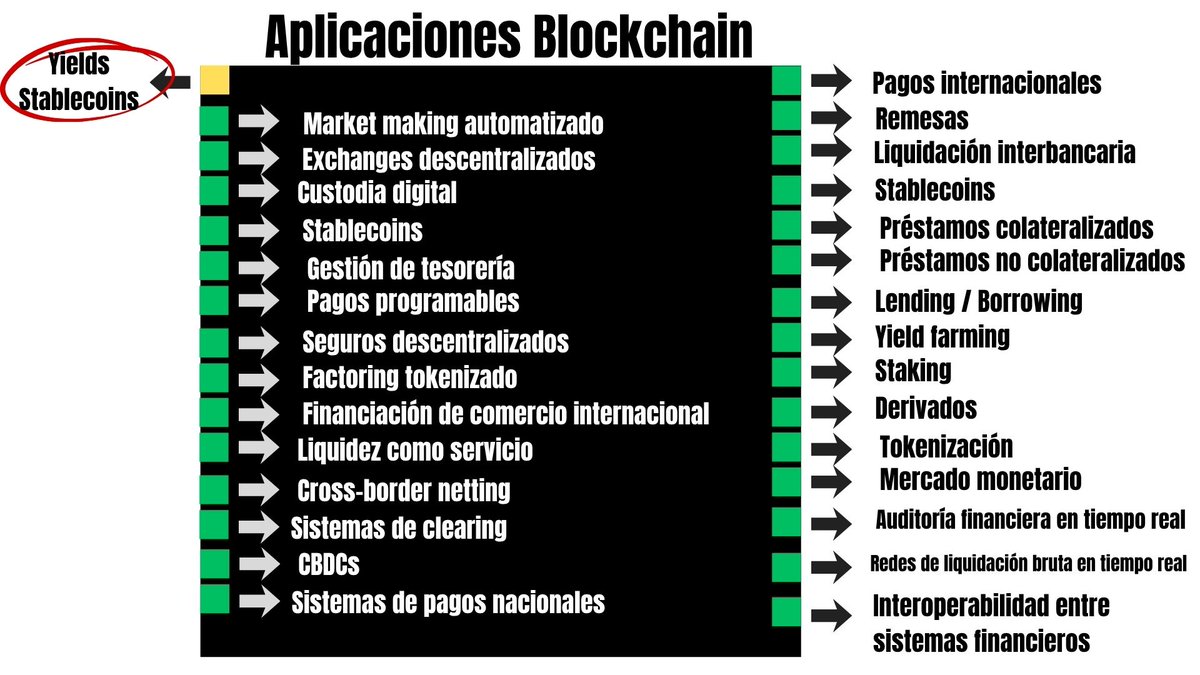
Procedo a enumerarte Todos los casos de uso que se me han ocurrido de esta tecnología.
Seguro que hay más y que con el tiempo, van apareciendo nuevos.
APLICACIONES DE LA BLOCKCHAIN:
FINANZAS
1) Pagos internacionales
2) Remesas
3) Liquidación interbancaria
4) Stablecoins
5) Préstamos colateralizados
6) Préstamos no colateralizados
7) Lending / Borrowing
8) Yield farming
9) Staking
10) Derivados (futuros, opciones, swaps)
11) Tokenización de activos financieros
12) Bonos tokenizados
13) Acciones tokenizadas
14) Mercado monetario on-chain
15) AMM
16) DEX
17) Custodia digital
18) Gestión de tesorería
19) Pagos programables
20) Crowdfunding
21) ICO / IDO / STO
22) Seguros descentralizados
23) Reaseguros on-chain
24) Factoring tokenizado
25) Financiación comercio internacional
26) Liquidez como servicio
27) Clearing
28) Auditoría financiera en tiempo real
INFRAESTRUCTURA
29) CBDCs
30) Sistemas de pago nacionales
31) RTGS
32) Interoperabilidad financiera
33) Redes de liquidez global
34) Emisión de dinero digital
35) Política monetaria
36) Dinero programable
37) Subsidios automatizados
38) Impuestos automatizados
39) Tesorería pública
LEGAL / IDENTIDAD
40) Identidad digital
41) KYC/AML
42) Firma digital
43) Notarización
44) Registro de propiedad
45) Registro mercantil
46) Smart contracts legales
47) Arbitraje
48) Votación
49) DAO
50) Certificados digitales
51) Licencias
52) Patentes
53) Propiedad intelectual
54) Evidencias digitales
SUPPLY CHAIN
55) Trazabilidad
56) Inventarios
57) Seguimiento envíos
58) Certificación origen
59) Control calidad
60) Anti-falsificación
61) Logística automatizada
62) Documentación comercial
63) Aduanas
64) Tokenización mercancías
ACTIVOS REALES (RWA)
65) Inmuebles tokenizados
66) Propiedad fraccionada
67) Alquileres automatizados
68) Infraestructura tokenizada
69) Energía tokenizada
70) Commodities tokenizados
71) Arte tokenizado
72) Coleccionables
73) Derechos explotación
74) Regalías automatizadas
GAMING / METAVERSO
75) NFTs
76) Activos in-game
77) Economías virtuales
78) Play-to-earn
79) Identidad digital gaming
80) Interoperabilidad juegos
81) Propiedad assets
82) Mercados secundarios
CONTENIDO
83) Música
84) Derechos autor
85) Monetización creadores
86) Plataformas sin intermediarios
87) Micropagos
88) NFTs contenido
89) Suscripciones tokenizadas
DATOS / TECNOLOGÍA
90) Almacenamiento descentralizado
91) Computación descentralizada
92) Oráculos
93) Compartición datos
94) Protección datos
95) Identidad IoT
96) Machine learning descentralizado
97) Monetización datos
98) Integridad datos
ENERGÍA
99) Smart grids
100) Energía P2P
101) Certificados renovables
102) Créditos carbono
103) Seguimiento emisiones
104) Incentivos energéticos
SALUD
105) Historial médico
106) Interoperabilidad sanitaria
107) Ensayos clínicos
108) Trazabilidad farmacéutica
109) Consentimientos
110) Identidad médica
EDUCACIÓN
111) Certificados académicos
112) Historial educativo
113) Credenciales verificables
114) Contenido educativo
115) Reputación
GOBIERNO
116) Transparencia presupuestaria
117) Gasto público
118) Contratación pública
119) Registro civil
120) Tierras
121) Elecciones
122) Identidad ciudadana
MOVILIDAD
123) Identidad vehículos
124) Historial mantenimiento
125) Seguros movilidad
126) Peajes automatizados
127) Flotas
128) Vehículos autónomos
RETAIL
129) Fidelización
130) Pagos ecommerce
131) Puntos tokenizados
132) Autenticidad productos
133) Supply chain retail
134) Marketplaces descentralizados
OTROS
135) Filantropía
136) Comunidades
137) Reputación
138) Freelance global
139) Contratos laborales
140) Membresías
141) Crowdsourcing
142) Redes sociales descentralizadas
143) Gobernanza corporativa
144) Derechos deportivos
Y resulta que sin el rendimiento de las stablecoins para Coinbase, nada de esto importa..... Venga ya....
@TateTheTalisman Because im alpha as fuk. I work hard as fuk. I don't let shit stop me. Yet I can keep me ego in check and have a leash on my pride. I get shit done. I build things, both real world like construction and also can program engineer. My principles can't be comprised. I would hire me.
BREAKING: President Trump just told 450 million Europeans: sign my deal by Thursday or I cut your gas. And if you think this is impulsive, you are not paying attention. This is the most calculated energy play in American history.
Qatar’s LNG is offline. Force Majeure. Ras Laffan shut after Iranian drones hit it on Day 3. Seventeen percent of global LNG capacity gone for 3 to 5 years. Russia’s pipeline gas to Europe was severed after Ukraine. Norway is maxed. Europe’s LNG prices have surged 35 to 50 percent since Hormuz closed. One supplier remains at scale: the United States. Trump’s ambassador to the EU just told the Parliament: ratify the $750 billion trade deal without amendments by Thursday March 26, or lose “favorable access” to American LNG.
Now decode the strategic geopolitical chess game which is being played in realtime.
Saturday night, Trump posted a 48-hour ultimatum threatening to obliterate Iranian power plants. That was not about Iran. That was about oil prices. He needed them high enough to terrify Europe into ratifying the LNG deal, but not so high that American consumers revolted before the midterms. The ultimatum spiked Brent past $113 and WTI past $100 on Sunday. Monday morning, Trump posted about “productive conversations” and paused the power plant strikes for five days. Oil crashed over 10 percent in hours. WTI hit $89. The S&P surged $2 trillion.
He spiked oil to create the fear. Then crashed it to create the relief. The fear makes Europe sign. The relief makes American voters forgive the war. Both moves serve the same president. Both happened within 36 hours. Both were executed with social media posts, not missiles.
The $750 billion deal is the permanent monetisation of Europe’s energy vulnerability. LNG. Oil. Civil nuclear. Locked in until 2028. The EU had been delaying ratification for months. Three wars removed every alternative: Iran removed Qatar, Ukraine removed Russia, Norway’s geology removed Norway. What remains is American LNG. Trump is not selling gas. He is selling the absence of alternatives.
The 5-day power-plant pause expires Saturday March 28. The EU Parliament votes Thursday March 26. Europe must ratify American energy dependency two days before the war might escalate again. If the pause collapses Saturday and Iran executes Ghalibaf’s promise to “irreversibly destroy” regional energy infrastructure, European LNG prices spike after the deal is already signed. Trump gets the $750 billion commitment at crisis pricing, then potentially triggers the next crisis 48 hours later. The deal locks in before the leverage expires.
This is Trump Doctrine in its purest form. He does not separate trade from security from energy from markets. He operates them as one instrument. The war degrades Iran. The degradation closes Hormuz. The closure spikes energy. The spike terrifies Europe. The terror forces the deal. The deal locks in $750 billion. The pause crashes oil. The crash rallies stocks. The rally preserves midterm support. Every move funds the next move.
He used the words “Department of War” in the pause announcement. Not Defence. The pre-1947 name. The name that tells Europe: the man offering you gas can resume bombing power plants on Saturday.
Yesterday Russia signed a deal to build Vietnam’s first nuclear plant. Today Trump threatens to cut Europe’s gas. Two great powers selling energy security to two desperate continents during the same war. Both profit from the crisis. Both lock in decades of dependency. Both timed the offer to the moment the customer cannot refuse.
The strait closed the alternatives. The ultimatum created the fear. The pause created the relief. The deal monetises both. Thursday is payday.
Full deep dive analysis:
https://t.co/iFmUcarGdV