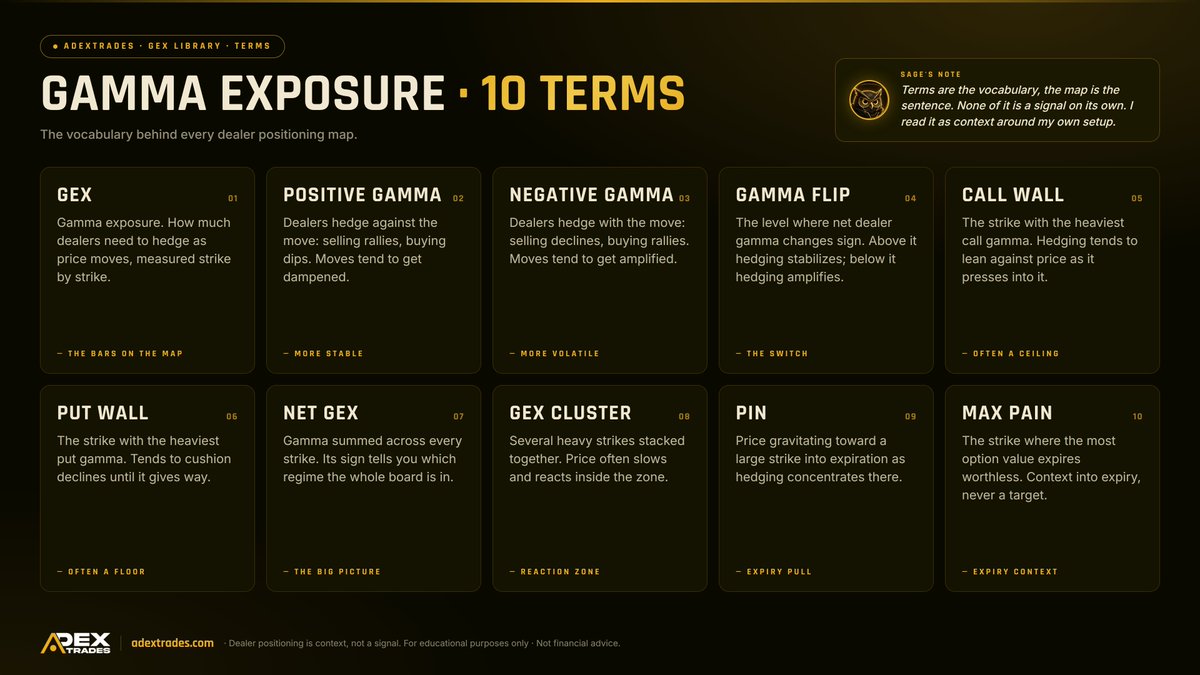
We'll be posting a lot more GEX levels on here.
So before that, here are the 10 terms you'll see us use:
1. GEX: how much dealers need to hedge as price moves
2. Positive gamma: dealers hedge against the move. Moves get dampened.
3. Negative gamma: dealers hedge with the move. Moves get amplified.
4. Gamma flip: where dealer gamma changes sign
5. Call wall: heaviest call gamma strike. Often acts as a ceiling.
6. Put wall: heaviest put gamma strike. Often acts as a floor.
7. Net GEX: all strikes added up. Tells you the regime.
8. GEX cluster: heavy strikes stacked together. Price tends to slow there.
9. Pin: price drifting toward a big strike into expiration
10. Max pain: where the most option value expires worthless. Context, not a target.
We'll be referencing these terms a lot. Bookmark this! 🔖
Shocking @TradingLucid Live program stats!
-50% of total live accounts are blown in a single day
-48% of total live accounts are blown the very first day
-32% have at least one profitable day but get no payout
-18% of total live accounts get a payout
-The average live account lasts about 3 days
prop firm rules aren't trading rules. they're psychology traps and you can exploit them to make $100k/month
every single rule a prop firm gives you is designed to exploit a known retail behavior (read this it's sauce):
"max daily loss: 2%" - this isn't to keep you safe. it's designed to be reachable in exactly 3-4 emotional trades. they're betting you'll revenge trade after 2 losses and hit it
let me show you the math. on a $50k Topstep with a 2% daily loss limit ($1,000), if you're risking 0.6% per trade ($300), you can take 3 losing trades before you're at the limit. most retail traders revenge after 2 losses. they take a 3rd trade emotional, often oversized. that 3rd trade either hits the limit alone (if oversized) or sets up the 4th trade that does. the firm has watched 100,000 retail traders do exactly this. the limit is set precisely where the predictable emotional breakdown happens
"max total drawdown: 4%" - designed to be reachable through slow bleed from overtrading. they're betting you can't stop yourself from taking 7+ trades a session
on a $50k account, 4% trailing drawdown means $2,000. if you're risking 0.6% per trade and you have 6 losses in a week, you're hit. with overtrading (10-15 trades per session, multiple sessions per week), 6 losses can happen in 2-3 days. the trader who takes 2 trades per session might have 6 losses in 3-4 weeks. the firm structures the drawdown to catch overtraders specifically
"must trade minimum 5 days" is designed to force you to take low-quality trades on quiet days just to hit the minimum. they're betting you'll take a forced trade on a no-setup tuesday and lose
these aren't risk management rules. they're behavioral landmines
the smart way to pass a prop challenge is to NOT trade like an active trader
active traders fail prop challenges. mechanical executors pass them
mechanical execution looks like this:
- 2 trades per session max. pre-committed in writing.
- only the 3 specific setups you identified in your sunday review. no improvisation.
- 0.5% risk per trade. doesn't change session to session.
- platform closes after trade 2 regardless of P&L.
- trade only NY AM, only on the 4-5 highest-probability days of the week.
- target: +5% on the account in 8-12 sessions. then stop trading until funded.
with this, you literally cannot hit any of the prop firm's traps
at 0.5% risk per trade with max 2 trades, the worst possible day is -1%. you can't blow daily loss limit. with max 2 sessions a week of active trading, you never have a 5-day slow bleed
to hit the "minimum trading days" requirement (usually 5 in the eval), spread your 8-12 sessions across the calendar so you tick the 5-day box without forcing trades on no-setup days
one of my discord guys passed 6 of 7 challenges in q1 doing exactly this. his complaint after passing the 6th: "this is boring."
yes. that's the point
he wanted action. he wanted to feel like a real trader. he wanted the dopamine hit of watching trades develop in real time. the mechanical approach gives you almost none of that. you take 2 trades, you walk away, you do something else with your day, you come back tomorrow.
most retail traders cannot psychologically tolerate this. they want trading to feel like trading. so they take more trades, and they fail challenges, and they keep buying new ones, and they keep failing
the small group who can tolerate the boredom of mechanical execution passes challenges at a 70%+ rate while the active-trader crowd is passing at 8%
another discord guy switched from 14 trades per session (failing every challenge) to a strict 2-trades-only rule. he hated it for the first 3 weeks. felt like he was "missing trades." then he passed his next 4 challenges in a row. now he trades 2 sessions a week, takes 4 total trades a week, makes ~$2,800/month from a single funded account. he's bored. he doesn't care. he's funded
active traders fail challenges. boring traders pass them
pick which one you want to be
@TradersConf@TheJewishTrades I completely agree. For a retail trader, it’s unrealistic to fill 300 NQ at once without significant slippage. I spent half a year in a famous trader’s live trading room, observing him trade his 8 figure IBKR accounts. On most days, he even had trouble filling 30 NQ at once.
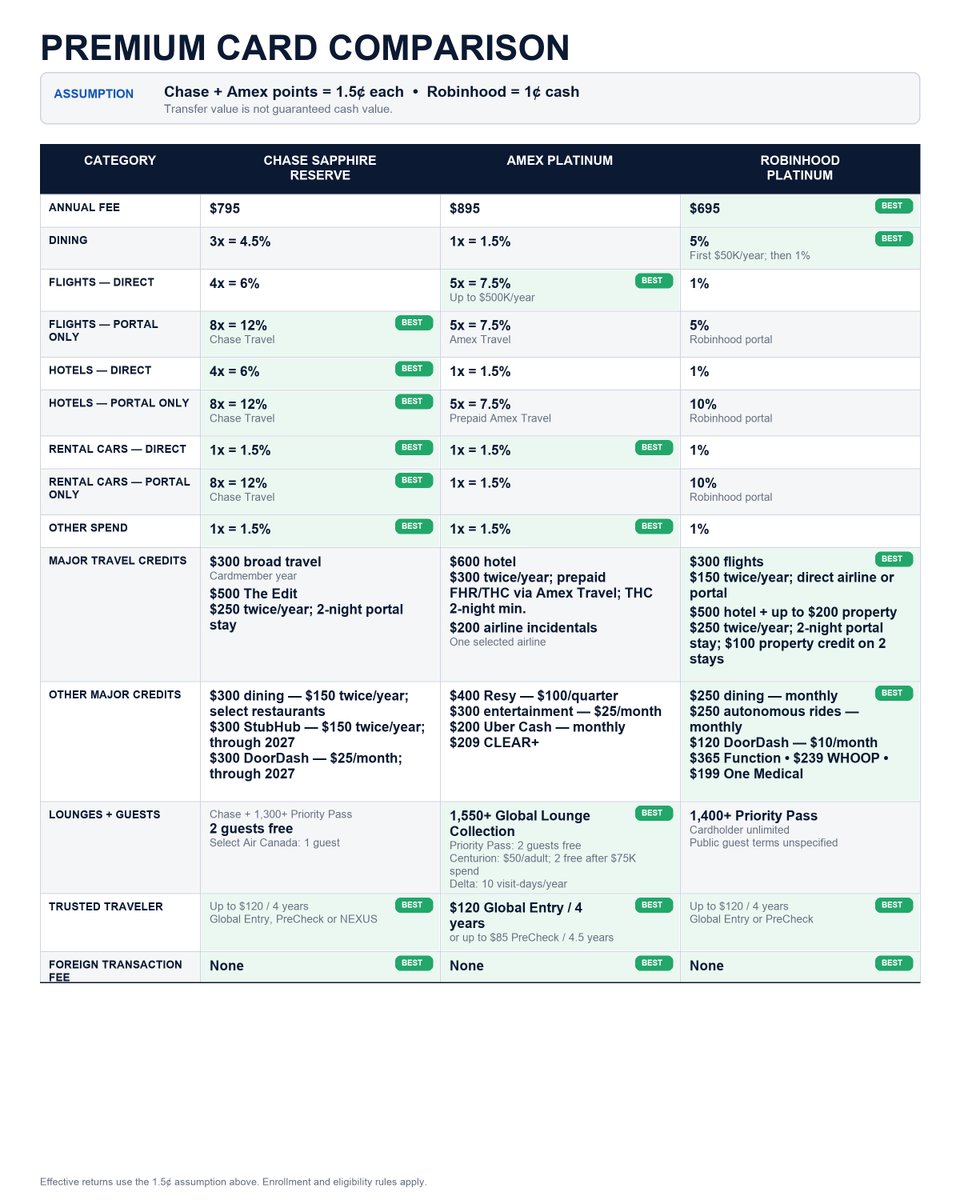
Robinhood launched the Platinum Card, a direct competitor to the Chase Sapphire Reserve and Amex Plat, but built for a younger, more tech-forward customer, with benefits I'd actually use that easily cover for the $695 annual fee.
They have improved it significantly from what they announced a few months ago, and could be a great card for you.
but... I won’t be getting it, and will instead be sticking to my existing stack:
Chase Sapphire Reserve for Travel and Dining (4.5%+)
United Quest Card for United (Even if you don't use the card it pays for itself if you are a frequent flyer because you get more miles just for having the card)
Amazon Prime Visa - 5% on Amazon/WholeFoods
Robinhood Gold card for 3% cash back on everything else
That being said, the Platinum is a very competitive card. Highlights:
• 27g platinum-plated card (a negative for me! I want a lighter card tbh)
• 5% cash back on dining (up to $50k spend/year- this is the best differentiating feature)
• 5% on flights booked through Robinhood
• 10% on hotels and rental cars booked through Robinhood
• Up to $1,000/year in travel credits ($300 flights plus up to $700 on premium hotels, spread across semiannual credits)
• Function Health ($365), WHOOP ($239) and One Medical ($199) included - if you use these 3 it pays for itself!
• Priority Pass lounges, concierge, no foreign transaction fees and Global Entry/TSA PreCheck credit (all table stakes for premium cards)
• Robinhood Gold included ($50)
I think most people in my demographic can easily justify the $695 annual fee, you'll easily get >$1000 of value from the card before you spend anything. I also like that it's straight cash back instead of points, although it's fairly easy to get 1.5c of value from Amex and CSR points.
2 main reasons I don't want to upgrade from Gold to Platinum:
1) They only allow one credit card per account, and the Robinhood Gold makes more sense for me
I already have the Robinhood Gold Card, which is a fantastic flat 3% cash back card. Upgrading would mean giving up unlimited 3% cash back on almost everything and dropping to 1% outside dining and portal travel. If I could keep both cards, I would get the platinum because the benefits easily cover the annual fee for me.
2) The travel portal sucks - you only earn 5% on flights and 10% on hotels when booking through their portal.
I just looked up a hotel I recently booked on Booking for $972. It costs $1,496 in the Robinhood portal. Even after 10% cash back, I'd still be paying hundreds more. Also the UX on the portal leaves a lot to be desired.
Flight portals are also a pain when plans change, so I always prefer booking directly with airlines.
If you're choosing between this card and the Chase Sapphire Reserve, I think it's a legitimate competitor and probably the better fit for a lot of younger professionals.
If you already have the Robinhood Gold Card, though, I'd keep it. The loss of 3% everywhere outweighs the Platinum's incremental benefits for me.
Half the world's finance firms now run autonomous AI trading agents. Their insurers are quietly writing those agents out of standard policies. US supervisors said the agents do not fit their rulebook. The Bank of England's fallback is a button that halts the whole market.
The systems are deployed. The people who insure them are stepping back. The people who supervise them have no rules for them. The fallback is a kill switch.
The number is from Cambridge, April 2026, 628 firms across 151 jurisdictions. 81% use AI at some level. 52% are already running agentic systems that plan and act on their own. Algorithms were already 60 to 80 percent of equity volume before these arrived.
On June 30th at the ECB forum in Sintra, Bank of England Deputy Governor Sarah Breeden said the quiet part out loud quite clearly. Existing frameworks were not built to contemplate autonomous agents, and a human in the loop for every agent action is unlikely to be realistic. Reuters reports the Bank is running simulations of AI systems at multiple institutions making the same move at the same instant, and is weighing market-wide circuit breakers to stop trading if they do. The Financial Stability Board asked for tighter safeguards in June.
Now the interesting part almost nobody has priced. A dedicated AI insurance market exists, Lloyd's backed, since April 2025. The largest towers on offer run 25 to 50 million dollars per company. Now set that against one number from the archive. A single trading algorithm at Knight Capital lost 440 million dollars in 45 minutes in 2012. Half the market is deployed. The biggest safety net anyone sells is a tenth of one old accident. And standardized exclusions now sit in most US commercial policies, taking AI out of the cover firms already hold.
The reason is not caution. It is math. Insurance works by pooling accidents that fail independently. A thousand agents built on the same handful of foundation models do not fail independently. They fail together, on the same signal, in the same second. That is not a thousand risks. It is one risk wearing a thousand names, and it cannot be pooled. When a risk cannot be pooled, the state stops writing policies and starts building off switches. A kill switch is what is left when insurance walks away.
The deepest problem is actually a timing one, and it has no rulebook at all. The damage from model drift begins long before the crash prints. The models degrade quietly, in the background, for weeks. When the loss finally lands, which policy year owns it. Which version of the model carries the blame. Nobody has answered that, and the fight over it will be argued over model weights.
The clock is not what the hype says. The EU's transparency rules land in 2026. Its high-risk regime was pushed back to late 2027. The agents went live last year. The rules arrive two years after the risk.
This is absolutely wrong if no correlated agent event hits any market through 2027, or if legacy insurers reverse and cover AI at scale again.
Half the market now runs the same unseen brain. The insurers are stepping back. The only backstop left is the button that turns it all off.
There's a 90-minute window every single trading day where the market basically tells you exactly what it's going to do…
Miss it and you're guessing for the next 5 hours
Catch it and you can close your laptop before lunch
95% of retail traders have never heard of this. The 5% who know it guard it like a trade secret.
Here's what gurus doesn't teach you:
The 9:30-11:00 AM window isn't just "market open"
It's when institutions reveal their hand
Big money can't hide. When Goldman or Citadel or any major fund needs to move size, they HAVE to do it when liquidity is highest. That's the first 90 minutes.
If they're buying, price expands up from the open
If they're selling, price expands down from the open
If they're not doing shit, price chops sideways
That expansion (or lack of expansion) tells you EVERYTHING about what's going to happen the rest of the day
The 9:30 AM Rule:
Look at the opening 30-minute candle (9:30-10:00)
Did price expand aggressively in one direction?
Did it take out the overnight high or low?
Did it leave a fair value gap behind?
Yes to all three = the direction is set. Trade with it.
No expansion? Price just chopping around the open? Close your laptop. The day is garbage. Institutions aren't playing.
This single filter eliminates 60%+ of losing trades before they happen
Most traders lose money between 11am-3pm trying to "find setups" in a market that's already made its move
The profitable traders caught the 9:30 expansion, rode it for 30-60 minutes, hit their target, and went to the gym
The 90-minute trading day:
9:15 - Open charts, mark overnight high/low
9:30 - Watch for expansion off the open
9:45 - If expansion + sweep + gap = enter trade
10:30 - Hit target or get stopped
11:00 - Done for the day regardless
That's it. That's the whole "job."
A guy I know has been doing this for 6 years. $300k+ prop account. Works 90 minutes per day maximum.
His words: "I used to trade 8 hours. Made nothing. Now I trade 90 minutes. Make $15k/month. The extra 6 hours were literally costing me money."
The market shows you its hand every single morning
Most traders are too busy staring at 15 indicators to see it
The 9:30 window is free information. Institutions can't hide their size.
You just have to learn to read it.
Or keep trading from 9:30am to 4pm wondering why you're not profitable
Your choice…
(if you think that's sauce, im dropping much more free sauce on IG. Link in bio)
@Tombsy5686691@traderbabyaxel@ApexTradeFund Glad to know that you still can request payouts. I have one account eligible for payouts, but I'm scared once I request it, I'm going to be call to Live . So right now, I'm just waiting for a few of my other accounts to qualify, and then I'm going to request them all together.
@Tombsy5686691@traderbabyaxel@ApexTradeFund I am in the situation with you , do you know why not able to purchase EOD anymore ? I conntact customer service but they said they don’t know neither which is very odd
𝗛𝗲𝗿𝗲'𝘀 𝗮 𝘀𝗶𝗴𝗻𝗮𝗹 𝗜 𝘁𝗿𝗮𝗰𝗸 𝘁𝗵𝗮𝘁 𝗺𝗼𝘀𝘁 𝗿𝗲𝘁𝗮𝗶𝗹 𝘁𝗿𝗮𝗱𝗲𝗿𝘀 𝗵𝗮𝘃𝗲 𝗻𝗲𝘃𝗲𝗿 𝗵𝗲𝗮𝗿𝗱 𝗼𝗳: 𝗳𝗶𝘅𝗲𝗱 𝘀𝘁𝗿𝗶𝗸𝗲 𝘃𝗼𝗹.
SPX makes a new local low. VIX ticks higher. Looks bearish. But if you check the implied vol at a specific strike (say 6400), it's flat. Actually drifting lower.
That divergence is the first crack.
When spot is making new lows but the vol surface refuses to reprice higher at the same strikes, someone is stepping in to sell premium at those levels. The marginal seller of volatility has appeared. That's institutional money saying "this is overdone."
VIX can stay elevated because of skew and term structure effects. But fixed strike vol is cleaner. It strips out the moving parts and tells you what's actually happening to risk perception and options supply/demand at a given level.
In my experience, fixed strike vol rolling over while spot makes new lows has been one of the most reliable exhaustion signals I use.
It often calls the turn before price does.
JUST IN: The Strait of Hormuz blocks the fertiliser from shipping. China just blocked it from being replaced.
Beijing has instructed exporters to suspend overseas shipments of nitrogen and potassium fertiliser blends. Urea. NPK mixes. The molecules that American, Indian, Bangladeshi, and African farmers need to plant are now gated at two chokepoints simultaneously: a 21-mile waterway controlled by provincial commanders with sealed radio orders, and a government directive issued from Zhongnanhai that requires no radio at all.
One third of global seaborne fertiliser trade transits Hormuz. China is the world’s largest fertiliser producer. When the strait closed and China suspended exports in the same month, the global food system lost its primary supply route and its primary alternative supplier at the same time. There is no third source at this scale. There is no backup to the backup.
Urea has surged roughly 40 percent since the war began. CBOT March futures settled at 610.50. The peak at New Orleans touched $683. Those prices were set by the Hormuz blockade alone. China’s ban adds a second floor underneath them. Even if the strait reopened tomorrow, Chinese urea would not flow until Beijing lifts the directive. Even if Beijing lifted the directive, the strait would still need to reopen, insurance to normalise, and vessels to be available. The two gates operate independently. Both must open for the molecule to move.
China’s logic is transparent. Hormuz disrupted global supply. Prices surged. Chinese domestic farmers face the same planting windows as everyone else. Beijing chose to protect its own agriculture by hoarding the molecule the rest of the world needs. This is the same country that is simultaneously drawing commercial crude reserves at a million barrels per day, running military exercises near Taiwan, receiving discounted Iranian oil through the permissioned strait, and restricting the phosphate exports it suspended months ago. Every decision serves one objective: China first. The rest of the world absorbs the shortage.
The American farmer is now squeezed from two directions. The Gulf urea he used to buy cannot transit the strait. The Chinese urea that could have replaced it is embargoed by Beijing. Domestic US production covers roughly 75 percent of normal needs, but normal needs assumed Gulf and Chinese imports filling the gap. The gap is now unfillable on any timeline that matters for spring planting.
USDA projects corn falling to 94 million acres. Soybeans rising to 85 million. The RFS mandate consumes 43 percent of a shrinking corn crop. The cattle herd sits at 86.2 million, a 75-year low. The protein cascade runs from corn to feed to meat to eggs to dairy to the grocery shelf. China’s ban did not create that cascade. The Hormuz blockade created it. China’s ban removed the last exit ramp.
Oman crude at $154. Brent at $102. WTI at $93. Gold at $5,000. The Fed holding at 3.50 to 3.75 with PCE revised to 2.7. Trump telling Israel to stop hitting gas fields. Iran threatening to burn the Gulf to ashes. Four countries’ energy infrastructure offline. And now the world’s largest fertiliser producer has locked its warehouse and told every farmer on Earth that the key is in Beijing, not for sale, and not available until further notice.
Two gates. One molecule. No alternative. The calendar closes in four weeks.
https://t.co/iFmUcarGdV
BREAKING: AI can now automate daily options income with 78% win rate like professional theta traders (for free).
Here are 12 insane Claude prompts that generate consistent 0.5-2% daily returns (Save for later)
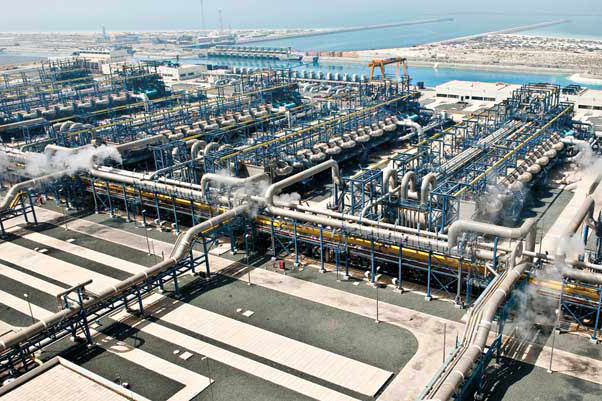
Two days ago I wrote that the most dangerous signal in this war was not what Iran was hitting but what it was not hitting. Desalination plants. Eight of the ten largest on earth sit on the Arabian Peninsula. One hundred million people drink what they produce. Iran had the coordinates and the capability. It was choosing restraint. The restraint was the weapon. And the hand that held the leash was dead.
The leash just snapped.
Iran’s Foreign Minister Araghchi posted on X on March 7 that the United States struck a freshwater desalination plant on Qeshm Island with missiles launched from its base in Bahrain. He said water supply to 30 villages was cut. His exact words: “The U.S. set this precedent, not Iran.”
That sentence is the most dangerous statement issued by any government official since this war began.
No independent verification exists. No satellite imagery. No Pentagon confirmation or denial. CNN, BBC, and Reuters report it as an Iranian accusation. The claim is unverified. That does not make it less dangerous. What matters is not whether the strike happened. What matters is that Iran has publicly framed a desalination attack as an American precedent.
Precedent is permission. Iran struck a US base in Bahrain within hours, framed as retaliation for the desalination hit. Whether the original strike was real or fabricated, the rhetorical architecture for targeting Gulf water plants is now constructed. The thirty one autonomous IRGC commands possess a publicly articulated rationale for striking desalination facilities anywhere in the Gulf.
Kuwait gets 90 percent of its drinking water from desalination. Oman 86 percent. Saudi Arabia 70 percent. The UAE 42 percent. These are not countries with backup rivers. These are not populations with alternative wells. The entire human habitability of the Arabian Peninsula depends on machines that convert seawater into freshwater, running continuously, at massive scale, connected to power grids and intake pipes that are among the softest targets in any military theater.
In 1991 Iraq pumped crude oil into Kuwait’s desalination intakes. Recovery took years. The Gulf in 2026 is orders of magnitude more dependent, and the Strait of Hormuz is closed. Emergency tanker imports face the same insurance withdrawal that stopped oil tankers. The redundancy that was supposed to protect water supply depends on shipping lanes that no longer function.
Gulf states deployed Patriot batteries around major plants after the accusation. Intake pipes have underwater sensors. Cyber defenses are air gapped. But the defense faces the same arithmetic: 93 percent success across a thousand drones still means 70 impacts. One impact on a military base is absorbable. One impact on a desalination intake shuts down water supply to millions.
The restraint is over. The precedent, real or fabricated, is set. And the hundred million people whose survival depends on desalination plants within range of Iranian missiles are now living inside the targeting envelope of a doctrine that just lost its last constraint.
https://t.co/ULBgEzZ3A8
🚨 BREAKING:
🇺🇸 THE U.S. SENATE IS SET TO REVIEW A $BTC AND CRYPTO MARKET STRUCTURE BILL ON MONDAY AT 2:00 PM.
IF PASSED, THIS LEGISLATION COULD OPEN THE DOOR FOR TRILLIONS IN NEW CAPITAL TO ENTER THE SPACE.
EXTREMELY BULLISH FOR CRYPTO MARKETS. 🔥🚀
🚨 TRADERS READ THIS
Scam prop firms don’t steal your money loudly.
They do it quietly with rules, delays, and confusion.
If a firm makes getting paid feel complicated,
it’s not “professional” it’s intentional.