Founder @RadiusAI | Building something exciting in healthcare | AI since 2017 | VoiceAI, Vision AI & agents | Proud father + husband | He/Him | Opinions my own
The moat isn't a secret model name.
It's proprietary data, real-world failure history, calibrated confidence logic, drift monitoring, hardware constraints, and thousands of small decisions learned the hard way.
LLMs make the starting line cheaper. They don't erase the finish line.
A prototype can be generated. A production system has to be earned.
Long version with 18 citations: https://t.co/BeG4hjtCQT
Someone asked me what stops them from rebuilding our vision AI system with ChatGPT.
Honest answer: nothing stops them from trying.
But "just use an LLM" misunderstands what production computer vision actually is, and I think this misread is going to cost a lot of teams a lot of money.
🧵
Google warned about this back in 2015 ("Hidden Technical Debt in ML Systems").
A 2022 MLSys study found deployed models suffer large accuracy drops even with frequent retraining.
Drift handling isn't a prompt. It's an operating loop: monitor, detect, diagnose, adapt, validate, learn.
A takeaway from local LLM training:
The model is only half of the system.
The rest is:
- prompt contract
- decoding settings
- adapter merge
- quantization
- serving runtime
- schema validation
- eval harness
- regression tests
Precisely. That’s been my main takeaway, too.
Working through this I had some useful breakthroughs. The LLM itself is not the product surface; it is behind a semantic parser, structured validation, workflow state, guardrails and evals.
For healthcare workflows, the interesting part is not “can the model answer? It’s whether the system can hold intent, not guess, and recover safely.
I will be blogging about the findings in a short series in the near future.
Local LLMs are accurate enough for use in healthcare applications now, but the real challenge is not model size.
It is in the provision of reliability of clinical data, clinical workflows, speech input/output and production evaluations.
This is where real engineering is done
@Hesamation I keep getting generic emails from them that they are working on adding additional capacity. But I don't know anyone who actually tested this.
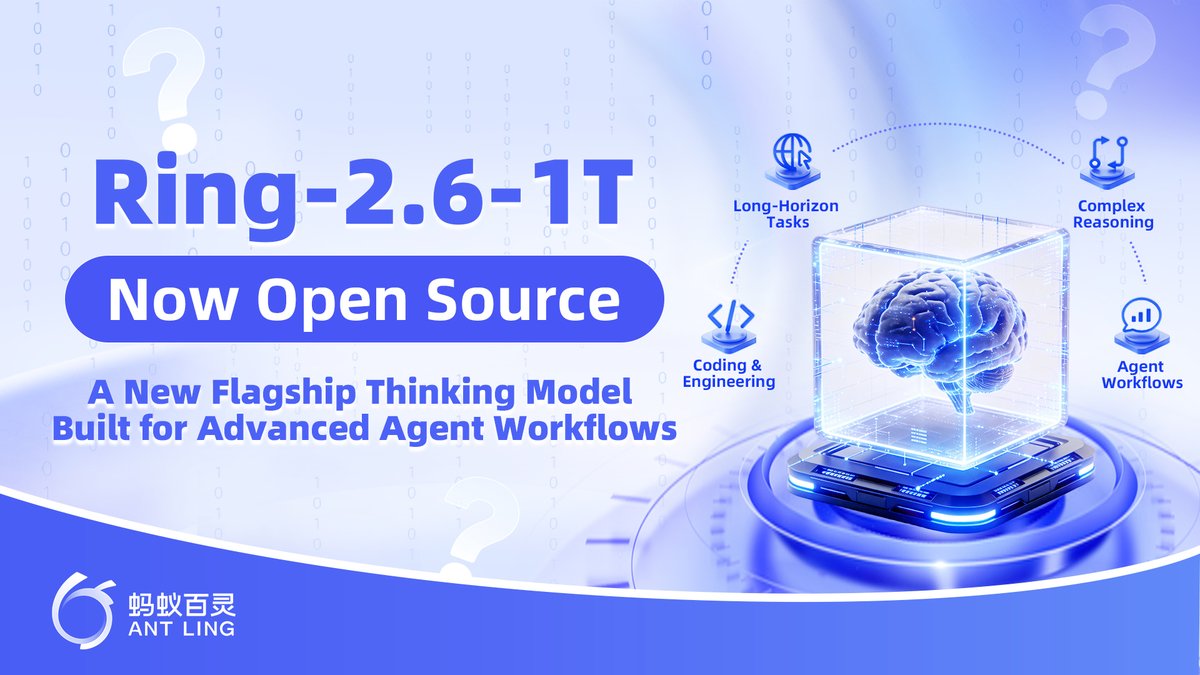
🚀 Ring-2.6-1T is now open source.
A trillion-scale flagship thinking model built for real-world complex tasks: Agent workflows, coding & engineering, long-horizon tasks, complex reasoning, research, and enterprise automation.
It is designed to move beyond “answering” toward execution: understanding context, planning steps, calling tools, and staying stable across long task chains.
Highlights:
- Advanced agentic workflow support.
- Reasoning effort levels: high for agentic tasks, xhigh for complex reasoning.
- Scalable asynchronous RL via the IcePop algorithm, enabling stable, trillion-scale training for long-horizon agentic RL.
@emanueledpt They have taken a thing or two from Oracles playbook. They want to lock people to their ecosystem. As AI model performance gap is tightening, model is no longer moat.
@plainionist I think its true atleast in our case. As a founder we always wonder if AI can replicate what we built. We ran bunch of tests trying to replicate our product it didn't even come close.