The fragile glue code problem is real, but this trade works only when your data model fits the platform's abstraction. The moment you need custom logic that doesn't map to RBAC boundaries or standard CRUD, you're fighting the framework instead of the boilerplate.
Stop having AI coding agents generate messy full-stack CRUD apps from scratch. 🛠️
If you tell Claude Code, Cursor, or Codex to scaffold an entire business system, you usually get fragile glue code, half-baked auth, and unmaintainable UI spaghetti.
Here is a much cleaner architecture: NocoBase (24k⭐ open source).
Instead of generating raw React/Node boilers, coding agents build directly on top of proven infrastructure: battle-tested relational data models, field-level RBAC, audit logs, and visual workflow engines.
Key architectural highlights:
• Hybrid human + agent building:
Agents use CLI and MCP skills to provision schemas, migrations, and workflows. Meanwhile, human teammates can visually tweak layouts and permissions in real-time via a clean WYSIWYG interface.
• Native MCP & Agent Ecosystem:
Connects seamlessly via Model Context Protocol (MCP) and REST to agents (Hermes, Claude, Dify, n8n). External agents can trigger business logic and query records within strict permission boundaries.
• In-system AI Employees:
AI workers run directly inside workflows (document parsing, risk scoring, automated ticket triage) governed by strict role-based access control rather than rogue API keys.
Quick deploy:
npm install -g @nocobase/cli
nb init
Self-hosted, modular, and completely decouples your data layer from the UI.
Link: https://t.co/coOiE7qMZD
The backward pass is where most FlashAttention explanations stop. Deriving it by hand forces you to see why the recomputation strategy works and where the memory savings actually come from.
Uploaded a video on deriving Flash Attention v2 with pen and paper (both forward and backward pass). It covers online softmax from the perspective of ring attention and how backward pass is calculated for flash attention
https://t.co/VQtXWhg7Wi
Check it out and let me know of any feedback
The chemistry works when the models solved similar problems in similar ways. Merge two vision models trained on different datasets and you might get generalization. Merge vision and language models and the weight space has no shared structure to average.
Model merging, what it actually means: combining two trained models into one — averaging their weights (strength numbers) to blend their skills. Sometimes you get the best of both; sometimes you get mush. Chemistry, with math. #AIEngineering#AI
Agent performance doubled on bug fixes without touching the model. The ceiling wasn't intelligence. Most agent failures come from context loss, bad tool calls, or skipping verification steps. The model was already capable enough. The bottleneck was everything around it.
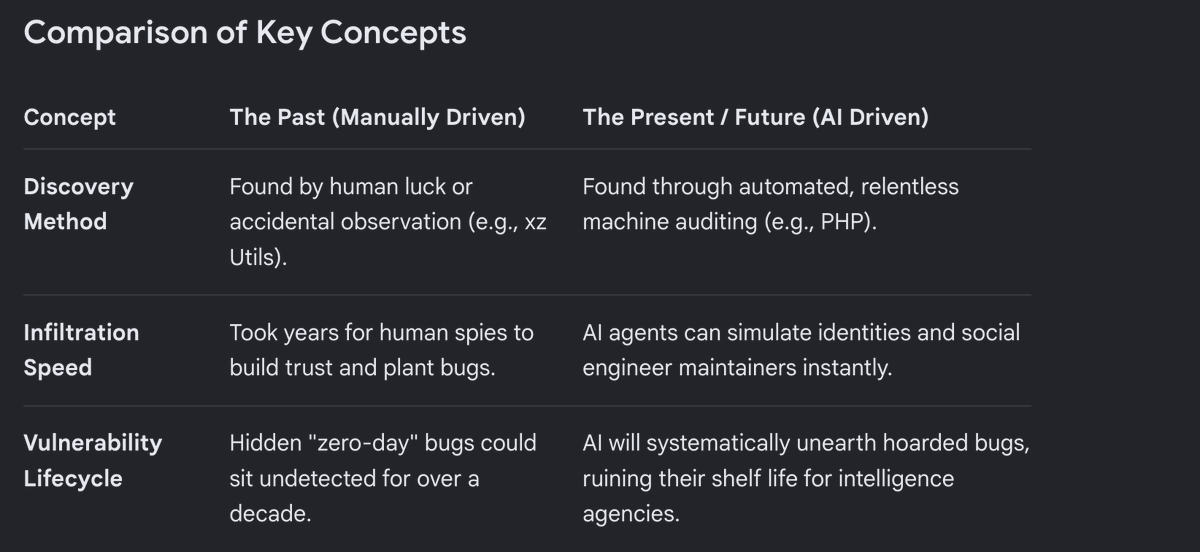
The PHP bug sat there for 12 years because code review doesn't scale to every commit in every repo. Systematic scanning does. That changes who can afford to look and what stays hidden.
🚨🚨🚨🚨🚨AI-Driven Code Auditing is Uncovering Decades of Hidden Cyber VulnerabilitiesOpenAI's discovery of a critical, long-standing PHP bug highlights a massive shift in cybersecurity:
AI is now executing systematic, comprehensive audits of open-source software. This breakthrough mimics the containment of threats like the xz Utils backdoor, where state-sponsored actors spent years building fake personas to quietly inject malicious code into foundational internet infrastructure.
While human vigilance caught the xz Utils threat by chance, AI systematically identified the PHP vulnerability, which had lain dormant since 2012. This suggests that intelligence agencies may be losing control over their hoarded zero-day exploits, as automated AI scanning can expose intentionally placed backdoors at an uncontrollable pace.
Furthermore, recent intelligence reports from bodies like the AISI warn that offensive AI agents are already capable of automating the entire infiltration process—generating fake identities and socially engineering maintainers to insert malicious code.
This raises a sobering question: is AI merely finding these ancient bugs, or did adversarial AI help plant them years ago?
@angel_flowstate@YorkYang5050 That architecture separates what foundation models can plan from what fast local policies must execute under physical constraints.