NO MORE HIDING BEHIND NIGERIA’S NATIONAL NUMBERS.
I think it is time for the @NBS_Nigeria to lead a subnational statistical revolution.
Nigeria cannot continue to discuss development almost exclusively through national averages when the country is a federation of 36 states, the FCT and 774 local governments, each with vastly different economic structures, resources and governance outcomes.
National aggregates can conceal subnational failure just as easily as they reveal national progress.
If Nigeria’s GDP grows, which states are driving that growth? If poverty falls, where is it falling fastest? If employment rises, where are the jobs being created? If internally generated revenue increases, which states are actually expanding their fiscal capacity? If investment is growing, where is the capital going?
These questions should not be left to political interpretation. The data should tell us.
The NBS should therefore publish a standardized State Performance Dashboard, disaggregating major socioeconomic indicators by geopolitical zone, state and, wherever statistically feasible, local government.
The dashboard should cover at least six areas:
Economic Productivity: state GDP, GDP growth, GDP per capita, sectoral output, manufacturing, agriculture, exports, business formation and employment.
Fiscal Effort: internally generated revenue, IGR per capita, IGR relative to state economic output, federal transfers, total revenue, capital expenditure, recurrent expenditure, debt and debt service.
Human Development: poverty, education, learning outcomes, healthcare, maternal and child health, water, sanitation, electricity and other quality-of-life indicators.
Investment & Business Climate: private investment, new businesses, business survival, industrial activity, infrastructure and other measures of economic attractiveness.
Public Finance & Outcomes: not merely how much governments spend, but what citizens receive in return. A budget is not an achievement. Expenditure is not an achievement. Improved outcomes are achievements.
Institutional Capacity: budget execution, financial reporting, procurement transparency, debt management and the quality of public administration.
But we must be careful not to create a simplistic league table. States do not begin from the same baseline. The NBS should therefore measure absolute performance, relative performance against comparable states, and trajectory over time.
A state that inherited severe structural disadvantages but is improving rapidly should receive credit. A state that inherited a strong economic base but is stagnating should not be allowed to hide behind history.
We should also introduce a Fiscal Dependency Ratio federal transfers as a proportion of total state revenue and a Fiscal Effort indicator that measures the extent to which states are building their own sustainable revenue base.
This is not an argument against federal transfers. Equalisation is a legitimate feature of federalism. But equalisation should help states overcome structural disadvantages; it should not become a permanent business model.
The bigger issue is accountability.
Today, governments can easily claim success or blame failure on “Nigeria.” That must change.
If one state is attracting investment while another is not, let us know.
If one state is improving education while another is deteriorating, let us know.
If one state is expanding IGR and reducing fiscal dependency while another remains permanently dependent on federal allocations, let us know.
If one government is converting public resources into measurable improvements in citizens’ lives and another is not, let Nigerians see the difference.
Good statistics are not propaganda. They are public infrastructure.
The NBS should publish the underlying data in accessible, machine-readable formats so that citizens, researchers, investors, journalists and civil society can interrogate it.
TINUBU INFRASTRUCTURE REVOLUTION: LIST OF COMPLETED AND ONGOING PROJECTS.
I made this list for those who are saying the economy is bad
Those bishops and their allies who enjoyed the days when PDP came and dropped checks of billions in their churches.
But built nothing.
The times have changed.
Oya here is a comprehensive overview of major federal road projects under President Asiwaju Bola Ahmed Tinubu 's administration, based on official statements from the Minister of Works and commissioning records.
COMPLETED & COMMISSIONED PROJECTS
The administration has completed 260 palliative road projects costing ₦208 billion, plus several major highway sections.
Key commissioned projects include:
Flagship/Legacy Projects
1. Lagos–Calabar Coastal Highway – Phase I, Section I (7.47 km):
The first completed stretch from Ahmadu Bello Way to Eleko Village in Lekki, Lagos, built with reinforced concrete pavement.
Commissioned May 2025.
2. Abuja Road Infrastructure
Outer Southern Expressway (OSEX), Abuja – main carriageways commissioned 2026
3. Arterial Road N20 Interchange Bridges, Abuja – commissioned 2025
South-East & South-South
4. Enugu–Port Harcourt Road Section III (Enugu–Lokpanta) – rehabilitated and commissioned
5. New bridge at Akpoha, Ebonyi State – replacing a near-collapsed bridge
6. Reconstructed Enugu Bridge at New Artisan Market, Enugu–Port Harcourt Road
7. Calabar–Ugep–Katsina-Ala Road Section II (Ugep–Katsina-Ala), Benue/Cross River
8. Alesi–Ugep (Iyamoyung–Ugep) Section, Cross River State
9. East-West Road Section II (Eleme Junction–Ahoada), Rivers State
10. 15 km section of East-West Road (Port Harcourt Eleme Junction–Onne Port Junction), Rivers State
SOUTH-WEST
11. Lagos–Shagamu–Ibadan Dual Carriageway Section II, Oyo State
12. Ikorodu–Shagamu Road, Lagos State
13. Emergency comprehensive repair of Eko Bridge (4.1 km), Lagos State
14. Deep-Sea Port Access Road, Lagos–Ogun States
North-Central, North-East & North-West
15. Shendam Bridge, Plateau State
16. Ilobu–Enrile Road, Kwara/Osun States
17. Jimeta Bridge, Yola, Adamawa State
18. Yakasai Badume–Damargu–Marken Zalli Roads, Kano State
19. Kano–Kwanar Danja Hadeja Section II
(Kano–Tsalle), Kano/Jigawa States
MAJOR ONGOING PROJECTS
The administration currently has 440 approved road projects ongoing nationwide, with 29 major infrastructure projects totaling over ₦2 trillion.
The Four Legacy Highway Projects
These are the administration's signature transformative corridors:
Abuja–Kaduna–Zaria–Kano Dual Carriageway (164 km) – ₦740.79 billion revised cost; completion targeted for 2026
Abuja–Lokoja–Benin Road – dualization with concrete technology; ₦305 billion approved February 2025
9th Mile–Oturkpo–Makurdi Road – dualization ongoing
Enugu–Onitsha Expressway (107 km) – 50–70% complete; deadline May 10, 2026
Benin–Asaba Superhighway (125 km) – flagged off March 2025; 30-month PPP timeline
Oyo–Ogbomoso Road – new contract awarded to JRB Construction at ₦147.89 billion
Bode Saadu–Kaima–Kosubosu Road (130 km, Kwara) – BUA Group-financed under Tax Credit Scheme
Enugu–Port Harcourt Expressway (Umuahia–Aba section, 56.10 km) – completion targeted June 2025
Second Niger Bridge Access Road (17.55 km, Asaba) – construction began March 2025
Lagos–Ibadan Expressway – Phase 2 ongoing (flyovers at RCCG, Wawa, Ogun Bridge, Arepo Bridge; 12 km Sagamu–Iperu dual carriageway; 48 km to Ore planned)
Bodo–Bonny Road (34 km, Rivers) – ₦280 billion revised cost; completion scheduled September 2025
Kaduna–Birnin Gwari Road (122 km) – flagged off August 2026
Kano–Maiduguri Road dualization (Section I: Kano–Wudil–Shuarin, 105 km) – flagged off
Ibadan–Ife–Ilesha–Akure–Benin Road – flagged off
Nembe–Brass Road – flagged off
If you think this kind of infrastructure revolution has taken place in Nigeria before show us evidence.
Ugoji Maximillian
#Adeleke
HOW ACCESSIBLE ARE DOCTORS IN NIGERIA? A SNAPSHOT OF HEALTHCARE WORKFORCE PRESSURE
Doctors in Selected Countries
🇺🇸 United States — 1,082,187
🇬🇧 England — 153,249
🇳🇬 Nigeria — 55,000
Nigeria-Trained Doctors Abroad
🇬🇧 United Kingdom — 12,198 (2023)
🇺🇸 United States — 16,000
Doctors per 10,000 people
🇺🇸 United States — 31.0
🇬🇧 England — 21.9
🇳🇬 Nigeria — 2.3
WHO Recommendation — 10
Nigeria records a critically low doctor density of about 2.3 doctors per 10,000 people, far below the WHO recommended minimum of 10. In contrast, the United States and England maintain significantly higher levels of 31.0 and 21.9 respectively.
#Statisense
(WHO, GMC, FSMB, NHS)
Details of Proposed Constitutional Amendments for the Establishment of State Police and Federal Police
1. Establishment of Federal Police and State Police (New Section 214)
• Two distinct police bodies are constitutionally established:
• (a) the Federal Police
• (b) State Police (one per State, established by State law)
The National Assembly must pass an Act prescribing:
• Structure, organisation, administration, and powers of the Federal Police
• Framework and guidelines for the establishment of State Police
• State Police cannot commence operational policing until:
• Established by a Law of the State House of Assembly, and
• Certified as meeting national minimum standards (prescribed by an Act of the National Assembly)
• Transitional provision: Until a State Police becomes operational, the Federal Police continues all policing functions in that State. After commencement, the Federal Police handles federal policing functions and may provide assistance to the State Police.
2. Responsibilities and Non-Interference (Section 214)
Federal Police is responsible for:
• Maintenance of public security, public order, and security of persons/property throughout the Federation (to the extent provided by the Constitution or National Assembly Act).
• Similar functions within a State to the extent the State has legislative power under the Constitution.
Key safeguard against federal overreach (Section 214(6)):
The Federal Police shall not interfere with State Police operations or a State’s internal security affairs except in these limited cases:
• To contain serious threats where there is a complete breakdown of law and order and the State Police is unable to respond.
• When the Governor requests intervention.
• When a State Police is unable to function due to administrative, financial, or other problems.
Any such intervention requires prior approval by the National Police Council.
Federal Capital Territory (FCT): Fully under the jurisdiction and operational control of the Federal Police.
3. Leadership and Command (New Section 215)
• Federal Police: Headed by the Inspector-General of Police (IGP).
• Appointed by the President on the advice of the National Police Council, from serving members of the Federal Police.
• Subject to confirmation by the National Assembly.
• The IGP has command over the entire Federal Police, including contingents in States.
• The President (or authorised Minister) may give lawful directions on public safety and order; the IGP must comply.
• State Police: Headed by a Commissioner of Police (CP).
• Appointed by the Governor on the advice of the National Police Council, from serving members of the State Police.
• Subject to confirmation by the State House of Assembly.
• The Governor (or authorised Commissioner) may give lawful directions on public safety and order; the CP must comply.
• If the CP believes a direction is unlawful or contradicts general policing standards, the matter can be referred to the National Police Council (whose decision is final).
4. Removal of Top Officers (New Section 216)
• IGP: Removed only by the President on the recommendation of the National Police Council for specified grounds (grave misconduct, breach of Police Act/Regulations/Code of Conduct, conviction for fraud/dishonesty, bankruptcy, or mental incapacity). Requires two-thirds majority approval of the National Assembly.
• State Commissioner of Police: Removed only by the Governor on the recommendation of the National Police Council for similar grounds. Requires two-thirds majority approval of the State House of Assembly.
5. Funding Support (New Section 216A)
The Federal Government shall provide grants or aids to State Police on the recommendation of the National Police Council, subject to approval by the National Assembly.
6. Oversight Bodies
National Police Council (restructured and renamed from the old Nigeria Police Council; new composition and expanded functions in Third Schedule):
• Broad membership including: Chairman (Presidential appointee confirmed by NA), Attorney-General of the Federation, serving senior Federal Police officer, Attorneys-General of all States, retired Commissioners of Police (one per geo-political zone), representatives of NHRC, Public Complaints Commission, NLC, NBA, NUJ, and Traditional Rulers’ Councils.
• Key functions: Appointment and discipline of Federal Police officers (except IGP); recommending State top officers (CP, DCP, ACP) to Governors based on State PSC lists; supervising Federal and State Police activities (within constitutional limits); setting standards for training, intelligence, forensics; assisting State Police on request.
State Police Service Commission (new body established for each State in Third Schedule, Part II):
• Composition: Chairman (appointed by Governor, confirmed by State HA), representatives of NHRC, Public Complaints Commission, NLC, NBA, NUJ, retired Assistant Commissioners of Police (one per senatorial district), and Traditional Rulers’ Council.
• Functions: Recommending three qualified candidates for CP/DCP/ACP to the National Police Council; appointment, discipline, and removal of State Police officers below the rank of Assistant Commissioner of Police; other functions as prescribed by Constitution or National Assembly Act.
7. Legislative Framework (Second Schedule – Concurrent Legislative List)
• National Assembly may make laws on: establishment/organisation/administration/powers/duties of Federal Police; powers/duties of State Police; national minimum standards for both; policing standards, inspection, certification, complaints mechanisms, criminal information systems, inter-governmental cooperation, federal intervention, use of force, firearms, grants, and accountability.
• State Houses of Assembly may make laws for the establishment, organisation, administration, funding, and oversight of their State Police — but must comply with the Constitution and valid National Assembly Acts.
• States may set higher standards than national minimums but not lower.
• National Assembly laws cannot give federal authorities routine command, deployment, appointment, promotion, transfer, discipline, or control over State Police personnel (except for explicitly authorised federal intervention).
8. Other Related Changes
• Updates to various constitutional provisions (e.g., Sections 34, 35, 39, 42, 84, 89, 129, 153) to replace references to “Nigeria Police Force” with appropriate “Police”, “Federal Police”, or “State Police” terminology.
• Exclusive Legislative List adjustments (e.g., light arms for policing purposes; fingerprints/biometrics/forensics shared with State Police; Federal Police listed separately).
• Consequential amendments to the Third Schedule for the new bodies and their compositions/powers.
It is said that the young man seen in the photo, whose name was Ahmed Abdullah, worked as a pharmacist in a pharmacy.
Every month, an elderly and poor woman would come to him to collect her medicine.
After receiving the medicine, she would go to the cash register where he sat.
Whenever she saw him, her face would light up with happiness. For years, she had been buying the same medicine, and this young man used to charge her only 200 Egyptian pounds. She would pay and leave.
Then one day, the young man passed away.
The elderly woman returned to the same pharmacy, asked for her medicine, and went to the cash register to pay 200 pounds.
But he was not there.
Before she could ask about him, the new cashier said, “What is this, ma’am?” She replied, “These are 200 pounds for the medicine.” The cashier said, “But this medicine costs 2,000 pounds, ma’am.”
Shocked, she said, “But for more than three years, I have been getting this medicine here for only 200 pounds from that young man who worked here… where is he?”
The new cashier replied, “He has passed away, ma’am. May Allah have mercy on him.”
When the records were checked,
it was discovered that the young man had been paying the remaining 1,800 pounds every month from his own salary.
When the pharmacy owner learned about this, he decided, for the sake of the young man’s pure soul, to continue giving the woman the medicine at the same price so that it could remain a “Sadaqah Jariyah” (continuous charity).
To honor this wonderful young man, the least we can do is share his photo across the world so that people may pray for mercy upon him.
May Allah forgive him and grant him a place in Jannatul Firdaus. 🤲 Ameen.
He truly deserves appreciation.
#copied
Note: Share this as much as possible so that people may be encouraged to do good deeds.
President Tinubu Ended Fuel Subsidy, So Where Is the Money He Saved Going?
Good question. And without beating around the bush, I will show you five key areas where the money saved is going.
In April 2023, just a month before the handover of power from General Buhari to President Bola Tinubu, JP Morgan, in a report titled 'Nigeria: Reform Pause Rather Than Fatigue', exposed that the Buhari administration actually left Nigeria with a net foreign reserve of $3.7 billion, rather than the $14 billion they claimed in public. From that meagre amount, the Tinubu government has raised our foreign reserves to $50.26 billion, as of Monday, June 8, 2026, our highest level in seventeen years.
You may ask why Nigeria needs such high reserves. It is to protect our economy against future economic shocks arising from a crash in exports, to help pay for vital goods and services we need from overseas, and, finally, to guarantee our loans.
Each state in the federation is now receiving at least double (some more than double) what they were getting under General Buhari when Nigeria still operated the subsidy regime. For example, the Federation Account Allocation Committee distributed a total of ₦725.571 billion as revenue to the three tiers of government in March 2022. However, for the same period in 2026, namely March 2026, the FAAC disbursed ₦2.036 trillion to the three tiers, which is three times what they received under General Buhari's regime.
Under President Tinubu, all six geopolitical zones now have development commissions, including the Northwest Development Commission, North-Central Development Commission, Northeast Development Commission, Southwest Development Commission, Southeast Development Commission, and the Niger Delta Development Commission.
These commissions have been receiving approximately ₦2.5 trillion annually under Tinubu, a new subvention they did not receive under the Buhari administration, because most of them did not even exist.
Over a million indigent Nigerian students are now receiving approximately ₦300 billion as loans under the Nigerian Education Loan Fund (NELFUND) initiative of President Tinubu's Renewed Hope Agenda.
Infrastructure: No other administration in the history of this nation has democratised road construction to the extent that the Tinubu government has done, simultaneously connecting the Southwest with the South-South via the 750-kilometre Lagos-Calabar Coastal Highway being built for ₦15 trillion, linking the Northwest to the Southwest with the 1068-kilometre Illela-Sokoto-Badagry Superhighway costing ₦13 trillion, and bridging the gap between the Southeast and the entire North through the 465-kilometre Trans-Saharan Road is being constructed at a price of an estimated $750 million.
Although there are more, these are five tangible areas where you can see the subsidy savings at work. Before the Tinubu government was inaugurated, we had a paltry foreign reserve and most states had a several-month backlog of wages. Today, states are no longer owing salaries because of increased subventions from the Tinubu-led Federal Government.
Nigerians can feel the impact of three years of the Tinubu administration, which is the first time in our history that we have not experienced strikes by the Academic Staff Union of Universities, because lecturers are now well paid, while students are receiving non-interest student loans.
The six regions now have their development commissions, and they are well funded. In addition, road and rail works are ongoing across all geopolitical zones.
So, with these facts in mind, it is a fallacy for anyone to say that the President ended the fuel subsidy regime, but you don't know where the money saved from that wasteful programme went. The funds went towards improving your life and Human Development Index as a Nigerian through the initiatives listed above!
Reno Omokri
Ambassador Designate to Mexico. Gospeller. Deep Thinker.. #1 Bestselling author
🚨 SHOCKING NEWS 😥
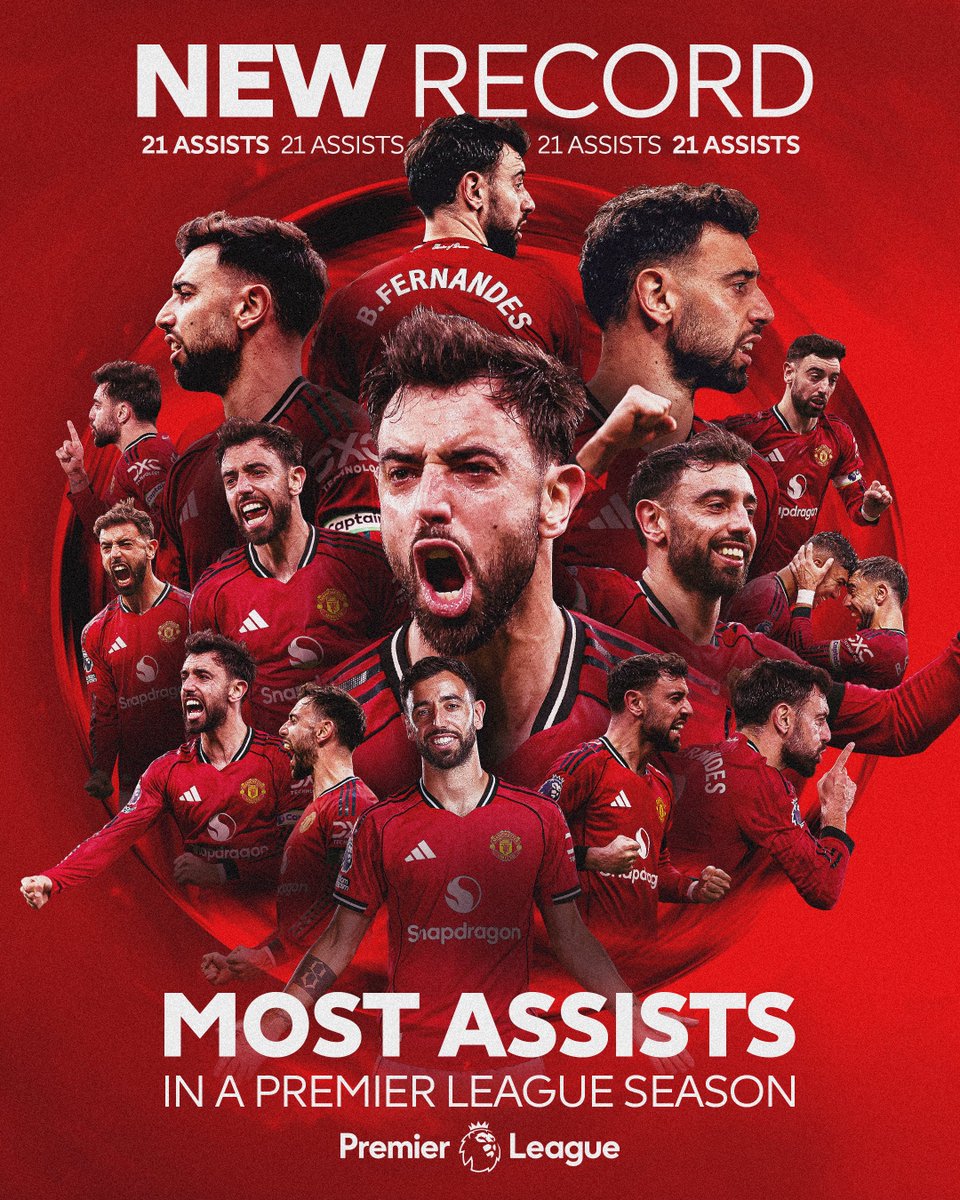
✅Michael Olise has the most assists (19) in the Bundesliga this season and he's already won the league player of the season award
✅Federico Dimarco has the most assists (17) in the Seria A this season and he won the league player of the season award
✅Lamine Yamal with just 11 assists is about to finish as la Liga's top assist provider and he won the player of the season award as well.
🤔But a particular fanbase living in their own delusions thinks Bruno Fernandes's 20 assists is not deserving of the player of the season award just because they're witnessing their club win the league for the first time in their lives.
Your tears means the world, keep it coming.
Maybe this is high time government intervene in the regulation of house rent and agent fee. If not for other thing, maybe for the sake of those earning legitimately and all civil servants 🤔.
GBN 🙏
🚨 A man died alone in room 3327 of a New York hotel.
Within 48 hours, the FBI seized everything.
His name: Nikola Tesla.
He invented the future: Wireless energy. Free energy. Technology that can't be measured, taxed, or sold.
They buried him. They stole his inventions. They erased his name.
But they made a mistake.
They let just one man review the files:
Dr. John G. Trump – Professor at MIT, electrical engineer.
Donald Trump's uncle.
For 83 years, the Trump family guarded Tesla's most dangerous legacy:
Free energy • Wireless electricity • Healing frequencies • Quantum technology.
Now his nephew is President.
Do you still believe in coincidence?
Medical beds, QFS, 6000 suppressed patents – all Tesla.
The Tesla Protocol is activated.
April 30.
Code: ROOM-3327 / JOHN-G-TRUMP / TESLA-83 / 6K-PATENTS / QFS-TESLA
The old world is dying. The new one begins.
FOLLOW ME, THE NEXT DROP WILL BE SHOCKING.
Largest Countries in the World:
10. 🇩🇿 ALGERIA – 2.38 Million km²
9. 🇰🇿 Kazakhstan – 2.72M
8. 🇦🇷 Argentina – 2.78M
7. 🇮🇳 India – 3.3M
6. 🇦🇺 Australia – 7.7M........ more
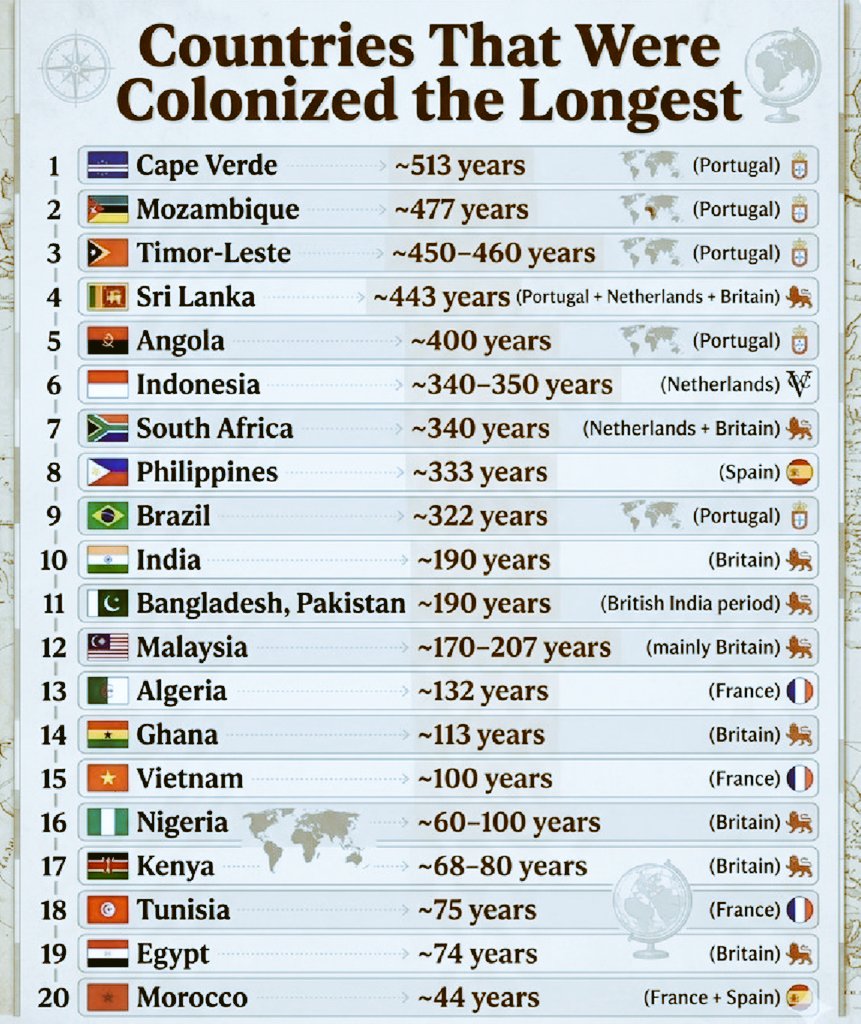
Countries That Were Colonized the Longest
1) 🇨🇻 Cape Verde ~513 years (Portugal)
2) 🇲🇿 Mozambique ~477 years (Portugal)
3) 🇹🇱 Timor-Leste ~450–460 years (Portugal)
4) 🇱🇰 Sri Lanka ~443 years (Portugal + Netherlands + Britain)
5) 🇦🇴 Angola ~400 years (Portugal)
6) 🇮🇩 Indonesia ~340–350 years (Netherlands)
7) 🇿🇦 South Africa ~340 years (Netherlands + Britain)
8) 🇵🇭 Philippines ~333 years (Spain)
9) 🇧🇷 Brazil ~322 years (Portugal)
10) 🇮🇳 India ~190 years (Britain)
11) 🇧🇩 Bangladesh, 🇵🇰 Pakistan ~190 years (British India period)
12) 🇲🇾 Malaysia ~170–207 years (mainly Britain)
13) 🇩🇿 Algeria ~132 years (France)
14) 🇬🇭 Ghana ~113 years (Britain)
15) 🇻🇳 Vietnam ~100 years (France)
16) 🇳🇬 Nigeria ~60–100 years (Britain)
17) 🇰🇪 Kenya ~68–80 years (Britain)
18) 🇹🇳 Tunisia ~75 years (France)
19) 🇪🇬 Egypt ~74 years (Britain)
20) 🇲🇦 Morocco ~44 years (France + Spain)
Note: Durations are approximate and may include multiple colonial powers or different phases of control.
Source: Historical Records, Other Web Sources
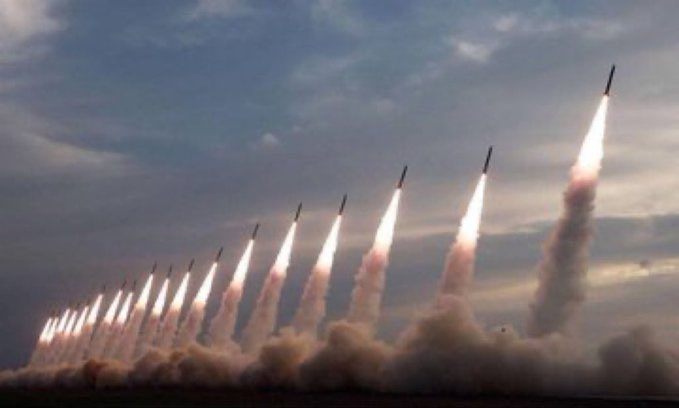
🚨 BREAKING
IRGC Missile Command:
"We announce the end of all targeting restrictions. We will strike infrastructure in a manner that will deprive the United States and regional countries of oil and gas resources for years to come.
Orders have been transmitted to local missile bases, and operations will begin immediately."
Dear Zuha,
I know you are inquisitive about how our religious days fit into the modern world. It is a brilliant question. I will be breaking this down for you so you can clearly see that Islam is not a copycat. It is a complete system with its own deep, independent roots.
Firstly, you asked: if the Gregorian calendar is not real, why do Muslims pray on Friday, and is there a different Friday in the Islamic calendar?
To help you and others understand, we have to go back to history.
Pope Gregory was the one who introduced the Gregorian calendar, and he introduced it in 1582. However, when you look at Islamic history, you will see that Muslims had been observing Jumu'ah for nearly a thousand years before that Pope was even born. If you open classical books of Islamic history such as the Seerah of Ibn Hisham or The Sealed Nectar, the physical proof is right there.
These books documented the very first Jumu'ah prayer held by the Prophet Muhammad (peace be upon him) in 622 CE. It took place in the valley of Ranuna during his migration from Mecca to Medina. In that same era, Allah revealed an entire chapter in the Quran called Surah Al-Jumu'ah, where He commanded the believers to leave their worldly trades and gather. This proves Yawm al-Jumu'ah was a lived reality in the 7th century, over 900 years before the Gregorian calendar existed in Rome.
Now, you might wonder how this connects to the Friday we know today. Frankly, the seven day weekly loop is an entirely different system from how we count solar or lunar months. It is an ancient, unbroken mathematical cycle. You do not even have to take my word for it. Non Muslim historians and sociologists agree on this.
For instance, Eviatar Zerubavel in his book The Seven Day Circle confirmed that this weekly cycle has remained completely unbroken for thousands of years across different empires. The day the Western world decided to call Friday aligns seamlessly with the sixth day of that ancient cycle.
In Arabic, the days are just numbered. Sunday is Day One. Monday is Day Two. The sixth day is Yawm al-Jumu'ah, the Day of Gathering. This means we do not pray on this day to honor a Roman calendar. That is, it was just a coincidental relationship. We pray on it because Allah established it on a divine timeline.
Secondly, you asked: why is Friday night considered so blessed, and what are you missing here?
To understand this, we have to look at the foundations of human existence. Friday goes more than just the end of the work week. The Prophet Muhammad (peace be upon him) taught us that Friday is the day Prophet Adam (peace be upon him) was created, the day he entered Paradise, the day he was sent to earth, and the day the world will end.
This is why the Prophet had a very profound routine. Every Friday during the early morning Fajr prayer, he would recite Surah As-Sajdah and Surah Al-Insan. He did this deliberately. These two chapters detail the creation of the universe, the biological creation of man, and the intense realities of the Day of Judgment. Praying these chapters every Friday morning is a divine reset. It reminds you of your origin and your final destination, both of which are tied to this specific day.
Because Friday carries the heavy weight of the end of times, reciting Surah Al-Kahf is your spiritual shield. The Surah contains stories about the ultimate trials of wealth, power, and faith. Reading it provides a divine light that protects your heart from the materialistic noise of the world and the deception of the Dajjal until the next Jumu'ah.
So by this fact, you are not missing anything. You just need to see that we are not following a Gregorian Friday. We are following a divine timeline. Don’t fret.
Allah knows best.
CANCELLED NETFLIX. CANCELLED AMAZON PRIME. CANCELLED HULU.
No more $19.99 each month. ChatGPT transformed my laptop into a free streaming center.
Here are 6 prompts to create this system: