Elon Musk: "I'll make another prediction, money won't matter in 2036."
Musk says when robots and AI are providing more goods and services than any human could possibly consume, money becomes meaningless.
"You want money for food, housing, transport, entertainment. If that is so abundant, what do you need money for in that case?"
🔥CLAUDE CAN NOW CONTROL THE HUMAN BODY
MIT students built a device that lets Claude control your hand through small electric pulses. You speak a task, a camera sees what’s in front of you, and your fingers move.
It can play piano without training, draw what you describe, and even mix a drink.
Six people built it in 48 hours. And, this is only the hand.
Florida just solved RANGE ANXIETY for EV drivers.
They’re testing a highway that charges your car WHILE you’re driving — wireless charging lane built right into the road.
Genius move for a tourism-heavy state like ours. More beach time, fewer charging stops.
Who else is ready for this? 🚗⚡
Ex Machina is no longer sci-fi. China has finally built it.
The company is AheadForm, founded in Shanghai.
The product is the world's most hyper-realistic robotic face.
Silicone skin you can't tell from human, 25 micro motors hidden underneath pulling the face into real expressions.
And RGB cameras embedded inside the pupils so when it looks at you, it actually sees you from where its eyes are.
They raised $28.5M to "give AI a head," which is also where the name comes from. AheadForm = a head form.
This is the opposite of where everyone else in robotics is focused.
Unitree, Figure, Tesla, Boston Dynamics: all about the body.
AheadForm chose the face because they think trust is the harder problem to solve, and trust gets decided at the face.
The reason nobody else has tried this is the "uncanny valley."
It's the creepy zone where a robot looks almost human but not quite, and looking at it just feels wrong even when you can't say why.
Most roboticists believed no amount of engineering could make a face realistic enough to escape it.
So they gave up and kept robots cartoonish on purpose: big anime eyes, exaggerated features, clearly synthetic.
But AheadForm decided to treat it as an engineering bug instead.
Add enough motors, tune the silicone, fix the timing, the valley closes.
And they're pulling it off.
A few crazy details about how this actually works:
1. The robot learns its own face in a mirror.
You put it in front of a camera, let it fire every motor randomly, and it watches what its face does and builds an internal map of "if I send command X to motor Y, my eyebrow does this."
Same exact process a human baby uses staring into a mirror. The robot teaches itself who it is by experimenting.
2. It predicts your smile 839 milliseconds before you smile.
By watching the micro-tells in your face that precede a smile, the robot starts smiling 0.8 seconds ahead, so its smile lands at the same moment yours does.
Most robot mimicry happens half a second late, which is exactly why it always feels artificial.
3. The pupils are the cameras.
When the robot makes eye contact, the gaze and the sensor are the same physical thing.
Most humanoid robots stick the camera on the forehead or chest, so they aren't actually looking at you when their eyes are pointed at you.
4. The founder, Yuhang Hu, did his PhD at Columbia under Hod Lipson.
Lipson is the guy who in 2006 built a four-legged robot that figured out it had four legs by experimenting with its own movement, nobody told it the body shape, it discovered it.
He has spent 25 years trying to build machines that know what they are.
AheadForm is that 25-year research arc productized.
5. NetEase Games already paid them to physically embody a fantasy video game character.
That opens up a brand-new category: robotics as the physical embodiment of fictional IP.
Every character-rich studio, Disney, Riot, Hoyoverse, Pokemon, Netflix, now has a question to answer about when their characters get bodies.
AheadForm believes whoever ships the first robot you'd actually want around your family wins.
That's the bet behind the most realistic robot face on earth.
The bionic skin Robots will hit the headlines in September 2026.
Love it or not love it, get used to it.
There are 79 companies building this now.
No skin robots will ultimately be exception and not the rule.
And yes some we be very “personal” robots.
I hope we mature—fast.
Chinese-made tents outperform similar products worldwide. They support internal wood stoves for heating, are extremely durable—even strong impacts don’t affect them—and can be set up easily and quickly.
✨🇨🇳China has deployed more than 10,000 driverless delivery vehicles across the country. Deliveries within a 30‑kilometer radius cost only 9.9 RMB (approximately $1.38), and customers can collect their packages simply by scanning the QR code on the vehicle.
🚨 CIA JUST CASUALLY ADMITTED BITCOIN IS THEIR SURVEILLANCE TOOL!
CIA General Counsel Michael Ellis admitted: “Bitcoin isn’t truly anonymous… it’s a TOOL we use for intel gathering.”
Russia called it a CIA control weapon. Bitcoin patents reveal it was designed by NSA. China banned it.
They LET it explode on purpose. Why do you think Tether printed endless USDT with no audit for a decade and continues without any scrutiny? Total transparency for the deep state.
That’s why they crucified Ripple with endless lawsuits and attacks.
XRPL is the real power shift: private transactions, zk-privacy for YOU, auditability when needed, compliance WITHOUT mass spying. Built for a post-surveillance world.
@DNAOnChain is building a zero-knowledge privacy system for decentralized identity on the XRPL(https://t.co/9wJytHr7dC).
Private Money. Private Identity.
Bitcoin = CIA’s perfect asset.
XRPL = freedom.
Now Africa, Europe, Asia, BRICS are adopting XRPL corridors into their economy for a true neutral bridge asset…
Your “decentralized” crypto was never yours.
It was always marketed for control and surveillance.
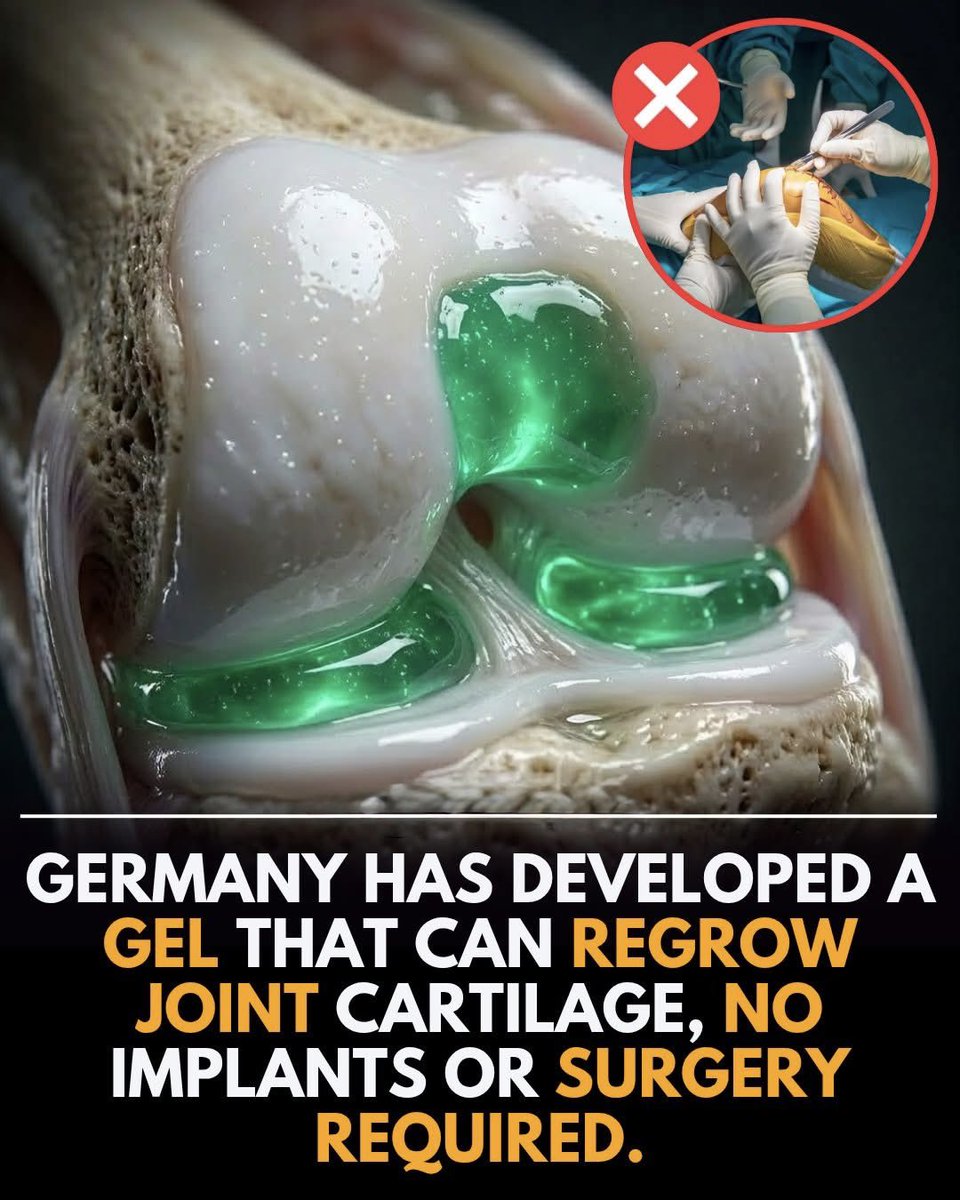
German medical researchers have engineered a novel, injectable hydrogel designed to stimulate the biological regeneration of articular cartilage. This non-surgical approach aims to directly repair joint damage and restore natural cushioning without relying on invasive and costly joint replacement procedures.
Orthopedic experts note that osteoarthritis and cartilage degradation affect hundreds of millions globally, often leading to debilitating pain and limited mobility. By utilizing a bioactive matrix that encourages the body's own stem cells to multiply and differentiate into healthy tissue, this gel could drastically shift treatment paradigms away from artificial implants.
The underlying technology relies on a specialized polymer network that seamlessly mimics the natural extracellular environment of human joints. Once introduced to the affected area, it acts as a supportive structural scaffold, safely dissolving over time as fresh, healthy cartilage takes its place.
Early clinical observations report a significant reduction in chronic joint inflammation and a much faster return to pain-free movement for affected participants. Unlike traditional surgical interventions, which frequently require months of strenuous physical therapy, this minimally invasive procedure could allow for an incredibly rapid recovery window.
While currently advancing through rigorous regulatory testing phases, the successful commercialization of this regenerative therapy could save global healthcare systems billions in surgical and rehabilitation costs. It offers a highly promising future where debilitating joint conditions are managed with a simple outpatient visit, permanently restoring active lifestyles for aging populations and athletes alike.
If this non-surgical treatment becomes widely available, how would the ability to naturally regrow joint cartilage change your approach to staying active?
Meet the incredible Huawei Maextro S800, its Chinas new ultra luxury car thats outselling giants like Porsche, Mercedes and BMW in the high-end market.
You can see why.
China’s innovations 👏🏻
Smart jackets equipped with airbags, worn by elderly people, automatically deploy in fractions of a second when a fall is detected, protecting the head, spine, and hips from injuries.
Today we're showing Helix 02 that can tidy a living room fully autonomously
Figure is designed so when you leave the house, your home resets exactly how you like it
🇨🇳 A year ago, humanoid robots were struggling with basic movements.
At China's 2026 Spring Festival Gala this week, they were doing backflips, parkour, and full kung fu routines with nunchucks.
Physical intelligence is moving faster than almost anyone expected.
Source: CGTN
Ray Kurzweil has been predicting this moment for 30 years, and we're at the cusp of it: AGI by 2029, followed by a singularity in the 2040s where machine–human hybrids trigger a post‑human intelligence explosion.
-- Robotics finally crosses the real-world barrier in 2026–27
-- 1000× intelligence jump by 2045, driven by human–AI integration
-- Longevity escape velocity by ~2032
-- Biology becomes computable