Of course, in a conversation that demands even a modicum of intellect “pick her” would be your response. That’s why the highest level your intellect can reach is the freezing point of all the alcohol you’ve been posting. Please step aside while the adults converse about preferences. We’ll call you when it’s time to talk about photo dumps.
Go to church bruv. Dont fall for that propaganda of I pray alone. “When two or more are gathered in my presence, there I am in their midst”. Praying alone is good. But you need fellowship. You need the encouragement of other believers.
Warning: Once you see this monk's 3-minute demonstration on "how to stop thinking," you can't unsee it.
Ajahn Brahm says:
"Your mind never actually stops. It just fills every gap you fail to notice."
His demonstration works because he exploits something neuroscience has quietly confirmed for years that "the thinking mind cannot generate thought and pay full attention at the same time."
Attention and cognition compete for the same neural real estate. When one runs at full volume, the other goes quiet.
Most people never experience mental silence because they've never once given attention *anything* to fully occupy it with.
What Brahm does in those 3 minutes is deceptively simple.
He asks you to listen to the *gaps between his words*.
The silence between syllables. The pause between sentences. And the moment you shift your attention to those gaps, your internal narrator goes quiet.
The reason is you directed your awareness with such precision that it fully engaged your attention and left no room for extra commentary.
Meditation traditions have circled this insight for 2,500 years.
The Pali term for mental chatter is *prapañca.*
Transaltion: Conceptual proliferation.
One thought spawns another, which spawns three more, and within seconds you're rehearsing an argument from 2014.
Brahm's technique interrupts the mechanism at its source. You cannot proliferate thought while genuinely tracking silence, because silence has no content for the mind to grab onto and multiply.
This is why most meditation instruction fails people. They're told to "clear the mind," which is like being told not to think of a polar bear. The very act of trying activates the machinery it's supposed to silence. Brahm inverts the entire approach.
Instead of asking you to stop, he asks to divert your attention somewhere so refined to rest that stopping happens on its own, as a side effect.
There's a deeper reason this demonstration hits so hard.
Modern life has trained our nervous systems to treat silence as a threat that must be filled with a podcast, a scroll, a snack, a plan.
We've forgotten that silence is the medium consciousness actually rests in. Sound is the interruption. It's not the other way around.
Once you experience even 5 seconds of genuine internal quiet, your relationship with your own thoughts permanently shifts. You stop believing every mental voice is *you*. You start noticing there's a witness underneath the chatter that was never anxious to begin with.
Please throw in your thoughts on this.
Yes. Meet people where they are. To be in the company of others is to be negotiating imperfection at every step. Because one day, you’ll meet someone that feels like the limits of your knowledge are far below their arbitrarily set standard required for them to engage meaningfully
Guys here is Template @KePiitso COPY AND PASTE
3 September 2026
To: The Energy Regulator
National Energy Regulator of South Africa (NERSA)
Kulawula House, 526 Madiba Street, Arcadia, Pretoria
REF: Comments on the Consultation Paper on the Eskom Retail Tariff Structural Adjustment (ERTSA) Application for Standard Tariffs for the 2027/28 Financial Year, published 2 September 2026 (closing date for comments: 2 October 2026, 16:00)
Subject: Unconditional objection to any further electricity price increase - nothing less than a reduction is acceptable
Dear Members of the Energy Regulator
1. I write in terms of the public participation process to record my unconditional objection to Eskom's ERTSA application for the 2027/28 financial year, which proposes yet another average increase of approximately 8.8% in the price of electricity. I say this at the outset, clearly and without equivocation: nothing but a reduction in the price of electricity is acceptable. Another increase is not merely undesirable - it is unjustifiable, unaffordable and unconscionable in the current economic climate.
2. Over the past twenty years, the price of electricity in South Africa has risen by more than 900% - cumulative increases that have outpaced inflation by a wide margin and dwarfed wage growth for ordinary workers. Every single year, South Africans are told that this year's increase is the last one, or the minimum possible, or somehow for our own good. Yet the increases never stop. Even the Regulator's most recent determination, approving an average increase of 8.76% for 2026/27, landed on consumers who are already drowning, and Eskom is already back asking for 8.8% more. Each increase compounds the last, and the burden is never lifted - it is only passed on.
3. This country is in the grip of a cost-of-living crisis. Food prices, fuel, municipal rates, transport and housing have all risen relentlessly, while salaries and wages have not kept pace. Working South Africans are doing more hours for less real money, and every cent counts. Electricity is not a luxury that can be cut from a budget - it is a basic need: it cooks our food, keeps medicine cold, lights our children's homework, and powers the small enterprises that employ our neighbours. For the poor, who spend a far larger share of their income on energy and who buy electricity through prepaid metres, every tariff increase is a direct, immediate cut to an already inadequate income. When the price of electricity rises, it is not Eskom's shareholders who feel it - it is the pensioner in a two-room house in winter, and the domestic worker who must choose between a warm meal and electricity for the week. The poor and the working class bear the brunt of every increase, and they can bear no more.
4. Eskom's demand for yet another increase is all the more indefensible given its own financial results. Eskom has now recorded its first profit since 2017 - R23.9 billion before tax in the 2024/25 financial year - and reports indicate that profits have since more than doubled. Eskom's own annual results attribute this turnaround in large measure to tariff increases already granted. In other words, the South African public has already paid for Eskom's recovery through higher prices, and Eskom now returns to the trough asking for more, while sitting on record profits. Those profits should be applied to reducing the price of electricity and easing the burden on consumers - not to funding yet another round of increases. A profitable Eskom that still demands annual hikes is not a utility in need; it is a monopoly that has learned that the public will always have to pay.
This fella made me quit my job in 2005 after reading his Rich Dad book and the other less talked about one, Cashflow Quadrant. His ideas were that compelling back then. Read the book in 24hrs nonstop. It was that unputdownable. Got another 9-5& haven't played w fire again since
Slightly tangential but I believe a fair amount of incidents where black people think they’ve been the victims of racism are them entering spaces where there are specific rules which they do not understand and therefore unknowingly break.
Spectators are expected to be quiet at tennis matches. Someone who hasn’t grown up attending or watching such events wouldn’t know this. I’ve definitely broken unspoken rules before when entering new spaces. It’s a huge part of class dynamics in Britain.
But black people, and to some extent other minority groups, are taught to perceive criticisms of their behaviour as racism. The reality is that different spaces have different expectations of behaviour and you can’t act the same way everywhere. No group appreciates it when you enter their space and don’t conform to their norms.
This is a new thing. My mom would walk 5 kilometres from where the taxi dropped her off coming from work.
For 18 years. Not once did she come home drenched on the 1st of September.
What we’re seeing now is new levels of indelelo and, in some cases, outright criminality.
Our society is slowly rotting!
This was recorded 📽️ before the Springboks 🇿🇦 lost to New Zealand. 🇳🇿
The reaction afterwards only reinforced the point. 🙃
New Characters & Campaigns, out now! 🚨
You have to fall in love with her in different versions. The young her, the tired her, the pregnant her, the ambitious her, the difficult her, the woman she becomes with time. That’s the real secret.
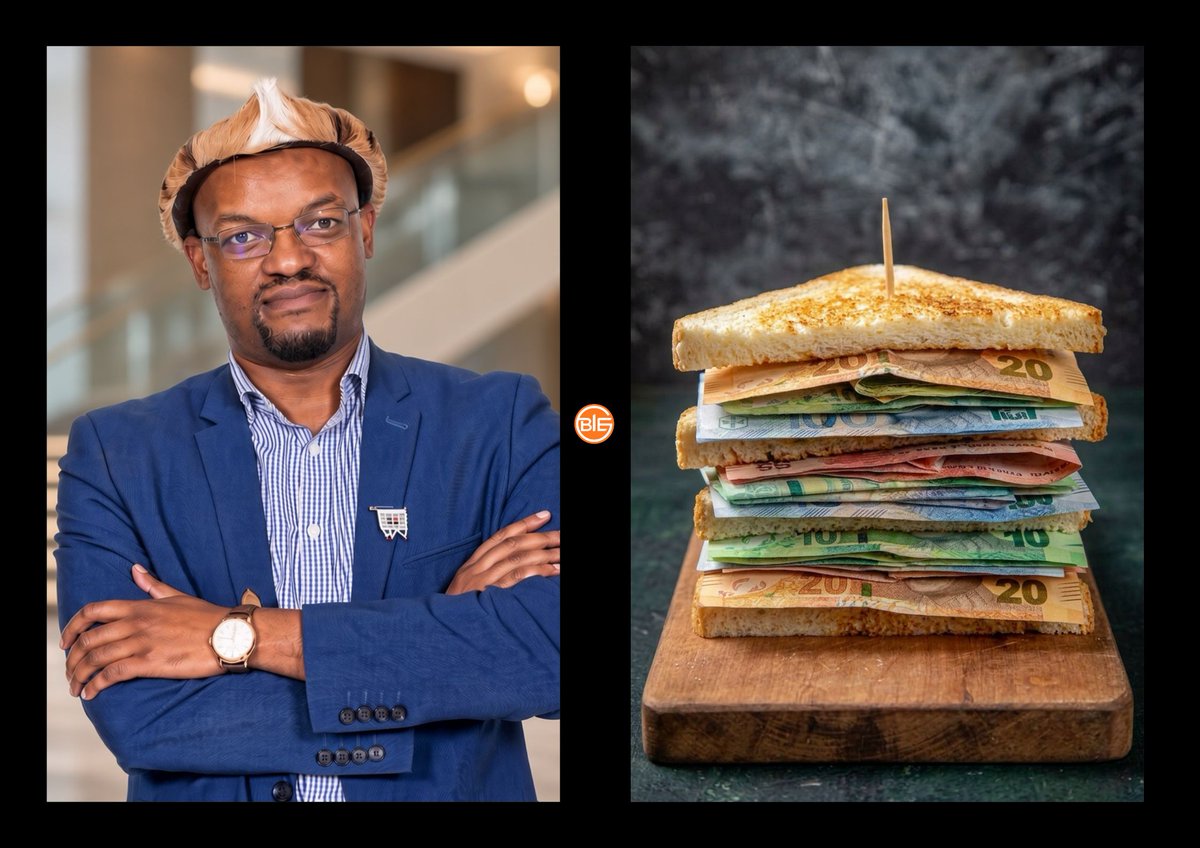
SITHOLE WARNS OF SANDWICH GENERATION
Khaya Sithole warns that South Africa's economy is resting on an increasingly narrow base, as new data lay bare just how few working-age citizens are actually carrying the country's economic weight.
Unemployment has climbed to 33.6%, and of South Africa's 63 million people, only 16.7 million are employed, just 40% of those aged between 15 and 64.
That imbalance falls heavily on what Sithole calls the "sandwich generation": working South Africans who must support not only their own children, but also ageing parents and unemployed relatives, often at the same time.
SARS data show how thin this base really is, with only about seven million people earning enough to pay income tax at all.
Old Mutual's latest savings monitor found that 40% of working adults are under severe financial stress, with lower earners struggling most to manage debt, some resorting to juggling accounts or skipping debit orders just to stay afloat.
Without stronger job creation and higher incomes, Sithole cautions, growing numbers of South Africans risk slipping into a lasting socioeconomic limbo, unsupported by a workforce already stretched too thin to help.
Full story - https://t.co/FzNBTbC7OX
Pictured - Khaya Sithole, Accountant, Activist, and Academic
Ladies, stop treating your body like a man's. You tolerate cold less well than he does. You dont do as well with fasting. You need more sleep. Carbs are critical for your hormones. You have a 28 day cycle unlike his 24 hour cycle. Your body is geared to safety, whereas his is geared to challenge.