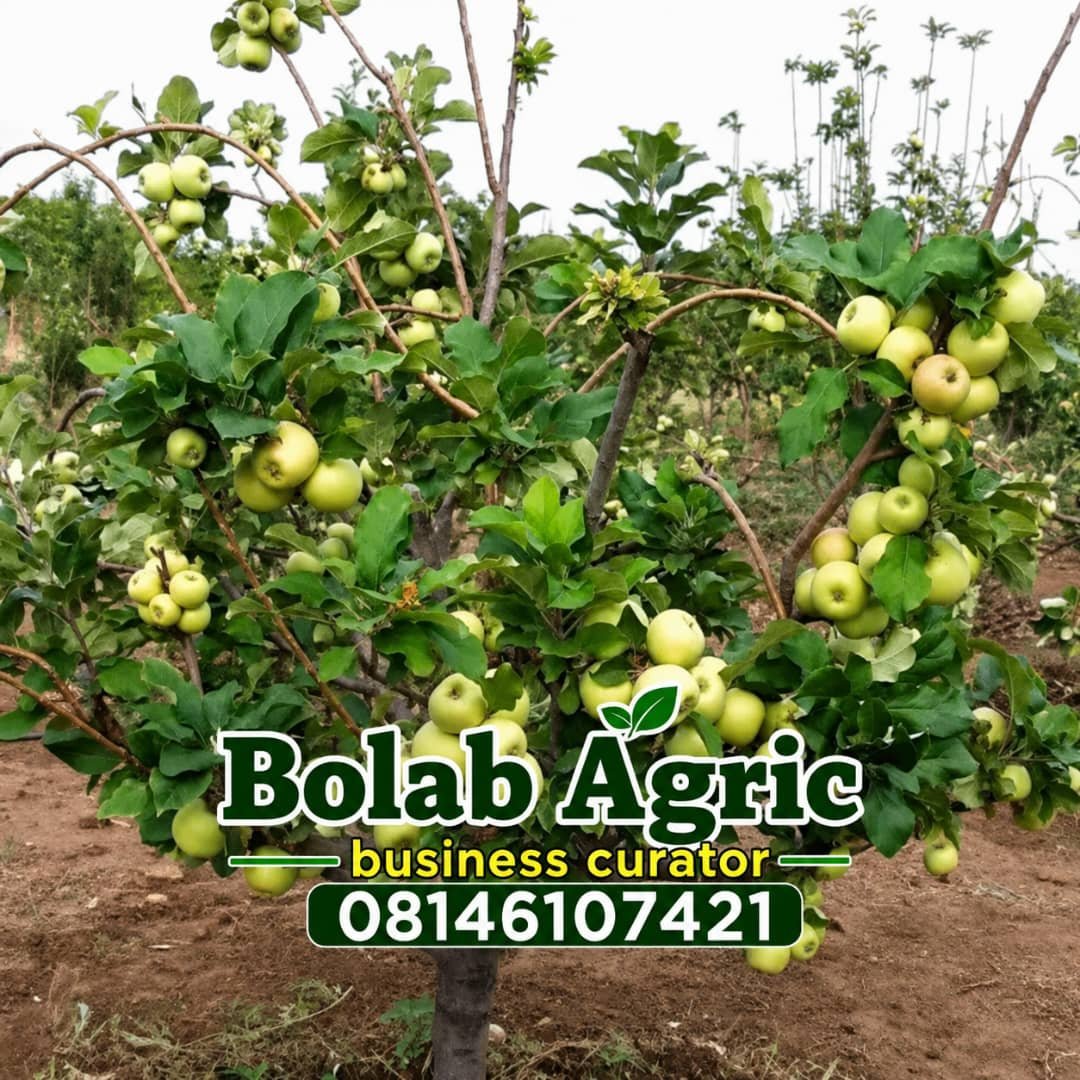
Yesterday, I went to one of our soybean farms. As I walked through the field, I noticed some of the plants had started flowering.
Immediately, I remembered that I had instructed the workers to weed the farm a few days ago.
To my surprise, the job hadn't been done.
That alone can affect the crop. Weeds don't wait because soybean has started flowering.
It reminded me that one of the biggest risks in agribusiness is assuming work has been done simply because you gave the instruction.
If you're not keeping records, following up, and inspecting the farm yourself, you may discover problems when it's already too late.
A farm is not managed from the phone. It is managed through records, supervision, and regular inspection.
Yesterday's visit was another reminder that what you don't inspect, you can't truly manage.
Nigerians have reportedly lost over ₦316 billion to Ponzi schemes.
Now think about this.
Some people will confidently send money to strangers on the internet because they're promised a guaranteed ROI.
But they won't invest in a genuine business owned by someone they know.
Worse still, some won't even pay for a product or service offered by their own brother, sister, friend, or relative. They expect it for free.
Isn't that ironic?
We trust strangers with our investments, but we struggle to support businesses we can actually see and verify.
Don't invest because the explanation sounds convincing. Invest because the business can be independently verified.
Real wealth grows through productive businesses—not empty promises.
One lesson from my journey in agribusiness.
When I look back on many of my failures, I discovered something that completely changed the way I see agriculture.
I used to think the problem was the enterprise. If one didn't work, I looked for another.
But with time, I realized that the crop or livestock was not always the problem.
The real problem was the business system behind it.
That was when I stopped chasing enterprises and started building systems.
Looking back today, I can confidently say:
Changing crops or livestock without changing the business system usually produces the same result.
This mindset changed my own journey.
It helped me move from operating in a single rented room and managing just half a plot of land to thinking bigger and gradually expanding into acres.
The biggest change wasn't the size of my farm.
It was the way I made decisions.
Today, whether it's poultry, fish, pigs, maize, cassava, soybeans, cocoa, or any other enterprise, I ask the same questions:
Who is the market? What are the numbers? What are the risks? Is the business system strong enough to survive?
I'm sharing this because someone may be planning to abandon one enterprise for another.
Before you do, ask yourself one honest question:
Did my enterprise fail, or did my business system fail?
That question changed my life. It took me from thinking like a farmer trying different enterprises to thinking like an agribusiness builder.
I hope it helps someone else do the same.
Messi, Ronaldo and the Biggest Agribusiness Lesson
Everyone is talking about Messi and Ronaldo after the World Cup. But I see a lesson every agribusiness entrepreneur should never forget.
No matter how great you were yesterday, every new season demands fresh preparation.
Messi's past trophies couldn't play this World Cup for him. Ronaldo's incredible career couldn't guarantee another title. They still had to compete.
Agribusiness is no different.
Last year's bumper harvest doesn't guarantee this year's success. Every season, you must prepare the land, understand the market, manage risks, and deliver quality.
The market doesn't reward your history—it rewards your consistency.
Many farmers fail because they rely on yesterday's achievements instead of today's preparation.
Whether you're producing, processing, or trading agricultural commodities, remember this:
Your greatest asset is not your last harvest. It's your ability to prepare for the next one.
That's how sustainable agribusiness is built.
I remember some years back....
Some poultry farmers will call you and say,
"Come and collect chicken."
You leave your house feeling lucky.
Only to discover it's a bird that died that morning. 😂
My question is...
After giving someone a dead bird, what kind of prayer are you expecting from the person? 🤣
Let's hear your funniest farm experience in the comments. 😄👇
One lesson that cost me money?
I learned that profit doesn't come from producing more. It comes from managing better.
Early on, I used to think a bigger operation automatically meant a better business.
Over time, I realized that's not true.
I've seen people with smaller farms sleep peacefully because they knew their numbers, controlled their costs, and had reliable customers.
I've also seen people with much bigger farms struggle because they expanded before their business was ready.
That changed my mindset completely.
Today, I don't admire the biggest farm.
I admire the farm that knows its profit, understands its customers, and can still be standing ten years from now.
That's the kind of agribusiness I'm committed to building.
A farmer once told me,
I want to stock 15,000 birds.
I asked him, Can your current business comfortably manage 2,000 birds and make consistent profit?
He smiled.
Here's what I've learned.
Many people want a farm that attracts attention before they build a business that makes money.
There's nothing wrong with starting big if your records, cash flow, market, and management can support it.
But if you're borrowing heavily just to look successful, you may be building pressure instead of profit.
I've seen small farms quietly grow into successful businesses because the owners focused on managing what they had before expanding.
Sometimes, the smartest business decision is not to expand.
It's to become profitable first.
What's your view? Is it better to grow fast or grow profitably?
One thing farming taught me before I became an Agric Business Curator is this:
Most farmers are not failing because they are lazy.
I used to think the answer was to plant more, work harder, and hope for a better harvest. But the more I farmed, the more I realized that hard work alone doesn't guarantee profit.
I met farmers who had good harvests but couldn't find buyers. Others couldn't tell whether they made a profit because they kept no records. Some repeated the same costly mistakes every season without knowing where they were losing money.
That was when it became clear to me.
The biggest challenge isn't farming itself. It's farming without a system.
The day I stopped seeing farming as just planting and harvesting, and started treating it like a business, everything changed. I began to plan better, keep records, control costs, and make decisions based on facts instead of guesswork.
That experience is one of the reasons I became an Agric Business Curator.
Today, my mission is simple: to help farmers build profitable agricultural businesses through the right systems, not just hard work.
Because farming can feed your family, but a good system can build your future.
A Business Lesson I'll Never Forget – Part 2
After my friend and the man agreed on the supply of 600 bags of cement, all their communication was through phone calls and WhatsApp. They never met physically.
The agreement was simple: payment would be made before the cement was offloaded.
On the way to Lagos, the truck developed a flat tyre, causing a delay.
While the driver was fixing it, the man called again. He said he had already arranged another truck because the project was urgent, but he still wanted my friend's truck to deliver another load. He sent the address of the store where the cement should be delivered.
When the truck arrived, my friend asked for the agreed payment before offloading.
Then a woman at the store came out and confidently said, "I've already spoken with your boss. Please offload the cement."
My friend politely refused.
He insisted that no payment meant no offloading.
That single decision changed everything.
The man stopped answering his phone. WhatsApp messages were no longer delivered. He had disappeared.
It became obvious that the man was not the real supplier. He had allegedly presented himself to the woman as the owner of the cement, while pretending to my friend that he was the buyer.
Imagine if my friend had offloaded the cement.
The woman could have paid the scammer, believing she was dealing with the genuine supplier. The scammer would disappear with her money, while my friend would still be demanding payment for 600 bags of cement.
The woman would insist she had already paid.
My friend would insist he had received nothing.
Both innocent parties could have ended up accusing each other, involving the police, going to court, damaging reputations, and suffering a huge financial loss—all because of a scammer who created a false connection between two honest businesses.
Thankfully, none of that happened because my friend followed one simple business rule:
Never release goods until the agreed payment terms have been met.
A few weeks ago, I received an unexpected phone call.
The caller said he had found my contact online because one of the services I offer is connecting people with business opportunities. He explained that he was working on a school construction project and urgently needed an architect.
At that moment, I was in a meeting with one of my clients, so I politely told him, "Give me about an hour, and I'll get back to you."
By the time I finished, I had already seen his WhatsApp messages. We continued our conversation, and as he explained more about the project, another need came up.
He mentioned they would soon begin molding blocks for the construction and needed a reliable cement supplier.
Immediately, I remembered a trusted friend of mine who supplies full truckloads of cement. I connected both of them, and they started discussing the details directly.
The following day, everything seemed to be moving smoothly.
Then came the big update...
They agreed on the supply of 600 bags of cement, with payment to be made upon delivery.
Everything looked like a genuine business opportunity.
But what happened next was something I never expected...
This pepper is selling for ₦200.
If I ask 100 Nigerians this question, I can almost predict the answer.
"The farmer must be making a lot of money."
But what if I told you that many pepper farmers don't even get anything close to that ₦200?
Strange, right?
The buyer thinks the farmer is getting rich.
The farmer says he's barely surviving.
So. Who is telling the truth?
- The farmer?
- The marketer?
- Or is there something about the pepper business that most people don't understand?
Before I explain, tell me what you think. I'm reading every comment.
~Odens
YOU ARE NOT IN THE FARMING BUSINESS. YOU ARE IN THE DECISION BUSINESS.
Many people believe the most valuable asset in agriculture is land.
I don't.
Give two farmers the same land, the same rainfall, and the same crop. By the end of the season, one is planning expansion while the other is looking for money to settle debts.
The difference wasn't the land. It was the decisions they made.
What to produce.
How much to produce.
When to buy inputs.
Who to sell to.
Whether to expand or wait.
Those decisions determine whether farming becomes a profitable business or an expensive hobby.
A farm is simply where production takes place. The real business is in the quality of the decisions you make before planting, during production, and after harvest.
Too many farmers focus on increasing acreage while ignoring the business structure behind the farm. That is why some people cultivate more land every year but make less money.
Your farm will never outgrow the quality of your decisions.
If you're serious about building a profitable and sustainable agricultural business—not just cultivating crops—then you need more than farming experience. You need business guidance.
At Bolab Agric Business Curator, we work with farmers, agribusinesses, and investors to make informed business decisions, reduce costly mistakes, improve profitability, and scale at the right pace.
For professional agribusiness guidance and business development support, send us a message. Let's build an agricultural business that makes sense—not just a bigger farm.