I didn’t get @RialoHQ at first.
Then I noticed how clean the identity is. No noisy gimmicks, no “look at me” energy. Just a mark that feels intentional, like it’s trying to be remembered for the product, not the marketing.
That usually signals one thing: they’re building for people who actually use crypto daily, not just people who scroll it.
If Rialo does this right, the win is simple:
Less mental overhead.
Fewer clicks that feel risky.
More of that “I know exactly what’s happening” feeling, even when the market is chaos.
I’m not here to pretend I know their full roadmap. I’m watching the fundamentals: design choices, clarity of communication, and whether the experience matches the brand’s calm confidence.
If you’re also tracking Rialo, what’s the first thing you want them to nail: UX, security transparency, or real utility?
@Richardx122@khant1506
@PhcThan24793527 Rally opening to everyone feels like a shift from follower-count marketing to contribution-based creator infrastructure. That is exactly what Web3 campaigns need if they want better content.
Crypto research can get messy very fast.
Charts, X posts, on-chain data, narratives, token updates, everything moves at the same time.
That’s why I’m interested in what @SurfAI is building: an AI analyst for crypto that helps turn scattered information into clearer insights.
Happy to be an Early Waver and looking forward to testing the Pro trial
We are giving out FREE PRO PLANS ($49/month) to anyone who joins our official discord server.
Only offered to the first 500 users.
Exclusive perks are available for current paying users as well.
Join now ↓
The next phase of DeFi will not be won by complexity.
It will be won by infrastructure that makes complexity invisible.
Today, accessing yield often means acting like a portfolio manager.
Users need to decide where capital should move, which protocol is worth using, when incentives are changing, how risk should be managed, and whether a position should be rebalanced.
The opportunity is there.
But the experience is still too operational.
One-click DeFi is not about making DeFi less powerful.
It is about making powerful DeFi easier to access.
@ConcreteXYZ Vaults are part of this bigger shift.
By using structured vault systems, automated execution, ctAssets, and automated compounding, Concrete helps simplify onchain capital deployment. Instead of asking users to manage every step, vault infrastructure can handle strategy execution in the background.
The user allocates capital.
The infrastructure does the work.
That model matters because DeFi needs more than high yields.
It needs capital efficiency, better execution, scalable systems, and risk-adjusted yield that can serve both everyday users and institutional DeFi participants.
DeFi users do not always need more buttons.
Sometimes they need fewer decisions.
And that is why DeFi vaults may become the default interface for deploying capital onchain.
Explore Concrete at https://t.co/lEvW6M5hIN
Why Should You Use a Concrete Vault?
The current DeFi experience is powerful, but it is not always simple.
Most users who want to earn yield onchain need to constantly monitor opportunities, compare APYs, move liquidity, claim rewards, compound returns, rebalance positions, and manage risk manually. This creates friction, wastes time, and often leads to inefficient capital deployment.
In a fast-moving market, being early is important. But being efficient is just as important.
This is why Concrete Vaults are useful.
A Concrete Vault gives users access to a structured system for deploying capital onchain. Instead of managing every action manually, users can rely on vault infrastructure designed to pool capital, automate compounding, optimize positions, and coordinate strategies over time.
This is the value of DeFi vaults.
They simplify participation while helping capital work more consistently. With automated compounding, rewards can be reinvested more efficiently. With structured strategy execution, capital can be allocated with clearer rules. With vault systems, users can reduce the operational burden of managing multiple positions themselves.
Vault infrastructure matters because DeFi is no longer simple.
Yield opportunities move quickly. Liquidity conditions change. Risk profiles shift. A manual approach may work for small experiments, but it becomes harder to scale when users want consistent execution and better capital efficiency.
Concrete Vaults are designed to support this next phase of structured DeFi.
They are not just passive wrappers around yield. They include systems for coordinating capital deployment, rebalancing positions, enforcing strategy constraints, and responding to changing onchain conditions. Through tools like ctAssets, onchain execution, and structured vault architecture, Concrete helps make onchain capital deployment more efficient.
This matters for both everyday DeFi users and the future of institutional DeFi.
As more capital moves onchain, users will need infrastructure that can reduce friction, improve consistency, and help coordinate liquidity across opportunities. Manual strategy management does not scale forever.
The future of DeFi may not be about who can click fastest or monitor dashboards the longest.
It may be about who has access to the best systems for coordinating capital.
That is the role of Concrete Vaults.
🚨 Explore Concrete at https://t.co/lEvW6M5hIN 🚨
SHIFT badge drop is live.
• Pre-register on https://t.co/HYzkdMqOV1.
• Complete the tasks.
• Reveal and share your badge.
This is where your points multiplier gets locked in.
🧵
DeFi Doesn’t Remove Trust — It Engineers It
The founding myth of decentralized finance is often captured in three words: "Code is Law."
Since the inception of Bitcoin and the subsequent rise of Ethereum, the prevailing narrative has been that DeFi is inherently "trustless." We were told that by replacing central bankers with smart contracts and opaque boardrooms with transparent ledgers, we could finally eliminate the need for human trust. No intermediaries, no permission, no vulnerability to human error.
But as the industry matures, we are hitting a wall of reality. In any complex financial system, trust is never truly removed—it is simply relocated. The question facing the industry today isn’t how to achieve total trustlessness, but rather: Where does the trust live, and is it being managed or merely hidden?
Where Trust Actually Lives
While a user might not need to trust a specific bank teller, they are still placing an immense amount of trust in the underlying DeFi infrastructure. Trust has been abstracted away into several critical layers:
Smart Contract Assumptions: You trust that the logic is flawless and that no "infinite mint" or reentrancy bugs exist.
Oracle Dependencies: You trust that external data feeds are providing accurate prices and haven't been manipulated.
Bridge Security: You trust that the collateral locked on one chain is actually safe while you play with "wrapped" assets on another.
Governance Systems: You trust that a handful of whales or a DAO won't vote to change the parameters of the protocol in a way that disadvantages you.
In these instances, trust isn't gone; it's just technical.
The Trap of "Decentralization Theatre"
The industry often falls into the trap of decentralization theatre—creating the appearance of a distributed system while maintaining centralized points of failure.
We see DAOs with such low participation that a single entity holds the keys, or "decentralized" protocols that rely on a 3-of-5 multisig controlled by the founding team. We see timelocks that provide a window for exit but offer no actual protection if the underlying code is exploited. These systems offer the ideology of decentralization without the actual safety required for institutional DeFi.
The Shift Toward Engineered Trust
A mature financial system doesn't run on hope; it runs on engineered trust. This is the transition from "trusting that nothing goes wrong" to "designing a system that remains resilient when things do."
Engineered trust means moving beyond the binary of trustless vs. trusted. It involves:
Clear Roles and Permissions: Defining exactly who can do what and under what conditions.
Enforced Constraints: Using code to set hard boundaries on behavior.
Dynamic Response: Acknowledging that code alone cannot predict every "black swan" event.
Real operational security requires more than just a static audit. it requires monitoring, layered security, and, occasionally, the inclusion of human judgment for edge cases that a rigid algorithm might mishandle.
How Concrete Is Redefining the Standard
This is where Concrete separates itself from the narrative of "trustless" idealism. Concrete recognizes that for DeFi to scale to institutional levels, trust must be explicit, structured, and enforceable.
Instead of participating in decentralization theatre, Concrete focuses on a robust architecture where:
Trust is Explicit: We don't hide where the levers are. Roles are clearly defined within the system architecture.
On-chain Enforcement + Off-chain Intelligence: By combining the transparency of on-chain execution with the sophisticated monitoring of off-chain data, Concrete creates a hybrid security model that is far more resilient than code alone.
Controlled Execution Environments: Concrete vaults are designed with a role-based architecture, ensuring that every action is verified and every constraint is enforced.
Concrete prioritizes engineered trust over ideological purity, ensuring that the infrastructure is built to survive the stressors of a volatile market.
The Future: Resilience Over Ideology
The "trustless" era of DeFi was a necessary starting point, but the next phase of the industry belongs to those who can build for the real world.
The future of DeFi security won't be defined by who claims to have removed trust entirely. It will be defined by the platforms that acknowledge where trust exists and engineer it into a bridge, rather than a barrier. Resilience matters more than narrative, and infrastructure will ultimately be judged by how it behaves when the lights go out.
Explore the future of engineered trust and Concrete vaults at https://t.co/lEvW6M5hIN.
Sustainable Yield Is the Future of DeFi
For years, DeFi has rewarded speed.
The fastest users found new farms early. The fastest capital entered high-APY pools before returns compressed. The fastest protocols attracted attention through incentives, emissions, and aggressive reward programs.
But speed alone does not create sustainability.
We have seen the same cycle repeat across DeFi many times. A new protocol launches with high APY. Liquidity floods in. Returns drop as more capital enters. Incentives weaken. Users leave. Then the market moves on to the next opportunity.
This creates a short-term mindset.
Everyone asks:
Where is the highest yield right now?
But as DeFi matures, a better question is emerging:
Which strategies can actually last?
What Sustainable Yield Really Means
Sustainable yield is yield that can persist over time.
It does not rely entirely on temporary token rewards. It is not built only for one market condition. It is not attractive only because the APY looks high for a short period.
A sustainable DeFi strategy should be durable. It should be able to generate returns through real demand, adapt to market changes, and remain useful across different cycles.
This is different from chasing peak performance.
Peak yield is about the highest possible number today. Sustainable yield is about whether the strategy can continue producing value tomorrow, next month, and through different market environments.
That distinction matters for serious onchain capital.
Temporary Yield Is Easy to Create
Temporary yield is everywhere in DeFi.
Protocols can use emissions to attract liquidity. Reward campaigns can push APYs higher. Early participants can benefit before capital crowds the opportunity.
But emissions-driven yield usually declines.
As more capital enters, rewards are spread across more users. As incentives slow, yields fall. If there is no real activity underneath the strategy, liquidity often leaves.
This is why many DeFi strategies fade quickly. They are not always supported by lasting demand. They are supported by attention, incentives, and short-term rotation.
Temporary yield can be useful, but it is not always reliable.
Real Yield Has a Stronger Foundation
Real yield comes from actual economic activity.
This can include lending demand, trading volume, liquidity provision, arbitrage, market inefficiencies, or other sources of onchain usage. These returns are generally more meaningful because they are connected to something users actually need.
A lending strategy supported by real borrowing demand is different from a farm supported only by emissions. A vault earning from trading activity is different from one relying on temporary rewards.
This does not mean real yield is risk-free. No DeFi strategy is. But real economic activity gives a strategy a stronger foundation.
Sustainable DeFi strategies usually begin with this question:
Where is the return actually coming from?
Market Conditions Decide What Works
Even strong strategies depend on the environment around them.
Liquidity depth affects execution. Volatility affects opportunity. User demand affects returns. Market cycles affect risk.
Some strategies perform well during volatile periods because there are more trading and arbitrage opportunities. Others may perform better when lending demand is high. Some require deep liquidity to avoid slippage. Others need active management to adjust when correlations change.
This is why sustainable strategies need flexibility.
A strategy that cannot adapt may work briefly, then break down when conditions shift. A more durable system monitors the market, understands costs, and adjusts capital when the opportunity changes.
That is where managed DeFi becomes increasingly important.
The Cost Side of Yield
One of the biggest mistakes in DeFi is focusing only on APY.
A high APY can hide many costs.
Execution costs can reduce returns. Rebalancing can eat into performance. Slippage can make trades less efficient. Changing market correlations can increase risk. Liquidity can disappear when it is needed most.
A strategy may look strong in a dashboard, but much weaker after real-world frictions are included.
This is why risk-adjusted yield matters.
The strongest DeFi strategies are not always the ones with the highest headline return. They are the ones that deliver attractive net returns after accounting for risk, cost, and changing conditions.
From Opportunities to Systems
The next stage of DeFi is not just about finding opportunities.
It is about building systems.
Sustainable DeFi requires diversification across strategies, continuous monitoring, active adaptation, and a focus on net performance. It requires moving beyond simple APY comparison and toward deeper strategy design.
This is especially important for institutional DeFi.
Institutions and long-term capital allocators are not only looking for yield. They are looking for process, risk management, consistency, and durability.
That is why DeFi vaults are becoming more important. Vaults can help simplify access to strategies while managing capital more intelligently across changing market conditions.
How Concrete Vaults Fit In
Concrete vaults are built around this more mature view of DeFi.
Instead of chasing temporary spikes, Concrete vaults aim to focus on sustainable yield sources, manage capital across strategies, and adapt as conditions change.
The goal is not just to maximize peak APY. The goal is to build more durable onchain capital strategies.
Concrete vaults help reduce reliance on short-term incentives by focusing on managed DeFi approaches. This makes them more aligned with users who care about consistency, risk-adjusted yield, and long-term participation.
In other words, Concrete is not just thinking about where yield is today.
It is thinking about what kind of yield can last.
Concrete DeFi USDT: Stability Over Hype
Concrete DeFi USDT shows why this matters.
It offers up to around 8.5% stable yield, giving users access to a more consistent return profile compared to many volatile DeFi opportunities.
That may seem less exciting than extreme APYs seen in short-term farms. But over time, stability can be more powerful than volatility.
A strategy that generates consistent returns can attract long-term capital. It can reduce the need to constantly rotate between opportunities. It can help users think more strategically about onchain capital.
Sustainable yield often looks quieter.
But quiet does not mean weak.
Sometimes the most durable strategies are the ones that do not need hype to survive.
Explore Concrete at: https://t.co/kvkPMtwuEM
The Future Belongs to Strategies That Last
DeFi is entering a new phase.
The market is moving from short-term yield chasing toward long-term capital strategies. Users are becoming more aware of risk. Institutions are paying closer attention to sustainability. Infrastructure is becoming more important than incentives.
The next winners in DeFi may not be the protocols with the loudest APY campaigns.
They may be the systems that continue working after incentives fade, after liquidity rotates, and after market conditions change.
Sustainability will matter more than peak returns.
Because the future of DeFi will not be defined by the highest APY.
It will be defined by the strategies that last.
@ConcreteXYZ
Stop Guessing, Start Engineering
Most DeFi users never ask the most important question: Where is this yield actually coming from?
When a dashboard shows a high APY, it creates a sense of security. But between that number and your actual profit lies a minefield of impermanent loss, rebalancing costs, and market volatility. If you don't have a model for how you are winning, there is a high probability that you are the one subsidizing the system for everyone else.
Real yield comes from trading fees, lending activity, and arbitrage. Everything else is often just temporary noise.
The difference between a retail participant and an institutional player is understanding. While one optimizes for the highest displayed number, the other models the net return after costs and risks. This is the shift from yield chasing to yield engineering.
@ConcreteXYZ Vaults are built to bridge this gap. By automating complex strategies and managing allocations, Concrete allows you to move away from manual errors and toward a structured, professional approach to decentralized finance.
Yield is a calculation, not a gift.
Start your journey at https://t.co/v42vsMhJpe
@ConcreteXYZ is not just yield
@ConcreteXYZ is conviction
In a market full of noise where capital chases short term trends there are still things built to last solid like concrete
The Moai I carved from wood represents that idea
simple strong not flashy but built to stand the test of time
Concrete is the same
not a place for quick farm and exit
but a system where capital is optimized managed and grown sustainably
Yield does not need to be loud
it just needs direction and time
Stay solid Stay Concrete
@crypttoji@d3crypt0r25@concrete_intern@nic_builds
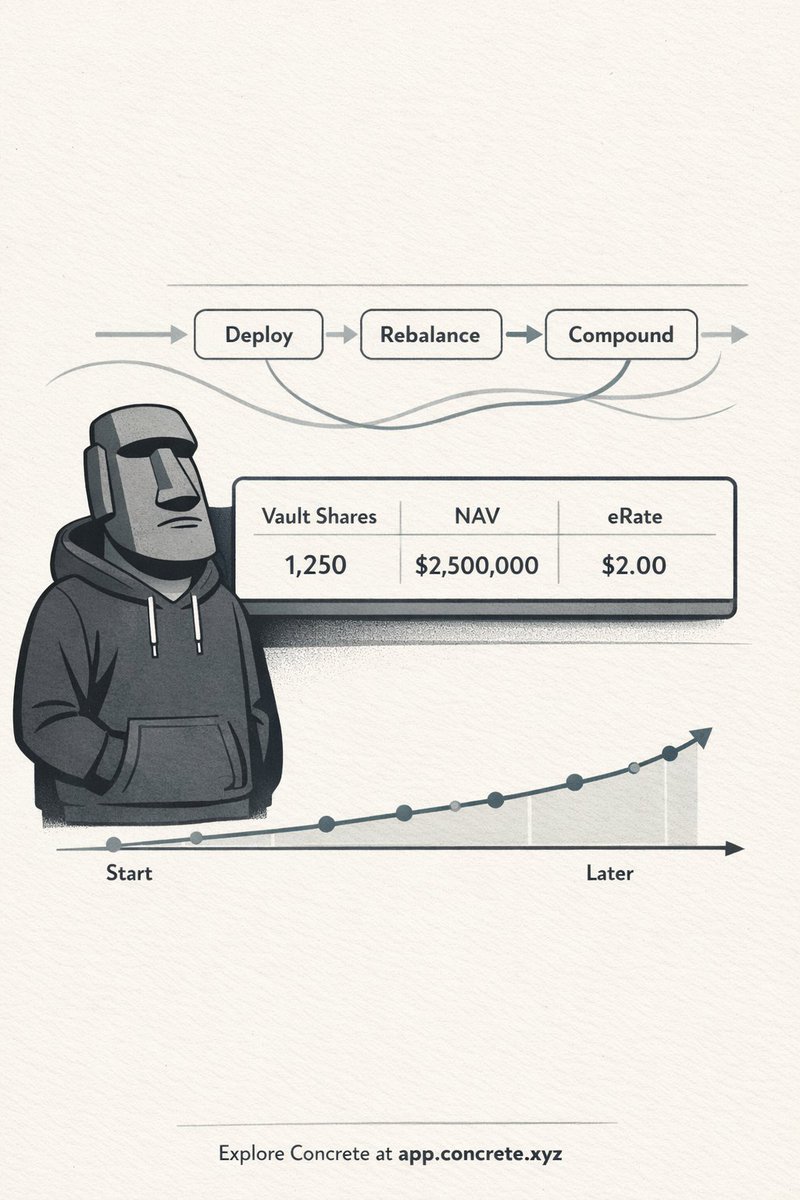
How Do @ConcreteXYZ Vaults Actually Work?
When users first enter Concrete vaults, they usually see numbers like NAV, eRate, and vault shares and wonder what they actually mean.
The easiest way to understand it is this:
When you deposit, you receive vault shares. Those shares are your portion of the vault.
NAV is the value of the entire pool.
eRate is the value of each share.
If the vault performs well and the pool grows, your shares become more valuable over time.
But vaults are not just about sitting and waiting. This is managed DeFi. Capital is deployed across strategies, rebalanced when needed, and adjusted as conditions change.
And time matters a lot.
Yield does not always appear instantly. Strategies need room to work. Compounding needs time to build. Short-term moves often feel the costs more than the benefits.
So the real value of DeFi vaults is not only the yield itself, but how that yield is managed over time.
That is the mental model:
You deposit into a system.
You own a share of the pool.
The pool is actively managed.
Time helps unlock better results.
Explore Concrete at https://t.co/v42vsMhJpe
@PhcThan24793527@grvt_io This is a solid reminder that market momentum is not always loud. Sometimes it shows up in the slow accumulation of trust and capital.
@PhcThan24793527@grvt_io The post explains it well. Allocation expansion helps reduce dilution, and protected points help preserve trust. Both are needed.
Tried turning the Moai into a sticker pack this time
no big scene
just small expressions, small moments
but still carrying that same idea of structure and control
feels like a cleaner way to show what @ConcreteXYZ is about
@d3crypt0r25