Crypto Cards with no KYC: how they work and what you risk
I read the contracts behind 16 cards sold as no-KYC. Here is what you should know before you use one
So how do they work?
- the provider does not issue anything. A company registers, passes KYB, the business version of KYC, and gets the right to open cards for its "employees"
- you are one of those employees on paper. You pay the provider, top it up in USDT, and get a card number out of that company's program
- the bank behind it sees one business client, not you. Nobody checked you, and nobody can vouch for you either
- one card is listed as no-KYC while the provider's own page says "KYC is required everywhere we operate"
- another opens with "no photo ID needed" and hangs an asterisk on it: subject to AML and regulatory requirements
How do no-KYC cards make money?
- one charges 5% on the email-only tier and 0% on the tier that checks your ID. The discount is for showing documents
- top-ups run 2% to 5%, opening a card costs $5 to $168, and one contract takes $0.25 for every authorization attempt, approved or declined
- another takes 3% of every declined transaction
- one reserves the right to charge 10% of your remaining balance per month after 90 days with no login and no spending
And what do you risk?
- when funds get frozen, the contract says you are the bank's counterparty, not the service. Help getting them back is offered as a courtesy
- that same provider discloses that in February 2026 a banking partner locked accounts and caught part of customer balances. It says it refunded most of them voluntarily, with no obligation to
- your card can die for how you spend rather than what you buy: decline and refund rates above their limit, and one bans Steam and Uber as platforms that trigger the bank's risk controls
- three of them have no terms, no privacy page, nothing legal on the site at all. One of those still points buyers to a token presale page that has been switched off
You are not skipping KYC here. You are using someone else's
Do you use no-KYC cards, and why?
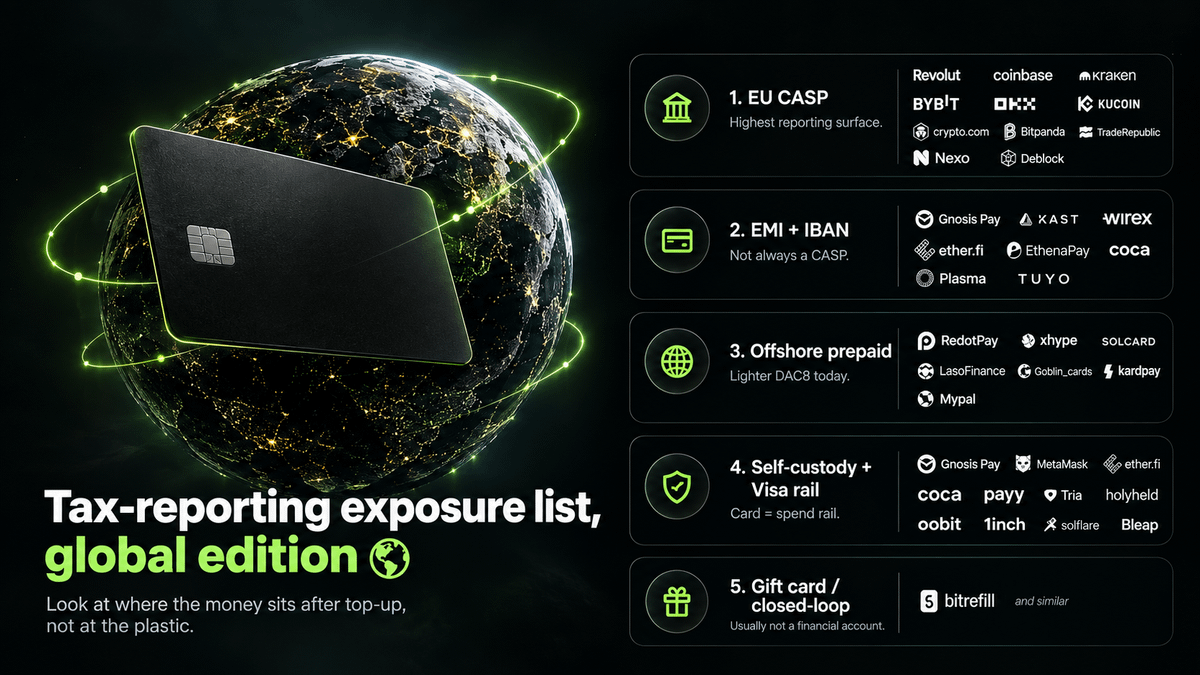
[MAP] NOT YOUR KEYS, NOT YOUR CRYPTO CARD
Crypto cards can suddenly stop operating. Kulipa was one example, and it likely won’t be the last.
When that happens, you want to know that you still control your funds and holdings.
That’s why custody matters.
How do CARD PRIVACY actually work?
“No KYC”, “no name”, “private card” but where does the privacy actually come from?
I looked into the architecture behind PRIVACY cards.
Important: some details are based on public info, reviews and my own analysis. Issuer/BIN structures are often undisclosed. If I got something wrong, card teams feel free to correct me.
@solcard
• The basic Mastercard is issued without sending a passport to the issuer
• The service issues a prepaid card as a program product, not as a personal bank account
• The issuer sees top-ups, limits, transactions, and usually email/wallet data. It does not onboard you as a normal bank customer
• That is why the basic card lasts only while the BIN partner allows a no-doc tier. The Apple Pay / higher tier needs KYC because the partner set that rule
This is a likely model, not a quote from the issuer.
@kardpay
• Outside it looks like Visa/Mastercard. Inside it is a white-label program
• The issuer is hidden: to the card network, the visible client is closer to the Kardpay program than to you personally
• Privacy comes from the wrapper: no name on the plastic, no public bank brand, no heavy KYC at the door
• The issuer can still tell the service: request documents or freeze the BIN. Then privacy ends in the partner dashboard, not at the merchant
For the card network, the client looks like a Kardpay program, not like you personally. This is a conclusion, not their formulation.
@Goblin_cards
• The hardest version: this is not a personal card in your full legal name
• The card is ordered for the issuer as a corporate/program prepaid. You sit closer to an authorized user than to a normal named cardholder
• That is why there is no name on the card: for Mastercard it belongs to the program, not to “John Smith”
• The issuer sees program volume, shipping address, and top-ups. Your passport is not required as long as the program stays inside limits and does not trip risk controls
The wording is "corporate prepaid / authorized user, the card belongs to the program. The founder said something similar in an interview.
@LasoFinance
• It does not keep one permanent account per person
• Each time you buy a separate prepaid Visa for a fixed amount
• For the issuer this is a stack of small prepaid instruments, not a full customer file
• Instead of a passport, the service and risk engine get a wallet, an on-chain transfer, and device signals
• The issuer makes the card authorizable on Visa. Laso’s job is not to bring the issuer an unidentified high-risk client
Instead of a passport, they give you a wallet + onchain + device fingerprint. The wallet and onchain are official. Device fingerprint more from reviews/their compliance descriptions
@xhypeofficial
• XHYPE is not the issuer and not a bank
• The issuer writes cards to a company/program. The user buys access to that program
• So Visa/MC see program payments, not “a citizen’s bank account”
• If KYC still appears, it often goes through a third party like Verinex. The app/issuer may get pass/fail rather than storing the full file in the wrapper itself
• The privacy here is legal layering: you are a user of an intermediary, not a direct BIN customer
@payy_link
• There are two circuits
• Issuer circuit: a normal Visa. The issuer needs identity checks or there is no BIN
• Chain circuit: the debit happens through a private transaction, so a public wallet does not make it easy to see what was bought
• Result: the issuer knows the cardholder, the merchant knows the card, but the open blockchain does not show a clean link
• @AnomaPay
• There is no live card yet, but the logic is the same as Payy
• Funds first enter a shielded pool, where balance and recipient are not public
• The future card will still need a normal Visa/MC program
• They want to create privacy before the issuer: top up from a hidden balance, not from a public wallet
Most services do not publish the names of specific BIN/issuers.
The patterns are changing. No-KYC ≠ anonymity and ≠ protection from freezing.
DYOR, NFA.
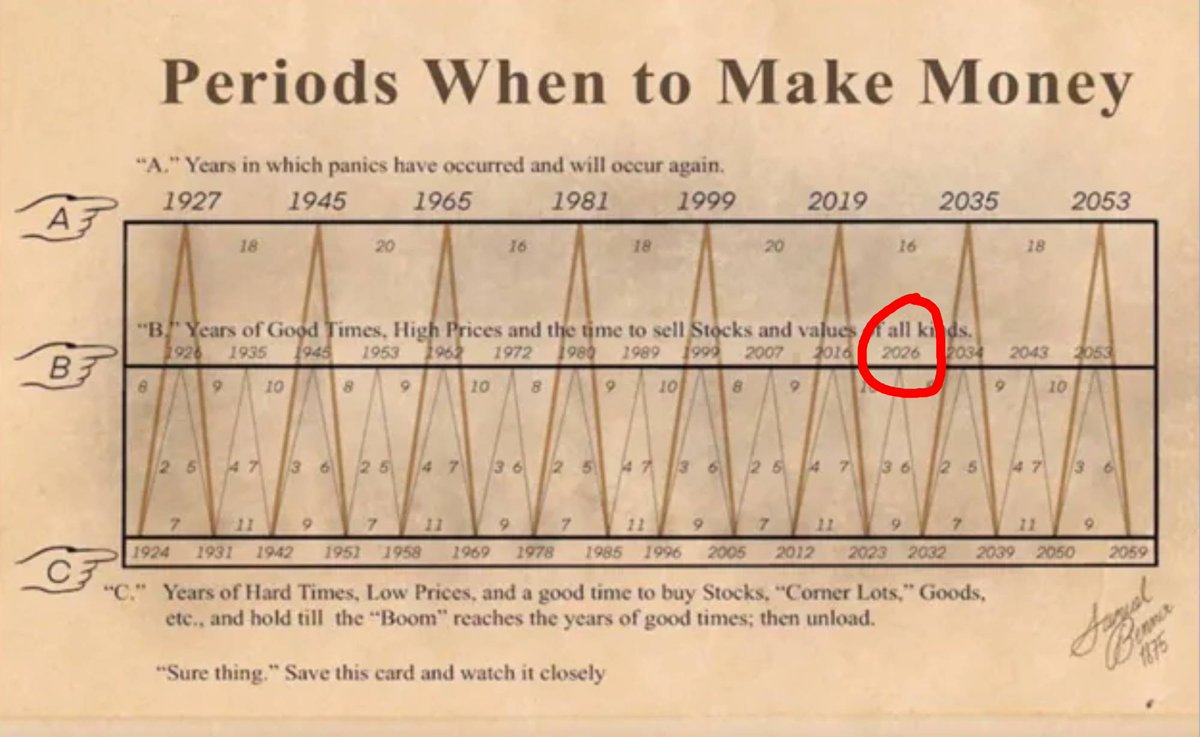
The "Scott Banner chart" is representative of Benner Cycle, a famous 19th-century economic forecast.
Created in 1875 by Ohio farmer Samuel Benner, it maps repeating market booms, panics and recessions using pig-iron and crop price data. It has been 85% accurate.
Structure of the Benner Cycle Chart
Panic Years (Line A): Marks major market crashes and trend reversals using an alternating 18-, 20-, and 16-year sequence.
Good Times / Peak (Line B): Highlights high asset prices and recommended windows to sell, repeating every 8, 9, and 10 years.
Hard Times / Lows (Line C): Identifies valleys of low prices and optimal windows to buy assets ahead of the next bull run
2026 is a period of increased risk. A time to sell stocks.
Warren Buffet already has. He is waiting for bargains around 2032.


![JoinTODEY's tweet photo. [MAP] NOT YOUR KEYS, NOT YOUR CRYPTO CARD
Crypto cards can suddenly stop operating. Kulipa was one example, and it likely won’t be the last.
When that happens, you want to know that you still control your funds and holdings.
That’s why custody matters. https://t.co/4RfqgoATOh](https://pbs.twimg.com/media/HSLRzSBWsAAW5VQ.jpg)