30 minutes of active mobility a day:
✅ Lower risk of heart disease
✅ Better mental health & reduced stress
✅ Improved fitness & weight
✅ Lower risk of diabetes-2
✅ Better sleep
✅ Better air quality
✅ Less congestion
✅ Stronger community
Good for you. Good for the planet.
"Don't You (Forget About Me) " by Simple Minds was written especially by Keith Forsey (the same of hits such as the Flashdance theme) and Steve Schiff for the soundtrack of the classic The Breakfast Club (1985).
The Scottish band refused to record the track because it was not their composition and Jim Kerr did not like some parts of the lyrics. Before them, the song was offered to Bryan Ferry (Roxy Music) and Billy Idol, who also did not accept it.
In the end, Kerr's wife at the time, Chrissie Hynde (The Pretenders), convinced the band to accept, the track is not on any Simple Minds studio album, only on the film's score. It became the biggest hit of their career in the US: #1 on the Billboard Hot 100 for a week in May 1985 (the band's only #1 there).
BREAKING: Pope Leo XIV makes historic apology for Holy See's own role in legitimizing slavery and for failing to condemn it for centuries. https://t.co/cQz8oU5Wkh
“We spend as much time together as we possibly can. We have classes together. We try to eat dinners and lunches together, and we’re definitely a family. We love hanging out with each other, and we always have each other’s backs.”
- Kilian Registe
(Acre & Iron: Separation Season)
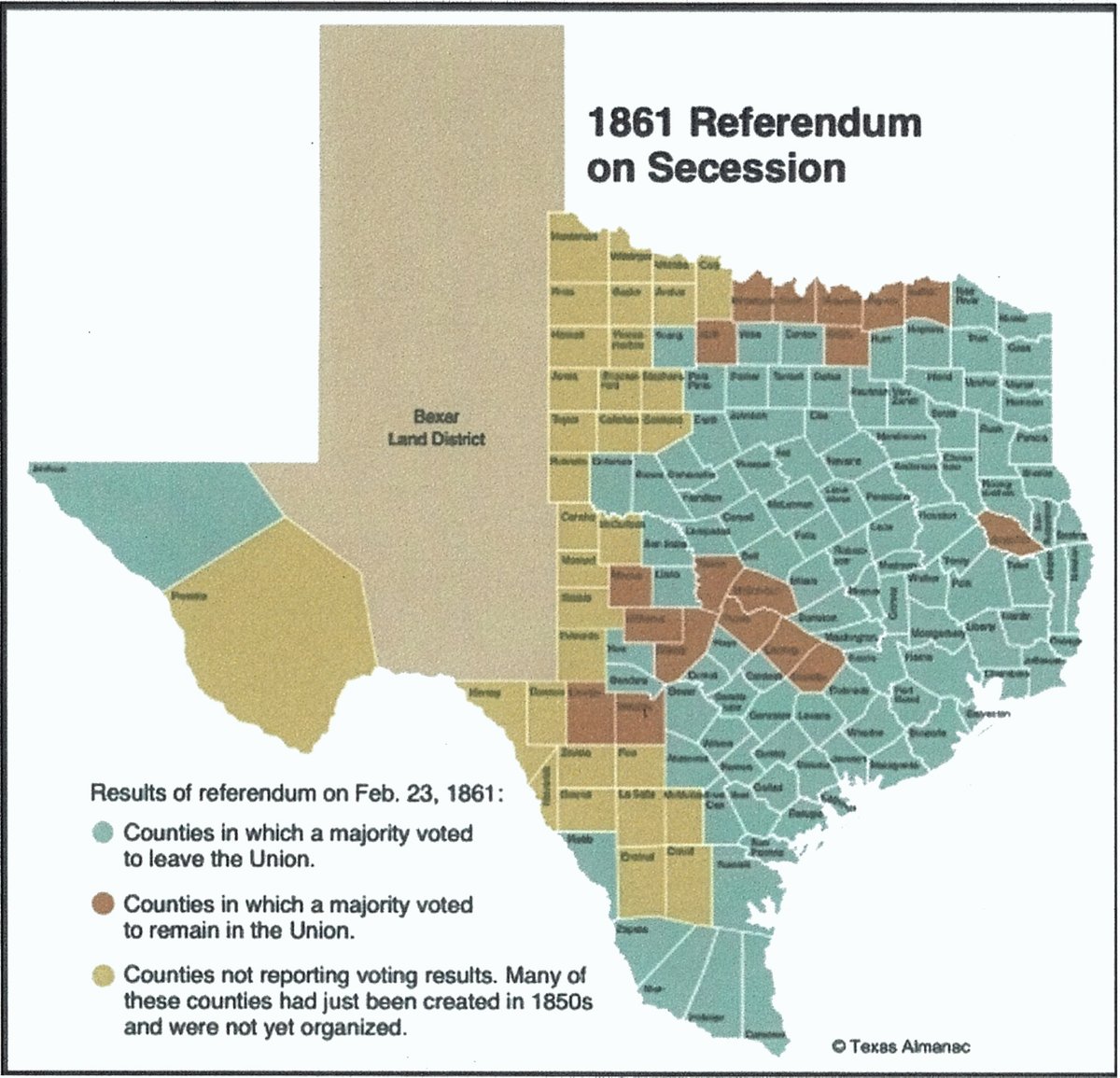
This is a map representing how Texas counties voted on the question of secession back in 1861. I've been studying it for several days and cogitating and have these observations:
The map is almost a perfect overlay of Texas’s cultural fault lines in 1861. What jumps out first is how strongly the plantation belt of East Texas voted to leave the Union. From the Red River down through the Brazos and into the coastal counties, secession support is nearly continuous. These counties held the highest concentrations of enslaved people, in some cases 30–50 percent or more of the population. Their wealth, political leadership, and social structure were deeply tied to slavery, so their vote reflected both economic self-interest and political alignment with the broader Deep South.
In striking contrast, the strongest pockets of Unionist sentiment appear in the Hill Country, especially Gillespie, Kendall, Comal, and surrounding counties. These areas had large populations of German immigrants, many of whom came to Texas after the failed European revolutions of 1848. They tended to oppose slavery on political or moral grounds and had little economic stake in it. But there's also this: they had only recently settled the frontier and often depended on the U.S. Army for protection from Comanche raids. Secession meant the likely withdrawal of federal troops, which many saw as a direct threat to their survival.
There's also a belt of divided or Union-leaning counties stretching across parts of North Texas, particularly along the Red River and westward. Much of this region was still frontier in character, with fewer enslaved people and a population made up largely of small farmers rather than plantation owners. These communities had weaker ties to the slave economy and often stronger attachment to the federal government, which provided military protection and infrastructure.
I think the above observations almost self-evident once you understand the demographics and the commerce patters. What is more curious to me is South Texas. Despite having relatively few enslaved people compared to East Texas, many counties there still voted for secession. This reflected the influence of large ranching elites and established political leadership, particularly in older Tejano and Anglo settlements. My impression is that loyalty to local power structures and political identity often outweighed purely economic considerations.
Finally, the yellow counties in the west and northwest show me just how incomplete Texas settlement still was. Many of these counties had only been created in the 1850s and had too few residents or too little organization to hold a meaningful vote. Texas in 1861 was still a frontier state, with its political geography shaped as much by settlement patterns as ideology.
Viewed altogether, it's clear that Texas did not move toward secession as a unified block. Instead, votes followed the invisible boundaries of slavery, ethnicity, settlement age, patterns of commerce, frontier dependence etc.... The strongest support for the Union came from newer, less slave-dependent, and often immigrant communities. The strongest support for secession came from older, wealthier, slaveholding regions tied culturally and economically to the Deep South.
Thanks to the Texas Almanac for providing this great map!
@konstructivizm Dad had a 3rd water well dug NE Tarrant County (DFW). He let the pump run for a week or so to get all of the stuff out of the well. It started pumping water w/pure white beach sand like FL Panhandle beaches about 3 days into it. Matches up w/this
TDU chaos, 24 years ago: Michael Rogers was knocked down by an official’s motorbike, borrowed a fan’s identical bike and rode 80 km to win the GC. The fan later received "three or four" suitcases of Mapei kits. #TourDownUnder