Let’s set this straight once and for all.
The Hiring Manager isn’t HR, but the manager of the department that needs a new team member.
HR designs the recruitment process, ensures fairness, screens for fit, and guides the experience.
The Hiring Manager is the one who feels the gap in their team, defines what they need, and makes the final call.
In summary, HR gets you into the room.
The Hiring Manager decides if you stay in the room.
That said, no serious-minded HR, HM or Talent Acquisition professional would reject a strong application simply because you didn’t specify their name in an opening remark.
How to survive until you have revenue
1. Keep your burn microscopic
Strip the business to the bare essentials. Cut anything that doesn’t directly produce revenue or a product customers will pay for.
Ethical Language and Responsible Communication in Mental Health Reporting.
Language carries power. The way government communicates about mental health can either build understanding or deepen stigma. In @followlasg's post titled "Lagos Ministry Rescues Mentally Unstable Woman," several words, though unintended, were ethically wrong & socially insensitive.
1. "Mentally Unstable"
This phrase is outdated and stigmatizing. It defines the woman by her condition instead of her personhood.
Better alternative: "A woman experiencing a mental health crisis."
This person-first phrasing reflects dignity and aligns with the UN Convention on the Rights of Persons with Disabilities (CRPD, 2006), which promotes respect, individuality, and autonomy.
2. "Rescues"
Using "rescues" makes the action sound like charity instead of public duty.
Better alternative: "Responds to a mental health emergency” or “provides intervention."
This language shows structured responsibility, in line with the World Health Organization’s Mental Health Action Plan (2013–2030).
3. "Filed a Complaint Against the Sun"
This wording breaches dignity and confidentiality by exposing a private symptom that invites ridicule.
Better alternative: "She appeared disoriented and expressed confusion, prompting concern for her wellbeing."
This is factual, respectful, and consistent with the UN Principles for the Protection of Persons with Mental Illness (1991).
4. "Rehabilitation Centre"
In Nigeria, this term can sound punitive.
Better alternative: "State-owned mental health and care facility."
This shows support and treatment rather than correction or custody.
5. Missing Rights-Based Language
The post should include an affirmation of inclusion and human rights.
Suggested addition: "This intervention reflects Lagos State’s commitment to promoting mental health awareness, inclusion, and the protection of every resident’s dignity."
Collaboration and Capacity Building:
To improve communication and reduce stigma, the Lagos State Government should strengthen partnerships with key advocacy groups such as the Mentally Aware Nigeria Initiative (MANI), the Autism Parents Association International (APAI), and the Joint National Association of Persons with Disabilities (JONAPWD). These organisations have ongoing public education and inclusion programmes that align with state and global priorities.
Recommendations:
Government communication must model respect, confidentiality, and professionalism. To achieve this:
1. Train press and social media officers on ethical and person-first language.
2. Review all mental-health-related content before release.
3. Maintain partnerships with mental health and disability advocacy groups for ongoing guidance.
By choosing words that preserve dignity and reflect human rights, @followlasg can lead by example & set a higher standard for mental health communication in Nigeria.
Thank you.
- @Jomilojju
Tired of HR theory that doesn’t deliver real results?
This is for the pro who wants to master how to build systems, use data, design fair pay & sit at the strategy table — not just the admin desk.
Seats are limited. 100% online.
👉 https://t.co/cxdHDrlziu
📢 FINAL REMINDER!
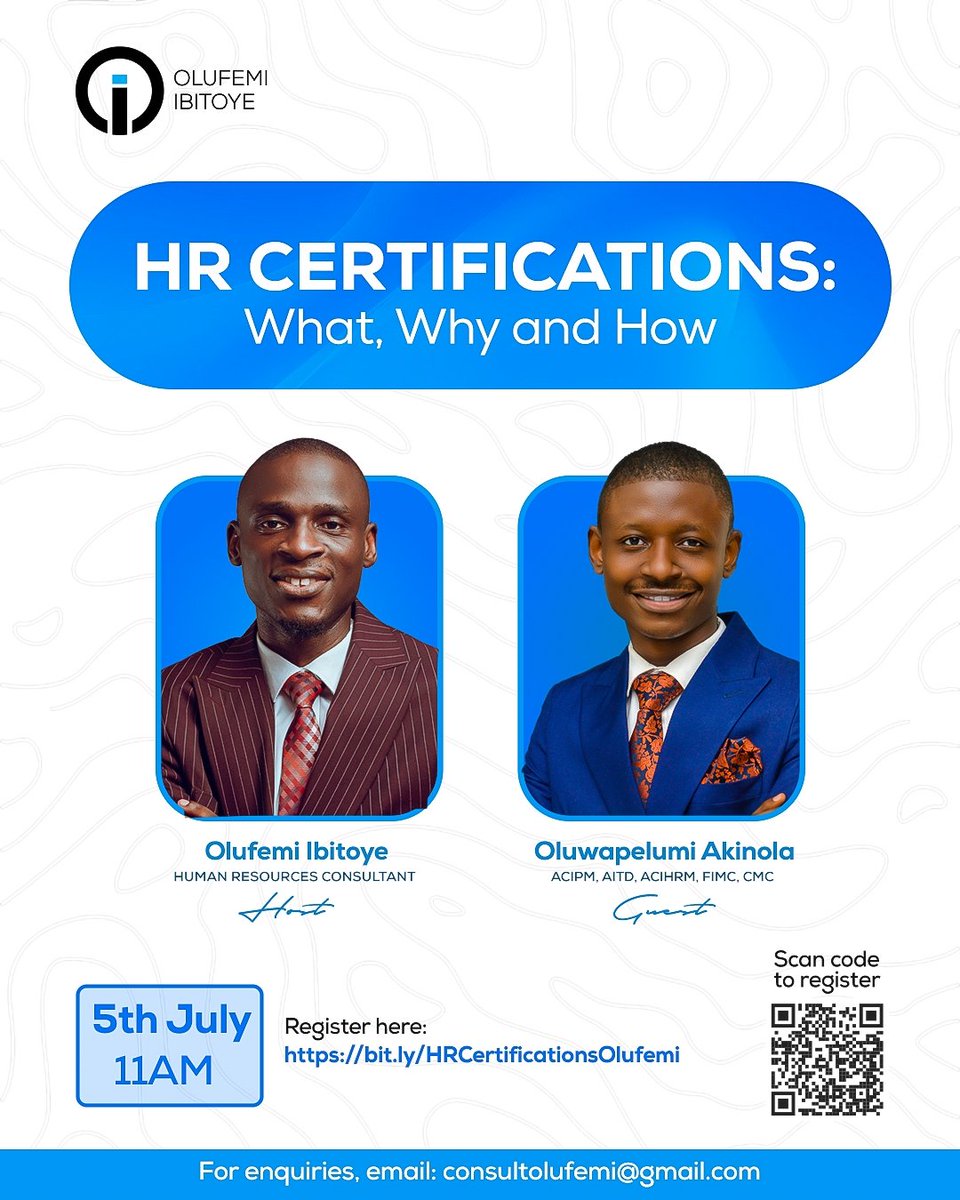
Our FREE HR Certification info session holds tomorrow at 11:00 AM (WAT).
We’ll cover:
✅ Key HR certifications (aPHRi, PHRi, SPHRi, GPHR)
✅ Why they matter for your career
✅ How to choose the right one
Register here:
👉 https://t.co/hR3jq6LirV
After 20 years of helping companies fix performance management systems, one pattern stands out more than any other: performance management starts with energy and promise… then fizzles out. Again and again. It’s like a movie we’ve all seen before—different company, same ending.
I’ve written before about the common reasons performance systems fail: no alignment with strategy, poor follow-through, vague goals, lack of accountability, and systems that are built for compliance rather than clarity.
But there’s one more big reason we don’t talk about enough: we make performance management unnecessarily complicated.
In many companies, what is called a “performance agreement” is actually just a heavy administrative burden. It’s full of long lists, unrelated activities, and pages of detail that confuse more than they clarify. The result? People disengage. Managers dread it. Employees see it as a tick-box exercise. And nothing changes.
This is why I still love the Balanced Scorecard—not just as a tool, but as a philosophy.
It forces clarity. It links actions to outcomes. It helps you tell a simple story: “If we do these things well, we’ll achieve these results.” Strategy becomes visible. Performance becomes meaningful. And yes—you can fit it all on one page.
Simplicity is not the enemy of performance. Complexity is.
If your performance management system is too difficult to explain on a single page—or to a new team member in 5 minutes—you don’t have a performance system. You have a reporting headache.
The test of a good performance system is not how impressive it looks in a PowerPoint deck. The test is whether it actually helps people focus, take action, and improve performance—consistently.
The best systems are simple, aligned, and built around cause and effect. And they work, not because they’re complex, but because they’re clear.
@ipcconsultants
If you’re going to offer performance incentives to employees, make them count. A well-designed incentive should be big enough to transform an employee’s life—otherwise, it won’t change their behavior. Too often, companies hand out token bonuses that feel more like an afterthought than a true reward. Incentives only work if employees feel they’re genuinely worth striving for. If you're serious about high performance, then the top performers should be able to earn at least 1.5 times their annual salary when incentives are paid annually. The same principle applies to quarterly schemes—structure them so top performers can earn 1.5 times their monthly or quarterly pay.
But incentives shouldn’t be a blanket payment. For non-managerial staff—those in lower bands—quarterly incentives work best because the immediacy boosts motivation and meets more immediate financial needs. For managers in D band and above, pay incentives annually, and only after the audited financials are out. This timing aligns their rewards with the company’s real performance and keeps them focused on long-term value creation. The separation in timing also reinforces the different levels of accountability across the organization.
Finally, none of this works without a credible performance management system. If your system can’t reliably differentiate performance levels, any incentive—no matter how large—will be seen as unfair or arbitrary. And one more thing: design your incentive scheme to be self-funding. That means it must be tied to actual performance improvements.
@ipcconsultants
Abi you, you're allergic to dedication & devotion? You don't have a purpose in life that a partner should be committed to supporting you to achieve?
Let's even say he's very focused that's why he can't see your needs. Ok you, are you also oblivious? to your own self? Ehn my dear?
As you're carrying their load on your head, being the good & selfless woman you've been raised to be, where is your own load, my darling? Is the person you're planning a lifetime of love with carrying you?! Or they, like you, are carrying themselves, counting on your naiveté?
You & your good natured, well intentioned self may have forgotten that we share the world with people who don't share our values & it is our personal responsibility to self protect from people will milk you dry, then blame you for letting them. You need discernment & discretion.
What role are you playing in the story of YOUR life? The main character, co-creating with God to make a masterpiece? Or a passive participant, waiting to get selected & assigned a role in someone else's story?
You are not a piece of floating driftwood. You have agency. xoxo
What's your own personal roadmap you've developed for your life? your values? Your core needs? Your goals? Where are you going& what are the minimum entry requirements for those allowed to get on the ride with you?
Are you clear about that? Before they use bread to pack your stew
One of the most common questions I receive is: Do employees in the same job grade have to earn the same salary? The answer is it depends. It primarily depends on whether the organization intends to reward performance or not.
If a company values and recognizes performance, it is best practice to differentiate salaries within the same grade. This is why, after job grading, we encourage companies to establish a pay structure that includes a minimum, midpoint, and maximum salary per grade. Such a structure acknowledges that employees within the same grade contribute different levels of value to their roles.
Failing to differentiate pay within a grade can lead to pay compression—a situation where there is little to no difference in pay between employees, regardless of differences in performance, experience, or tenure. Pay compression can demotivate high performers, reduce retention of top talent, and weaken an organization’s ability to attract skilled professionals.
A well-designed and competitive pay structure should accommodate whatever compensation policy the organization chooses to pursue—whether it prioritizes internal equity, performance-based pay, or market competitiveness.
@ipcconsultants
Even if it were unimaginably true that you did it ALONE, This is against the ethics of consulting and the confidentiality code that all PwC staff and alumni sign to. We should never undermine the integrity of the profession for Twitter likes & applause. This can land you in jail!
A complete aberration! You can’t be using your client’s project to chase clout. A project on which you were most likely learning and being taught by your partner and managers who will rather go to their graves with their project details than do this. Confidentiality is so sacrosanct that we were made to do repeat trainings and signings for it. So grave that even on CVs and at times on proposals, we don’t disclose the name of the client, except with their obtained consent.
People like this should never have been allowed foot into the field. It jeopardizes the very essence of the profession and exposes too many to legal risk. If this person had worked on my team, I will spend my last dime to track you down & sue you for it before the client sues me.
When setting salaries, compare with companies that want the same talent as you, not just those in your industry. Top employees move across sectors for better opportunities.
Do not sacrifice competence on the altar of confidence.
The chisel must do its work, otherwise the rough edges will always show up.
In your seasons of growth, lay a solid foundation and then build incremental capacity.
First things first.
I have been recruiting for multiple roles over a few months and based on what I observed, we need as a matter of urgency to start teaching young women how to be more assertive, not sell themselves short and how to talk their shit.