I'm curious whether he grapples with the fact that in order to be in his bubble, he had to consciously ignore everything that other Black people had said about race in America for his entire life until his adopted daughter experienced it directly.
for my @letterboxd debut (!!!!!) — and in honor of YOU, ME & TUSCANY, the rare black rom-com that actually feels both romantic and comedic — i shine a light on a few other essential black-led romances: https://t.co/16WTO7pN1q
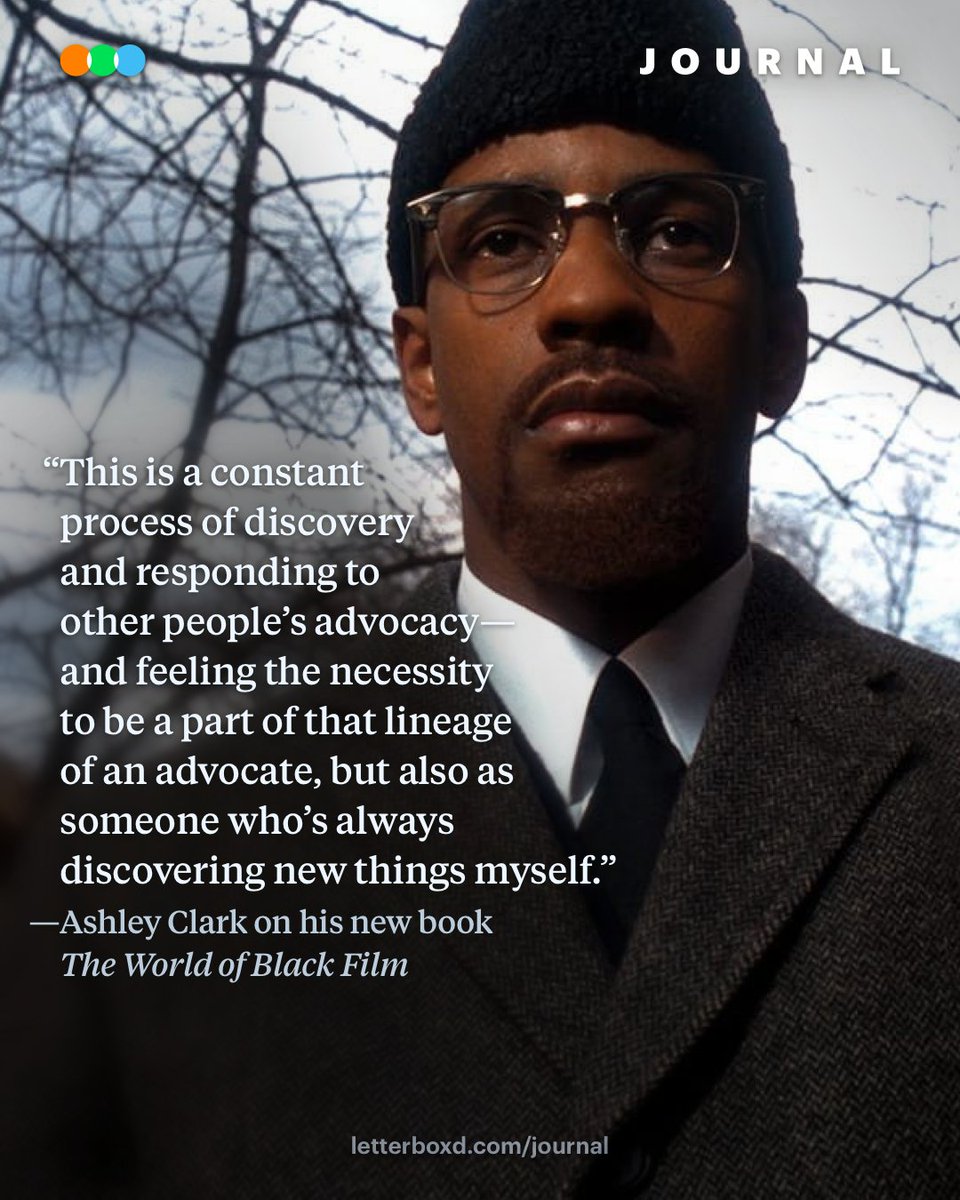
With his new book spanning Black cinema across the ages, genres and regions, The World of Black Film author and Criterion curatorial director Ashley Clark tells Ella Kemp about curation, discovery and the films he wishes he could have included. https://t.co/GybsvyEYDi
President Obama explains how he solves problems he's not an expert on:
When asked by Destin Sandlin (creator of Smarter Every Day) how he gets up to speed on unfamiliar topics, Obama reveals an approach rooted in the scientific method.
"Over the years you accumulate knowledge and you test hypothesis and propositions. So how I think about it today is different than the first day I walked into the oval office."
He explains that after years in office, he built a baseline of knowledge that changed how he consumed information.
Instead of going deep into every briefing book, he began scanning for what was different, looking for anomalies against patterns he'd already seen.
"I've learned to be pretty good at listening carefully to people who know a lot more than I do about a topic and making sure that any dissenting voices are in the room at the same time."
Obama describes a deliberate structure:
After an initial presentation, he makes sure to hear from everyone present. He asks whether anyone disagrees with the baseline facts.
He asks whether there's any evidence that contradicts what was just said. If there is, he wants that argument made directly in front of him.
"What I'm pretty good at is then asking questions, poking, prodding, testing propositions and seeing if they hold up."
He draws a direct parallel between this approach and the scientific method. Accumulate knowledge, challenge assumptions, pressure-test conclusions.
A powerful reminder that the best decision-makers aren't the ones with all the answers.
They're the ones who know which questions to ask and who to listen to.
In 1981, Orson Welles recorded a discussion with students at USC. When asked if he planned to make another film to “counter” the wave of purely commercial releases, this was his response…
Gizelle Bryant’s daughter recreating her mom’s AKA photo from undergrad, in the exact same spot after crossing the same chapter, is quite iconic.
Now, this is a legacy.
Not to be THAT dictionary, but…
It’s ‘per se,’ not ‘per say.’
It’s ‘dog-eat-dog world,’ not ‘doggy-dog world.’
It’s ‘hunger pangs,’ not ‘hunger pains.’
It’s ‘one and the same,’ not ‘one in the same.’
It's 'buck naked,' not 'butt naked.'
Ray Bradbury didn't write Fahrenheit 451 in an office. He wrote it in the basement of a library— on a coin-operated typewriter that cost 10 cents every 30 minutes. He was 33. Broke. Newly married. And desperate for quiet. So he fed in coins and typed fast. In 9 days, he finished the draft. A novel about a world where books are burned-written in the one place built to protect them. The symbolism was perfect. Surrounded by shelves of stories, Bradbury wrote a warning: about censorship, distraction, and a future that felt close. He paid under $10 to write it. And gave the world one of the most important books of the 20th century.
I share stories daily btw