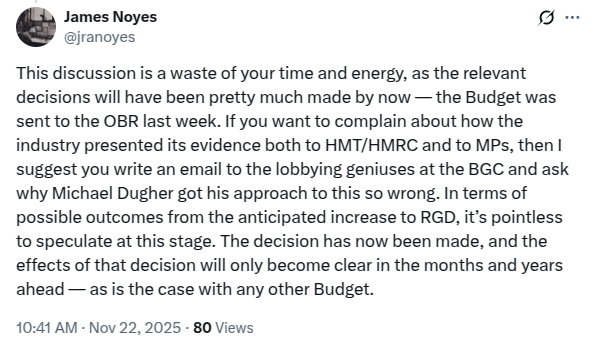
@VaughanLewis1 The problem is gambling policy has too often been determined by sentiment rather than facts. It started with what was called a precautionary cut to B2 stakes and carried on from there. Issue is exacerbated by little to no review of impact post changes. It is death by 1000 cuts.
The debate around whether organisation and people such as the Social Market Foundation, James Noyes or Matt Zarb-Cousin are anti-gambling often gets stuck on language. They insist they are not against gambling itself, only against harm. But the real issue has nothing to do with what they claim about themselves. It is the population level policy framework they promote. This is the public health approach.
Public health thinking is built for activities that society wishes to reduce. It is the logic used to lower smoking rates, alcohol misuse and unhealthy consumption. It is not designed for activities society wishes to preserve or regulate proportionately. When this model is applied to gambling, the goal subtly shifts from helping individuals to lowering the total amount of gambling taking place in society. That shift is what turns well-intentioned policies into broad, population-wide restrictions. They inevitably apply to every gambler, regardless of whether they show signs of risk.
The influence of this model is so strong that even organisations within the gambling industry sometimes drift into it. When the Betting and Gaming Council endorses affordability checks and blanket stake limits on online slots, it is not supporting targeted intervention for vulnerable people. It is accepting the public health framing in which all gambling is viewed as a risk that must be reduced. This may be strategic or defensive, but it feeds the same ideology that undermines the regulated market in the long run. Instead of advocating targeted, data-driven interventions that protect those who need support, the BGC too often backs measures that fall on every customer without distinction. That alignment with public health thinking is unlikely to end well for the industry or for racing.
The difference between public health restrictions and genuine consumer protection becomes obvious when you compare the tools each uses. A public health approach demands affordability checks for every customer. Consumer protection focuses on behaviour and intervenes only when someone shows genuine risk markers, such as chasing losses or sudden spikes in activity. Public health insists on universal stake limits or mandatory deposit caps for all adults. Consumer protection allows people to spend their own money as they choose but uses timely prompts or warnings when someone gambles heavily or for long periods. Public health seeks bans on bonuses, incentives and promotions across the entire market. Consumer protection respects adulthood and choice but allows customers to opt out of promotional material or block offers if they find them unhelpful.
These contrasts reveal the core truth. Public health policies treat all gambling as a societal problem. Consumer-protection policies focus only on those who are actually vulnerable. Public health reduces freedom for everyone. Consumer protection supports the small number of people who need help while preserving the freedom of the vast majority who gamble responsibly. The logic of the public health model is unmistakably anti-gambling because its purpose is to reduce gambling participation across the population rather than manage harm at an individual level.
This is exactly the logic promoted by the Social Market Foundation, Noyes and Zarb-Cousin. Their proposals consistently include universal affordability checks, population-wide limits and regulatory or tax measures based on the perceived harmfulness of specific products. These are not targeted interventions by any reasonable definition. They are broad restrictions that reduce gambling activity across the board and shrink the regulated market. Whether intentionally or not, their policies move in the direction of less regulated gambling, fewer products and less participation.
Everyone supports helping people who experience genuine harm. Targeted behavioural monitoring, personalised interventions, voluntary limits, advanced risk modelling and self-exclusion tools allow operators and regulators to support those who need help without restricting the freedom of millions who do not. None of this requires a public health ideology. It simply requires good systems, good data and a proportionate regulatory environment.
The public health approach goes far beyond this. It places gambling in the same category as tobacco and alcohol and assumes that the safest society is one in which people gamble less. Once you accept that framing, the trajectory becomes predictable. Advertising tightens. Access declines. Limits fall. Friction increases. Costs rise. Consumer choice narrows. Participation in the regulated market falls. You do not need to call it prohibition for it to have the same long-term effect.
There is another important point. You cannot have a public health approach aimed at online casino without that same logic eventually consuming sports betting and racing. Public health frameworks do not stay confined to one product because the underlying theory makes no distinction between them. If the claim is that harm is linked to gambling as an activity and that reducing participation reduces harm, then every form of gambling becomes a target. First casino/slots, then in-play betting, then sports wagering, then racing. Once you accept the premise, the scope expands automatically.
In reality, gambling products are intertwined. They share the same accounts, the same operators, the same customer journeys and often the same individuals. Someone who plays a £2 slot game may also place a weekend accumulator or bet on a horse in the Grand National. The regulated market is a single ecosystem. Public health ideology cannot be confined to one corner of it because it treats participation itself as the problem. Eventually it spreads to all products because it is built to reduce the activity as a whole.
The public health approach will not eliminate gambling. But it could eliminate regulated gambling. When mainstream, licensed, supervised gambling becomes too restricted, too inconvenient or too unappealing, people migrate to unregulated alternatives where there ia no oversight and no protection. Gambling continues. Only safety collapses. This is the great irony of the public health model: in trying to reduce harm, it pushes people toward environments where harm is more likely.
This is why the public health approach is inherently anti-gambling. And this is why the organisations and campaigners who promote it, including the SMF, Noyes and Zarb-Cousin, sit on the anti-gambling side of the debate whether they acknowledge the label or not. Their framework can lead to only one destination. It shrinks regulated gambling for everyone, including the millions who enjoy it safely.
The question then becomes whether racing, gamblers and bookmakers should collaborate with those who promote the public health approach to gambling regulation. Cooperation may sound constructive, but the underlying aims are incompatible. Public health seeks to reduce gambling participation. Racing, bookmakers and bettors depend on gambling participation to survive. There is no stable middle ground because the tools used to reduce gambling at a population level inevitably weaken the regulated market that supports racing and the wider ecosystem.
Partnership is only possible when both sides share at least one common objective. Public-health advocates do not share an objective with racing, operators or recreational bettors. Their desired direction of travel is less gambling, fewer opportunities to gamble and a smaller industry footprint. Racing seeks a healthy betting ecosystem that can sustain the sport. Operators want an environment where responsible adults can spend their own money without excessive friction. Bettors simply want the freedom to gamble as they always have.
Trying to align these positions is like trying to align the interests of alcohol producers with groups committed to reducing alcohol consumption in society. One side exists to sustain the activity. The other exists to reduce it. However polite the language, the underlying goals do not align.
None of this means harm should be ignored. It means only that harm should be addressed through targeted, evidence-based interventions rather than through a public health ideology that treats gambling itself as the problem. Targeted intervention preserves freedom while protecting those who need help. Public health undermines freedom in pursuit of reduced participation.
If racing, bookmakers or bettors choose to work with public-health advocates, they should do so with a clear understanding of what that alignment means. It means working with a framework designed to shrink the regulated market. It means accepting future rounds of restriction, not just on casino and sports betting, but eventually racing as well. And it means allowing the fundamental premise of the debate to shift from managing harm to reducing gambling as a whole.
That is why the gambling sector, and racing in particular, must be clear about the difference between protecting vulnerable individuals and accepting a public health ideology. One strengthens the regulated market by ensuring it functions responsibly. The other steadily erodes it. Racing, bettors and bookmakers must decide which of those two paths they prefer to walk.
After the government’s tax increases on gambling, the anti-gambling movement moved immediately to its next objective. Within days, five London councils demanded that gambling advertising be removed from the Underground. They argued that gambling is a public health emergency. They used last week’s tax win as a springboard for a new campaign. The movement is organised, relentless and already planning its next stage.
By contrast the gambling and racing industries appear to be at war. This pattern is not new. It mirrors what happened to alcohol in the decades before Prohibition. The alcohol industry fractured internally, and each fracture strengthened the temperance movement. Brewers argued beer was safe and wholesome while whiskey was dangerous. Distillers said the real problem was saloons. Saloons blamed the distillers. Each sector tried to redirect moral pressure onto another, believing that by giving the temperance movement a victory elsewhere they could secure safety for themselves.
The temperance movement saw these divisions as gifts. When brewers claimed whiskey was dangerous, campaigners repeated those words in state legislatures. When distillers framed saloons as corrupt, campaigners used that framing to shut saloons down. Every concession reinforced the core temperance message that alcohol was a threat requiring political intervention. Once that message became established, the movement did not stop at spirits or retailers. It expanded until it had enough power to impose national Prohibition. The internal alliances that were meant to protect individual sectors ended up destroying the entire industry.
A similar pattern is now unfolding in gambling. In 2019, the maximum stake on Fixed Odds Betting Terminals was reduced to £2. Adult gaming centres and seaside arcade operators supported this because FOBTs threatened their businesses. Councils, researchers and campaigners joined them, creating a coalition that succeeded. But once that coalition tasted a major victory, it did not stay focused on machines. It moved immediately toward online gambling, and then toward adult gaming centres themselves.
By 2020, affordability checks were being pushed onto online customers. The same campaigners who had fought FOBTs argued that online gambling was even more harmful. The government adopted the logic. Online operators became the new target. At that point advertising pressure increased. Then came fresh tax campaigns. Each victory built the legitimacy of the public health framing. And every part of the industry that supported restrictions on a rival helped strengthen the same movement that would later target it.
The racing sector joined this dynamic recently. Elements of racing argued during the tax debate that online casinos were uniquely dangerous and that racing should be protected. Anti-gambling campaigners sowed the seed of this argument because it aligned perfectly with their view that online gambling is the core of modern harm. Together they created political space for a carve-out that kept racing’s betting tax at 15% while raising online casino tax from 21% to 40% and raising other online betting tax to 25%.
The carve-out looks like a victory for racing, just as brewers once thought their alliances against spirits were victories. But it strengthened the wider argument that gambling harm can be tackled through aggressive fiscal policy. That logic does not stop at casinos and online sports betting. It will cost racing because racing cannot survive in a shrinking ecosystem. High taxes on online products will reduce marketing spend, reduce customer flow and reduce funding across the sport. There is now a tax imbalance between online and high street gambling. Campaigners will eventually say this must be addressed, leading to the mass closure of betting shops, further hurting racing.
Another front has opened against adult gaming centres. Campaigners now target 'aim to permit' licensing, arguing that AGCs are spreading too quickly across high streets. Some operators who own betting shops support these calls because AGCs compete for retail customers. The pattern repeats. A part of the industry thinks it can gain by supporting restrictions on a rival. The wider movement uses their support to expand its influence.
Throughout this period, the gambling industry has tried to appease the anti-gambling lobby rather than defend the right of punters to spend their money as they wish. It accepted affordability checks. It accepted increasingly restrictive advertising rules. It accepted stake cuts. It has tacitly accepted a public health framing designed by its opponents. Each time it accepted these measures believing it would reduce political hostility. The opposite has happened. The movement has grown more determined, more coordinated and more confident.
The history of alcohol shows why this is dangerous. Once the temperance movement secured early wins, demand for alcohol did not disappear. It changed shape. Prohibition did something the reformers did not understand. It increased the consumption of the highest-potency alcohol. Beer drinking collapsed because beer was bulky and difficult to smuggle. Whiskey and spirits became dominant because they were compact, easy to transport and far more profitable per unit. The illicit market always optimises for intensity. As a result, overall harm increased. People consumed stronger alcohol in unsafe environments. The attempt to reduce harm produced the opposite effect.
The same shift is now happening in gambling. As regulations create friction in the legal online market and as affordability checks push customers away from licensed sites, more people migrate toward offshore operators. These sites are the modern equivalent of bootleg spirits. They are high intensity, high margin, unrestricted and anonymous. They have none of restrictions the anti-gambling lobby want. No affordability checks, no spending caps and no advertising rules. They fill the space created when legal supply becomes constrained. Just as Prohibition increased the appetite for potent alcohol, modern restrictions risk increasing the volume of high-intensity, unregulated online gambling that pays no tax. Harm increases, not decreases, because consumers move into environments with no safeguards.
The latest calls against gambling advertising are part of this same continuum. It is the next step after FOBTs, affordability checks and tax campaigns. The alliances that formed around each measure have strengthened the anti-gambling movement’s framing that gambling is a public health crisis. Once that framing is in place, every part of the industry becomes vulnerable. No carve-out lasts. No internal alliance protects the long term. The prohibitionist logic eventually turns on everyone.
If the gambling and racing industries want a future, they must finally learn the lesson that the alcohol industry learned too late. You cannot buy safety by sacrificing your neighbour. You cannot appease a movement that believes the entire category must be restricted. Every concession strengthens the movement, and every attempt to redirect pressure onto another sector brings the pressure back with more force.
The history of alcohol shows that once a prohibitionist movement gains momentum, it never stops at the first target. It continues until it reaches its logical conclusion. The gambling and racing industries are now repeating the same mistakes, and unless they change course, they are heading toward the same destination.
Your attempt to silence people because you think “the budget is set” will not work. It remains essential that those who genuinely understand the gambling market set out the consequences of your tax proposals with complete clarity. The implications are not abstract. They affect jobs, tax revenue, racing’s funding model, levels of gambling harm, and the size of the black market. These outcomes are measurable, predictable, and have been explained repeatedly by people who work in and use the gambling industry every day.
You have had ample time to revisit or withdraw your report before the budget. You have been shown clear evidence that higher point of consumption taxes in a mature, internationally competitive market push consumers offshore, reduce the regulated share of wagering, weaken product offering, and shrink the tax base. You have been told repeatedly that racing does not rely only on levy, but also on media rights, both of which fall sharply when regulated turnover and shop footfall decline. Betting shops remain a major employer and local economic contributor, and their margins are already tight. Additional taxation accelerates closures.
It is not only the industry that has pointed this out. Gamblers themselves have warned that increasing costs will push them toward offshore operators with zero consumer protection. Treatment providers have explained that harm rises when activity moves into markets with no oversight or intervention systems.
There is no ambiguity left. If extra tax policies are adopted, responsibility for the consequences lies with those who promoted them. Job losses will be traceable. Reduced tax receipts will be visible. Damage to racing’s levy and media-rights income will be quantifiable. Growth of the black market will be the predictable result of ignoring evidence.
Your “duty to differentiate” proposals combined with the SMF’s Theo Bertram ideas on machine gaming duty are public record. Warnings from dozens of people through articles, TV and social media are also on record. Claiming you lacked information or were misled will not work.
This is the final opportunity to acknowledge the real-world impact before decisions are locked in. If you proceed, and your policies are adopted, the outcomes are yours to own.
Government are asking Regulators to:
"Ask their stakeholders how they can improve their service and draw up action plans to do so, with an update to Government by June."
Have @GamRegGB ask this question of stakeholders?
https://t.co/uCQR08gmve
The headline is unbelievable but it gets worse when you read the detail. Clearly the UKGC have little to no understanding of the retail betting industry.
Corbett Bookmakers Limited will pay £686,070 for social responsibility and anti-money laundering failures.
To read more about this story, visit our website 💻 https://t.co/G65WjHR4Us
'Stop the Government from spying on all of our bank accounts'
We told you affordability checks for gambling were just the start.
https://t.co/8J7W7JBlv4
You will see a lot of this with the gambling harm groups, including public health. They need the problem to get worse, not better to get the wages in, once the statutory levy is in, they will be like rats in a sack fighting over a lump of goose fat
The Gambling Commission has invented a survey that attracts problem gamblers like moths to a lightbulb. It is pure disinformation. https://t.co/CmcKlsT949
Today we have gold standard gambling harm statistics from the Health Survey with 60%-70% response rate. Prof Heather Wardle explains in clip why methodology was so robust.
Tomorrow @GamRegGB will provide the stats from own survey with <20% response rate riddled with caveats.
Racing
Is fucked. Absolutely finished
In the meantime flutter and arena argue about rates for data supply
Instead of attacking false claims about gambling harm
Led by its own regulator. The gambling commission.
The siren of anti gambling
https://t.co/JZSRNuw9Kn