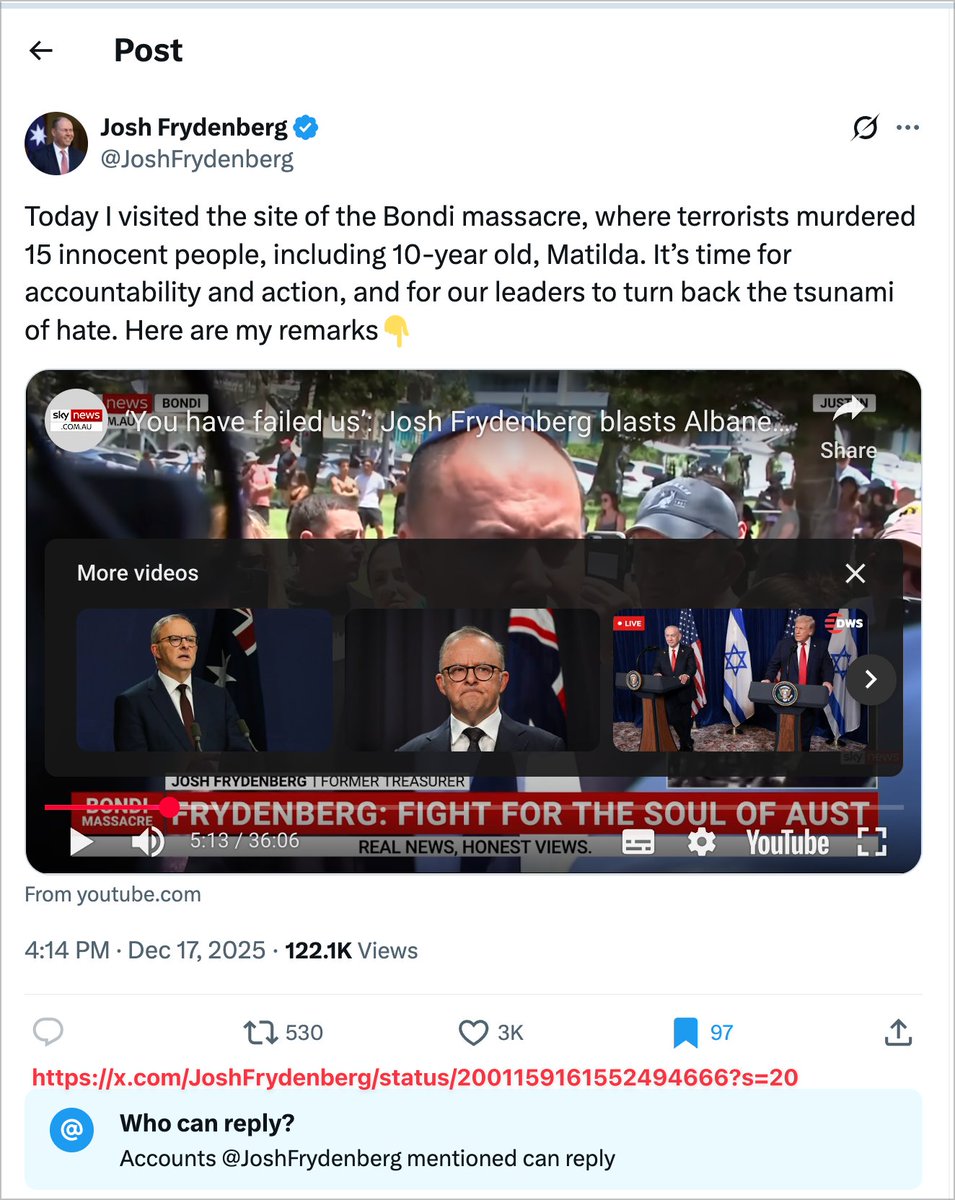
Media Analysis: #JoshFrydenberg Post - 4:14 PM · Dec 17, 2025
COMMENTS WERE DISABLED by Frydenberg
🧵 1/3 inc. Sources*
Despite attracting over 122,000 views, less than 3% likes and 0.5% reposts, Josh Frydenberg turned off comments, essentially shutting down public feedback. What follows is an unemotional, factual analysis. It does not sidestep the horror, grief, or gravity of the terrible event at Bondi, nor is that the intention here.
This is not about questioning grief or denying pain. It is about being precise with facts and timelines.
Josh Frydenberg says he went to Bondi “to mourn” — and that is not in dispute. But he also explicitly says, very early in the speech: “I’m here to mourn, but I’m also here to warn.” From that moment (≈1:43), the speech changes function. By structure and content, the address becomes a political intervention. Roughly 90 seconds focus on mourning; the remaining ~33 minutes are devoted to attributing blame to the Prime Minister, framing Bondi as a “terrorist attack” to shift the debate into the security domain, and outlining a specific policy platform.
This is where context—and history—matters.
The speech presents the current threat as a sudden, post-October 7 failure. However, the record shows that the Coalition government, in which Frydenberg was a senior Minister and NSC member or attendee, already knew there were significant threats years ago.
1. The “Bollards” vs. “Prevention” Shift:
Between 2016 and 2022, the Coalition provided tens of millions in security funding (via the Safer Communities Fund - $184 million) to Jewish schools and synagogues among others. The money never stopped. The current claim in his speech that the community has been “abandoned” (36:18) is a rhetorical choice, not a financial reality. Funding for security infrastructure was a standard, multi-million dollar commitment long before October 2023.
2. The Dismantled Architecture:
After Christchurch in 2019, the government established a specialised Taskforce to Combat Terrorist and Extreme Violent Material Online. It focused on the very thing Frydenberg now warns about: radicalisation. Yet, in 2021, while he was Treasurer and attended the National Security Committee, this taskforce was quietly disbanded.
-----------------------------------------
The focus shifted: his government prioritised physical protection (bollards and guards) while dismantling the intelligence and prevention infrastructure. He is now blaming the current government for a lack of “prevention,” despite his own administration's decision to dissolve the body specifically designed to provide it.
3. Identifying Narrative Defense Tactics:
In our previous analyses, we have observed a recurring pattern of “Moral Substitution.” This occurs when a structural critique (e.g., questioning anonymous sourcing or policy timelines) is met not with a factual rebuttal, but with a moral accusation (e.g., reframing media analysis as “advocating for community withdrawal”).
This is a form of “Poisoning the Well”—discrediting the analyst's motivations to avoid the analysis itself. We identify these “substitution” tactics early to ensure the focus remains on the verifiable record. Any attempt to shift this debate into the realm of moral character rather than factual history will be identified and held to the text.
4. Omitting History:
By omitting the history of his own government’s decisions, Frydenberg presents a narrative of “sudden failure” rather than a long-term erosion of security focus that began on his watch.
The choice to disable comments is significant; it prevents this historical context from being raised and limits the public's ability to assess political speech against the speaker's own record.
You can hold two truths at once:
• Genuine grief can coexist with political speech.
• Political speech must still be assessed honestly.
Observing that a speech functions primarily as a political intervention is not an attack on anyone’s identity or faith. It is an accurate reading of what was said, what was omitted, and the historical record of the speaker himself.
Facts don’t diminish grief; they demand accountability.