@Adricor_fer Pues no estoy de acuerdo con Usted, D. Adrián. Informan de lo que está pasando con valentía y a contracorriente. Si porque los medios afines al gobierno han tratado de taparlo. Y si alguien ha polarizado ha sido esta izquierda esquizofrenica, y a fe que lo han conseguido.
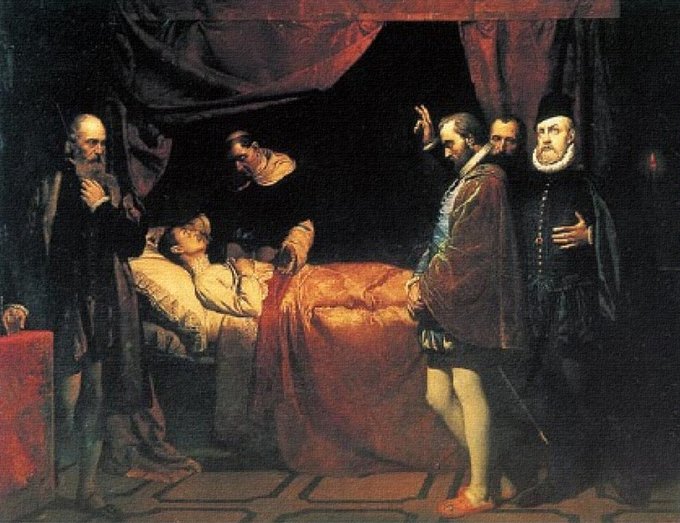
El 13 de septiembre de 1598, en el Monasterio de San Lorenzo de El Escorial, fallecía el rey Felipe II, figura central de la monarquía católica española y uno de los soberanos más influyentes de la Europa del siglo XVI. Su muerte, tras una larga y dolorosa enfermedad, ponía fin a un reinado de más de cuatro décadas que había llevado a España a la cima de su poder político y territorial.
Sus últimos meses los pasó en El Escorial, el monumento que él mismo levantó y que mejor resume su reinado. Allí sufrió una larga agonía, entre fiebres, gota y llagas que lo mantuvieron postrado en cama. Murió a los 71 años, y su desaparición tuvo una repercusión enorme en toda Europa: se iba el monarca que había encarnado la defensa del catolicismo frente al avance protestante y que había gobernado un imperio "donde no se ponía el sol".
Heredero de Carlos V, Felipe II supo consolidar y ampliar un imperio que se extendía por Europa, América, África y Asia. Bajo su reinado, España se convirtió en la primera potencia del mundo conocido. Se libraron batallas que marcaron época, como San Quintín (1557) o Lepanto (1571), y se afrontaron episodios tan complejos como la rebelión de los Países Bajos o el desastre de la Armada Invencible en 1588.
Pero, más allá de las batallas y los tratados, hay una imagen de Felipe II que muchos desconocen. La Leyenda Negra lo dibujó como un rey gris, frío y despiadado. Sin embargo, historiadores como Joseph Pérez o J.A. Escudero han demostrado, a través de sus cartas y documentos, a un hombre atento con sus hijas, apasionado por la naturaleza, la arquitectura y las ciencias. El propio Escorial, además de palacio y panteón, fue un auténtico centro cultural y científico de su época, con una biblioteca de referencia en toda Europa.
¿Fue un santo? No. ¿Fue peor que el resto de monarcas de su tiempo? Tampoco. De hecho, fue el primer gobernante en la historia con territorios en los cinco continentes conocidos, una hazaña política y logística casi impensable para el siglo XVI. Y sin embargo, mientras otros países celebran sin complejos a reyes como Enrique VIII o Isabel I de Inglaterra, con episodios mucho más oscuros, en España seguimos arrastrando el relato negativo que sembraron nuestros enemigos hace más de 400 años.
Hoy, 13 de septiembre, se cumplen 428 años de la muerte del Rey Prudente. Quizás sea un buen día para conocerlo un poco mejor, más allá de los tópicos.
@el_pais Si no fuera tan trágico, por la situación del país y de Ceuta, parecería una broma de mal gusto. Parece que estamos en una peli de esas de serie B, donde acabas riéndote de las supuestas tragedias por lo malas que son. Y piensas, eso no pasa en la vida real, y sí, si pasa.
As a Dutchman, Spain occupies a strange and wonderful place in our history.
We fought an Eighty Years' War against the Spanish Crown, built part of our national identity around that struggle, and still teach names like William of Orange, Philip II and the Duke of Alba in school. You would think that might make Spain the historical villain in the Dutch family story.
Instead, I feel an enormous affection for the country.
Spain is one of Europe's great civilisations. Romans and Visigoths, centuries of Islamic rule, the Christian kingdoms and the Reconquista all left their marks there. Then came the Spain of Columbus, Magellan's expedition, conquistadors and an empire that connected Europe with the Americas and Asia on an extraordinary scale.
Spanish influence is still visible across much of the world. Hundreds of millions speak the language. Cities thousands of kilometres from Madrid carry Spanish names. Spanish architecture, religion, law, food and customs crossed oceans and became woven into entirely new cultures.
And then there is Spain itself.
Old plazas that come alive in the evening. Churches and cathedrals standing where generations before us worshipped. Families taking their time over food. Tiny bars where several plates somehow become dinner. Football treated with the seriousness of a minor religion, local festivals that can involve anything from solemn processions to people being chased through streets, and villages that still seem intensely proud of being that particular village.
I admire that.
The Dutch and Spanish have a particularly interesting relationship because our histories are tied together through both conflict and exchange. The Habsburg Netherlands were ruled by the same monarchy that ruled Spain, and our revolt against Philip II eventually became the long struggle from which the independent Dutch Republic emerged.
There was terrible violence on both sides. Spanish troops sacked cities in the Netherlands, while the Dutch revolt produced its own brutality. Our ancestors weren't especially talented at conducting polite disagreements.
Yet the story didn't end in 1648 when Spain finally recognised Dutch independence.
Over the centuries that followed, Dutch and Spanish merchants continued doing business, diplomats maintained relations and our countries gradually went from old enemies to European neighbours, partners and friends. Today thousands of Dutch people travel south every year, while Spaniards live, work and study here. What was once a relationship shaped by armies and dynasties is now so ordinary that most of us barely think about how remarkable that transformation is.
I also think our differences make the relationship more enjoyable.
The Dutch schedule dinner. The Spanish appear to regard our dinner time as a late lunch.
We like directness, planning and knowing approximately when something will end. Spain has taught generations of Dutch holidaymakers that an evening can simply continue until everybody decides it has finished.
But underneath those differences I recognise something familiar: attachment to family, region, local traditions and a strong sense that culture belongs to the people who inherited it.
That is why I want Spain to remain unmistakably Spanish.
I want Andalucía to feel different from Galicia, Catalonia different from Castilla, and a Spanish town to offer something that could never be recreated perfectly in Amsterdam. Europe becomes poorer when those differences disappear.
Our ancestors spent eighty years fighting over who would rule the Netherlands.
More than four centuries later, I can look south and feel no need to diminish Spain to celebrate Dutch independence. In fact, understanding what a formidable civilisation our ancestors were fighting makes our own history more interesting.
Spain helped shape us partly through friendship, partly through exchange and, admittedly, for quite a long time by trying to prevent us from leaving.
Families can be complicated like that.
But after centuries of shared European history, Spain doesn't feel distant to me.
It feels like one of those relatives with whom we once had an absolutely spectacular argument, eventually made peace, and somehow never stopped being connected.
@ladycrocs@jpurias De este señor, Lady, hay algo que me llama siempre poderosamente la atención, cada vez que publica algo. Que sea profesor de derecho y diga tantas tonterías, hasta el punto de dudar, a veces, si era cuenta parodia.
La dirección de DECATHLON se niega a hacer un encargo en el que le piden grabar en las camisetas "Ceuta es española"
La excusa es que no quieren entrar en el conflicto político.
¿Qué conflicto?
No vuelvo a pisar DECATHLON en mi vida.
Ojalá 10.000 retuits a este vídeo.
@militamadrid@juansotoivars El ensañamiento es con la aquiescencia de su propio partido que se ha dedicado siempre a cercenar las posibilidades de las mujeres dentro del mismo,en un machismo sin justificación.Nadie quiere que Ayuso prospere,la izquierda porque arrasaría,y el PP porque es mejor que Feijoo