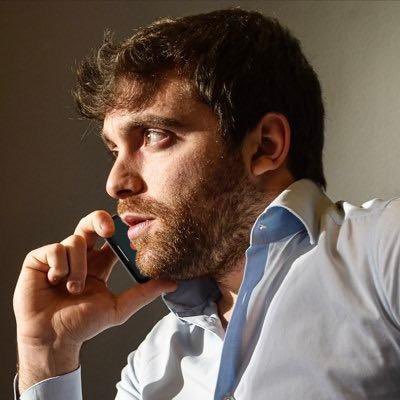
Our conversation with Tim Henman, former World No.4, Olympic silver medallist, four-time @Wimbledon semifinalist, and now part of the Wimbledon board.
2:00 Growing up in a tennis family
6:00 Why playing other sports mattered
7:00 Supportive parents vs. obsessive parents
8:00 The problem with pressure in junior tennis
9:00 The values his parents gave him
11:00 The Grand Slam prize money debate
12:00 Why Wimbledon is a tennis club first
15:00 Transparency, public accounts, and where the money goes
16:00 Why players ranked 101–200 need a better ecosystem
19:00 Wimbledon, the LTA, and telling the story better
20:00 Becoming Britain’s No.1
21:00 His first Centre Court match
23:00 Why grass felt like home
24:00 The 1995 Wimbledon disqualification story
28:00 How one mistake changed his relationship with the media
29:00 Making peace with never winning Wimbledon
33:00 “If you choke this year, we’ll never forgive you”
34:00 Confidence, pressure, and success
35:00 Why success is maximizing your potential
36:00 The mental side of elite sport
52:00 What surprised him inside Wimbledon
56:00 Wimbledon as a club, not just a tournament
59:00 His advice to young players
New episode out now with Lorenzo Musetti
An honest conversation about pressure, consistency, and what it really takes to perform at the highest level of professional tennis.
From life on tour to the reality behind the rankings — this one goes beyond the scoreboard.
🎧 Watch / listen now: https://t.co/kGFWYhKwYy
What does it actually feel like to get advice from Novak Djokovic?
Olga Danilovic explained it in a way only someone who’s lived it can.
“After I finish the conversation with him, I'm like… okay, give me a racquet, I'm gonna beat everyone.”*
That’s the effect Djokovic has on Serbian tennis. On young players. On anyone who crosses his orbit with curiosity and ambition.
He’s not just the GOAT — he’s involved, available, open, and deeply committed to helping the next generation.
When you’re 18, 19, 20… and you have no idea what’s going on in the tennis world, having someone like him willing to answer every question hits differently. It gives clarity. It gives direction. And it gives belief.
And Olga felt it from day one.
- “He really mastered… yes, of course the game, but especially the mentality.”
- “I’m very proud that I can call him my friend.”
- “Successful people don’t judge.”
She told us she never once felt judged around him, not even when sharing the most vulnerable athlete thoughts, the ones players don’t usually say out loud.
The fear. The anxiety. The “I shit my pants before this match” moments.
Novak listens. Helps. Never makes you feel small.
And then there’s the United Cup.
Olga played mixed doubles with him — and called it a bucket-list moment.
“I was tight… next-level tight. I was like, I cannot miss one ball today.”
Walking onto the court, seeing him behind her, she had that surreal “Oh my God, this is real” moment athletes dream about.
But the real gift Novak gives isn’t a single piece of advice.
It’s the example.
“I can never tell you one thing he told me… it’s more the mental toughness. The way he represents himself… he’s very true to himself. Do what you feel like doing. That’s what he shows us every day.”
For Olga, that’s the lesson she carries with her:
Be true to yourself. Do what you feel. Stand strong in who you are.
That’s Novak’s legacy behind the scenes, the one TV cameras don’t capture.
And hearing it from someone who’s walked beside him on court…
it hits different.
One of my favorite moments this season on @tennisinsidercl was asking Darren Cahill — the man who’s coached legends like Agassi and Sinner — what advice he’d give to the next generation. His answer? Pure gold 🙌🏼
New Episode Alert! 🎙️
@BelindaBencic opens up about her journey from child prodigy to Olympic champion, battling perfectionism, and how motherhood changed her perspective on tennis.
Don’t miss this raw and inspiring conversation with @CaroGarcia & @BorjaDuran on the Tennis Insider Club!
New Episode With Stefanos Tsitsipas!
From facing his idols to navigating career-defining challenges, Stefanos shares raw insights, untold stories, and his vision for the future, in our newest episode. Available here on X and on your favorite streaming platforms.
New Episode Alert!
Iga Swiatek gets real on Tennis Insider Club! From Grand Slam wins to life off the court, she shares her incredible journey, handling pressure, and finding balance.
Don’t miss this unfiltered conversation! Watch now:
Let the journey begin.
In just one month, if all goes well, I’ll step back onto the court at the Australian Open. This is more than a return to competition—it’s a personal reckoning. Every day, I’m putting in the work, pushing myself to be ready both physically and mentally.
Most days, I find joy in the process, but there are moments when the shadows creep in—the fear of failure, the fear of not being enough. These thoughts can feel overwhelming, but I’ve come to realize that the real failure would be giving in to them, letting them define me.
I want to discover what it means to play for me—to chase my own goals, to find my own reasons, to finally uncover the joy in being a tennis player. To not let others define me.
I don’t want winning a Grand Slam or returning to the top 5 to be my goal anymore. I want those achievements to be the outcome—the result of being happy, working hard, and continuously improving as a player and a person.
The focus is no longer on the destination, but on embracing the journey, with all its challenges and beauty. Winning has to be the outcome, not the goal.
I want to do it not for the trophies, not for the rankings or for my environment’s expectations or dreams, but for the person I’ll become through the process.
When this chapter ends, I want to look back and know that I succeeded—not just as an athlete, but as a human being. That I faced every difficulty, every self-doubt, and forged my own path. That I left behind the unbearable weight of expectations and found my way forward with courage and purpose.
No matter the outcome, I want to look back and say: I did it my way, and that was enough.
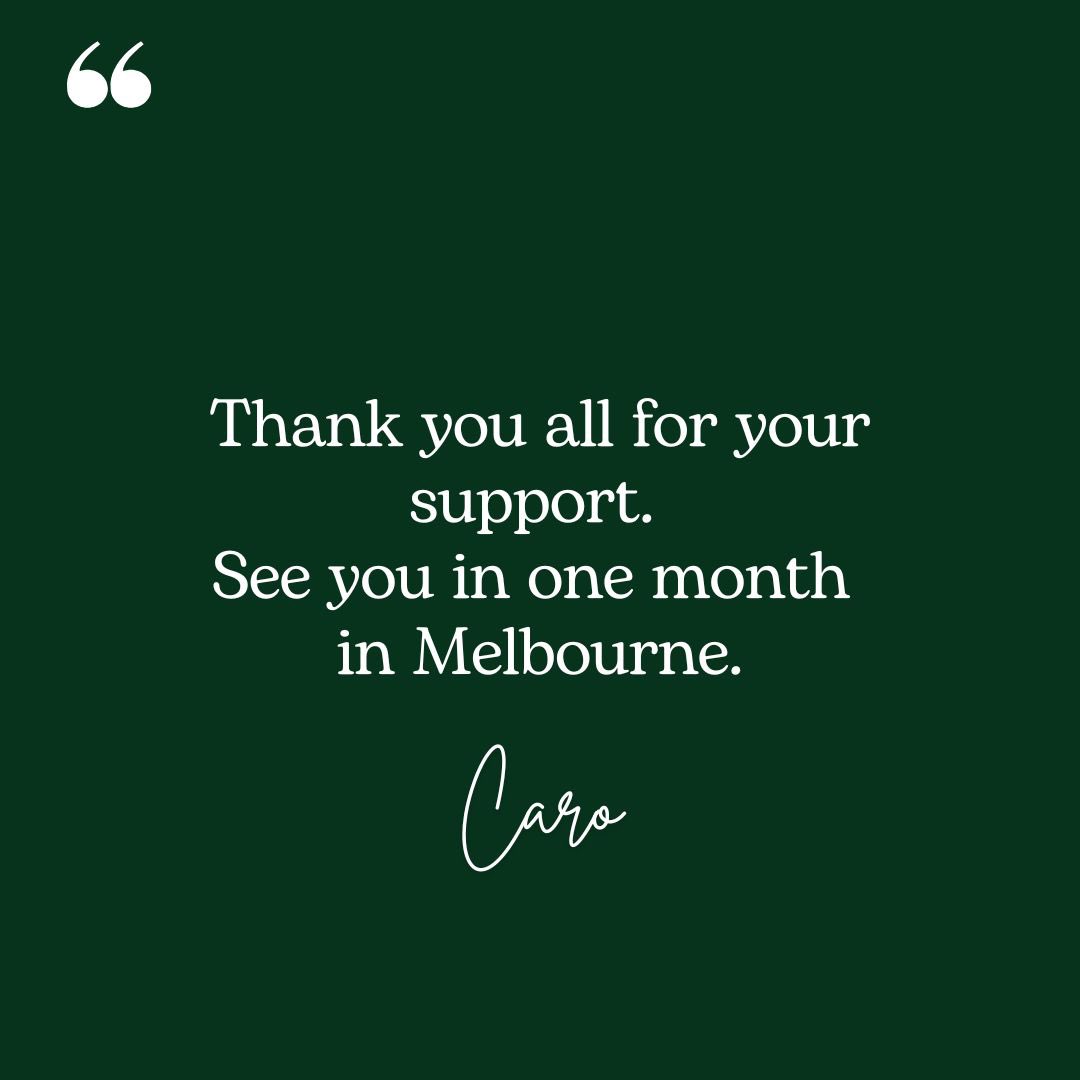
Thank you all for your support.
See you in one month in Melbourne.
Caro
Our final guest of the season: Alex Corretja. A former World No. 2, ATP Finals champion, and the last Spanish man to win the prestigious title, Alex has excelled both on court and off—as Andy Murray’s coach and now a renowned Eurosport commentator. This episode is packed with wisdom, unforgettable memories, and valuable lessons. Don’t miss it!
Youtube: https://t.co/NQSGpa6YKy
Spotify: https://t.co/lgOwGAlLeL
Apple: https://t.co/xYrZRHaKem
If the election outcome is as I expected, it should cause the large minority of the country who supported @KamalaHarris and predicted her victory to begin to question their sources of truth.
Half the country has believed that @X is filled with mis- and disinformation, and that they could only therefore rely on The NY Times, MSNBC, CNN and other mainstream media for their news. And they did.
If, however, you have been active on @X for the last year, you have known the truth days, weeks and often months before the facts appear in the MSM.
The MSM excerpted, clipped and cut to defame @realDonaldTrump while claiming that @JoeBiden was fit as a fiddle. Then when Biden’s polls collapsed, @KamalaHarris was anointed the candidate and her hagiography was written with glowing acclaim from the press. But this could not hold as she ducked the media and held fast to the teleprompter.
Citizen journalists with their phone cameras in hand captured the real Kamala forcing her to defend her record and her plans in more media appearances. It did not go well and the public demanded to learn more so @KamalaHarris had to risk more unscripted media.
The doom loop was underway with perhaps 60 Minutes as one of the more dramatic examples, even after CBS tried to save her, most glaringly by excerpting one answer to replace a word salad response to another. But the citizen journalists on @X quickly caught and outed this fraud and demanded a transcript.
As many who supported Kamala began to realize that they have been misled, they became open to Trump as an alternative, but they didn’t want to rely on the media to understand him because they did not want to be misled again.
They wanted to hear the candidate in his own words and that is where @lexfridman and @joeroganhq long form podcasts came to the rescue. When Kamala was offered the same opportunities to explain herself, she rejected them. And the voting public could only draw a negative inference.
When the story of this election is written, I expect it will be as much about how half of America woke up to the reality that they have been manipulated by the media. This should lead to an abandonment by many of the MSM as their primary source of information. It will push more people to @X, to podcasts and other empirical sources, and it will lead to a more informed public.
The other outcome I hope happens is the implosion of the Democratic Party. The Party lied to the American people about the cognitive health and fitness of the president. It prevented, threatened, litigated and otherwise eliminated the ability of other candidates for the primary to compete, to get on ballots, and to even participate in a debate. The Party and the administration used lawfare in an attempt to imprison, bankrupt or otherwise kill off Trump as a candidate. These acts are collectively grave threats to our democracy. With the highest irony in order to hide these acts, the Party accused the opposition candidate of being the grave threat to democracy.
The Democratic Party proved itself to be fundamentally undemocratic. It needs a complete reboot. The leadership should be thrown out and those responsible should apologize to the American people.
Honest Abe said it best:
You can fool some of the people all of the time, and all of the people some of the time, but you can not fool all of the people all of the time.
Sloane Stephens says one of the biggest problems with the ATP & WTA tours is that players feel forced to compete even when they’re not in a good mental or physical state:
“I never pushed myself to be like ‘I am going to stick it out for another three weeks just because I need my ranking.’ I feel like a lot of players just do that in general.
You are just there because you don’t want to pay the fine, or you’re supposed to be… you entered the tournament, and you don’t want to have any more withdrawals. You’re present, but mentally you’re not there.”
“I feel like one of the problems with both Tours, ATP and WTA, is that you are forced to play even when you are probably not in the best mental state or physical shape. Or you might be injured, and you just show up because that’s what you’re supposed to do. I think that’s probably set people back more than anything. Not having the freedom or independence to be like ‘Hey, let me make this decision.’”
(via @tennisinsidercl)
Source:
https://t.co/25pLHm8G30
“This is a good job to stay at!”
Major champion Sloane Stephens gets candid on the tennis tour, top ranked players and retirement in a new Tennis Insider Club episode ⤵️
https://t.co/InAv6sO0UH
Just dropped an EXCLUSIVE interview with US Open Champ @SloaneStephens! 🏆🔥 She spills untold stories, career secrets, and talks about handling the pressure on & off the court. 👀👑
Don’t miss this one—her journey is INSANE! 💪💥
🎧 https://t.co/DcqU9Bcbj5
#SloaneStephens