@markkaplan20 Homocysteine-lowering therapy (folate, vitamin B12, and/or vitamin B6) has not been shown to prevent future cardiovascular events nor reduce rates of recurrent venous thromboembolism.
Sure, *some* change is inevitable and desirable, as technology changes societies and cultures evolve to adapt. But, as @CreativeDeduct said, the *rate* of change is the key variable here.
When technological change happens too fast -- such as in 18th century France when Voltaire and his monarch buddies crushed the Catholic church (which had played a vital role, despite its undeniable flaws, in upholding public morality) or in 20th century Russia with the simultaneous rapid influx of Western technology plus chaos from WW1, you get the mass murder and chaos eg the French and Russian revolutions.
The French revolution lead to literally millions of deaths and the murderous tyrant Napolean and the Russian revolution to 100 million+ deaths from murder and famine and 100+ years of mass suffering of 2 billion+ people under various totalitarian and communist regimes.
As a former progressive and now somewhat liberal centrist I think that conservatism, at it's best, is the wisdom to understand that societal structures take thousands of years to build in order to solve the mass suffering and chaos which is the natural state of affairs, yet can be destroyed in less than a day.
In other words, it rejects the evolutionary illiterate, "humans are infinitely malleable", blank slatist view of human nature.
I highly recommend following @avidseries and reading Moral Animal (an incredible book re evo psych) by @robertwrighter.
Why does every social issue seem to be reframed as a struggle between oppressors and the oppressed?
It's no coincidence. It's the product of a philosophical method that has shaped the left for more than two centuries: the dialectic.
It originated with Georg Wilhelm Friedrich Hegel in the early 19th century. Hegel argued that history advances through a process of conflict between opposing forces - a thesis and its antithesis - which are then resolved in a higher synthesis. This dialectical movement, he believed, represented the progressive unfolding of human freedom and reason.
Karl Marx took Hegel’s method but stripped it of its idealism. He replaced the clash of ideas with the clash of economic classes. For Marx, history was driven by material contradictions within modes of production. Capitalism contained the seeds of its own destruction through class struggle, which would eventually produce a communist synthesis. The dialectic became a tool not just for understanding history, but for justifying revolutionary action.
When classical Marxism failed to produce the expected proletarian revolution in the West, the Frankfurt School adapted the dialectic once again. Thinkers like Adorno, Horkheimer, and Marcuse shifted the focus from economic base to cultural superstructure. They developed Critical Theory as a form of permanent negative critique, aimed at exposing and undermining the contradictions within liberal capitalist society — in family structures, sexuality, education, and language.
This dialectical framework continues to shape progressive politics today. Identity-based activism often follows the same pattern: identify an oppressive structure (thesis), mobilise a marginalised group against it (antithesis), and demand systemic transformation toward equity (synthesis). Because the dialectic views conflict as the necessary engine of historical progress, it has little interest in stable institutions, incremental reform, or the preservation of existing social order.
This is why progressive movements frequently reject liberal norms of debate and tolerance. Once politics is understood as an endless series of contradictions that must be resolved through struggle, the goal is no longer peaceful coexistence or mutual accommodation, but the permanent transformation of society through continuous agitation. The dialectic has proven remarkably effective precisely because it offers both a method of analysis and a justification for never-ending conflict.
🚨 New declassified records: @ODNIgov says Dr. Fauci funded risky Wuhan research, manipulated intelligence toward a natural-origin narrative, silenced dissent, and misled Congress.
The media covered for him.
It is time for St. Fauci to be held accountable for his sins.
READ @WashTimesOpEd 👇
https://t.co/8VS7s0Z1OU
¿La ministra de Igualdad sabe hablar en inglés, o al menos tiene ocasión de que el presidente del Gobierno, que sabemos lo habla con fluidez, pueda traducirle este breve del editor de The Spectator, Douglas Murray, en un perfecto inglés de Hammersmith..?
https://t.co/eRFm71u0ou
Easy.
The 2003 SARS outbreak exposed how outdated WHO's disease rules were, since the old International Health Regulations only covered a few named diseases. In response, the World Health Assembly launched a revision process.
By 2004, avian flu drove CDC and global experts to draft the Manhattan Principles, which coined "One Health," a plan to unite human, animal, and environmental health to stop zoonotic outbreaks before they start.
In 2005, WHO member states unanimously adopted the updated International Health Regulations (IHR 2005), legally binding all countries to detect, report, and respond to any event that might become a global health emergency.
That framework began taking shape in practice with USAID's PREDICT program (2009), which hunted new zoonotic viruses worldwide and trained scientists in the One Health approach. One of its partners was EcoHealth Alliance, which later collaborated with the Wuhan Institute of Virology to study bat coronaviruses under a 2014 NIH grant.
Meanwhile, WHO, FAO, and OIE formalized their Tripartite Concept Note in 2010, turning One Health into an institutional partnership. This tripartite later became a key partner in the Global Health Security Agenda (GHSA), launched in 2014 by the U.S. and allies to accelerate IHR 2005 compliance.
EcoHealth Alliance and the Johns Hopkins Center for Health Security both participated in GHSA networks. Hopkins would go on to stage the infamous Clade X (2018) and Event 201 (2019) pandemic simulations which happened just months before the COVID-19 outbreak.
At the same time, the Sendai Framework (2015) wove biological threats into global disaster planning and introduced the "Build Back Better" language for post-crisis recovery, further cementing IHR 2005 principles in international policy.
So by the mid-2010s, the global outbreak response framework and the virus discovery networks had fused into one system.
In other words: the same institutions doing the gain-of-function COVID-19 research were also heavily involved in creating the response playbook and doing the scenario games. It was all happening in parallel. We likely would not have had COVID-19 in the first place if we had never adopted the IHR 2005 regulations in the first place.
The pandemic created its response, but the response also created the pandemic. That's the cover-up.
Now go end the filibuster.
con una cláusula adicional que establezca: "y, de manera preceptiva, siempre que el Gobierno no consiguiera aprobar la ley de Presupuestos Generales del Estado por segundo año consecutivo, presentada ante el Congreso de los Diputados según lo previsto en el artículo 134.4"
Hay que modificar urgentemente el artículo 112 de la CE donde dice: "El Presidente del Gobierno... puede plantear ante el Congreso de los Diputados la cuestión de confianza sobre su programa o sobre una declaración de política general",
@JesusFerna7026@BarqueroDelAlba Avicena, Maimónides, Isidoro de Sevilla..., y fuera de nuestras fronteras el Doctor Angélico, Doctor Común y Doctor de la Humanidad, el grandísimo Tomás de Aquino. ¿A todos ellos los querría usted mandar de verdad a la basura de la historia? No despotrique usted al buen tuntún...
@JesusFerna7026@BarqueroDelAlba Corrijamos y terminemos con la perpetuación injusta de acuerdos y privilegios anacrónicos seculares. De acuerdo. Pero no denostemos nuestra historia medieval, riquísima en contribuciones a la cultura universal: desde Alfonso X El Sabio, pasando por Gonzalo de Berceo,
Ramon Llull
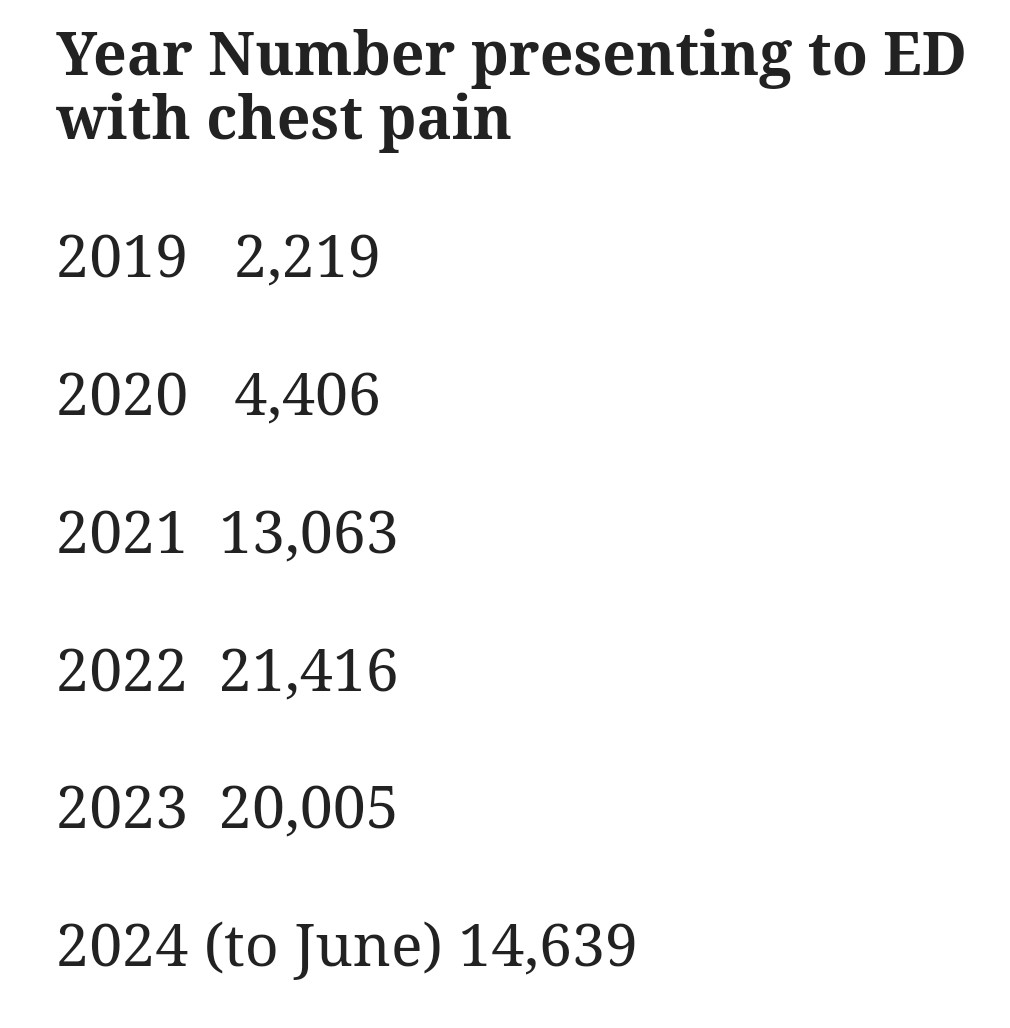
"These alarming figures are not marginal, they stand up and slap you in the face. They have been in the possession of Health NZ from the outset, but the public has heard nothing about them from official sources."
https://t.co/rxGu1tjmJd
An OIA (freedom of information) request to Health NZ asked for ‘the number of people under the age of 40 presenting to Emergency Departments throughout NZ hospitals with Chest Pain or Heart Issues by year?’ The answer contains shattering information:
"The OIA figures suggest a tenfold increase in chest pain and/or cardiac events among those under 40, the close association between covid mRNA vaccination and chest pain and/or heart disease among younger people becomes very clear."
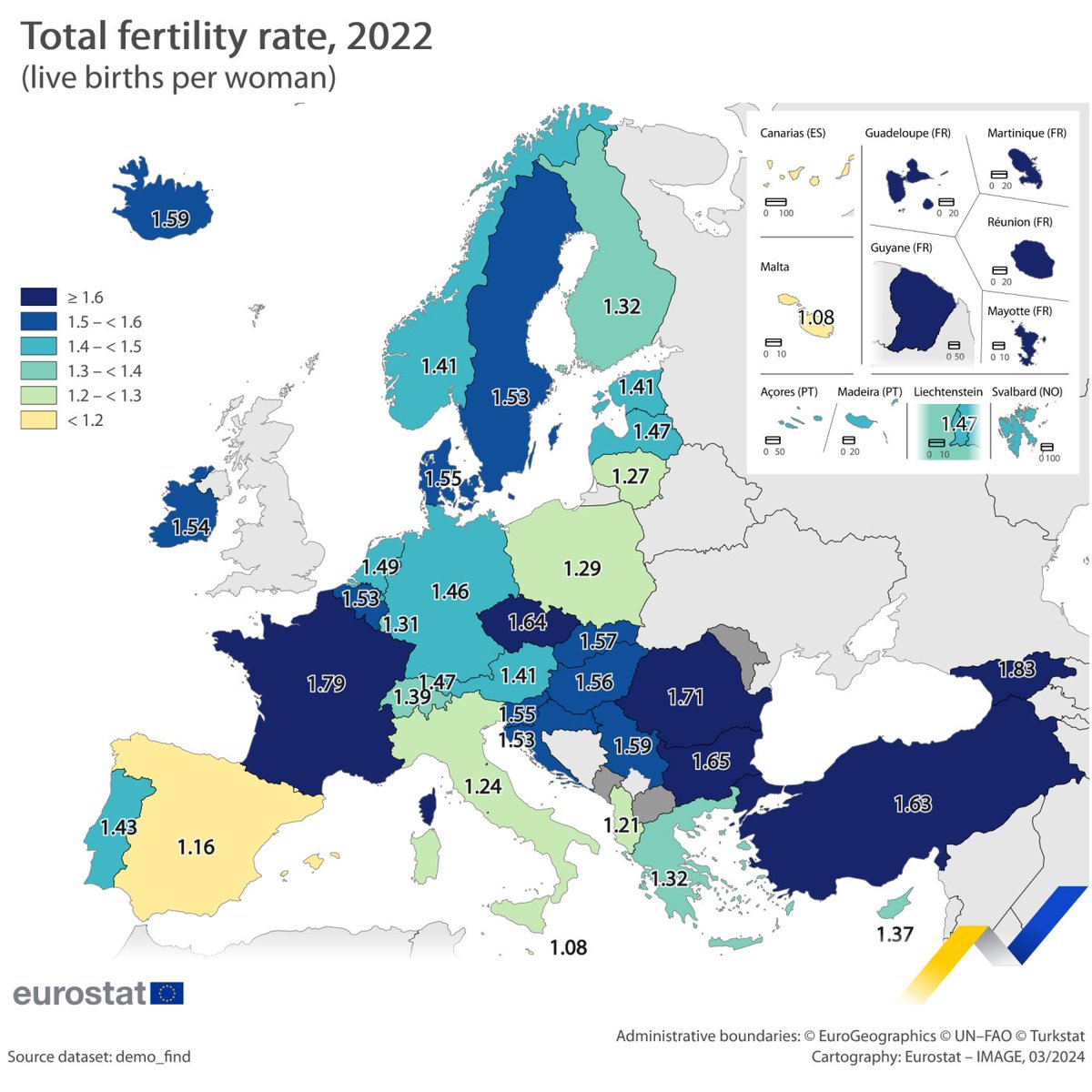
España, 'campeona' de Europa en infertilidad. La segunda tasa de fertilidad más baja de la UE (1.16) por detrás de Malta (1.08). El crecimiento demográfico desde 2009 es inferior al 1%. ¿Hay algún plan en la mesa del Consejo de Ministros para evitar la catástrofe que se avecina?