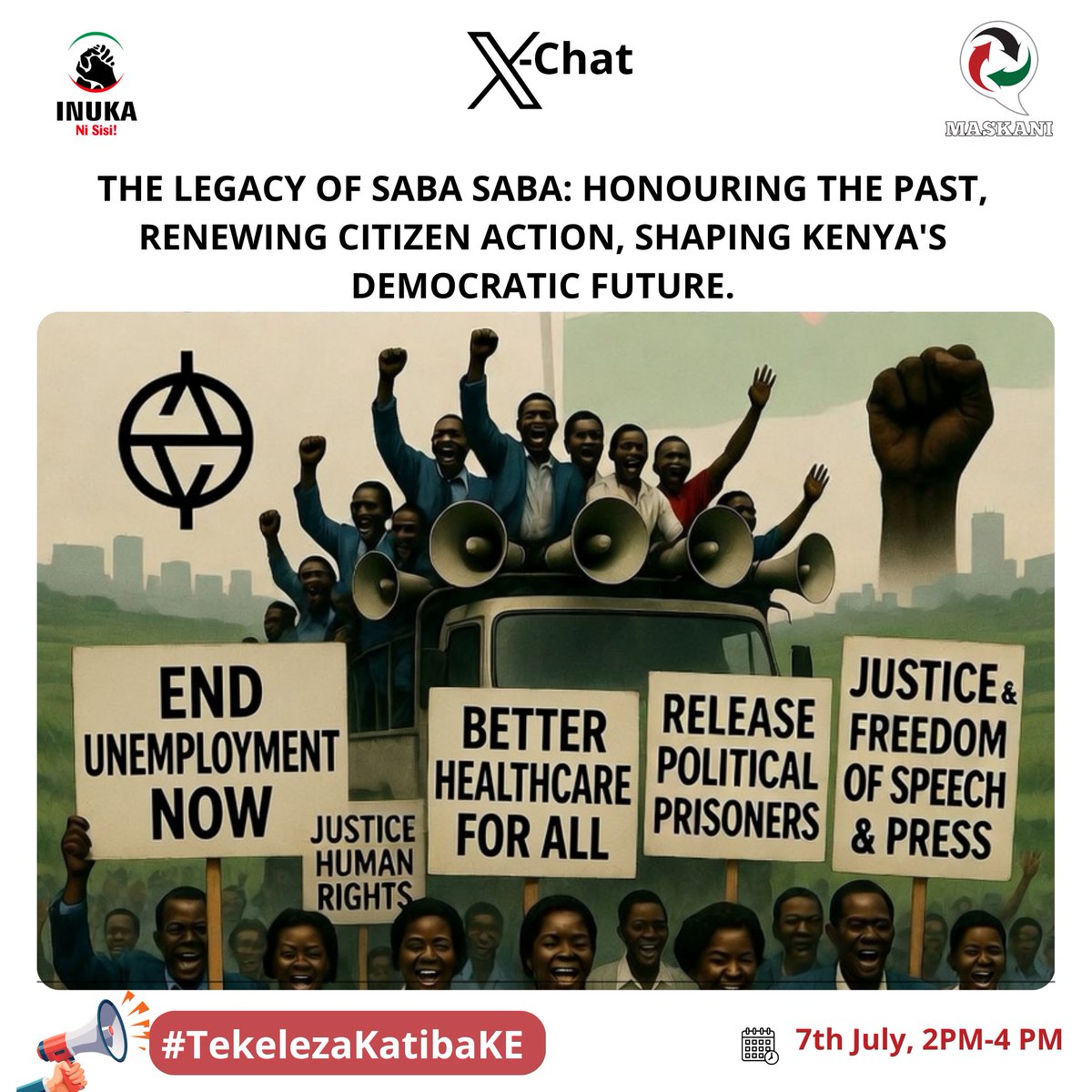
Saba Saba activists demanded an end to authoritarian rule and called for accountable leadership, constitutional governance, multiparty democracy, transparency, and a government that served the interests of its citizens rather than political elites.
Kenya has made significant democratic progress through the 2010 Constitution, devolution, and independent oversight institutions. However, concerns over weak accountability, misuse of public resources, poor service delivery, and declining public trust in institutions continue to dominate public discourse.
The 2024 National Ethics and Corruption Survey identified unemployment, corruption, poverty, and the high cost of living as the country's most pressing challenges, highlighting continued public concern about governance and accountability.
Thirty-six years after Saba Saba, has Kenya built the accountable government that citizens envisioned in 1990?
#TekelezaKatibaKE
The Saba Saba movement demanded integrity in public office, an end to abuse of power, transparency in government, and responsible management of public resources.
Corruption remains one of Kenya's biggest governance challenges, affecting public services, economic development, and citizen trust in government institutions.
According to the 2024 National Ethics and Corruption Survey, 52.1% of respondents witnessed bribery in public offices, 30.5% encountered bribery, and 97.2% of bribery incidents went unreported due to fear of retaliation and lack of confidence in reporting systems.
Can Kenya fully realize the promise of Saba Saba without winning the fight against corruption?
#TekelezaKatibaKE
The Saba Saba movement was not only a struggle for political freedoms but also for economic justice, accountable management of public resources, and improved living standards for ordinary Kenyans. Citizens demanded a government that would prioritize the welfare of its people through prudent public finance management, equitable development, job creation, affordable public services, and responsible use of taxpayer resources.
36 Years Later, While Kenya has made significant democratic gains, economic hardship remains a major concern for many households. Millions of Kenyans continue to grapple with the rising cost of food, transport, housing, fuel, healthcare, and other basic necessities. At the same time, concerns over the management of public finances, growing public debt, corruption, and inefficient public expenditure continue to dominate national discourse.
Kenya's public debt has now surpassed KES 12 trillion, raising questions about fiscal sustainability, debt servicing, and the long-term impact on economic growth and future generations. As debt obligations increase, a significant share of public revenue is directed towards debt repayment, reducing the fiscal space available for essential services such as healthcare, education, social protection, infrastructure, and youth employment.
The 2024 National Ethics and Corruption Survey also identifies the high cost of living, unemployment, and corruption among the country's most pressing challenges, highlighting the interconnected nature of governance, public finance, and citizens' welfare.
Thirty-six years later, is Kenya's public finance system delivering the economic justice and responsible governance envisioned by the champions of Saba Saba?
#TekelezaKatibaKE
Saba Saba activists of (1990) envisioned a Kenya where democratic governance would create equal opportunities, decent jobs, and economic empowerment for all.
Despite a young and educated population, unemployment and underemployment remain major challenges, particularly among young people.The 2024 National Ethics and Corruption Survey ranked unemployment as Kenya's number one national challenge (49.1%).
How can the government create meaningful opportunities for young people and fulfil the economic promise of democracy?
#TekelezaKatibaKE
Thirty-six years after the historic Saba Saba movement of 7 July 1990, Kenya continues to reflect on one of the most defining moments in its democratic journey. Saba Saba represented a collective demand by citizens for political pluralism, constitutional reforms, respect for human rights, accountable governance, and greater public participation in national affairs.
Despite state repression, arrests, and violence, the movement marked a turning point in Kenya's history, laying the foundation for the repeal of Section 2A of the Constitution, the reintroduction of multiparty democracy, and ultimately the promulgation of the Constitution of Kenya, 2010.
Over the past three decades, Kenya has made significant democratic gains. The Constitution has entrenched the Bill of Rights, devolved governance, strengthened independent institutions, expanded civic freedoms, and created greater opportunities for citizen participation in governance and public decision-making. These milestones represent important achievements that reflect the aspirations of those who participated in the Saba Saba movement.
However, many of the issues that inspired the struggle remain part of Kenya's national conversation today. Citizens continue to express concern over corruption, the rising cost of living, unemployment, inequality, misuse of public resources, police brutality, shrinking civic space, access to quality healthcare and education, and the need for greater transparency and accountability in public institutions. While constitutional and institutional reforms have created stronger democratic foundations, the realization of these gains continues to depend on effective implementation, responsible leadership, and active citizen participation.
The emergence of the Gen Z-led civic mobilizations in 2024 and 2025 further demonstrated that the ideals of Saba Saba continue to resonate with a new generation of Kenyans. Driven by demands for accountability, constitutionalism, economic justice, and responsive governance, these movements reaffirmed that democracy is sustained not only through elections but also through continuous civic engagement, peaceful participation, and the willingness of citizens to hold public institutions accountable.
The #TekelezaKatibaKE Saba Saba Campaign emerges as a citizen-led civic education and digital advocacy initiative aimed at commemorating the legacy of Saba Saba while encouraging renewed commitment to constitutional governance, accountability, and active citizenship. Rather than focusing solely on historical remembrance, the campaign seeks to connect the struggles of 1990 with the realities of present-day Kenya by fostering informed public dialogue on governance, democratic progress, constitutional rights, and the responsibilities of citizens.
The campaign further seeks to strengthen conversations around good governance, corruption, public accountability, human rights, healthcare, education, youth employment, public finance, police accountability, and meaningful public participation. It recognizes that democracy is not sustained by constitutional provisions alone, but through everyday actions by citizens, responsive institutions, transparent leadership, and continued protection of fundamental freedoms.
The Campaign encourages citizens to critically engage with important questions such as:
1. How far has Kenya come in achieving the aspirations of the Saba Saba movement?
2. Which democratic gains should be celebrated and protected?
3. What governance challenges continue to undermine the promise of constitutional democracy?
4. How can citizens strengthen accountability and public participation beyond elections?
5. What lessons can be drawn from the 2024 and 2025 Gen Z civic mobilizations?
6. How can young people continue shaping Kenya's democratic future through lawful and peaceful civic engagement?
7. What practical actions can citizens take every day to strengthen democracy, defend the Constitution, and promote accountable governance?
This campaign is not only about commemorating a historic day, it is about reflecting on Kenya's democratic journey, celebrating constitutional gains, confronting the challenges that remain, and inspiring renewed citizen action. It recognizes that democracy flourishes when citizens are informed, institutions are accountable, public resources are managed responsibly, and every Kenyan has the opportunity to participate meaningfully in shaping the country's future.
Join the conversation under
as we honour the legacy of Saba Saba, celebrate Kenya's democratic progress, and renew our collective commitment to constitutionalism, accountability, and active citizenship.
Together, let us protect the gains of democracy, strengthen public participation, and build a more just, accountable, and inclusive Kenya for present and future generations. #TekelezaKatibaKE
The 2010 Constitution answered "who has power." Saba Saba asked "who benefits."
Until a child in Mandera and a child in Muthaiga have the same shot at health, school, and a job, the promise is still unpaid. #TekelezaKatibaKE
Saba Saba was not only a struggle for political freedoms but also a call for a more just, equitable, and inclusive Kenya where every citizen could access opportunities, public services, and economic prosperity without discrimination or marginalization.
The Constitution guarantees equality, non-discrimination, and equitable development. Devolution has improved access to services in many parts of the country. However, significant inequalities remain in income, employment opportunities, healthcare, education, infrastructure, and access to basic services across regions and communities.
According to the World Bank and KNBS, poverty and inequality continue to affect millions of Kenyans, particularly in arid and semi-arid regions. Socio-economic disparities remain evident in employment, education outcomes, healthcare access, and household incomes despite notable progress in reducing extreme poverty over the past two decades.
How can Kenya ensure that the democratic gains achieved since Saba Saba translate into equal opportunities, dignity, and shared prosperity for all citizens?
#TelekelezaKatibaKE
@Maskani254@kawive@nisisikenya Saba Saba called for a Kenya with no marginalization.
We have devolution + a rights Constitution.
Next: Targeted investment in ASALs, equal quality in health + schools, jobs in every county.
Freedom without fairness is half a promise. #TekelezaKatibaKE
@Maskani254@kawive@nisisikenya KNBS + World Bank: Poverty and inequality persist, especially in ASALs.
Democracy must pay rent.
Solution: Equitable budgets, local jobs, universal health + education.
Equal opportunity should not depend on where you’re born. #SabaSaba36#TekelezaKatibaKE
@Maskani254@kawive@nisisikenya Back then : "Justice and prosperity for all"
Now Rights on paper. Gaps in reality.
To honor Saba Saba we need: Fair jobs, working services, dignity for every Kenyan.
Shared prosperity is the true measure of democracy. #TekelezaKatibaKE
Saba Saba was not only a struggle for political freedoms but also a call for a more just, equitable, and inclusive Kenya where every citizen could access opportunities, public services, and economic prosperity without discrimination or marginalization.
The Constitution guarantees equality, non-discrimination, and equitable development. Devolution has improved access to services in many parts of the country. However, significant inequalities remain in income, employment opportunities, healthcare, education, infrastructure, and access to basic services across regions and communities.
According to the World Bank and KNBS, poverty and inequality continue to affect millions of Kenyans, particularly in arid and semi-arid regions. Socio-economic disparities remain evident in employment, education outcomes, healthcare access, and household incomes despite notable progress in reducing extreme poverty over the past two decades.
How can Kenya ensure that the democratic gains achieved since Saba Saba translate into equal opportunities, dignity, and shared prosperity for all citizens?
#TelekelezaKatibaKE
@Maskani254@kawive@nisisikenya Access is not the same as opportunity.
Saba Saba demanded both.
Fix funding gaps, digital inequality, and teacher shortages - especially in marginalized areas.
Education must level the playing field, not reflect it.
#TekelezaKatibaKE
@Maskani254@kawive@nisisikenya Saba Saba wanted education as equal opportunity.
2026: >90% enrolment. Literacy up.
But: Teacher shortages, poor infrastructure, and unequal outcomes persist.
We got kids in school. Now let’s get quality in every classroom. #TekelezaKatibaKE#SabaSaba36
The Saba Saba movement envisioned a Kenya where every citizen had equal opportunities to succeed through access to quality education. Activists believed that education was essential for empowering citizens, reducing inequality, promoting social mobility, and enabling meaningful participation in democratic governance.
Kenya has made significant progress in expanding access to education through free primary education, increased secondary school enrolment, and constitutional recognition of education as a right. However, many learners continue to face challenges related to affordability, school infrastructure, teacher shortages, digital inequality, and access to quality learning, particularly in marginalized communities.
According to the Kenya National Bureau of Statistics (KNBS), literacy rates have improved significantly over the past three decades, and primary school enrolment exceeds 90%. However, disparities in learning outcomes, school completion rates, and access to quality education persist across counties and socio-economic groups. Recent government reports also continue to highlight teacher shortages and infrastructure gaps in public schools.
Thirty-six years after Saba Saba, has Kenya achieved an education system that provides every child with an equal opportunity to succeed regardless of their background?
#TekelezaKatibaKE
@Maskani254@kawive@nisisikenya@TISAKenya You can protect people AND the Constitution.
Reform needed: Human rights training for police, clear rules of engagement, ban on brutality during protests.
Article 37 is not a suggestion. It's the law.
#TekelezaKatibaKE
@Maskani254@kawive@nisisikenya@TISAKenya Saba Saba rejected state repression and excessive force.
36 years later we still need: Independent IPOA probes, command responsibility, and justice for victims.
Public safety without rights is not safety. It's fear.
#TekelezaKatibaKE#SabaSaba36
@Maskani254@kawive@nisisikenya@TISAKenya Full accountability for use of force
Independent investigations by IPOA for every death, injury, or arrest during protests. Fast prosecutions. Command responsibility. Victims must get compensation. No impunity.#TekelezaKatibaKE
The Saba Saba movement opposed state repression, arbitrary arrests, torture, and excessive use of force against citizens exercising their constitutional freedoms.
Concerns about police accountability and the use of force during demonstrations continue to feature prominently in national conversations on governance, justice, and human rights.
Human rights organizations have documented deaths, injuries, arrests, and allegations of excessive force during recent demonstrations, renewing calls for greater police accountability and reforms.
Thirty-six years after Saba Saba, what reforms are needed to ensure public safety while fully protecting citizens' constitutional rights?
#TekelezaKatibaKE
@Maskani254@kawive@nisisikenya@TISAKenya Strengthen constitutional institutions
Courts, Parliament oversight, EACC, and county assemblies must check executive power. Budget them properly so they don’t rely on the people they’re supposed to watch. #TekelezaKatibaKE
@Maskani254@kawive@nisisikenya@TISAKenya Protect civic space in law AND practice
Freedom of expression, assembly, and association must be defended offline and online. Repeal/amend laws used to target journalists, activists, and protesters. Digital freedoms are human rights too.
@Maskani254@kawive@nisisikenya@TISAKenya Enforce accountability, not just laws
KNCHR, IPOA, ODPP need independence + resources + teeth. When there’s police brutality or arbitrary arrests, there must be swift investigation, prosecution, and compensation. No more impunity.#TekelezaKatibaKE