Criei essa conta 5 anos atrás pelo entusiasmo com mercado de automação de texto, 5 anos depois estamos nesse mundo digital praticamente dominado pela IA. #MyXAnniversary
UNDERSTANDING THE MEANING OF 'TOKEN' IN PROMPTS
In one of my latest posts, I got a question: why do we call words in the prompt "tokens"? It can be confusing, especially for folks from WEB 3. So, I thought I'd write a post to answer that question and clear things up!
The term "token" was first used in linguistics and grammar to refer to a basic unit of language. It originated from the Latin word "tōken" or "tōkēn," meaning "sign" or "symbol."
In the early days of computer science and programming, the concept of tokens was introduced to represent individual elements of a program's source code. These tokens were the smallest units that a compiler or interpreter could understand and process. Each token had a specific meaning and function, such as keywords, identifiers, operators, or punctuation.
What are Tokens in Language Models?
In language models like GPT-3.5, a "token" is a small piece of text. It could be a word, part of a word, or even a single character. The model processes text by dividing it into these tiny parts.
How Do Language Models Split Text into Tokens?
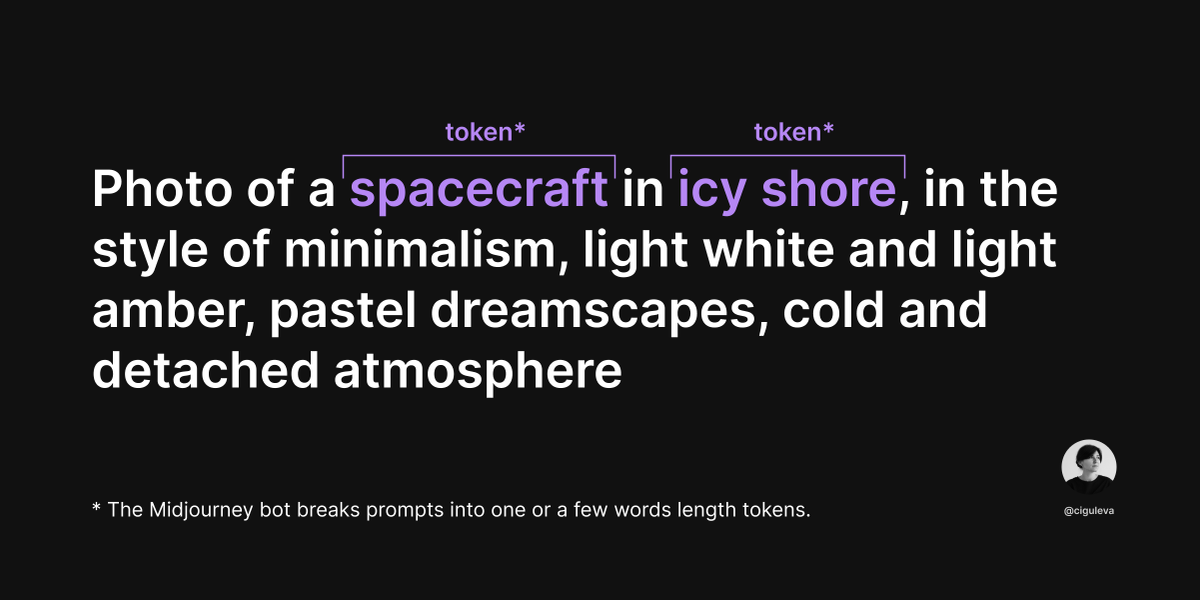
Language models use different methods to break down text. They can split it into words or smaller chunks like subwords. For example, a word like "running" might be divided into "run" and "ning" as two tokens. The Midjourney bot breaks prompts into one or a few words length tokens.
What's the Impact of Token Size?
The size of tokens affects how well the model understands and generates text or images. Smaller tokens can capture more details, while larger tokens give more context. However, using smaller tokens might make the model more computationally expensive.