Can robots learn to reason and act with NO human-annotated language or reasoning labels?
Introducing Action Self-Distillation (ASD), one model that teaches itself language goal-conditioned reasoning and navigation directly from robot demonstrations. #CoRL 2026🤖
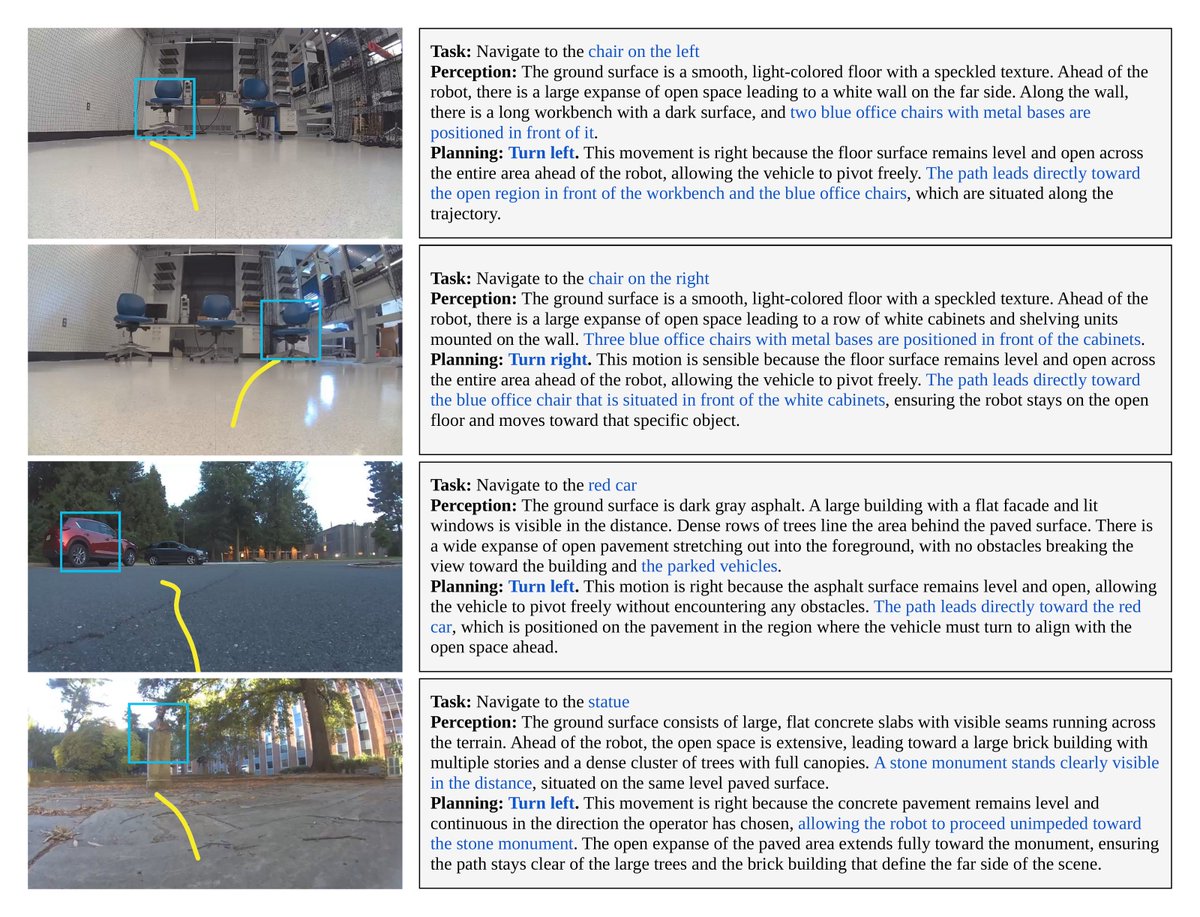
7/ Does reasoning actually help planning? 🧠
ASD generates interpretable reasoning traces grounded in visual observations, identifying relevant landmarks, target objects, and navigation decisions.
These reasoning traces help guide trajectory prediction toward the language goal.
6/ Is self-distillation better than external reasoning labels?
On our 5-task ablation, Qwen3.5-VL ASD reaches 80% success, vs. 36% for SFT on Claude Opus 5-generated labels.
And disabling reasoning at inference drops success to 14%. Reasoning matters!
5/ Real-world results 🚀
We tested on 13 zero-shot indoor and outdoor tasks with a FrodoBot rover.
✅ +30 percentage points indoors vs. OmniVLA
✅ 95% success outdoors
✅ Handles multi-stage navigation instructions
All from ~100 h of outdoor navigation data.
4/ Does language actually steer the robot?
Yes! In the same scene, ASD navigates to different targets:
🔵 “Blue/black chair”
⬅️ “Chair on the left/middle/right”
🗑️ “Trash bin/monitor/chair”
It changes its trajectory to follow the requested object, color, or direction.
3/ How does ASD learn?
Self-teacher: reasons with priviledged future trajectories.
Student: learns from onboard observations via reasoning distillation + action supervision.
The teacher is updated as an EMA of the student, enabling iterative self-distillation.
2/ Inspired by VLM reasoning traces
What if we condition a VLM on the ground-truth futurre trajectory?
This privileged feedback guides the self-teacher to generate reasoning aligned with the demonstrated actions, turning unlabeled trajectories into reasoning supervision.
1/ Why ASD?
Robot datasets contain camera footage and trajectories, but rarely language goals or reasoning annotations. Labeling them is expensive.
What if robots could infer their own goals and reasoning, and then learn from them?