Interesting tradeoff with Hermes Agent (@NousResearch): the desktop app gives you visibility and control, while TUI gives you speed and focus.
Desktop is the morning meeting. TUI is sitting down and doing the actual work.
Which one would you rather spend most of your day in?
Hermes Agent (@NousResearch) Desktop App vs TUI..which one should you actually use?
I break down the key workflow differences: visual orchestration, token efficiency, coding in terminal, remote backends, and when each setup makes sense.
Watch this before choosing your workflow:
Trump’s AI executive order could change how GPT, Claude, Cursor, and other frontier AI models reach the public.
Voluntary 30-day review. NIST definitions. CISA/OSTP oversight. Big implications for AI builders and users.
Watch the full breakdown now:
Your AI agent said it worked...It lied.
We put Hermes Agent Skills vs Dashboard head to head to see which actually builds reliable AI workflows and the answer might surprise you.
Watch here 👇
Michael Saylor selling a tiny amount of Bitcoin might be more psychologically damaging than a huge sale.
His whole brand was “never sell bitcoin:native ” If even the biggest Bitcoin believer has to sell, what does that do to market confidence?
Michael Saylor just SOLD Bitcoin for the first time in 4 YEARS. 🚨
Gods can bleed. Banks are circling. Is this the beginning of the end, or the best buying opportunity we've seen?
We break it all down. Don't sleep on this one.
🔥 Run Minimax M3 inside Claude Code no Anthropic key needed.
Just point the base URL + auth token to @MiniMax_AI and you're coding with M3 in seconds.
Full step-by-step setup guide 👇
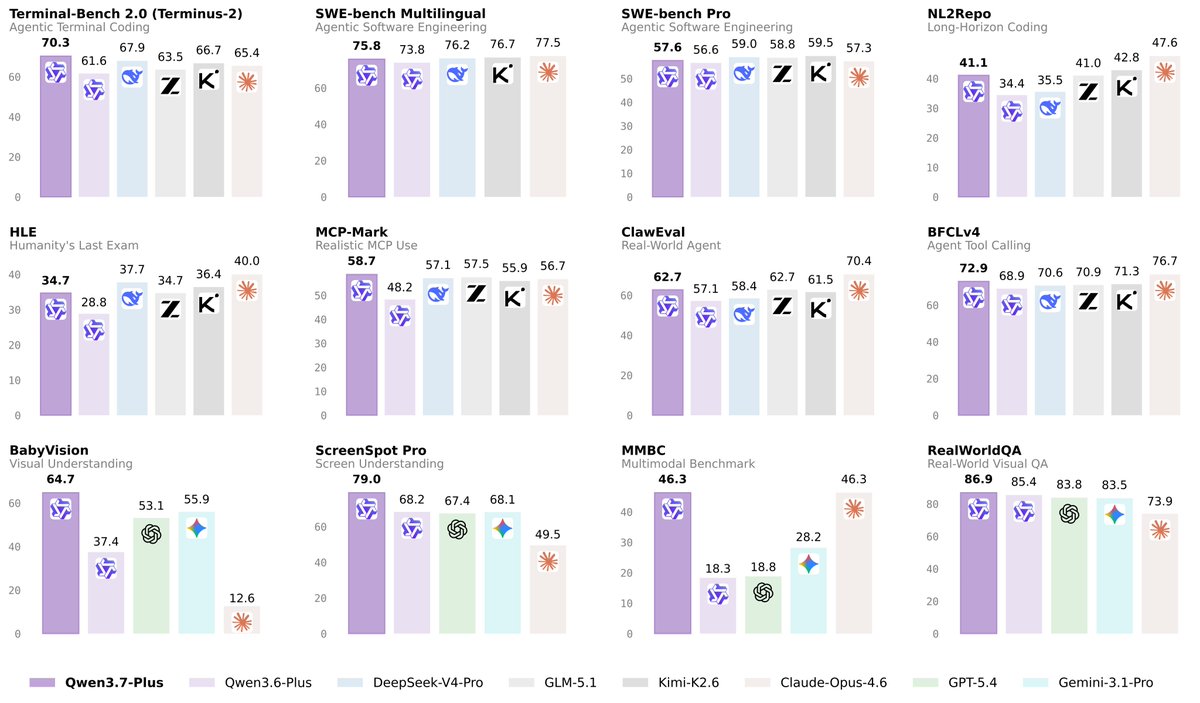
Qwen 3.7 Plus being 40% cheaper than Max changes the conversation.
If the output is close enough for most coding and much stronger for visual workflows, do you really need Max every day or only for the heavy terminal-only jobs?
👏👏 Introducing Qwen3.7-Plus — a multimodal agent model that unifies vision and language into one versatile agent foundation.
✅ Multimodal interactive hybrid agent: unified GUI & CLI operation across visual and text tasks
✅ Versatile coding agent & productivity assistant with full-modality input
✅ Visual Agent: perception, reasoning, grounding, and search-augmented QA
✅ Cross-harness generalization across diverse agent frameworks
One model. Sees, thinks, codes, acts.🙌🙌
Now available via API on Alibaba Cloud Model Studio. Try it — let us know what you build.😎
🔗🔗⬇️⬇️
Blog:https://t.co/pVYf0h3NNa
Qwen Studio:https://t.co/HUYgFW4cYf
API:https://t.co/viL0cXrMzW
Qwen 3.7 Plus might be the new daily driver for developers.
Native vision, GUI + CLI reasoning, OCR, visual-to-code, cheaper tokens, and real coding tests against Max.
Is Plus finally the smarter pick over Qwen 3.7 Max?
Watch the full @Alibaba_Qwen breakdown before you switch models:
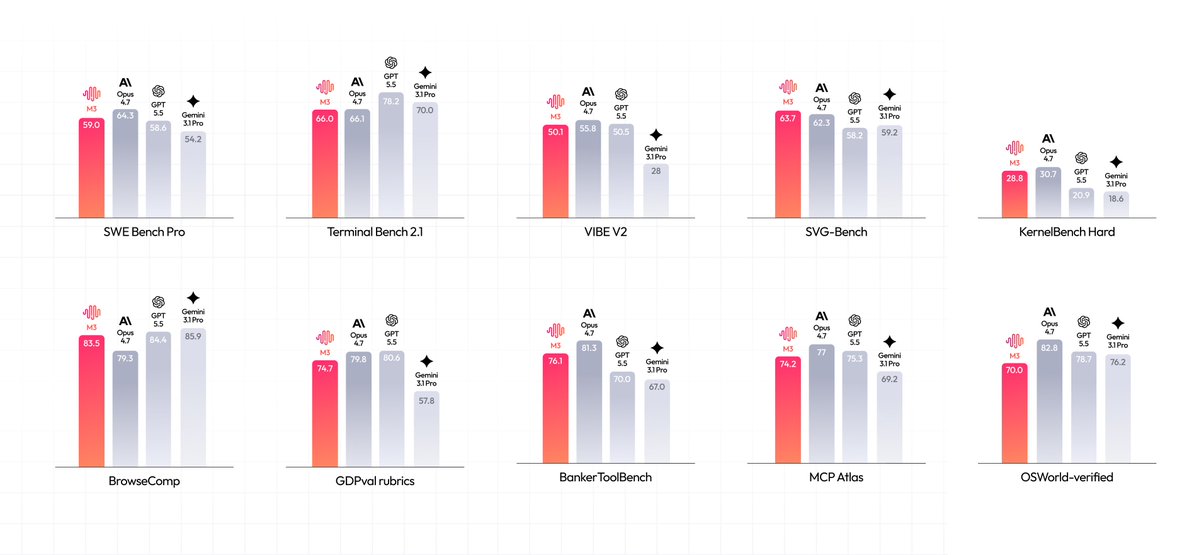
MiniMax M3 (@MiniMax_AI) feels like a real turning point for open-weight AI.
1M context, agentic coding, native multimodal training, and sparse attention in one release is not just a spec upgrade.
It is a serious attempt to build the foundation for long-horizon agents that can actually work across code, docs, screens, and real workflows.
@atomtanstudio Solid test workflow! PNG → HTML/CSS is one of the harder tasks since it needs precise layout interpretation. If it's completing it even slowly, that's saying something.
How's the output quality? clean code or does it need heavy editing after?
The thing that caught my eye about MiniMax M3:
They combined coding + agentic + multimodal in ONE model.
Most labs are still chasing one of those. They're throwing all three at the wall and somehow none of them are half-baked.
Curious what the open weights drop does to the market. Anyone else excited or just me?
MiniMax M3 (@MiniMax_AI) might be the first open-weight model to combine agentic coding, 1M token context, and native multimodal understanding in one release.
But is it actually ready for real coding workflows?
I tested the benchmarks, pricing, MiniMax Code, and early outputs.
Watch the full breakdown here: