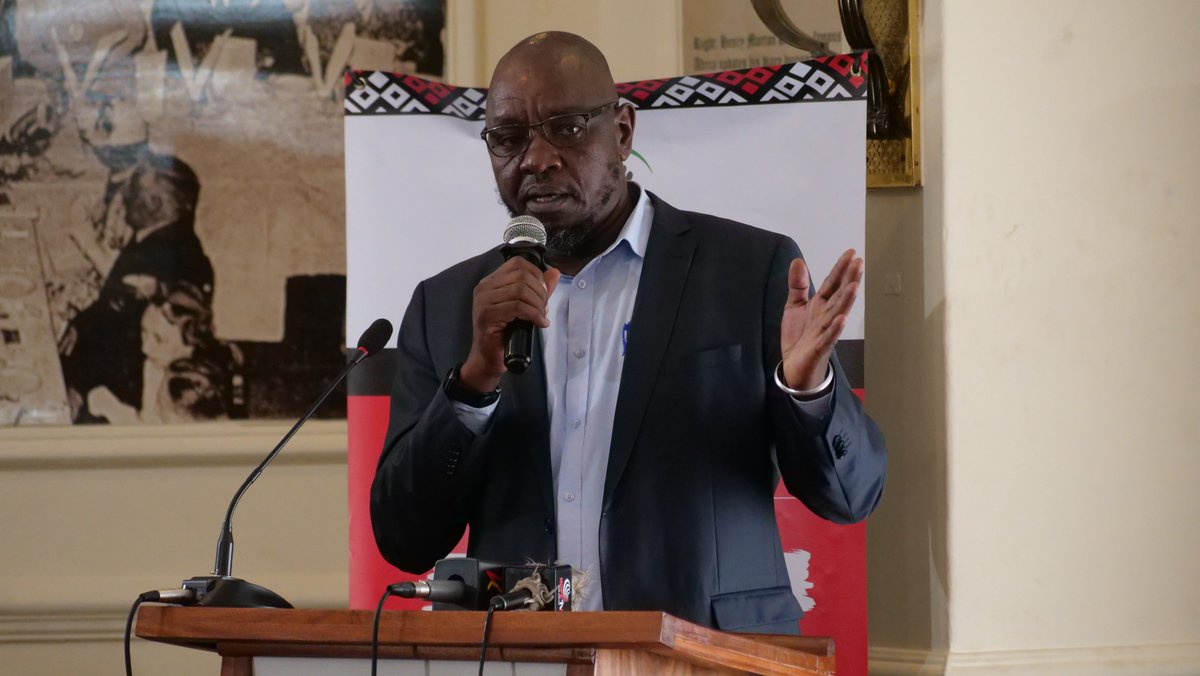
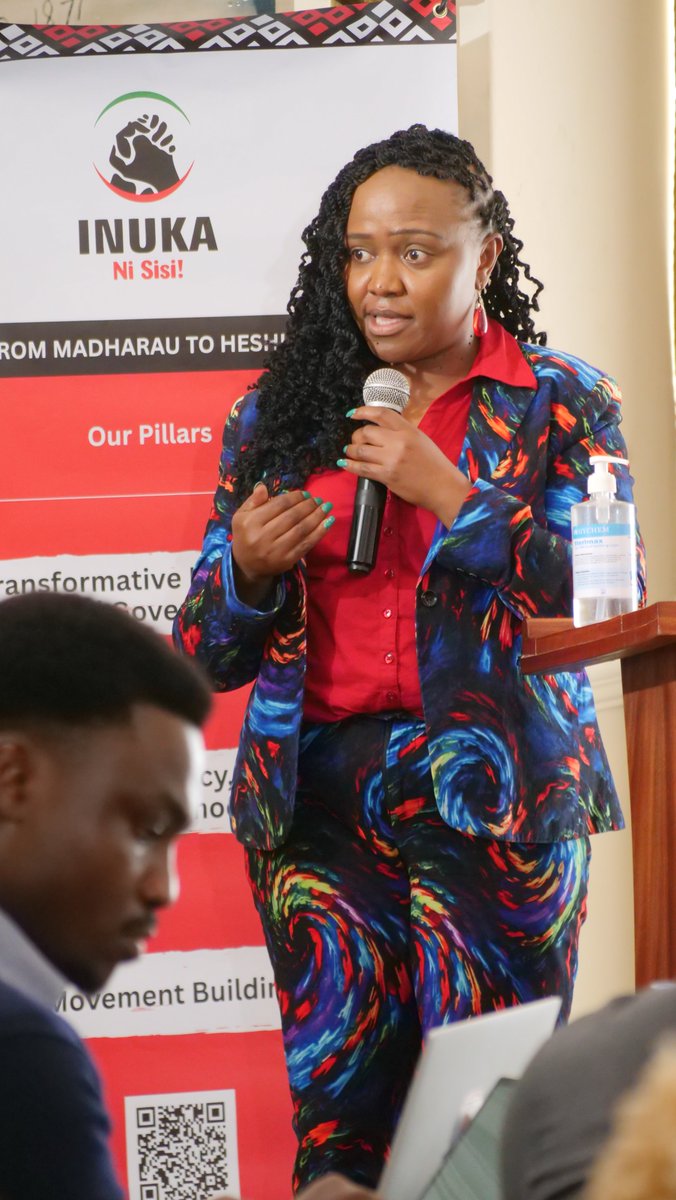
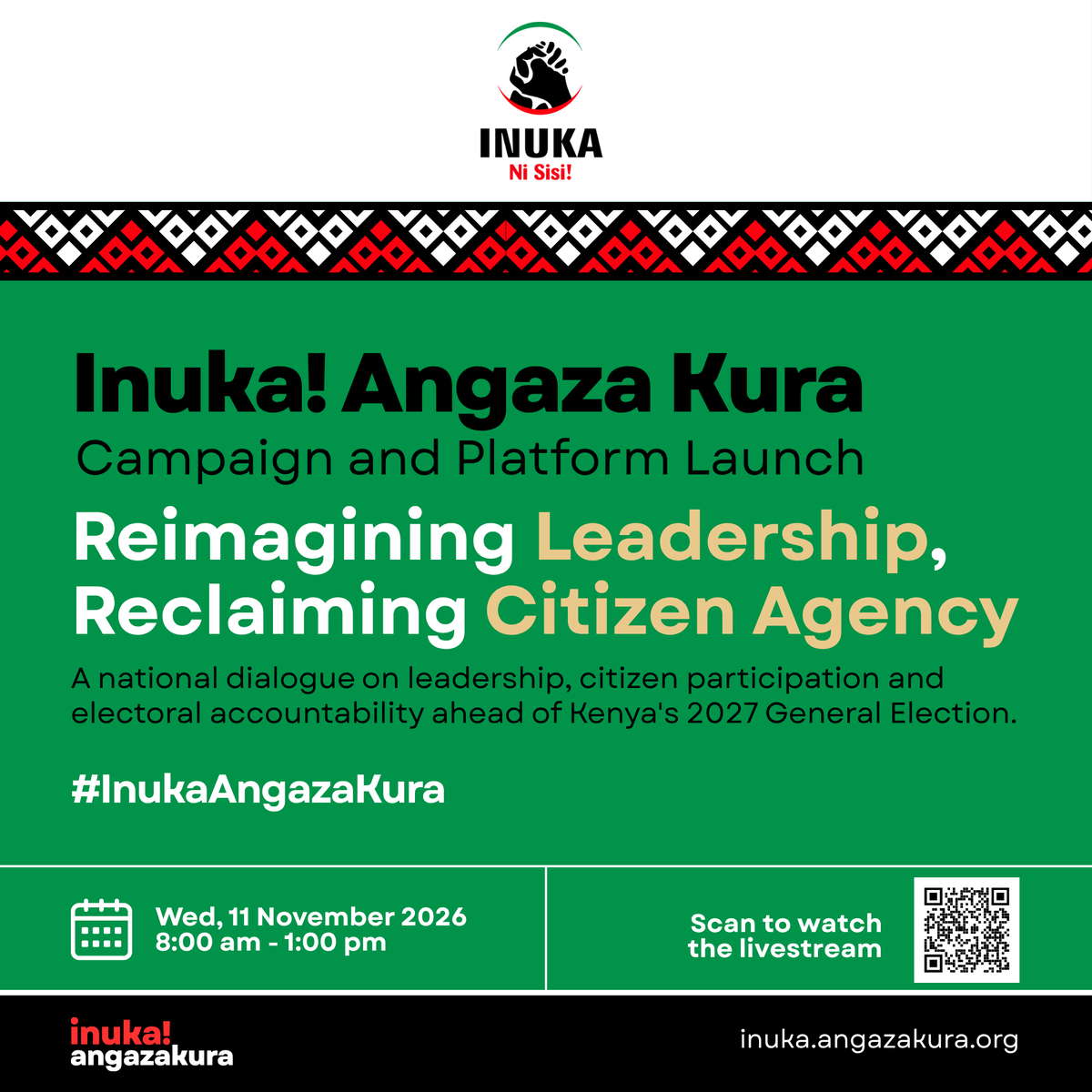
TODAY IS THE DAY! 🇰🇪
We officially launch the Inuka Angaza Kura Platform, bringing together citizens, young leaders, civil society actors and other stakeholders to reimagine leadership and reclaim citizen power.
As Kenya looks towards the 2027 General Elections, it is time to rethink who gets to lead, strengthen meaningful electoral participation and advance citizen-led accountability.
This is more than a platform launch. It is a call for citizens to take an active role in shaping the Kenya we want.
Reimagining Leadership. Reclaiming Citizen Agency.
📍 Nairobi, Kenya
Link to the platform:https://t.co/ijeBnPmLl1
#InukaAngazakura
@Maskani254@kawive@nisisikenya The one thing I would change is making accountability mandatory in Kenya’s political leadership. Leaders must serve the people. #InukaAngazaKura
Create image
If you could change ONE thing about Kenya's political leadership ahead of 2027, what would it be?
More accountable leaders? Transparent elections? Inclusive political participation? Stronger citizen oversight?
Let's rethink the leadership we want and the democracy we deserve.
📅 11 November 2026
📍 Nairobi, Kenya
#InukaAngazaKura
REIMAGINING LEADERSHIP. RECLAIMING CITIZEN AGENCY.
What if citizens had a greater say in defining the leadership Kenya needs and shaping the country's democratic future?
Through #InukaAngazaKura, an initiative of Inuka Kenya Ni Sisi!, seeks to move citizens beyond passive participation to active influence in leadership and electoral processes.
From identifying and championing leaders who embody integrity, competence and accountability to strengthening voter awareness, electoral participation and citizen oversight, the platform puts citizens at the centre of democratic transformation.
Join us as we reclaim the power of citizen agency and reimagine leadership ahead of the 2027 General Elections.
📅 11 November 2026
📍 Nairobi, Kenya
#InukaAngazaKura
What kind of leadership does Kenya need?
As we look towards the 2027 General Elections, it is time to move beyond personality-driven politics and ask what values, integrity and accountability should define our leaders.
It's time to rethink leadership. It's time to reclaim our voice.
Introducing Inuka! Angaza Kura.
📅 11 November 2026
#InukaAngazaKura
10/10. NO LAW IS ABOVE THE CONSTITUTION!
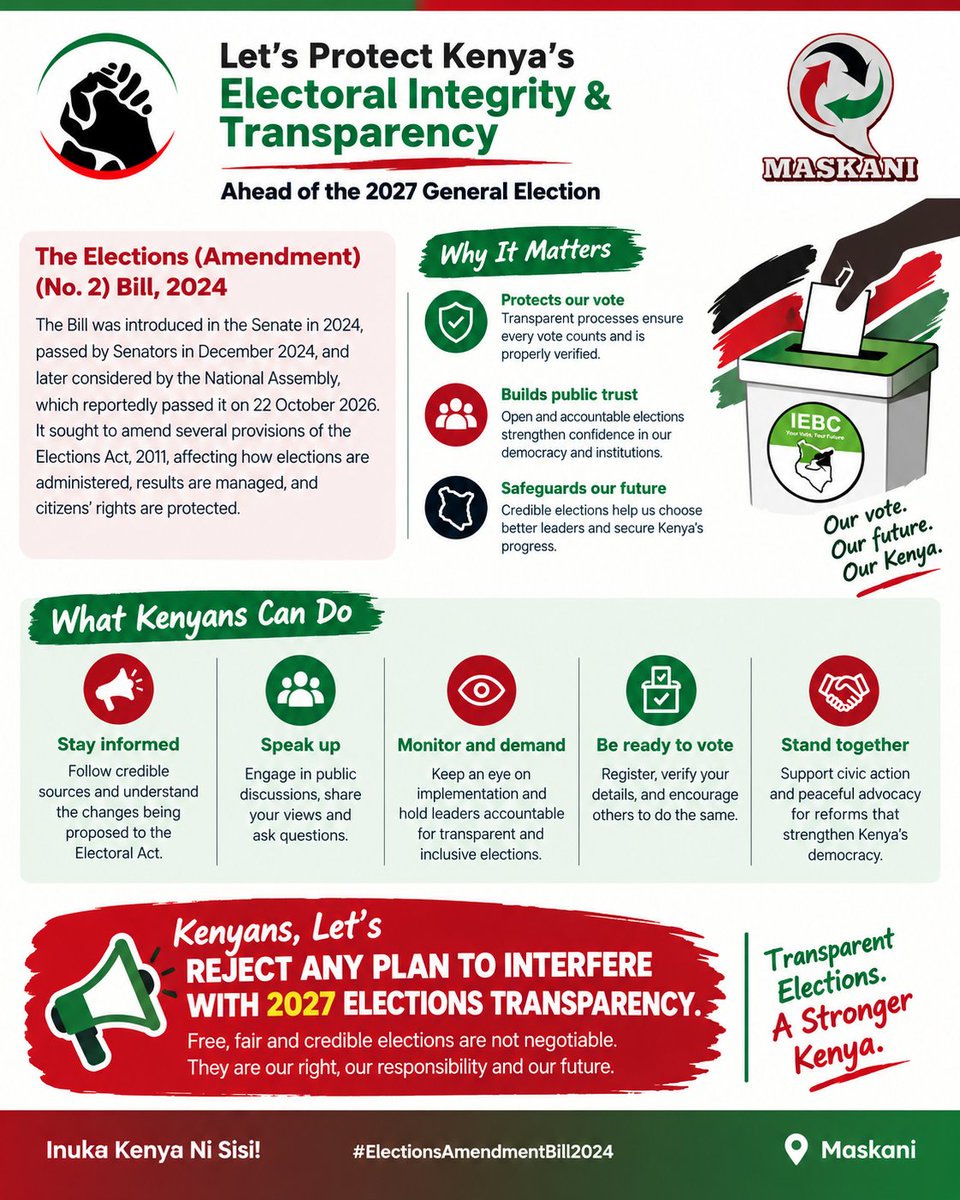
As Kenya approaches the 2027 General Election, we must defend every safeguard that protects the integrity of our vote. Article 81(e) demands transparent, free and fair elections, while Article 86 requires accurate, verifiable, secure, accountable and transparent electoral processes, including the open collation of results.
The proposed removal of the explicit legal requirement for IEBC to livestream results announced at polling stations raises serious questions about public access, accountability and electoral transparency. We cannot afford to weaken public confidence when we should be strengthening it.
We call on Parliament to uphold the spirit and letter of the Constitution, protect transparency in the electoral process and ensure that every Kenyan can trust how their vote is counted, verified and declared.
Kenyans, let us speak up, demand accountability and protect the integrity of our elections. Our vote is our voice, and our democracy is our responsibility. Free, fair and transparent elections are non-negotiable!
#ElectionsAmendmentBill2024 #ElectoralIntegrity #Transparency #2027GeneralElection #KatibaYetu
@Maskani254@kawive@nisisikenya Election reviews must lead to action, not just reports. Parliament should ensure IEBC recommendations are debated, funded and implemented, with clear timelines and public progress updates. #ElectionsAmendmentBill2024
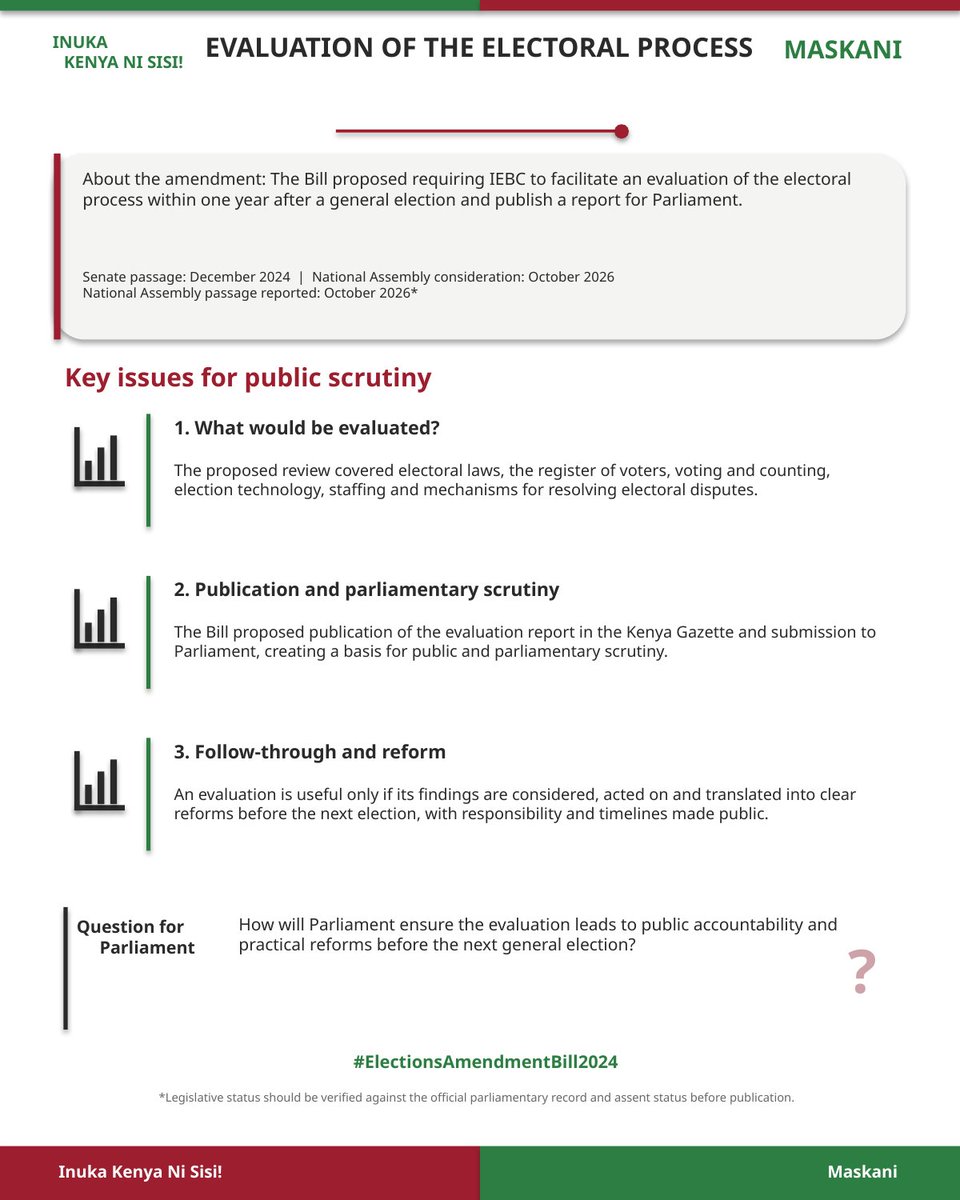
9/10. EVALUATION OF THE ELECTORAL PROCESS
The Bill proposed requiring the IEBC to facilitate an evaluation of the electoral process within one year after a general election and publish a report for Parliament.
Key issues for public scrutiny
1. Review of electoral laws:The proposed evaluation would have examined the legal framework governing the general election.
2. Audit of the voters' register:The proposed review would have included an audit of the register used in the election.
3. Assessment of election-day procedures: The evaluation would have covered voting, vote counting, election technology and the human resources deployed.
4. Review of election disputes:The proposed evaluation would have examined the mechanisms used to resolve election disputes.
5. Examination of election expenditure:The review would have included the cost of conducting elections, including procurement of goods and services.
6. Public reporting:The Bill proposed requiring the evaluation report to be published in the Kenya Gazette and submitted to Parliament.
How would Parliament ensure that lessons from each general election translated into practical reforms, stronger safeguards and more accountable electoral administration?
#ElectionsAmendmentBill2024
@Maskani254@kawive@nisisikenya The right to recall elected representatives is a key accountability tool. 🇰🇪 Any changes to recall procedures must uphold Article 104 of the Constitution, protect voters’ rights and ensure a fair, accessible process. #ElectionsAmendmentBill2024
8/10. RECALL OF MEMBERS OF PARLIAMENT
The Bill sought to amend Sections 45 and 46 of the Elections Act, which addressed the recall of Members of Parliament.
Key issues for public scrutiny
1. Existing recall provisions: The Bill proposed deleting Section 45, which contained statutory conditions for recalling an MP.
2. Recall petitions:It proposed deleting certain statutory requirements concerning petitioners and the submission of a High Court order with a recall petition.
3. Constitutional accountability: The proposals raised questions about how the statutory framework interacted with Article 104 of the Constitution, which provides for the right of voters to recall their Member of Parliament.
Would the proposed changes have protected citizens' constitutional power to hold elected representatives accountable while ensuring fair and accessible recall procedures?
#ElectionsAmendmentBill2024
@Maskani254@kawive@nisisikenya Complementary election mechanisms must never become loopholes for unverifiable results. 🇰🇪 The IEBC must set clear rules on when they can be used, with strong safeguards. #ElectionsAmendmentBill2024
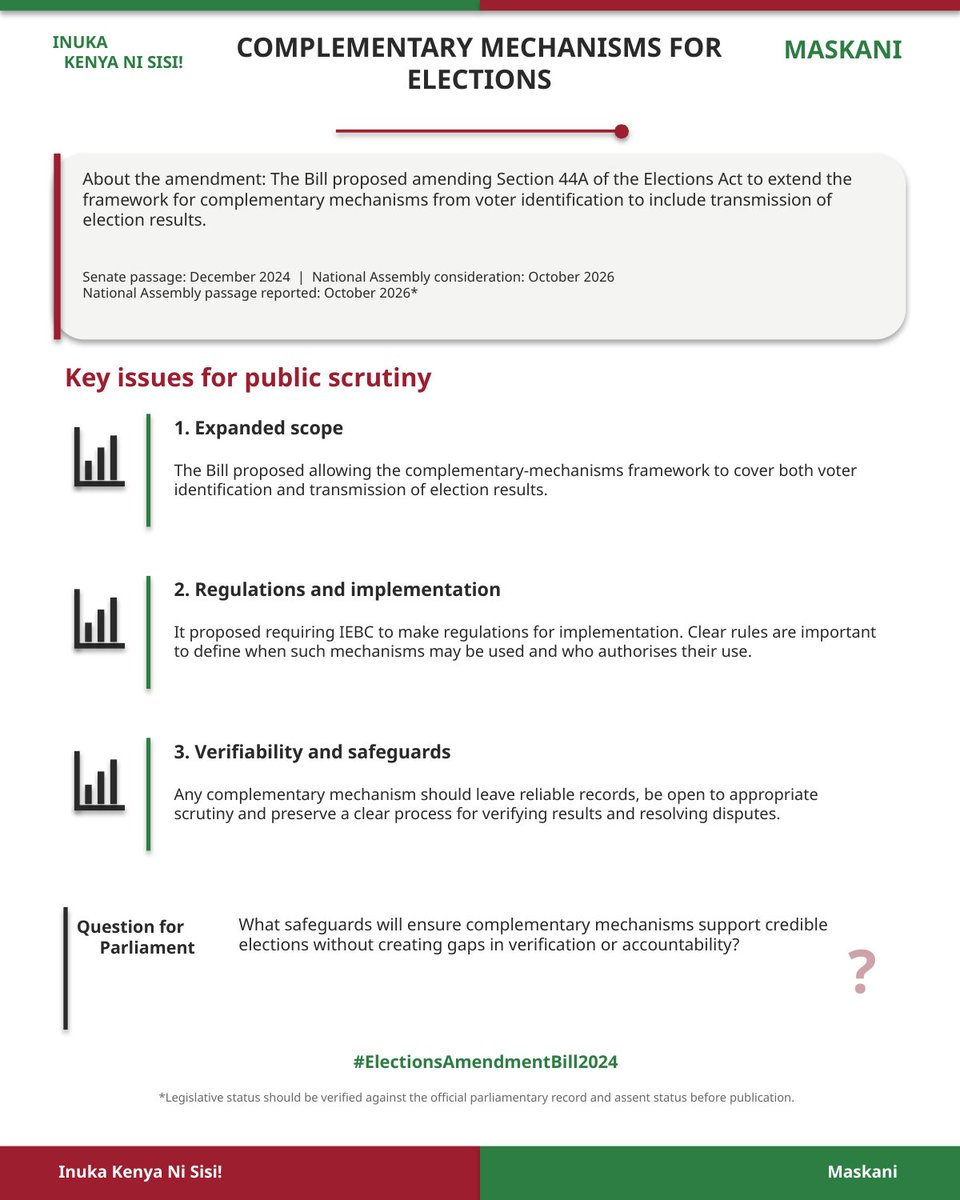
7/10. COMPLEMENTARY MECHANISMS FOR ELECTIONS
The Bill sought to amend Section 44A of the Elections Act to extend the legal framework for complementary mechanisms beyond voter identification to include the transmission of election results.
Key issues for public scrutiny
1. Complementary electoral mechanisms: The Bill proposed extending the framework to cover complementary mechanisms for voter identification and election-results transmission.
2. IEBC regulations:It proposed requiring the IEBC to develop regulations for implementing the relevant provisions.
3. Reliability and accountability: The proposed changes raised questions about the circumstances in which complementary mechanisms could be used and how the integrity of the electoral process would be protected.
Electoral reforms must strengthen resilience while safeguarding the verification, transparency and accountability of election results. No framework should leave gaps that undermine public trust or compromise the credibility of Kenya’s elections.
@Maskani254@kawive@nisisikenya Election technology must be secure, transparent and accountable. 🇰🇪 The IEBC needs clear oversight of procurement and intellectual property, while independent scrutiny safeguards public trust without compromising cybersecurity. #ElectionsAmendmentBill2024
6/10. THE ELECTION TECHNOLOGY AND INTELLECTUAL PROPERTY
THE ELECTIONS (AMENDMENT) (NO. 2) BILL, 2024
sought to amend Section 44 of the Elections Act, addressing the ownership, procurement and scrutiny of technology used in elections.
Key issues for public scrutiny
1. Ownership of intellectual property:The Bill proposed vesting intellectual property rights in election technology in the IEBC.
2. Supplier eligibility: It proposed restrictions relating to suppliers of election technology who had been found guilty of specified procurement violations or crimes.
3. Access for scrutiny:The Bill proposed providing for electoral technology to be accessible for scrutiny, subject to applicable laws.
4. Transparency and security:The proposed changes raised questions about how the IEBC would protect election systems while ensuring independent scrutiny and accountability.
Electoral reforms must strengthen the IEBC’s oversight of election technology while safeguarding transparency, cybersecurity and accountability in procurement. Effective election management must be built on secure systems, transparent processes and public trust.
@Maskani254@kawive@nisisikenya Every vote must count, and every result must be verifiable. 🇰🇪 Electronic transmission, public access to polling-station forms and clear safeguards for transmission failures.
#ElectionsAmendmentBill2024
5/10. TRANSMISSION AND DECLARATION OF ELECTION RESULTS
THE ELECTIONS (AMENDMENT) (NO. 2) BILL, 2024
sought to amend Section 39 of the Elections Act, which governs the determination, transmission and declaration of election results.
Key issues for public scrutiny
1. Finality of polling-station results: The Bill proposed making results declared at polling stations final.
2. Electronic transmission: It proposed requiring the electronic transmission of presidential election results within two hours of their declaration at polling stations.
3. Verification and publication:The proposed framework provided for verification of transmitted results and publication of polling-station results forms on an online public portal.
4. Failure to transmit or publish results electronically:The Bill proposed that failure to transmit or publish results electronically would not, by itself, invalidate results already announced and declared.
Would the proposed safeguards have ensured that every vote was accurately counted, transmitted and reflected in the final results?
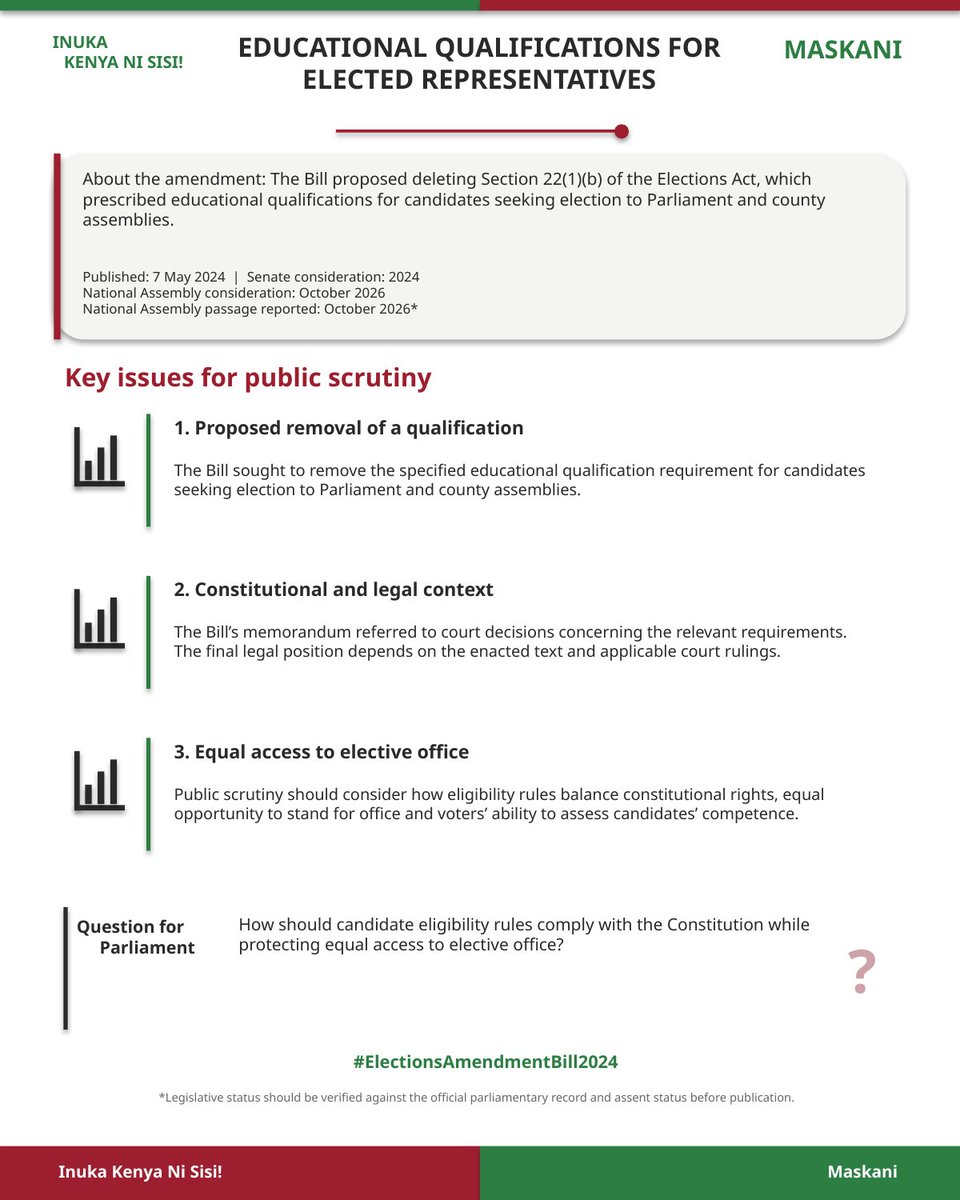
4/10. EDUCATIONAL QUALIFICATIONS FOR ELECTED REPRESENTATIVES
THE ELECTIONS (AMENDMENT) (NO. 2) BILL, 2024 sought to delete Section 22(1)(b) of the Elections Act, which prescribed educational qualifications for candidates seeking election to Parliament and county assemblies.
Key issues for public scrutiny
1. Removal of educational requirements: The Bill proposed deleting the specified educational qualification requirement for candidates seeking election as MPs and Members of County Assemblies.
2. Constitutional considerations: The Bill's memorandum referred to court decisions that had declared the relevant requirements unconstitutional.
3. Inclusive political participation: The proposed amendment raised questions about equal access to elective office and the legal requirements governing candidates' eligibility.
Candidate eligibility requirements must uphold the Constitution without creating unnecessary barriers to political participation. Kenya must protect every citizen’s right to seek elective office while ensuring fairness, inclusivity and equal opportunities for all to participate in democratic leadership.