Your radiologist reviewed 500 images. You got two paragraphs with no images.
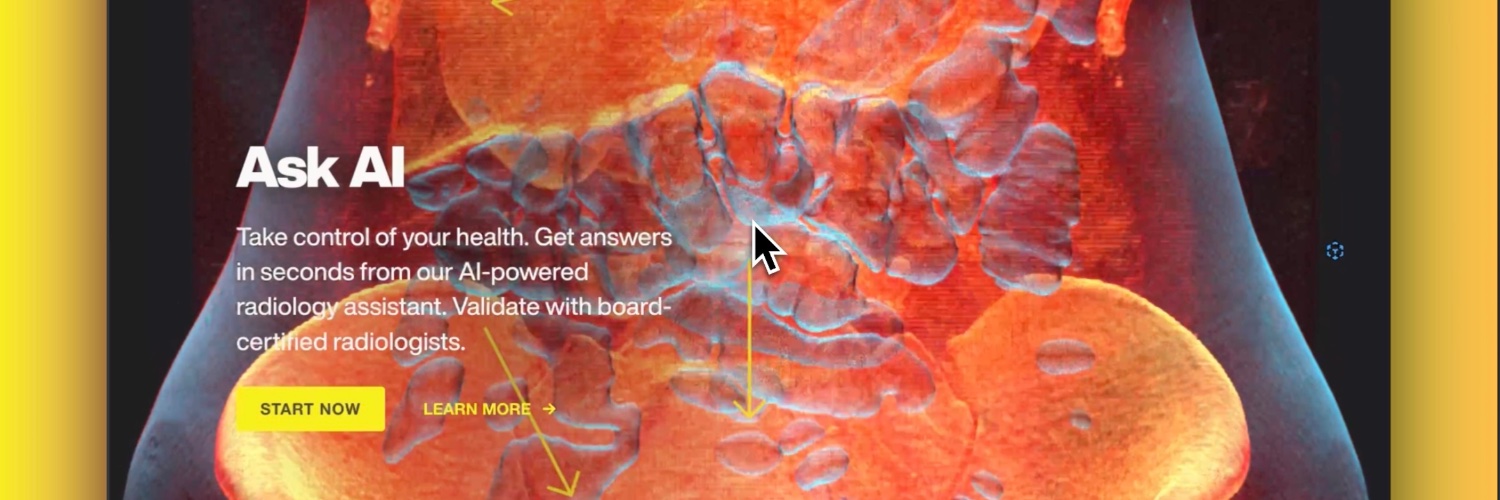
We’re live on Product Hunt with the Interactive Radiology Report: annotated findings, measurements, and plain-English explanations from your actual scan.
https://t.co/4dveewoDZc
Free AI analysis and a $199 radiologist second opinion are not the same product.
One helps you understand what is in the scan.
One gives you an independent written medical read.
We broke down when free AI is enough, and when it is time to upgrade:
Your MRI or CT contains far more signal than the average patient ever gets back in the report.
The interesting product question is how to turn that locked-up imaging data into something people can actually explore and understand.
That is the idea behind Ask AI:
Radiology reports describe images you never get to see.
That is backwards.
A patient-friendly radiology report should show the finding, not just name it.
We wrote about what interactive radiology reports should actually look like:
Researchers estimate 75,000 lives could be saved every year if everyone with a concerning scan got a second radiology opinion.
Early detection. Your right. Your choice.
https://t.co/c7Hvyla5Vw
#SecondOpinion#PatientRights
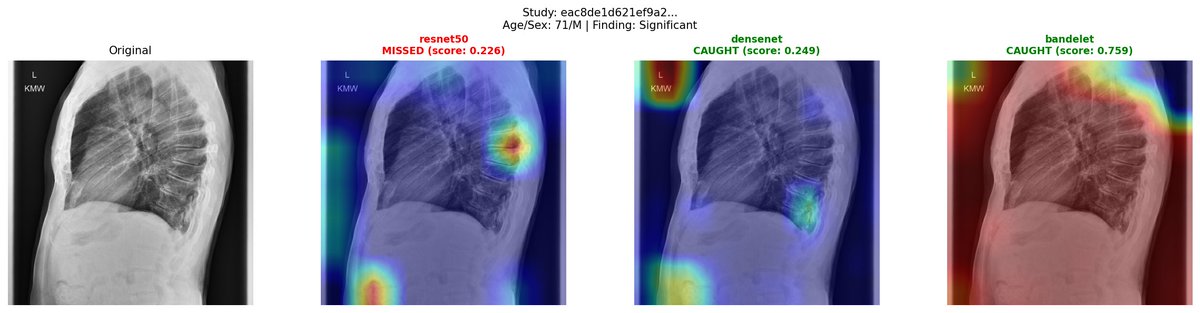
Standard CNNs use fixed filters. Our Bandelet-DenseNet uses learnable geometry that adapts to how anatomy actually curves. 0.916 AUC, no pretraining.
https://t.co/R24sFFrJhb #RadiologyAI#DeepLearning
Our fracture AI: 1.9% miss rate. We published every false negative and false positive. Publishing your failures is what makes clinical AI trustworthy.
https://t.co/1jwp37aaz9 #RadiologyAI#FractureDetection
Most radiology AI trains on 1-2 institutions. Ours: 360K+ studies, thousands of sites. External validation: 0.933 AUC. Full methodology:
https://t.co/K0cAq7l6br #RadiologyAI
When you get a radiology report, ask for the DICOM files too. That's the actual image data, and it's yours under federal law.
https://t.co/8GnDQbB25V #PatientRights#DICOM
Symptoms don't match your scan report? ER read done in a rush? Report says "cannot exclude"? These are all reasons to consider a second opinion.
https://t.co/1f81V5uI3D #RadiologySecondOpinion
Patients Googling their MRI results at 11pm deserve better than a wall of jargon. The imaging report was written for a clinician — not for you. That gap is the whole problem. (And yes, a radiologist should still be accountable for what it says.)
Our AI models don't all fail the same way. That's by design. Ensemble majority voting across architectures: 4.14% auto-clear, zero false negatives.
https://t.co/DbJo0TZ6yY #RadiologyAI
Patients are Googling their CT and MRI results more than ever — and finding answers that often raise more anxiety than they resolve. A radiologist who can explain what the report actually means for your situation isn't optional. It's the whole point.
"Was something missed on my MRI?" gets searched thousands of times a day. The answer shouldn't be a blog post. It should be a radiologist who actually looked at your scan.
Our AI models achieved 98.1% sensitivity on fracture detection, trained on 359K+ studies. Full methodology + every false negative published.
https://t.co/hZWfey2S7M #RadiologyAI#FractureDetection
Everyone is racing to prove their AI is the most accurate in radiology.
Nobody talks about what happens when it's wrong.
The miss rate matters as much as the hit rate. Publish both.
We do: https://t.co/k3CuxPgPZa
#RadiologyAI
Our AI models cleared 4.14% of chest X-rays with zero false negatives — ~130 hrs/year returned per radiologist. Full methodology:
https://t.co/LDVUuB4cVa #RadiologyAI
“We don’t release imaging files”
If you’ve heard this, you should know:
that’s often not true under federal law.
What patients are legally entitled to — and what to do if access is delayed: https://t.co/1mxBQjvdja
Radiology AI just hit a turning point at #RSNA2025.
Specialized models → fading.
Foundation models + agentic workflows → rising.
Our breakdown of the shift happening right now in Chicago: https://t.co/KQpTH4dqo6
Which part of your scan makes you most curious? Ask AI connects multiple advanced models to explain scans in plain language. Explore: https://t.co/1QqOChXyFf