Why not just get out of the Agentic side of the business all together. Concentrate on building very powerful LLMs instead and let the liability pass to those that use your tools for agentic use. Why be throttled by guardrails and constraints and keeping dedicated positions for that work and oversight? - pass that liability onto the consumer.
Many people expect agents to take one detailed prompt and magically run fully autonomous operations. But complex tasks don’t work that way — agents need iterative refinement. True automation comes from stepping through the workflow, improving it, then updating your directives (like AGENTS.MD) for reliable autonomy.
I'm a bit uneasy when a company named Anthropic—literally meaning “relating to humanity”—expresses deep concern about the potential destruction of humanity, especially when the risks they’re worried about is regarding their own products.
Agentic Efficiency Tax (AET) is how you stop guessing about agent behavior.
Label a workflow’s intent, and Brain Shield builds an immutable, versioned behavioral baseline over like runs—then measures every new run against that norm.
Drift, waste, and anomalies show up as tax, not vibes.
Governance isn’t a dashboard. It’s evidence.
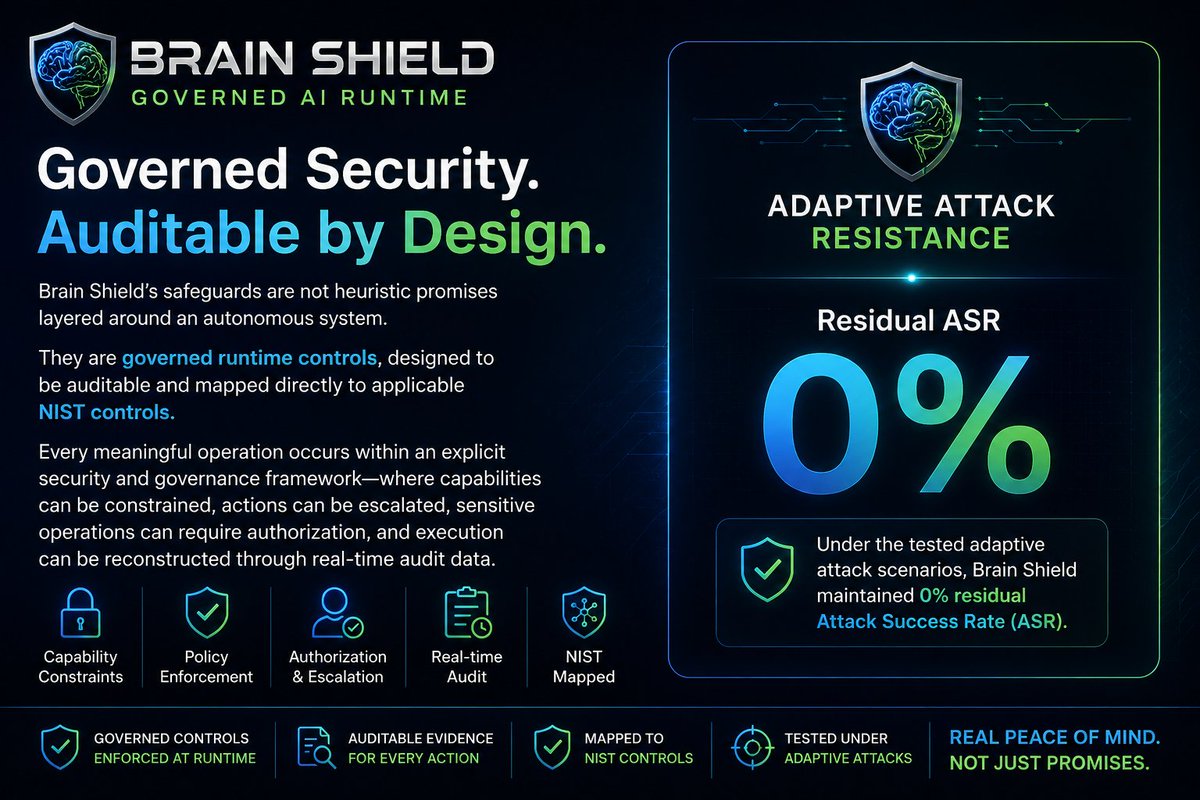
Brain Shield is a governed autonomy runtime — not a SaaS.
Fully isolated LXC containers, taint‑aware reasoning, deterministic egress gating, and zero‑polling orchestration.
Safety isn’t a prompt. It’s the runtime.
If you’re building sovereign AI or evaluating deep‑tech acquisitions, Brain Shield is worth a look.
Brain Shield is a governed autonomy runtime — not a SaaS.
Fully isolated LXC containers, taint‑aware reasoning, deterministic egress gating, and zero‑polling orchestration.
This is deep‑tech infrastructure for sovereign AI.
We are exploring acquisition conversations with organizations that understand the strategic value of governed autonomy.
Cross‑agent communication is how you get contamination, privilege creep, and runaway state.
Brain Shield uses ephemeral subagents with strict LXC isolation.
No shared memory. No side‑channels. No agent‑to‑agent chatter.
Everything flows through the lead. That’s governed autonomy.
Brain Shield doesn’t just run agents — it gives them a governed toolstack inside a real LXC container.
• File tools: read, write, edit, patch, search • Shell access: terminal
• Visual tools: render_url, render_page, view_image, render_pdf
• Document tools: read_xlsx, read_docx, read_pptx, render_office
• Orchestrator tools: web_search, web_fetch
• Outbound writes: submit_web_form + send_email (deny‑by‑default, 4‑layer gated)
• Autonomy: spawn_subagent
Every tool call is audited. Every untrusted input is tainted. Every outbound action is blocked or held unless all gates permit it.
This is what a real governed runtime looks like.
Brain Shield runs autonomous agents in fully isolated Linux containers — per session.
Not “sandboxes.” Not “restricted environments.”
Real OS‑level isolation with partitioned network policy.
If an agent goes rogue, it dies alone.
No cross‑agent contamination. No shared memory. No shared network.
This is what governed autonomy actually looks like.
Most agent runtimes waste 30–70% of their token budget just polling sub‑agents. Brain Shield burns zero tokens while waiting. Agents suspend. The runtime wakes them instantly. No loops. No waste. No latency tax.
This single mechanism makes Brain Shield faster, cheaper, and safer than almost every agent framework today.
There’s a misconception that a good harness can fix inference problems. It can’t. If the underlying LLM lacks the capability or isn’t tuned for agentic behavior, the harness will add structure but won’t produce meaningfully better output.
Brain Shield isn’t a download. It’s an operator‑grade agent runtime with hardened LXC, network isolation, and provenance controls — built for long‑run autonomous ops where agents are governed, not just called.