Join the global brain stimulation community in Lyon, 21–24 Feb 2027, for outstanding science, discussion & networking.
Register by 4 Dec to save with the early registration discount.
#BrainStimConf https://t.co/Q92z2bDrIS
Can ultrasound help clear brain waste after trauma?
Wang et al. show low-intensity pulsed ultrasound restores lymphatic drainage in TBI mice, clearing toxic proteins via Piezo1.
https://t.co/wX5dJEGaZP
@brainstimj#TBI#Neurotech
Did your brain stimulation effect disappear, or did task demands hide it?
Int-Veen & Ehlis show heavy post-stimulation cognitive load can mask neural TMS changes in fNIRS, urging accounting for post-stim task demands.
https://t.co/ujfZEWCPqt
@brainstimj#TMS#fNIRS
Congratulations to Professor Alexander Opitz, recipient of the 2027 Early Career Brain Stimulation Award!
Hear his plenary lecture at #BrainStimConf, 21–24 Feb 2027 in Lyon, France.
Register early & save! https://t.co/B3IJy48kcs
Congratulations to Helen Mayberg @IcahnMountSinai, recipient of the 2027 Int. Brain Stimulation Award! #BrainStimConf
Join us in Lyon where Dr Mayberg will receive the award & deliver a plenary lecture.
https://t.co/rmjrspFpVG
Is the seizure onset zone hyperconnected or disconnected?
LaRocque et al. show it is both: strongly wired to itself, yet functionally isolated from the rest of the brain.
https://t.co/0XSKy6CaJZ
@brainstimj#Epilepsy#BrainStimulation#Neurology
How does focal brain stimulation spread across the cortex?
Francesco Resta, Alessandro Scaglione et al. show optical activity follows direct wiring first, before brain state shapes integration.
https://t.co/PczqhASzGP
@brainstimj#Neuroscience#BrainStim
Deadline today! Last chance to submit your symposium proposal or poster abstract for the 7th International Brain Stimulation Conference.
Don’t miss your chance to be part of the program in Lyon! #BrainStimConf
https://t.co/Q92z2bDrIS
Can brain response to TMS reveal suicide risk in depression?
Noah Stapper et al. show prefrontal TMS-EEG N100 amplitude tracks suicidal ideation severity across 5 sites (n=237).
https://t.co/FiRyai54GW
@brainstimj#TMS#EEG#MentalHealth
Time is running out! Submit your symposium proposal or poster abstract for the 7th International Brain Stimulation Conference by 18 September.
Be part of the scientific program in Lyon. #BrainStimConf
https://t.co/Q92z2bDrIS
Deadline extended! Submit your symposium proposal or poster abstract for the 7th International Brain Stimulation Conference by 18 September.
Share your research and join us in Lyon! #BrainStimConf
https://t.co/Q92z2bDrIS
New work in @brainstimj. A novel hemispheric device, sham/active design, personalized targeting approach, and densely-sampled single-subject fMRI, we demonstrated acute disruptions in cingulate-based connectivity, which rebounded by 24-hours.
https://t.co/OsJyNpEGsH
Liu et al. tested 30 patients. 130 Hz SN-DBS cut motor symptoms by 43.6% & increased stride length by 13.5%, matching standard STN-DBS efficacy.
https://t.co/g7M2OqSMXI
@brainstimj#Parkinsons#DBS
Alexandra Griffin et al. evaluated fully remote, supervised tDCS in children with cerebral palsy, finding strong feasibility and no serious adverse events.
https://t.co/qPrDs1x1uo
@brainstimj#CerebralPalsy#tDCS#Neuromodulation
Austin Messner's paper proposing component control for TMS trials is out in @brainstimj .
https://t.co/wVYVde0K1r
The problem it addresses is one most of us in the TMS field have run into. A modern accelerated protocol varies several things at once: how the target is chosen, pulses per session, sessions per day, total treatment days. When the protocol works, the trial has told us the package works. It has not told us which component carries the effect, and often the design could not have told us even in principle.
We propose two things.
A Component Map: a figure accompanying each multicomponent trial that shows which components were manipulated and which were experimentally isolated versus confounded.
The Component Control Index (CCI): the ratio of controlled to total manipulated components, ranging from 0 to 1. A component counts as controlled when at least one contrast in the design varies that component alone.
What CCI is not is as important as what it is. It is a descriptive reporting tool, not a quality metric and not a ranking. A proof-of-concept trial of a novel bundled protocol will have a low CCI, and that is appropriate; establishing that something works comes first. Decomposing it is the complementary next step. The index simply makes the inferential boundary of each design explicit.
What CCI is not is as important as what it is. It is a descriptive reporting tool, not a quality metric and not a ranking. A proof-of-concept trial of a novel bundled protocol will have a low CCI, and that is appropriate; establishing that something works comes first. Decomposing it is the complementary next step. The index simply makes each design's inferential boundary explicit.
Precedent shows why this matters. Psychotherapy research spent years dismantling treatment packages after they were already in widespread use, and found that behavioral activation alone accounted for much of CBT's effect in depression. That finding produced more parsimonious and more scalable treatments - but it arrived late. Neuromodulation is at the point in its development where that work can be done early rather than retrospectively.
Proud of Austin Messner, who led this work! Wouldn't have been possible without @tgroveradams and Elizabeth Arnold.
Daneshzand et al. developed a modular array that electronically steers the E-field hotspot by 1cm. In vivo tests (n=3) confirm it mimics physical movement.
https://t.co/uDwQm4qqzu
@brainstimj#TMS#Neurotech
What does panic look like in the human brain?
In our new paper in @brainstimj , we captured its neural and autonomic signature during DBS: a surge in prefrontal theta, with tract engagement to the amygdala and insula.
Grateful to be part of this work with @drpouratian and @SameerShethMD
https://t.co/C1bS7WB8n0
@UTSWNeurosurg@UTSWBrain
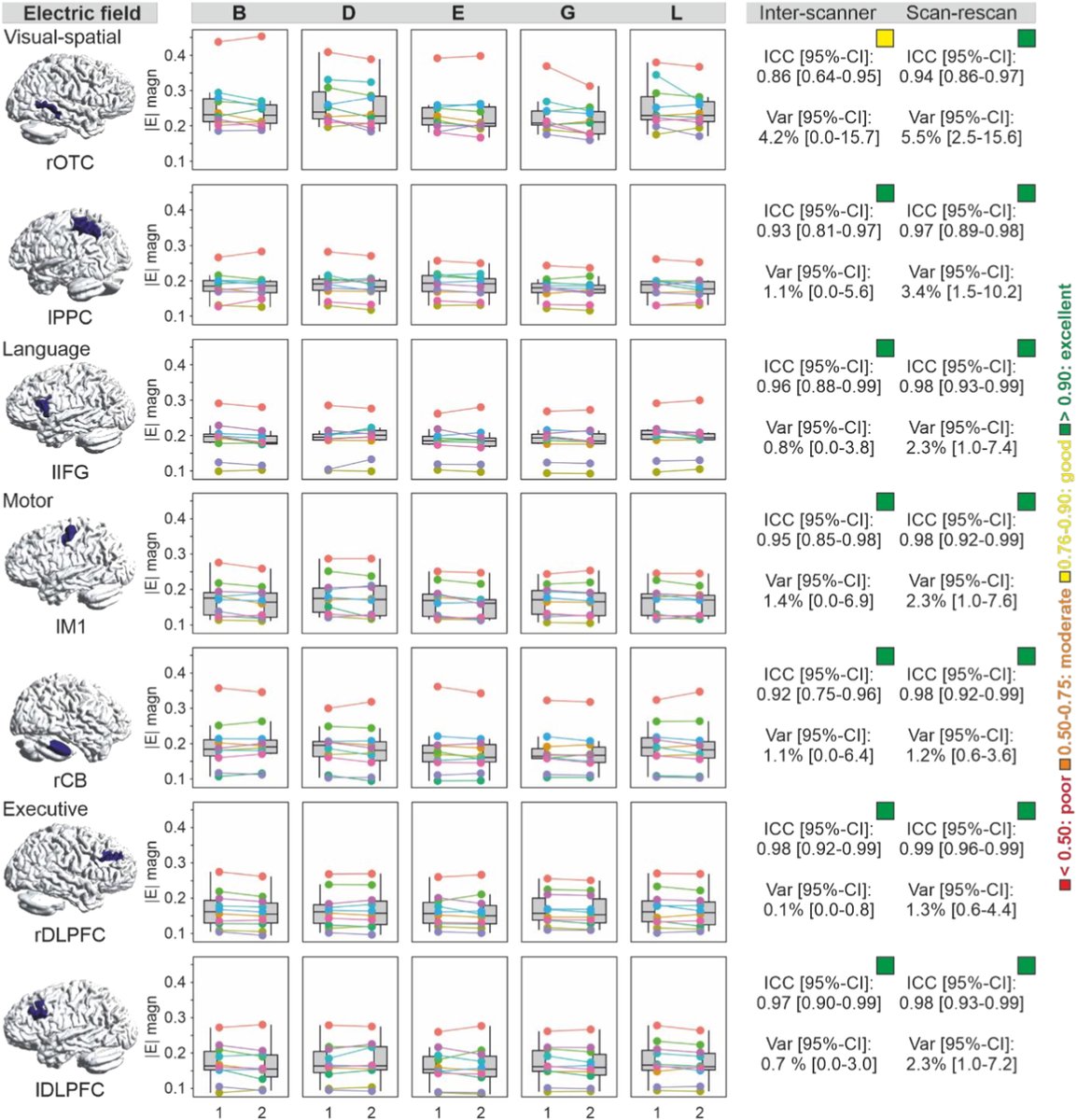
Can electric field models be harmonized across MRI sites?
Hayek & Antonenko et al. show high inter-scanner reliability (ICC 0.86-0.97) for tDCS simulations, enabling individualized multicenter dosing.
https://t.co/54K6myjSBj
@brainstimj#tDCS#MRI#Efield
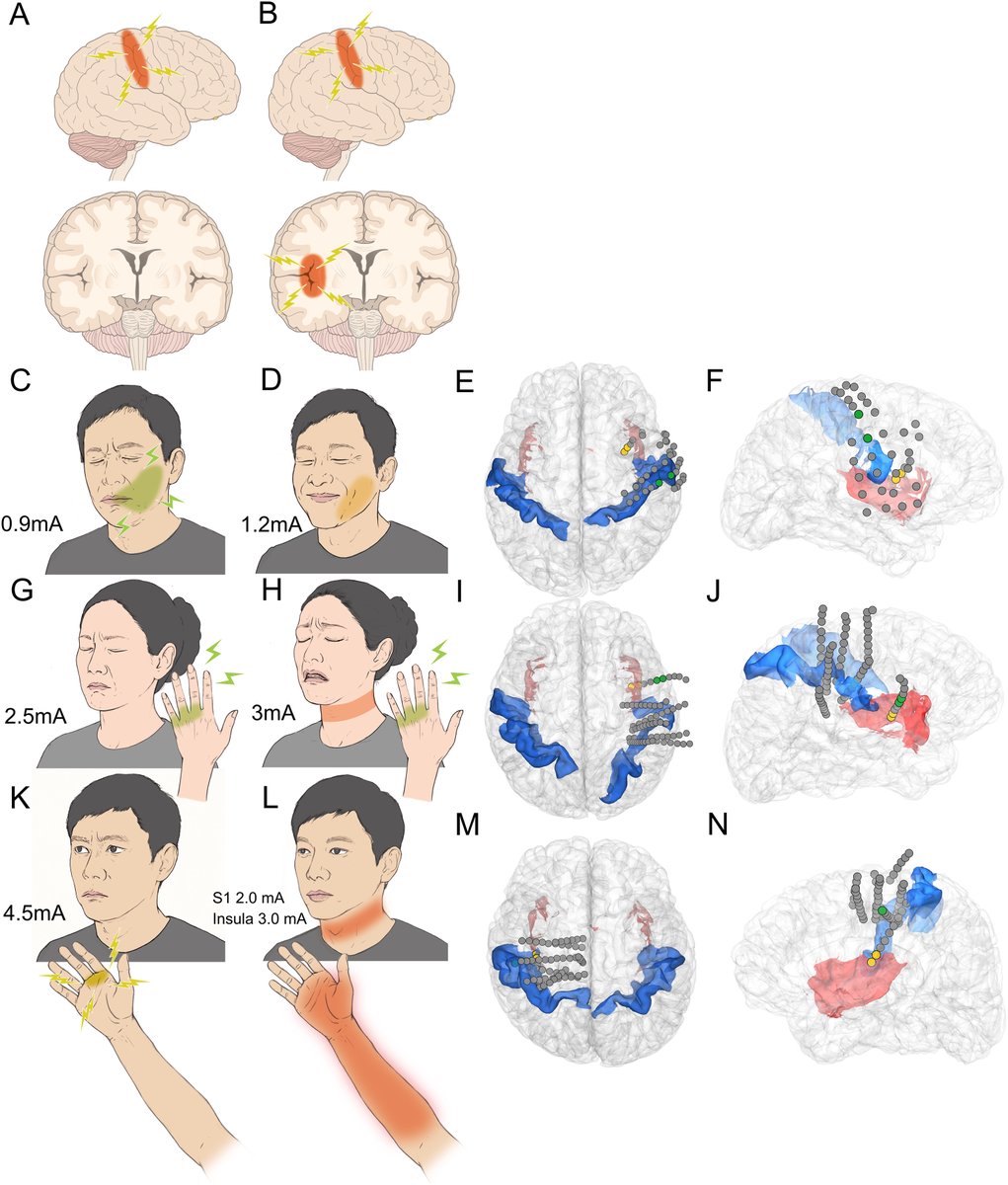
Can rapid sEEG transform surgery for severe facial pain?
Huang, McGeoch, et al. mapped multi-node brain networks using 5-day sEEG to deliver personalized DBS.
https://t.co/9ifXaH1FBN
@brainstimj#DBS#ChronicPain#Neuroscience