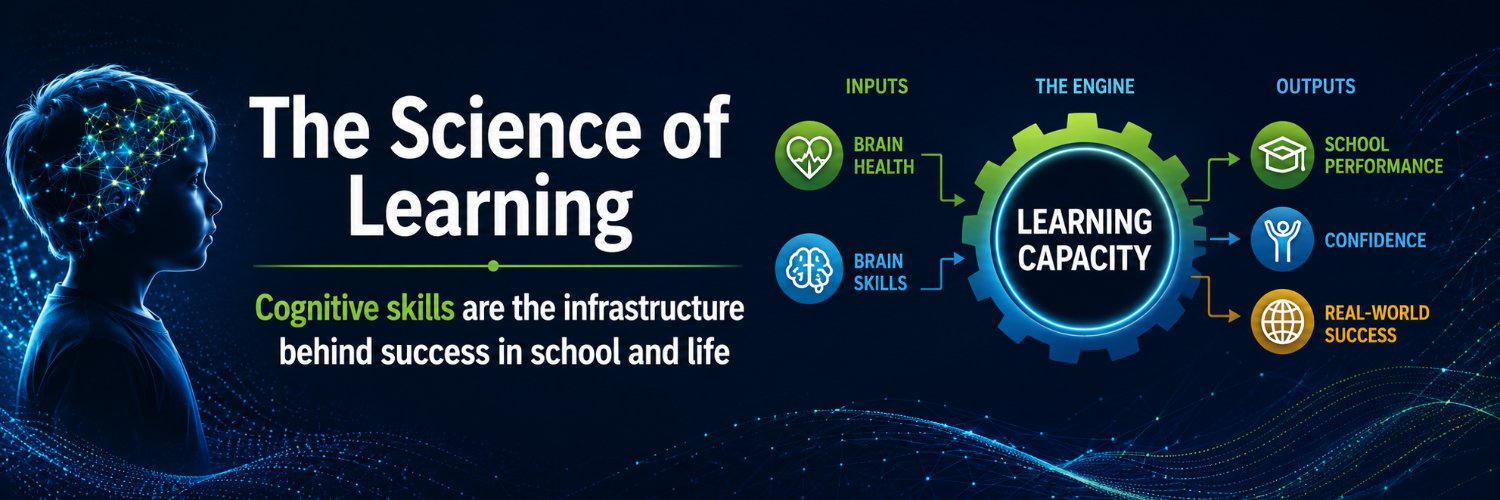
BrainWare Learning Company offers programs to further the application of neuroscience research to learning and teaching. We build capable, confident learners.
JOIN US LIVE!
Is your child working hard but still struggling to learn?
Sometimes, the answer isn’t more studying, practice, or repetition.
Join us for:
5 Simple Steps to Help Children Overcome Learning Struggles and Become Capable, Confident Learners
Can weak cognitive skills actually get stronger?
We analyzed 7 years of data from nearly 1,800 students who participated in CICT.
Across 10 cognitive skills, initially weak skills gained 17–33 percentile points, with 43–63% moving out of the Support Range.
For generations, education has focused primarily on what we teach, how we teach it, and how we measure what students have learned.
But there is another side of the learning equation: the capacity the learner brings to instruction.
That is the central idea behind the book, Your Child Learns Differently, Now What?
As Dr. Rebecca Estes, former Asst Secretary at the Indiana Department of Education, observed:
“Learning IS what truly counts, and teaching is only really important if learning is taking place.”
Tens of thousands of parents have watched our 5 Simple Steps presentation. On Sept. 22, I’m presenting it live.
We’ll explore why children struggle with learning—and what can change when we understand how they learn.
Register: https://t.co/qtKWy6ltWA
More students need special education services—even as schools provide more interventions, specialists and accommodations.
The question is: What are we missing?
We took a closer look in The Special Education Surge: What the Numbers Are Really Telling Us.
https://t.co/9SejzTuj4l
When the first Labor Day was celebrated in 1882, work depended largely on physical strength, endurance and skilled hands.
144 years later, the tools have changed dramatically.
What will work look like 144 years from now?
@HiddenBrain Yes! And empathy also relies on cognitive skills especially cognitive flexibility which allows us to move beyond our own viewpoint and truly understand someone else's.
@TolentinoTeach Exactly. The question is: What does it depend on? Every student brings a different cognitive profile. Great teaching isn't just reading the room—it's understanding the learners in it.
For 20 years, “brain games,” “brain training” and “cognitive training” have been treated as though they were the same thing.
They aren’t.
We now know cognitive capacity can be strengthened.
The question for education is: What do we do with that knowledge?
@eduwithtina Practice matters. But practice alone doesn’t guarantee learning. Attention, working memory, processing speed and other cognitive skills determine how effectively a child can benefit from that practice. Sometimes “more practice” isn’t what a struggling learner needs most.
@itsbriankelly Yes, as Dick Guindon reportedly said, "Writing is nature's way of letting you know how sloppy your thinking is". I always used to think the quote was fuzzy rather than sloppy, but it's true either way.
“If your child is struggling in school, is the answer really to study more, practice more, and repeat it again?”
Practice matters. Repetition matters.
But they don’t fix weak working memory, focus, slow processing, or other cognitive skills that can make learning hard.
And asking a struggling child to just do more can sometimes mean more time, more effort—and more frustration.
Maybe the better question is:
What is making learning so hard in the first place?