GET SMART again by breaking your PHONE ADDICTION.
Science | Literature | Essays | Studies
Tips for #Autodidacts & #Polymaths.
↓ My full escape guide (free)
How to NOT redownload TikTok and Instagram after deleting them
->I used to think deleting the apps would fix everything. I’d remove TikTok and Instagram, feel proud for a day, and then spend the rest of my time on Pinterest or X instead. Even when it worked for a few weeks, I always ended up downloading them again. Every. Single. Time.
I tried every cheap app-blocker, every productivity hack, every “make your phone black and white so it’s less fun” trick on the internet. None of it changed anything for me.
WHAT ACTUALLY KEEPS YOU OFF THE APPS IS A LIFE WORTH LIVING.
I know, it sounds simple. But it’s the only thing that works. You need to build a life that gives you long-lasting, sustainable dopamine instead of the fake instant stuff.
-> That’s what this chart is about. Dopamine itself isn’t bad, it’s just that some dopamine actually builds your life, while other dopamine destroys it. I want you to pick a few things from the green side and mold them onto your situation. Take a pen (seriously, physical action matters) and write down which ones would actually be manageable for you.
Find one good dopamine habit for every day so that when you come home from school or work, you have something real to do, not just the void of your phone.
!!!And please don’t let being an INTROVERT stop you!!!
I know how exhausting it is to leave your comfort zone after work or studying. But you need people, and you need external commitment.
THIS IS THE PART NOBODY TELLS YOU:
If you don’t involve other people, you won’t stick to it.
Telling yourself you’ll do something “at some point this week” will never have the same weight as having someone else expecting something from you.
If you want to read more, join a book club.
If you want to paint more, create an art account.
If you want to write more, send your work to contests.
If you want to train more, find a gym buddy.
If I had to give just one piece of advice for overcoming addiction, this would be it:
We break promises to ourselves all the time- but we HATE disappointing others.
Look at your list of good dopamine habits and find an external commitment for each one. Ask a friend to check your work once a week. Join a club. Read your poems to your partner at dinner. Set the bar higher than your own willpower.
Build structure and let other people anchor you to the life you’re trying to build.
You are not learning just by consuming.
Watching a thousand TikToks and Reels won’t make you remember any of them, and you’ll develop zero skills.
You get good at social media by doing social media.
You become a fast reader by trying to read faster, and you become a good writer by trying to write better.
Only collecting knowledge is comfortable but pointless.
Never neglect the human experience.
Every minute you spend on social media or comparing your life to others deconstructs the path you should have actually been on.
You are the outcome of your decisions, actions, and ideas. If you let something else dictate them, you’re stealing your own potential.
This is an attention economy. No one is entitled to your focus as much as you are. And by now, every day you must make a conscious decision about what deserves your time.
Choose yourself.
I was addicted to my phone for more than 3 years, with 6+ hours of screen time every day.
I deleted the apps more times than I can count, only to download them again a few days later.
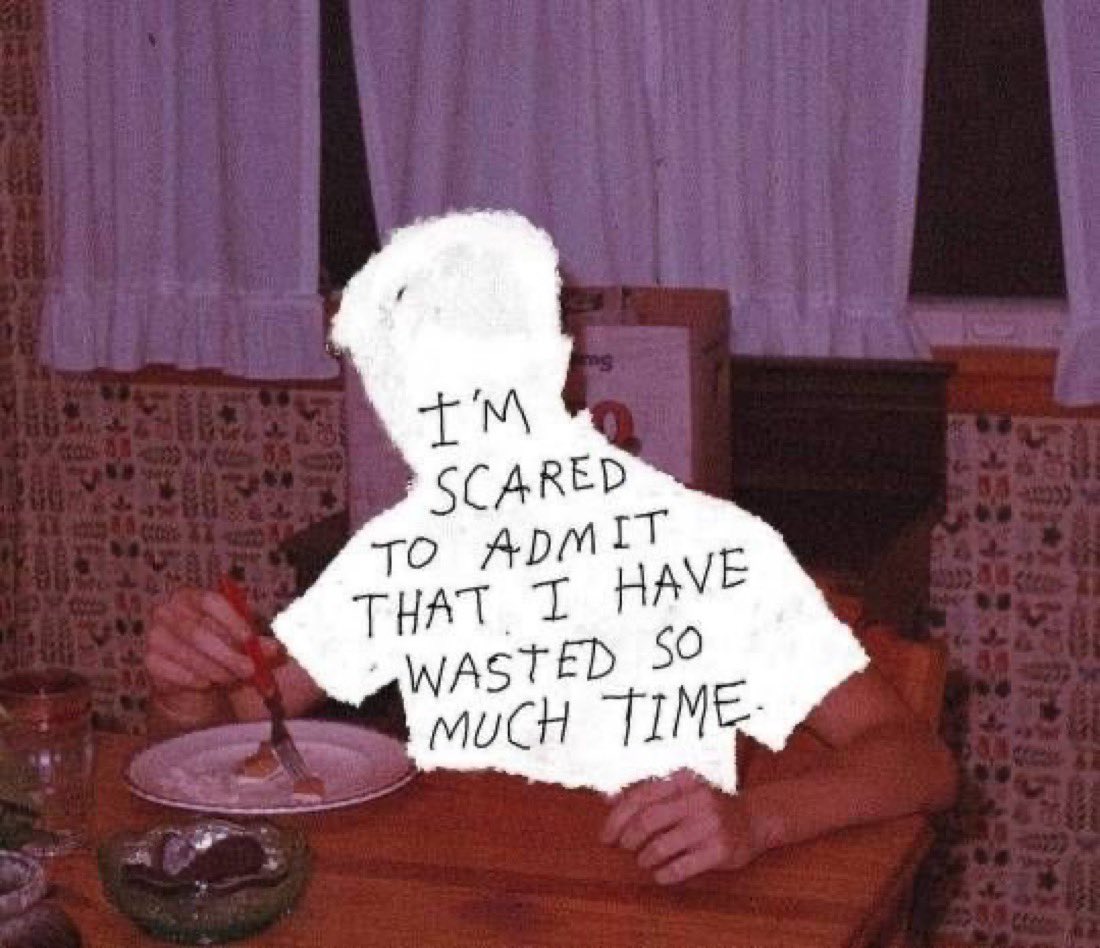
At some point I realised I hadn’t painted, written, or properly read a book in months. I kept saying those were my passions, but in reality I just lay in bed and scrolled until my brain felt fried.
Nothing magical happened to “fix” it. I just hit a point where I was genuinely embarrassed by how I was living.
Now I’m not “cured”, but I’m back to a life where reading, painting, and writing are actually happening again, not just part of the fantasy version of myself in my head who’s an accomplished artist “one day”, after deleting all the apps.
I’ve been “clean” for a few months now and it’s insane to think that this is something so many people are experiencing, because almost every second person is addicted to screens. I have unironically dedicated my entire account to this problem now because I see so many people struggle.
You find happiness by desiring less.
It sounds so simple and obvious but we spend way too much time watching people who seem to have everything we want and compare ourselves to them.
All that scrolling through Instagram models, self-made millionaires, academic prodigies, scientists, professional athletes, and influencers, people who look like they’ve unlocked every job, friendship, and relationship you ever dreamed of, slowly destroys your sense of self. You don't even know anymore what you wanted out of live because everybody seems to have everything.
Life is only truly exciting when you’re actually DOING and CREATING things. Every other path will lead you into depression and exhaustion.
The idea that books are “incredibly overrated” would only be true if other media were able to deliver the same density of information and depth of engagement. In practice, that’s rare.
Most modern media optimizes for immediacy and stimulation.
What makes reading "transformative" isn’t the medium itself, it’s the forced slowness.
For a few hours, you have to sit with an idea or a story long enough to see it from multiple angles, connect it to what you already know, and actually integrate it into your own life.
It’s the opposite of short-form content: instead of being fed conclusions, you have build them yourself, which is of much greater value.
It is insane to see that there are levels to brainrot by now.
We went from books to movies, to binge-watching Netflix, to gaming, to short-form video content completely frying our brains.
I used to feel really bad in high school if I spent the entire day watching movies after school, but after I developed a phone addiction, I almost started to see watching a movie as an “intellectual” thing to do.
We are all being pushed out of creating and active thinking and straight into pure consumption.
I was addicted to my phone for more than 3 years, with 6+ hours of screen time every day.
I deleted the apps more times than I can count, only to download them again a few days later. At some point I realised I hadn’t painted, written, or properly read a book in months.
I kept saying those were my passions, but in reality I just lay in bed and scrolled until my brain felt fried. Nothing magical happened to “fix” it. I just hit a point where I was genuinely embarrassed by how I was living.
I’ve been “clean” for a few months now and it’s insane to think that this is something so many people are experiencing, because almost every second person is addicted to screens. I have unironically dedicated my entire account to this problem now because I see so many people struggle.
I was addicted for more than three years, with 6+ hours of screen time every day. I deleted the apps more times than I can count, only to download them again a few days later. I guess I had to wrestle with myself a bit more haha.
Here is the post I made about the topic: https://t.co/rL3ENg2lJm
If someone here could use it, these were the core steps I took:
1. Building a new dopamine funnel
-You can’t live in a dopamine deficit for long — you’ll just redownload the apps.
-Add 2–3 stable offline sources of reward immediately (gym, reading, art, meeting a friend).
THE NUMBER ONE THING THAT WILL KEEP YOU OFF THE APPS IS A LIFE WORTH LIVING.
2. Building external commitment
-Schedule things with people: a gym buddy, a study partner, a book club, an art account. External commitment beats willpower every time.
-We break promises to ourselves all the time, but we hate disappointing other people.
3. Removing all entertainment apps from your phone
-Not “less,” not “just TikTok.”
-Delete everything that gives you fast dopamine hits: Pinterest, X, Facebook, whatever it is.
4. Tracking your progress visually
-Photos of workouts, pages read, art you’ve made, weight, steps.
-Your brain needs proof that your real life is growing again.
5.Externalizing the addiction
This is a method used in addiction-recovery programs, and one I used myself.
Treat the urges like a separate voice, not your identity. It removes shame and gives you leverage to fight back. When you notice yourself sliding into old habits, talk to your addiction. It’s hard to explain in a short text, but it’s a widely used technique and it builds a powerful mindset around recovery.
I’ve unironically made my entire account about this topic now because I see so many people struggle with it.
Hope this helps someone. :)
This whole thing looks like a social experiment.
You can ban the apps, but if people don’t have a life worth returning to, they’ll just find the next substitute.
If you don’t replace scrolling with real connection, movement, creation, and responsibility, you’re not quitting anything. You’re just sitting in withdrawal waiting to relapse.
if i could give myself one advice 4 years ago, it’d be to go ALL IN.
> pick 1-2 subjects that i truly love
> cut out all the noise and bs
> learn it so much it sounds crazy
> know more about it that 99% others
> push the science rather than chase it
it’s called complete mastery.
I used to be a phone addict and was addicted for more than 3 years, with 6+ hours of screen time every day.
I deleted the apps more times than I can count, only to download them again a few days later.
I have a Substack about how I got out here (https://t.co/rL3ENg2lJm) but in its core these were the steps that helped me the most:
1. Building a new dopamine funnel
-You can’t live in a dopamine deficit for long, you’ll just redownload the apps.
-Add 2–3 stable offline sources of reward immediately (gym, reading, art, meeting a friend).
->THE NUMBER ONE THING THAT WILL KEEP YOU OFF THE APPS IS A LIFE WORTH LIVING.
2. Building external commitment
-Schedule things with people: a gym buddy, a study partner, a book club, an art account.
-External commitment beats willpower every time. We break promises we make to ourselves all the time, but we hate disappointing other people.
3. You guessed it: removing all entertainment apps from your phone
-Not “less,” not “just TikTok.”
-Delete everything that gives you fast dopamine hits. Pinterest, X, Facebook, whatever it is.
4. Tracking your progress visually
-Photos of workouts, pages read, art you’ve made, weight, steps.
-Your brain needs proof that your real life is growing again.
5. Externalizing the addiction
This is a method actually used in addiction-recovery programs, and one I used myself.
Treat the urges like a separate voice, not your identity. It removes shame and gives you leverage to fight back. When you notice yourself sliding back into old habits, talk to your addiction. It’s hard to explain in a short text, but it’s a widely used technique and it builds a powerful mindset around recovery.
I have unironically made my entire account about this topic now because I see so many people struggle with this.. Hope this could help someone :)
It is extremely important, and this can’t be overstated, that every part of your life is embedded in real relationships.
“Your net worth is your network”, but so is your mental health, your dating life, your sense of meaning, your resilience when things inevitably fall apart.
We as humans are wired to live in community and to work in community.
The highest purpose you will ever find in life will always come from providing value for others, not only for yourself. We live in a civilization obsessed with individualism and personal success. We get married less than ever before, we have fewer friends, and we talk less to our families. You are being robbed of the chance to find fulfillment and connection.
Do not build a life on the illusion that you can be alone and still flourish. Even if you are strong and independent, other people need you, and that gives you purpose.
Instant gratification has dumbed us down so badly that we’re going against the path nature envisioned for us.
Not to say that money, power, and sex are noble pursuits, but they’re programmed into us and therefore natural.
Short-form video content has us looking like those fat people from WALL-E.
@sn0oozey You will never be as young as you are now ever again. Don’t focus on the past.
You will wake up in five years and think the exact same thing if you don’t start to implement change now.
Most modern day problems are agency-problems.
You don’t have to be lonely: you can go outside, talk to people, embarrass yourself a little.
You don’t have to be chronically online: you can put the phone in another room and survive the discomfort.
You don’t have to hate your body: you can move it regularly, eat like it matters.
You don’t have to feel mentally dull: you can read, think, write, sit with a thought.
You don’t have to stay stuck in a job you despise: you can start something small on the side, learn in public, ship imperfect work.
You don’t have to feel meaningless: you can choose devotion to a craft or a person.
You don’t have to numb yourself every evening: you can let boredom pass without anesthetizing it.
There is no authority to rebel against anymore, the only battle left is against yourself.